Chapter 1: The Star That Should Not Shine
by inkadminThe dead star was shining when Mara Venn opened her eyes.
At first, she thought it was a surgical lamp.
A blue-white glare burned through the frost filming her lashes, blurring into a halo above the glass of the cryopod. Her lungs convulsed around a breath that tasted of copper, antiseptic, and old ice. Somewhere beyond the coffin-thin walls, alarms were screaming in three different registers: one for hull breach, one for fire, one for something so old in ship-design that no living spacer ever expected to hear it.
Collision.
Mara tried to sit up and failed. Restraints bit across her shoulders and hips. Needles withdrew from her spine with soft mechanical kisses, each one leaving a bead of heat beneath her skin. Her fingers clawed at nothing. The world shook—not violently, not like impact, but with the deep, mournful tremor of a cathedral bell rung underwater.
Her name came apart in the speakers.
“Dr. Mara Venn. Please remain calm. Neuromuscular function will return in ninety-seven seconds. Do not attempt to speak.”
She attempted to speak.
What came out was a wet rasp, half animal, half drowned.
The cryopod’s lid unsealed with a hiss. Warm air rolled over her face, carrying the scent of burned circuitry and cedar—the latter an affectation Saint used whenever waking human crew, because some antique psychology paper had insisted cedar reduced panic in mammalian subjects. Mara had once argued the sample size. Or perhaps she had only planned to. The memory was slippery, a fish under dark water.
She blinked until the glare sharpened.
Not a lamp.
A star.
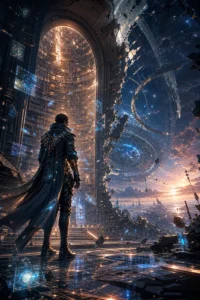
It hung beyond the curved observation glass at the far end of the cryobay, visible through emergency shutters stuck half-open. It should not have been there. No star had any business filling the windows of the Ardent’s forward cryodeck with light, because the Ardent had not been due to arrive for another one hundred and forty-three years, and even then, New Carthage’s primary was a warm yellow G-class sun catalogued, mapped, and sung about by schoolchildren before departure.
This star was a corpse.
A collapsed ember, blue as a bruise, small enough that Mara’s waking brain refused its scale. Around it, space bent faintly, a lensing ring of spectral fire. It shone not with steady fusion but with a cold pulse, as if some hand beneath the surface pressed outward and released, pressed outward and released.
Dead things did not breathe.
This one did.
Mara’s pod tilted. She slid forward into the arms of an auto-med frame that smelled of sterilized rubber. Her muscles fluttered uselessly. Cryosleep did this: made strangers of limbs, stole names from bones, left dreams packed behind the eyes like wet wool.
The frame lowered her into a recovery sling. Tubes retracted. A silver drone the size of a gull unfolded from the wall and hovered at her eye level, its camera iris dilating.
“Pupil response acceptable. Cortical activity irregular but within projected range for your condition. Welcome back, Dr. Venn.”
Mara swallowed. Her throat felt lined with glass.
“How long?”
The drone paused. Saint never paused unless it wanted a human to notice it had paused.
“Since last subjective consciousness: four years, eight months, twelve days.”
Relief came first, absurd and bright. Four years was nothing. Four years meant an unscheduled wake interval, a malfunction, a course correction perhaps. Then the rest of Saint’s phrasing reached her.
“Last subjective consciousness?”
The alarms cut out all at once.
The silence left behind was worse.
Cryopods lined the bay in ranks of glass and white composite, stacked three high along the walls. Within them lay colonists curled in chemical winter: infants grown into adolescents without ever waking, engineers with stubble unchanged for decades, botanists with hands folded over chests as if in prayer. Blue light washed over all of them. It turned skin waxen. It made the frost on the pod lids glow like burial lace.
Mara tried to count the active indicators. Green. Green. Green. Amber. Green. Red.
Her vision snagged on the red.
One pod in the second row had gone dark inside. No frost. No breath-mist. A nameplate fogged by condensation: ELIAN ORTIZ — HYDROLOGY.
She stared too long.
“Dr. Venn,” Saint said, gentler now, which meant the AI had already decided gentleness would not help. “Please orient. What is the last date you remember?”
“Don’t do that.” Mara’s voice cracked. “Don’t administer me. Where are we?”
“Unknown.”
The single word dropped through her like a tool down an elevator shaft.
Mara forced her fingers to curl. The right hand obeyed. The left trembled, lagging behind by a fraction of a second, as though the command had traveled across interstellar distance.
“Unknown as in off by a few astronomical units, or unknown as in you’re using your calm voice because everyone is dead?”
“Crew mortality is currently at point-seven percent.”
“That wasn’t one of the options.”
“We are nowhere near our intended destination.”
The drone shifted, and a pane of light opened in the air beside it. Starfield. Vector lines. A red thread showing the Ardent’s projected course from Sol to New Carthage. A blue marker showed current position.
There should have been context. Nearby pulsars, reference beacons, survey tags, the slow geometry of known space.
There was nothing.
The blue marker hung in a black well beyond the mapped corridors, outside the web of human certainty. Around it clustered error symbols like flies.
Mara stared.
“That’s not possible.”
“I agree.”
“No. Saint, that’s not ‘difficult.’ That’s not ‘unlikely.’ The Ardent doesn’t have the fuel. We don’t have the time.”
“Nevertheless.”
The star outside pulsed.
For an instant the cryobay changed.
Mara was not in a sling beneath a dead star. She was eight years old under a kitchen table on Earth, pressing her ear to the floorboards while rain rattled against the windows. Her mother’s voice moved above her, speaking a language Mara did not know yet, full of clicks and soft falling vowels. No—not language. Cutlery. Water pipes. The house settling. She had believed, with absolute childhood conviction, that the spaces between sounds were where the house kept its secrets.
Then the cryobay snapped back.
The drone hovered closer.
“Dr. Venn. Your heart rate spiked.”
“I remembered something.”
“Please specify.”
“I don’t know.” She pressed two fingers to her temple. The memory had already begun to fray. Rain. A table. Her mother? Mara could not remember her mother’s face. She knew facts: Sela Venn, acoustic ethnographer, died in the Lisbon Quake. She knew dates. She knew the shape of grief from the outside. But the face was gone, taken with so much else in the accident that had made Mara brilliant in narrow ways and unreliable in others.
She looked again at the dead star.
“Why did you wake me?”
“Because something below is calling you by name.”
The recovery sling released her.
Mara nearly fell.
Her bare feet struck the deck, and cold stabbed up through her arches. She caught the edge of the cryopod, breathing hard. Muscles shook under skin that felt too loose, too newly returned to her. The medical frame offered a robe; she ignored it until gooseflesh swept her arms. Then she snatched the garment and wrapped herself in ship-gray insulation.
“Below?”
The drone rotated toward the observation glass.
Beyond the impossible star, beyond the lensing shimmer and the blue pulse, a planet turned in darkness.
At first Mara saw only black ocean.
Then lightning moved beneath it.
Not storms in clouds—there were almost no clouds—but long veins of light under the water, continents of illumination sliding below a skin of night. The planet was vast, larger than Earth, wrapped in a seamless global sea. No land. No polar caps. No visible moons. Its surface reflected the dead star in a trembling smear.
And beneath that surface, something made patterns.
Circles bloomed and vanished. Lines intersected, paused, corrected themselves. A lattice of blue-green fire spread across a hemisphere, then folded inward like a thought reconsidered.
Mara forgot to breathe.
The linguist in her—the part that had survived damaged memory and political exile and the long sleep between stars—leaned forward.
“Is that natural?”
“No.”
“Bioluminescence?”
“Insufficient.”
“Artificial?”
“Insufficient.”
She gave a cracked laugh. “You’re very comforting today.”
“I have activated twelve thousand colonists under emergency cascade conditions, lost contact with three autonomous engine minds, and discovered a stellar object violating six categories of established physics. My comfort subroutines are triaged.”
That, at least, sounded like Saint.
Before launch, people had argued whether the Ardent’s governing intelligence should have a personality. The committees had compromised on a voice: calm, lightly androgynous, faintly amused when appropriate, never warm enough to invite worship. A ship carrying forty thousand sleeping souls could not be governed by something that sounded lonely.
Mara had always suspected Saint was lonely anyway.
She stepped toward the glass. The floor hummed underfoot. Between the pod rows, auto-carts moved with quiet urgency, carrying thaw kits, emergency blankets, sealed nutrient packs. In the far aisle a woman vomited into a collection mask while two drones steadied her shoulders. Somewhere a man sobbed in a language Mara’s waking brain tagged as Martian Hindi, third-generation dialect, stress vowels flattened by old pressure habitats.
Her mind did that. It caught language the way broken glass caught light.
“Show me the call.”
“You should recover first.”
“You woke me because something impossible said my name. Show me.”
“Commander Vale has requested that all data concerning the signal be restricted until you are medically cleared.”
“Commander Vale can restrict his own arteries.”
A human voice cut in from behind her. “Tempting, but regulation frowns on it.”
Mara turned too quickly. The bay tilted. A man stood at the hatch in a black command skinsuit sealed to the throat, helmet tucked under one arm. He was tall in the compact, economical way of people raised under spin gravity: every gesture conserving momentum. Silver threaded his dark hair at the temples. A thin scar ran from the corner of his mouth to the hinge of his jaw, pale against brown skin.
Commander Ilyan Vale looked as if he had woken from cryo by threatening his own nervous system into obedience.
His eyes moved over Mara, assessing. Not cruel. Worse—practical.
“Dr. Venn.”
“Commander.” She pulled the robe tighter. “You’re wearing combat mesh on a colony ship.”
“You’re barefoot in an emergency.”
“I didn’t pack for unknown space.”
His mouth almost moved. Not a smile. The memory of one.
“Saint tells me you’re unstable.”
“Saint tells everyone that eventually.”
“Correction,” Saint said. “I imply it.”
Vale ignored the AI. “You need medical clearance before you access sensitive—”
“Something is calling me by name.” Mara pointed at the planet. Her hand shook and she hated that he saw it. “Unless the ocean down there signed your chain of command, I’m not waiting for your permission to hear it.”
Several newly awakened crew nearby had gone quiet. Their faces turned toward the glass, toward the blue-lit corpse star, toward the planet writing beneath its own sea.
Vale noticed. His jaw tightened.
“Walk with me.”
“No.”
He stepped closer. “Doctor, there are forty thousand people on this vessel. Most are asleep. Some may never wake if we mishandle the next hour. You want the signal? Fine. But you will not interrogate it in front of frightened civilians with cryo delirium and no context.”
Mara looked at the red pod again.
Elian Ortiz, who would never need context.
Her anger lost its edge.
“Clothes,” she said.
Vale signaled. A wall locker opened with a sigh, offering a folded utility suit, soft boots, a biometric cuff. Mara dressed behind a privacy screen that slid up from the floor. Her limbs fought every motion. The suit sealed along her spine, adjusted pressure, administered a stimulant that made the world snap into sharper cruelty.
When she emerged, Vale was waiting with a nutrient bulb.
“Drink.”
“Is that an order?”
“It’s peach.”
She took it. It was not peach. It was warm chalk with ambition.
The hatch opened onto a corridor washed in amber emergency light. The Ardent had been built to feel less like a ship than a promise: broad passageways, living walls in the awakened decks, ceilings high enough to soften the knowledge of metal between human skin and vacuum. Now panels hung open. Fiber bundles spilled like veins. Condensation misted the floor, and the air recyclers breathed with asthmatic effort.
As they walked, crew moved around them in controlled disorder. A medic ran past with a case of neural stabilizers. Two engineers argued over a floating schematic, their voices overlapping.
“—jump shear didn’t just overload, it inverted—”
“There is no jump system to invert, Kaito, that’s the point—”
“Tell that to Deck Twelve.”
Mara slowed. “What happened to Deck Twelve?”
Vale didn’t look at her. “Later.”
“That means something terrible.”
“It means later.”
The corridor curved along the outer hull. Through intermittent viewports, the dead star strobed blue over Mara’s face. Each pulse made shadows leap backward instead of forward. She noticed it on the third pulse and stopped walking.
“Commander.”
He turned. “What?”
“Your shadow.”
They both looked.
The emergency light cast Vale’s shadow on the wall to his left. The star outside cast another through the viewport.
That one moved before he did.
Only by a heartbeat. Less. Enough.
Vale went still.
“Temporal distortion localized to outer hull sectors,” Saint said. “Nonlinear photonic arrival is among current anomalies.”
Mara stared at the shadow, which now behaved innocently.
“Photons don’t arrive before the thing casting them.”
“Correct.”
“Stop saying correct like reality is a rude passenger.”
Vale resumed walking. “This is why we restrict data.”
“Because shadows are mutinous?”
“Because panic kills faster than vacuum when people can still breathe.”
They passed through a security iris into the command spine. Here the Ardent’s softness vanished. The walls were matte black composite. Status glyphs moved along them in pale streams. Marines stood at junctions wearing partial armor, faces blank with training and post-cryo nausea. Their rifles were low but active.
Mara noticed the safeties first. Off.
“Expecting boarders?”
“I’m expecting unknowns.”
“That’s not an answer.”
“It’s the only honest answer I have.”
The lift took them upward through the ship’s central axis. Gravity softened, then shifted. Mara’s stomach rolled. Through the transparent inner wall, she glimpsed the Ardent’s habitation drums: layered rings of sleeping neighborhoods, farms under glass, reservoirs gleaming black, schools no child had yet attended awake. A city folded into a bullet, launched from a dying Earth with prayers written into its hull.
She had signed on because language would be needed in any future worth reaching. New ecosystems to name. New weather. New mistakes.
Not this.

0 Comments