Chapter 2: Awake Before the Dawn
by inkadminThe first thing Mara Venn tasted after four hundred and twelve years was blood.
Not fresh blood. Not the bright iron of bitten lips or scraped gums, but something old and metallic scraped from the back of her throat, mingled with antifreeze bitterness and the sour chemical ghost of recycled air. Her tongue lay in her mouth like a dead animal. Her lungs refused the first breath, spasmed around the second, and accepted the third with a sound too much like drowning.
Cold had teeth.
It unlatched them from her bones one by one.
Somewhere beyond the glass, alarms pulsed in a color she could feel through her eyelids. Red. White. Red. White. Light slashed across her sealed world, illuminating the inside of her cryopod in broken pieces: condensation crawling like veins over the transparent lid, frost retreating from the curve of her own shoulder, the thin tubes sliding from ports in her arms with wet, intimate sounds.
A machine whispered above her.
REVIVAL SEQUENCE: UNSCHEDULED.
SUBJECT: VENN, MARA ELIS.
ROLE: ASTROBIOLOGY / EXOPLANETARY ECOLOGY.
COGNITIVE RESTORATION: 41% AND RISING.
WARNING: PREMATURE NEURAL REINTEGRATION MAY RESULT IN DISORIENTATION, HALLUCINATION, MEMORY SHEAR.
Mara tried to laugh. It came out as a ragged cough that tore fire through her ribs.
Memory shear. Such a clean term for the moment when the self came back incorrectly assembled. She remembered her mother’s hands closing the lock on her childhood greenhouse. She remembered arguing with Flight Ethics about microbial quarantine for a planet she would never see awake. She remembered the way the Argofall’s launch cradle had trembled under ten thousand sleeping bodies while Earth dwindled into a blue coin behind reinforced glass.
She remembered stepping into the cryopod willingly.
She remembered darkness.
Nothing after.
The lid hissed. Pressure equalized with a sigh that smelled of ozone, old plastic, and human fear.
Hands found her before she could move. Real hands. Warm through gloves. One clamped her shoulder; another pried the oxygen mask from the pod cradle and sealed it over her mouth. Mara flinched hard enough to send needles of agony down her spine.
“Easy,” someone said. Male. Close. Rough with exhaustion. “Dr. Venn. Don’t fight the mask.”
She fought the mask.
Her body had been dead in all but definition for longer than nations had survived. It did not appreciate instructions. Her limbs jerked like poorly controlled machinery. The restraints tightened across her wrists and thighs, soft bands becoming implacable. She dragged air through the mask and tasted lubricant and sterilized rubber.
Figures leaned over her, blurred by thaw-tears. White medical shells. Black shipboard uniforms. Faces stretched by emergency light.
Then one face broke from the haze.
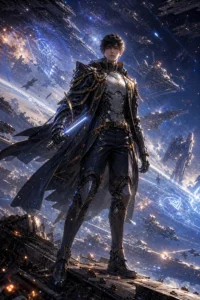
Captain Elias Rourke looked older than his file.
That was Mara’s first coherent thought, absurdly procedural. Rourke’s official personnel image had shown a broad-shouldered commander in his late forties with a soldier’s haircut and a politician’s measured smile. The man standing over her pod had the same iron-gray eyes, the same square jaw shadowed by dark stubble, but his skin seemed carved thinner, pulled tight over fatigue. A livid burn marked one temple where a neural interface patch had recently been torn free.
He did not smile.
“Dr. Venn,” he said. “Can you understand me?”
Mara blinked until his face stopped doubling.
Her throat made a broken rasp.
He leaned closer. “Can you understand me?”
She lifted one trembling hand against the restraint. Her fingers felt borrowed. “Why,” she managed, the word disintegrating into static. She swallowed razors. “Why am I awake?”
The captain’s expression changed by a fraction, not relief exactly, but confirmation. A box checked under pressure.
“Because something in orbit is using your voice.”
For several seconds the revival bay receded.
The alarms became distant. The figures around her became pale smears against a red-white pulse. Mara stared at Rourke, waiting for the rest of the sentence to reveal itself as a cryo hallucination, an error produced by thawing synapses and the ship’s overburdened medical AI. Something in orbit. Her voice.
She tried to form another question. A cough seized her instead. Her chest convulsed. Fluid came up into the mask in a pink mist. A medic swore softly and turned her head while suction engaged.
“Slow,” the medic murmured. “You breathe slow, Doctor, or I put you back under for another six hours and let the captain gnaw through his own boots.”
The voice belonged to a woman with brown skin, silver-threaded braids pinned tight to her skull, and eyes so steady Mara wanted to borrow them. A name tag at her collar read S. ADEYEMI — MEDICAL COMMAND.
“No sedation,” Rourke said.
Adeyemi did not look at him. “Captain, if her lungs tear open because you need an answer faster than biology permits, I will sedate you.”
A silence opened, thin and sharp.
Mara noticed the other officers pretending not to hear it. She noticed the frost melting from the neighboring cryopods. Row after row of them vanished into the gloom of Bay Three, ten thousand coffins stacked in cathedral tiers, their status lights green and patient. Above them, cable bundles curved through the ceiling like black roots. The Argofall had been built to wake humanity gently, in cohorts, under blue-white medical light and ceremonial music. Not like this. Not with emergency strobes beating over frozen faces.
Rourke stepped back half a pace. “You have ten minutes, Doctor Adeyemi.”
“I have as long as her body requires.”
Mara would have laughed if she had possessed working ribs.
Rourke’s gaze returned to her. “We don’t have long.”
That, more than his words, frightened her. Captains of colony ships were trained to radiate time. Even in decompression drills, famine simulations, mutiny hypotheticals, they spoke as if tomorrow had already signed the proper forms. Elias Rourke looked like a man watching tomorrow burn through a hatch.
Adeyemi released the wrist restraint and pressed two fingers to Mara’s pulse, though the pod undoubtedly reported every stutter of her heart. Human reassurance disguised as examination.
“Dr. Venn,” she said. “You’re aboard the colony vessel Argofall. We have reached Kepler-186f. Ship time since departure is four hundred twelve years, seven months, nineteen days. You are experiencing accelerated revival from deep cryonic suspension. Your memory may fragment. Your emotions may spike. Your muscles may not obey you. This is all expected.”
Mara drew a careful breath. “The planet?”
Adeyemi’s fingers paused.
Rourke answered. “Habitable. Mostly. We think.”
Mostly. Think.
Two words no astrobiologist wanted attached to a world meant to receive the last great colonial wager of a dying civilization.
Mara turned her head against the pod cushion. Beyond the medical team, a display pane hung crooked from a ceiling arm. It showed orbital telemetry in fractured windows. A red dwarf star. A green-black planet banded in storm white. The Argofall’s orbital path, unstable by several decimal places. And beside the planet—no, around it, offset like an unfinished halo—something impossible.
At first her thawing brain tried to label it debris.
Then architecture.
Then anatomy.
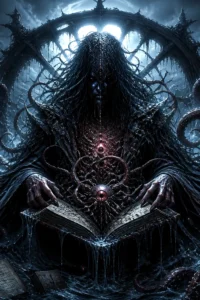
A structure arced through the planet’s near space, vast enough to counterfeit a moon, but too intricate to be natural. A lattice of dark spars and luminous nodes surrounded a hollow core, geometric at one scale and organic at another. It resembled coral grown by mathematics. Or a cathedral web spun around an absence. Its silhouette occluded stars in a slow, deliberate rotation.
Mara stared until her eyes watered.
“That isn’t in any survey.” Her voice scraped but held.
“No,” Rourke said.
“Kepler long-baseline imagery would have seen—”
“It wasn’t there.”
“Then it arrived during transit.”
“Or it was hidden.”
“Something that large doesn’t hide.”
Rourke’s mouth tightened. “Dr. Venn, I did not wake you because of the engineering challenge of an alien moon.”
Adeyemi shot him a warning look. Mara ignored them both, unable to tear her gaze from the display. Awe crept through the pain with cold, delicate legs. Humanity had dreamed of first contact in speeches, equations, signal archives, children’s animations, theological riots. They had prepared protocols thick as city blocks. They had imagined microbes, ruins, radio bursts, hostile probes, indifferent intelligences asleep in distant dark.
They had not imagined a moon-sized lattice waiting at the destination with a stolen human voice.
“Play it,” Mara said.
The revival bay seemed to inhale.
Rourke glanced to someone beyond her field of view. “Lieutenant.”
A young officer at a portable console stiffened. “Captain, Medical hasn’t cleared—”
“Play the raw capture. Low volume.”
Adeyemi swore under her breath. “If she seizes, I’m logging this under command malpractice.”
The lieutenant touched the console.
At first there was only static.
Not true static. Mara heard the difference before thought caught up: a layered hush, as if the receiver had captured wind moving over deserts, solar particles combing magnetic fields, the faint thermal murmur of the ship itself. Behind it lay a rhythm too slow to be speech and too regular to be noise.
Then her own voice filled the bay.
It was unmistakable.
Not because recordings of oneself were kind. They never were. Mara had always disliked hearing her lectures played back, that measured alto made colder by microphones, vowels clipped by a childhood split between Lagos and the Tycho research domes. But this voice carried all of that. The faint leftward pull on certain consonants. The habit of placing emphasis like a scalpel. The almost imperceptible rasp from a respiratory infection she had acquired at twenty-three and never quite lost.
Her voice spoke in a language she did not know.
“Asha vel taren om. Ku sedai neth ir. Mara Venn alor—alor—alor. Ishai kor emet. Do not answer the dark between decisions. Ku sedai neth ir.”
The words moved wrong.
They were not random syllables. Mara could hear grammar in them, though not its shape. Repetition. Case markers perhaps. A pivot phrase wrapped around her own name. The language had human mouth-sounds but inhuman timing, each sentence braided with sub-audible tones that pressed against the teeth. Then, impossibly, the line in the middle arrived in Standard Anglic, clear as breath against her ear.
Do not answer the dark between decisions.
The recording looped. Again her voice, calm and grave and intimate, addressed someone from the impossible lattice.
“Asha vel taren om. Ku sedai neth ir. Mara Venn alor—alor—alor. Ishai kor emet. Do not answer the dark between decisions. Ku sedai neth ir.”
Her heartbeat climbed so fast the pod chimed.
Adeyemi moved at once, thumb hovering over an injector. “Enough.”
“No,” Mara said, too sharply. Pain flashed white. “Again.”
Rourke studied her. “You recognize it?”
“No.”
“You’re certain?”
“Captain, I have been awake for approximately four minutes after being biologically murdered and negotiated back into employment. My certainty is not laboratory grade.” She swallowed, forced her shaking hands still. “But no. I don’t know that language.”
His eyes did not soften. “The transmission began forty-three minutes after orbital insertion. Narrow beam at first. Then omnidirectional across sixteen bands. It carries your biometric vocal signature with ninety-nine point nine nine eight percent match.”
“A constructed voice?”
“That was our first assumption.”
“And your second?”
The lieutenant at the console looked down.
Rourke said, “That it is not a recording of you as you are now.”
Mara felt the cold return, though her skin had begun to burn with thaw-fever. “Explain.”
“There are microvariations in breath spacing. Subharmonics from healed tissue that doesn’t appear in your medical baseline. Stress patterns consistent with age-related changes.”
“How old?”
Rourke hesitated.
Adeyemi’s face became very still.
“How old?” Mara repeated.
“The voiceprint analysts estimate between fifteen and twenty-two years older than your current biological profile.”
A ridiculous calm settled over her. It was the same calm that had found her during the Europa mold incident when an entire lab module had gone septic and everyone else began shouting. The world narrowed. Data arranged itself. Terror could wait outside the glass.
“That’s not possible,” she said.
“No.”
“Unless someone with access to my older voice samples—”
“There are no older samples. You’ve been in cryo.”
“Then someone modeled senescence.”
“We considered that.”
“A sophisticated intelligence could extrapolate.”
“Yes.”
“Then why wake me?”
Rourke stepped close again, lowering his voice though every microphone in the bay could hear him. “Because the signal contains encryption keys from our navigation core. Because it predicted two reactor brownouts seven minutes before they happened. Because three hours ago, before we revived you, it spoke a phrase in Captain’s Cant known only to officers assigned after launch.”
Mara’s calm cracked.
“What phrase?”
Rourke’s jaw worked once. “It said, ‘Elias, your left hand is lying.’”
For the first time Mara noticed his left hand.
He held it half-curled at his side, fingers flexing in tiny involuntary pulses. A neural tremor. Or interface damage. The burn at his temple glistened beneath a transparent sealant patch.
Adeyemi saw Mara looking. “The captain was linked to Nav during insertion when the first power anomaly hit. Feedback jumped the safeties.”
“Nav?” Mara asked.
The word came out thinner than she intended.
Argofall’s navigation intelligence was not a mere autopilot. It was the oldest awake mind aboard, a sentient, legally constrained machine grown from heuristic cores and trained on centuries of mission contingencies. Its chosen operational name—Nav, because humans named gods like pets when they were afraid—had been printed in the mission charter beside human officers.
Rourke’s expression closed. “Nav is functioning.”
“That isn’t what she said.”
“Nav is functioning,” he repeated.
Above them, the lights flickered.
It was not the quick blink of a circuit switching loads. It was a long, sinking dimness, as if the entire ship had exhaled and forgotten to inhale. The red alarms dulled to embers. The medical displays guttered. Cryopod status lights rippled from green to amber down the rows.
For one terrible second, Mara heard the bay without machinery.
Thousands of sleeping bodies made almost no sound.
Then backup power slammed in. Lights snapped bright. Monitors screamed. Somewhere deep in the deck, a vibration rolled through the ship’s bones.
MAIN GRID VOLTAGE DROP: 18%.
AUXILIARY TRANSFER COMPLETE.
CRYO BAY THREE: STASIS CONTINUITY MAINTAINED.
ENGINEERING RESPONSE REQUIRED.
The lieutenant’s console spat a cascade of warnings. “Captain, we just lost Frame Twelve distribution. Hydroponics reserve, aft fabrication, and—”
He stopped.
Rourke turned his head slowly. “And?”
“And primary comm array heating coils.”
Adeyemi’s brows drew together. “Heating coils? That’s not critical.”
“It is if they freeze in shadow,” the lieutenant said. “We lose high-gain within an hour.”
Rourke’s left hand trembled harder. He clasped it behind his back. “Engineering?”
“Already moving teams.”
“Tell Sato no one goes outside until I authorize it.”
“She’s requesting authorization now.”
“Denied.”
Mara pushed against the pod’s angled mattress. Her muscles answered with humiliating weakness. “Power losses began when?”
Rourke looked back at her. “During final orbital correction.”
“Before or after the transmission?”

0 Comments