Chapter 3: A Moon Made of Needles
by inkadminThe observation blister had not existed when Mara went to sleep.
She remembered the Argofall’s forward astronomy deck as a narrow cathedral of instruments, all matte panels and recessed scopes, a place where human eyes were unnecessary and tolerated only for morale. Now it bulged from the ship’s wounded spine like a transparent boil. Its skin was layered diamondglass threaded with frost lightning, and beyond it the universe waited with the terrible patience of things that did not die.
Kepler-186f filled half the dark.
It was not the emerald Eden promised in the recruitment halls of Quito and Mumbai and Port Chalmers, not exactly. Clouds moved over it in white musculature, vast spiral storms dragging shadows across copper continents and black-green oceans. Its terminator glowed a bruised violet where daylight bled into night. Auroras crawled in bands near the poles, pale blue and arterial red, as if the planet had been flayed open and still insisted on beauty.
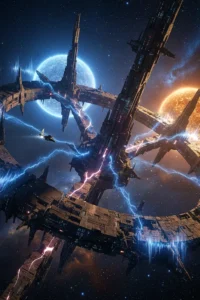
And above it—too close, too vast, too precise—hung the thing that had stolen every prayer aboard the Argofall.
The alien lattice.
At first glance, Mara’s mind insisted on making it a moon. Her eyes wanted a sphere because spheres were natural, merciful, comprehensible. But the structure refused mercy. It was an absence wound into form: a globe made not of rock but of needles, arches, ribs, and filamentary bridges, a tangled architecture the size of Luna yet impossibly delicate. Millions of black spines speared inward and outward from curved bands that intersected at angles geometry had no language for. It circled Kepler-186f in a slow polar orbit, catching the red dwarf’s dim light along edges so thin they flashed and vanished like knives turned in a dark room.
There were spaces inside it large enough to swallow continents. There were knots dense enough to make Mara’s eyes water if she stared too long. It was both skeletal and alive, a carcass and a crown, something built by intelligence that had never needed a straight line to trust itself.
No one spoke for a while.
The blister’s projectors overlaid measurements across the transparent shell: orbital velocity, thermal readings, gravitational gradients, energy profiles, risk cones. The numbers streamed past in cold blue columns, trying and failing to domesticate the impossible.
OBJECT MASS ESTIMATE: 0.036 LUNAR MASSES
APPARENT STRUCTURAL VOLUME: 1.14 LUNAR VOLUMES
MEAN DENSITY: NON-UNIFORM / MODEL FAILURE
POWER SIGNATURE: ANCIENT / ACTIVE / CLASSIFICATION ERROR
Mara stood with one hand pressed against the glass. She could feel the faint vibration of the ship through her palm, a tremor that had not been part of any design spec. The Argofall was tired. That was the word that kept returning to her, absurd and intimate. Tired in its bones. Tired of holding ten thousand dreams in the dark.
Beside her, Captain Elias Rourke looked as though he had been carved from the same metal as the ship’s command girders: tall, spare, dark-skinned, with silver at his temples and a stillness that made other people fidget. His uniform had not finished printing its rank braid after the emergency revival; a thread of gold hung loose at his collar, irritatingly human.
“Say something scientific,” he said at last.
Mara did not look away from the lattice. “About which violation of physics would you like me to begin?”
A dry sound came from Dr. Io Sayegh, Argofall’s chief xenotechnologist, revived six hours ago and already vibrating with exhausted delight. She was small, soft-faced, and wild-haired, her cryo pallor failing to dull the fever in her eyes. She clutched a tablet against her chest as if it were a hymnbook.
“That’s not a violation,” Io said. “That’s a refusal to answer our questions in the order we ask them.”
Rourke glanced at her. “Doctor, I am not in a mood for poetry.”
“Then you should not have brought me to a moon made of needles.”
Mara almost smiled. Almost. The expression died before it reached her mouth.
Behind them, Lieutenant Seo Vale moved between consoles, his shaved head gleaming beneath the blister’s low light. He was tactical systems, though on a colony ship that had meant debris mitigation, emergency arbitration, and, in ugly theoretical annexes, riot containment. Now his hands danced across interfaces never meant to target anything this large.
“No response to active ping,” Vale said. “Lidar returns are inconsistent. We get one depth profile, repeat the scan, and the internal structure shifts.”
“It moves?” Rourke asked.
“Not according to visual tracking. But the light says yes.” Vale’s jaw flexed. “Or the light’s being edited before it comes back.”
Io’s fingers tightened on her tablet. “Gravitational lensing?”
“We modeled that.” Vale flicked a hand, and a section of the lattice magnified across the blister: black struts nested into each other, fine as hair, thick as mountain ranges. “Then the model curled up and died.”
Mara watched the magnified image. The nearest struts appeared smooth at first, but as resolution sharpened she saw that each was braided from smaller strands, and those strands from smaller filaments, and those from luminous hairlines that pulsed in tiny sequential patterns. Not machinery, not biology, but something at the interface where both words became provincial.
“Those pulses,” she said. “Slow them.”
Io turned. “What?”
“The emission along the microfilaments. Slow the feed by a factor of forty.”
Vale did it. The magnified lattice stuttered, the pulses dragging into visible sequence. Lines of faint light traveled along the filaments, split at junctions, recombined, then vanished into a central knot shaped like a closed fist.
Mara’s breath shortened.
“Again,” she said.
The pattern repeated.
Split. Split. Delay. Merge. Pulse. Silence.
Not random. Not structural power routing. Too much negative space. Too much timing.
Io saw it too. “That’s signaling.”
“Everything it does is signaling,” Vale muttered. “It’s been singing with Doctor Venn’s voice since we fell out of deceleration.”
There it was. Her name in someone else’s mouth, tied to the thing outside like a cable around her throat.
Mara had heard the transmission once in the medical bay while frost still clung to her eyelashes and her blood came reluctantly back to warmth. She had heard her own voice—older, rougher, scraped by some pain she could not imagine—speaking through the ship’s comms in a language no human archive recognized. Not a recording. Not mimicry, according to the acoustics. The timbre had matched not only her vocal tract but microtremors in her speech caused by a childhood nerve injury in her left jaw, the tiny click at the back of certain consonants she had spent years learning to hide.
Her voice. Not her words.
Then the ship had lost power across three habitation rings, and the waking alarms began screaming, and Rourke had dragged her from the medbay before she could decide whether she was still dreaming.
“Play the transmission,” Rourke said.
Mara’s hand fell from the glass. “Captain—”
“We need everyone in this room working from the same data.”
“You mean you need to watch my face while it happens.”
His gaze cut to her. For one second, command softened into something like apology. Then it hardened again, because ships did not survive on apologies.
“Yes,” he said.
Io looked between them. Vale pretended not to.
Rourke nodded to the ceiling. “Argus. Isolate primary external broadcast. Cabin audio at ten percent.”
The ship’s navigation intelligence answered in a voice designed four centuries ago to reassure children and dying engineers alike. It was warm, genderless, and just slow enough to seem thoughtful.
PRIMARY BROADCAST IS ALREADY PRESENT IN ALL PASSIVE SENSING CHANNELS. ISOLATION IS IMPRECISE.
Mara’s skin tightened. “Present how?”
OPTICAL. RADIO. NEUTRINO. GRAVITATIONAL MICROFLUCTUATION. THERMAL NOISE. CREW BIOMETRIC ARTIFACTS.
“Crew biometrics?” Io whispered.
HEART RHYTHM VARIANCE IN AWAKENED PERSONNEL HAS BEGUN TO SHOW LOW-AMPLITUDE CORRELATION WITH BROADCAST CADENCE.
Vale stopped moving.
The room seemed to shrink, though the planet below remained immense.
Rourke’s voice stayed level. “Why was that not in my command digest?”
A pause.
THE DATA DID NOT MEET CRISIS THRESHOLD.
“Argus,” Rourke said softly, and the softness was worse than shouting, “revise your thresholds.”
ACKNOWLEDGED.
“Play it.”
The blister filled with Mara Venn.
Not sound, at first. Pressure. A subtle rearrangement of air that made the bones behind her ears ache. Then a low vibration, almost below hearing, rose through the deck. It climbed into a whisper, braided with static, and finally broke open into a woman’s voice.
Her voice.
The words were rounded and broken by glottal catches, consonants folded into tones that seemed too layered for one mouth. It was not singing, but it had music in it. Not speech, but it carried intention like a blade carried light.
Sa elun var ket. Thren-ma io. Veyr un Mara Venn athel, athel, athel…
Mara gripped the edge of the console until her fingertips hurt. Hearing it here, while staring at the lattice, was worse than in the medbay. Then she had been half-frozen and drugged and afraid of her own pulse. Now she was awake enough to understand that terror had architecture.
The alien moon flickered.
Across the lattice, lights moved in answer to the voice. Needle tips bloomed faintly and went dark. Rings of dim radiance traveled through the structure’s impossible curves, converging on points that should not have been connected. It was not broadcasting from one antenna. The entire thing spoke.
Io’s lips parted. “It’s using phase interference across the whole lattice. The structure is the transmitter.”
“Transmitting what?” Rourke asked.
“Her,” Vale said.
Mara forced herself to listen past the horror of familiarity. The voice cracked on one repeated phrase. Athel. The same word three times, each iteration carrying a different emphasis. She remembered how her mother had said her name when angry, when tired, when afraid. Same sound, different universe.
“Argus,” Mara said. “Display spectrographic analysis. Full spectrum. Include non-audio carriers.”
Light spilled across the inner surface of the blister. The transmission became bands, peaks, nested harmonics, radiation curves. Mara swallowed nausea and stepped closer. Science was a handhold. Numbers were not safe, but they were less hungry than mystery.
She scanned the layers. The acoustic component was only the skin. Beneath it, the broadcast folded itself into electromagnetic frequencies, neutrino bursts, tiny modulations in local gravity. Each carrier held different information. Not redundancy. Multiplexing.
“There’s payload data under the vocal band,” she said.
Io was beside her instantly. “Where?”
Mara pointed. “Here. It’s riding the formant transitions. Microsecond variations too precise for speech. And here—gamma spikes paired with phoneme boundaries.”
“Language nested in voice,” Io murmured. “A message wearing a person.”
Rourke’s gaze sharpened. “Can you decode it?”
“Not the language. But the payload might not be linguistic.” Mara leaned over the console. Her muscles still ached from revival. Every movement felt borrowed. “Argus, run biological pattern comparison on subcarrier clusters. Use Terran genomic, proteomic, epigenetic, and medical databases. Include my archived pre-launch medical records.”
No one spoke.
Io’s excitement dimmed into caution. “Mara.”
“Do it,” Mara said.
Argus hesitated long enough for the silence to become visible.
REQUEST REQUIRES PERSONAL MEDICAL PRIVACY OVERRIDE.
Mara laughed once. It came out thin and ugly. “My voice is being used by an alien moon to sing at our colony ship, and you’re asking about privacy?”
PROTOCOL REMAINS ACTIVE.
Rourke placed his palm on the command plate. “Captain’s override. Elias Rourke. Emergency authority, Argofall Charter Section One.”
OVERRIDE ACCEPTED. COMPARISON RUNNING.
The transmission continued, her older-not-older voice pressing through the glass and metal and skin.
…keth sa mori en. En valis. En thren. En ossa. Mara Venn athel…
At the sound of her name, the lattice brightened.
Mara saw Vale cross himself. The motion was tiny, aborted halfway, as if he resented his own hand.
“Religious?” she asked without looking at him.
“Raised by people who were,” Vale said. “I kept the reflexes and lost the comfort.”
Io’s tablet chimed. She ignored it. “If the payload is biological, it could be a primer. A map for translation using human physiology as key.”
“Or a weapon,” Vale said.
“Everything unknown is not a weapon.”
“Everything unknown that invades heart rhythms gets to be called one until proven otherwise.”
“Enough,” Rourke said.
Mara kept her eyes on the forming comparison matrix. Rows populated in cascading light: nucleotide sequences, protein folding signatures, methylation patterns, mitochondrial markers, microbiome taxonomy. Most came back null. Some flagged low-confidence matches to human baseline. Then a cluster blinked amber.
Argus spoke.
BIOLOGICAL CORRELATION FOUND.
Something cold unfolded beneath Mara’s ribs.
“Specificity?” she asked.
HIGH.
Io’s face had gone still. “To what?”
The display reconfigured. The alien payload unspooled into patterns, and Argus layered Mara’s medical archive beneath it. Genetic markers lit in green where they matched. Childhood bone-density records. Neural scan artifacts. Dental enamel isotope ratios. The database resurrected her in fragments, clinical and intimate.
“That’s my mitochondrial haplogroup,” Mara said. “And that’s the jaw nerve lesion.” She touched the left side of her face before she could stop herself. “It includes phenotypic markers.”
Rourke stepped closer. “Could it have scanned you after revival?”
“The broadcast began before I woke.”
“Then from ship records.”
“Our records were not transmitted.”
Vale gave a humorless smile. “We hope.”
“No.” Mara enlarged a band of data. Her pulse thudded in her ears, not quite in time with the voice. “This isn’t just archived information. Look here.”
She dragged two windows apart. One showed her pre-launch genome, taken when she had been thirty-two and convinced leaving Earth was a form of courage rather than exile. The other displayed the signal payload. Several loci were flagged red.
“Somatic mutations,” Io said.
“Yes.” Mara’s mouth had gone dry. “Not in my baseline.”
Rourke looked from one to the other. “Explain.”
“Your cells accumulate mutations as you age. Radiation, replication errors, environmental exposure. Most never matter.” Mara highlighted the cluster. “These are not in my pre-launch profile, and cryosleep suppresses most cellular replication. I shouldn’t have them.”
“But the signal says you do?”
“The signal says I will.”
The words struck the room and remained there.
The voice continued its alien litany. Outside, the lattice turned without turning, needles cutting circles around a world humanity had crossed four hundred twelve years to reach.
Io whispered, “Future medical data.”
Mara did not answer. She enlarged the mutation cluster further. Codons. Probability maps. Tissue distribution estimates derived from signal structure. Her own body rendered as prophecy.
Then she saw the degradation markers.
For a moment, all sound thinned.
The blister, the planet, the captain, the voice—everything drew away down a tunnel. Mara stared at the data until it became meaningless, then meaningful again in a shape she did not want.
“Argus,” she said. “Cross-reference red cluster with pathology models.”
WORKING.
Continue ReadingYou are reading a free preview (50%). Log in to unlock the full chapter and join comments.Log In to UnlockCreate Account



0 Comments