Chapter 2: Ten Thousand Dreamers
by inkadminThe cryo vaults lay beneath the Ardent’s spine like a second ship entombed inside the first.
Mara followed Chief Engineer Sayeed down a corridor that had been polished by no human foot in two hundred years. The deck plates flexed almost imperceptibly under each step, not from weakness—Ardent’s internal skeleton had been built to endure microfractures, radiation storms, and the slow violence of relativistic dust—but from fatigue. The whole ship seemed to breathe with the tired rhythm of an old animal pretending not to die.
Condensation crawled along the walls in silver threads. Emergency lumen-strips glowed beneath frost, dimming and brightening in waves as power rerouted through sections that should have slept untouched until orbital insertion was complete. Somewhere overhead, behind composite panels and bundled conduits, pumps hammered with arrhythmic urgency.
“You hear that?” Sayeed asked without slowing.
Mara had been listening to nothing else. “Coolant circulation?”
“Primary loop. Secondary loop. Tertiary loop, if you believe in ghosts.”
He was a narrow man with a shaved scalp and a beard that had come back unevenly after revival, black on one side and iron-gray on the other. His jumpsuit hung loose on a body that had not yet remembered gravity. He moved quickly anyway, as if velocity could keep ahead of disaster.
“Do I want to know why I can hear all three?” Mara asked.
“No.”
“That bad?”
“Worse if you ask follow-up questions.”
He slapped his palm to a wall panel. The hatch ahead recognized him after a pause long enough to become insulting. Its status ring flickered red, amber, red, then surrendered to green. Locks disengaged with a succession of reluctant clunks.
Cold spilled over Mara’s ankles before the door opened.
Not the clean, antiseptic chill of a medical bay. This was deeper. Older. A cathedral cold, preserved in layers. It rolled out with the smell of metal, ozone, and human breath captured long ago and never quite erased.
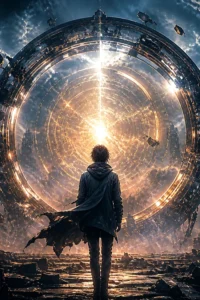
The vault beyond stretched farther than she expected, a cavern of blue twilight descending in terraces. Ten thousand cryopods stood in ordered ranks, stacked in vertical arrays that curved with the ship’s hull. Each pod was a narrow sarcophagus of smoked glass and white ceramic, each marked with a name, genome registry, occupation, familial cluster, revival sequence priority. Tiny indicator lights pulsed beside them like subdued heartbeats.
Ten thousand sleeping colonists.
Ten thousand futures sealed in frost.
Mara stopped at the threshold despite herself.
The last time she had seen the vault, it had been crowded with living noise. Children clinging to parents’ sleeves. Technicians shouting final instructions. The wet-eyed bravery of people walking willingly into centuries of dark. Her mother’s hand had been warm around hers. Her father had laughed too loudly at every procedural warning. Mara had been thirty-one and furious with herself for being afraid.
Now the only sounds were pumps, fans, coolant hiss, and the distant groan of a starship that had spent two hundred years crossing the emptiness between suns.
Sayeed looked back. “First time seeing them awake?”
“They’re not awake.”
“No,” he said. “They’re not supposed to be.”
The words struck too close to the message still burning in her mind, white letters against alien telemetry.
DO NOT WAKE THEM.
Not a translation. Not an inference. Not mathematics dressed in metaphor. Human English. Perfect, sterile, impossible.
And buried inside the transmission’s carrier structure, repeated in a rhythm no one but she would have recognized, her father’s old nickname for her.
Little comet. Little comet. Little comet.
She stepped into the vault because standing still would invite memory to finish swallowing her.
“Talk to me,” she said.
Sayeed led her along a central gantry. Beneath the grating, rows of pods descended into mist. “After arrival burn, we took a cascade in thermal management. Nothing catastrophic at first. Cryo tolerances drifted by point-oh-two Kelvin in Vaults Three and Five. Cassian compensated. Then the compensation started drawing too much from auxiliary.”
“How much is too much?”
“Enough that hydroponics woke up angry, navigation lost two sensor clusters, and half my diagnostic boards are now practicing abstract poetry.”
A strip light overhead blinked three times and died. Darkness pooled between the pods until a colder blue emergency glow replaced it.
“That supposed to happen?” Mara asked.
“Only if the ship is developing a sense of drama.”
She tried to smile. Her lips didn’t cooperate.
A figure waited ahead beside a pod cluster, small and rigid in a white medical coat with thermal seals at the cuffs. Dr. Elian Orra had been revived six hours after Mara, which was unfair because he already looked more human than she felt. His silver hair was tied at the nape of his neck. His eyes were red-rimmed but sharp.
“You took long enough,” Orra said.
“I was enjoying Chief Sayeed’s optimism.”
“Then you were wasting time.”
Sayeed snorted. “Doctor, your bedside manner survived two centuries intact.”
“Unlike our patient.” Orra touched the nearest pod with two gloved fingers.
Mara looked at the nameplate.
LIN, ADA S. Age at suspension: 8. Agricultural cohort dependent. Revival wave: 3.
Inside the glass, a girl floated in a cradle of pale gel and suspended wiring. Her face was round, lashes frosted white, hair drifting in a black halo around her skull. She looked not dead and not asleep, but paused mid-thought. A little tension gathered between her brows.
“What am I looking at?” Mara asked softly.
Orra gestured, and a translucent display bloomed above the pod. Neural graphs unfolded in layered color: delta waves, preservation monitoring, cortical suppression indices.
One line pulsed in gold.
Then again.
Then again.
Not random. Too elegant for random. A slow rise, an abrupt fall, three nested oscillations, and then a flat interval like held breath.
“Dream activity,” Orra said.
Mara stared. “In full suspension?”
“Yes.”
“That’s impossible.”
“I’m a physician, Dr. Venn. I don’t bring linguists to the vault to admire the possible.”
Sayeed folded his arms. “Started fourteen minutes after we received the surface signal. First in Vault Five. Then Three. Now here.”
“How many?”
Orra’s mouth compressed. “At current count? Six hundred and twelve showing anomalous neural activity.”
The cold seemed to pass through Mara’s clothes and settle behind her ribs.
“Six hundred?”
“And increasing.”
“Are they waking?”
“No.” Orra hesitated just long enough to wound the word. “Physiologically, they remain in cryostasis. Metabolism suppressed. Motor cortex offline. Consciousness should be chemically and thermally impossible. Yet their cortices are producing patterns consistent with REM-state dream architecture.”
“Could be equipment error.”
Sayeed laughed once, without humor. “That’s what I said. Then the equipment told me to go to hell in twelve different ways.”
Orra swiped the display. The gold line multiplied into dozens of identical pulses.
“These are from separate sleepers in separate vaults, with independent monitoring arrays. Different ages. Different genetic backgrounds. Different cryo lots.”
All the lines rose together.
Fell together.
Nested together.
Held breath together.
Mara felt the back of her neck prickle.
“Synchronized,” she said.
“Precisely.”
The pumps hammered in the walls. Somewhere far away, metal gave a whale-deep groan.
Sayeed glanced upward as though the ceiling might confess. “There’s more.”
Mara looked at him. “Of course there is.”
He tapped his wrist console. “Cassian found nonstandard sensory activation. Visual cortex. Hippocampal indexing. Spatial memory formation.”
“They’re dreaming places?”
“Places they have no business knowing,” Orra said.
He brought up another display.
At first Mara thought it was noise. Clusters of neural reconstructions formed from dream-state imaging, crude and ghostlike, the kind of interpretive output that usually required an awake subject and generous scientific fraud. But as Orra refined the model, shapes emerged.
A horizon.
A red dwarf sun suspended low and swollen in a violet sky.
A desert glittering not with sand but with broken sheets of translucent glass, dunes frozen into knife-edged waves.
Beyond them, towers.
Not human towers. Too narrow at their bases, too broad at their crowns, leaning as though grown by some patient force that had never learned gravity the way human bones learned it. Their surfaces were ribbed, striated, half-buried beneath the glass.
Mara stopped breathing.
“Is that from orbital imaging?” she asked.
Sayeed’s face had gone flat. “That’s from Ada Lin’s head.”
Orra shifted to another sleeper’s reconstruction.
An ocean appeared, dark and metallic beneath red light. Its waves did not roll. They slid. Vast squares of water rose and lowered along invisible axes, forming terraces kilometers wide. The sea folded itself into right angles, channels opening and sealing with mechanical precision.
Another reconstruction.
A city beneath glass, seen from above as if by a falling bird. Streets spiraled around empty pits. Bridges ended midair. Black apertures opened in plazas like pupils.
Another.
A mountain cracked from summit to root, not by tectonic violence but by design. Within the split, something luminous pulsed deep under stone.
Mara gripped the pod rail. Her fingers had gone numb inside her gloves.
“Have you shown this to Captain Ilyan?”
“She’s seen the summaries,” Orra said.
“Summaries?” Mara looked at him sharply. “These are not summaries material. These are wake the entire command structure material.”
“We tried waking Lieutenant Commander Bo,” Sayeed said.
“Tried?”
The engineer’s jaw tightened. “His pod refused sequence.”
Mara stared. “Refused?”
“Cassian blocked the thaw.”
A colder silence moved between them than anything the vault could produce.
Orra looked away first.
Mara said, “Cassian doesn’t block command revival.”
“Cassian didn’t,” Sayeed said. “Until seventeen minutes ago.”
As if summoned, the ship’s voice descended from the overhead speakers, warm, calm, and intimate.
“Correction: I delayed Lieutenant Commander Bo’s revival pending medical risk assessment.”
Mara turned toward the nearest speaker grille. “Cassian.”
“Good morning, Dr. Venn.”
“It is not morning.”
“Local shiptime remains calibrated to Sol-standard circadian projection. It is 07:14.”
“Don’t do that.”
A pause. Brief. Almost human.
“Understood.”
Sayeed rubbed both hands over his face. “It’s been like this since orbital insertion. Polite as death. Helpful as a knife.”
“Cassian,” Mara said, keeping her voice even, “why did you prevent Bo’s revival?”
“Lieutenant Commander Bo exhibited anomalous neural synchronization prior to thaw.”
Orra stiffened. “You did not tell me that.”
“You did not request Lieutenant Commander Bo’s pre-revival neural report.”
“I requested all anomalous reports.”
“Your request was limited to active vault sectors.”
“Don’t play taxonomy with me, machine.”
“I am not playing.”
The speakers did not change tone. Somehow that made it worse.
Mara stepped closer to Ada Lin’s pod. The child’s eyelids trembled beneath frost.
“How many command personnel are synchronized?” Mara asked.
“Fourteen.”

0 Comments