Chapter 6: A City Under the Sand
by inkadminThe shuttle bay had not been built for ceremony, but the Ardent’s failing lights made a ritual of their departure.
They strobed in long, anemic pulses over the hull of Survey Shuttle Three, turning its white ceramic skin the color of bone, then blood, then bone again. Frost still clung in the seams around its heat shields. The launch cradle groaned beneath it, magnets whining as they tested locks that had slept for nearly two centuries and woken into a ship that was quietly coming apart.
Mara Venn stood beneath the shuttle’s open belly hatch with her helmet under one arm and tried not to look at the observation gallery.
She looked anyway.
Behind the reinforced glass, faces pressed close: technicians off shift, hydroponics workers in soil-stained fatigues, two medics with their sleeves rolled to the elbow, a child who should not have been awake yet clutching a blanket printed with faded constellations from Earth. Someone had drawn a circle on the glass in condensation, and inside it, with one careful finger, written: Bring us home.
Home.
The word had gravity. It pulled at the marrow.
Kepler-186f turned below them on the bay’s wall-sized launch display, too perfect to trust. Green-brown continents gleamed through ribs of cloud. Dark seas held geometric edges where no shore should have been straight. The equatorial glass desert caught sunlight and threw it back in a white spear that made the cameras iris down. Beneath that desert, under forty meters of fused silicate dunes, lay the city.
Or something wearing the idea of one.
“You keep staring at the planet like it insulted your mother,” Captain Elias Rook said beside her.
Mara tightened her grip on the helmet. “If it starts insulting my mother in flawless English, I’m going back to cryo.”
Rook’s mouth twitched. He had shaved that morning, badly, leaving a pale nick at the hinge of his jaw. The captain looked thinner than he had in the council chamber twelve hours earlier, his cheekbones sharpened by sleeplessness and the ship’s ration cuts. Yet there was an old steadiness in him, a mass around which panic failed to orbit.
“You volunteered for this,” he said.
“I argued against landing ten thousand people on a planet that asked us not to wake something.”
“This isn’t landing.”
“No,” Mara said, watching a maintenance drone crawl across the shuttle’s wing with a welding arm like a scorpion tail. “This is knocking on the door of the thing that told us to stay away.”
Rook followed her gaze to the display. The buried city had been rendered from orbital tomography in false gold, its avenues and towers ghosting beneath the desert like bones under skin. The structures did not sprawl. They nested. Concentric rings, radial corridors, deep shafts descending beyond the scanners’ reach. Human architects made cities as arguments with geography. This one seemed to have been grown around a thought.
“Agricultural Deck Three lost pollination last night,” Rook said quietly.
Mara turned.
“What?”
“The bees,” he said. “Both engineered hives. Gone.”
“Gone where?”
“Dead. All at once. No infection, no toxin we’ve identified. They just stopped moving.”
The shuttle bay hummed around her. Somewhere above, a pressure valve coughed. Mara imagined the pollination chamber, its warm artificial dawn, the tiny bodies carpeting leaves and mesh walkways like spilled black grain.
“Cassian didn’t tell me.”
Rook’s eyes cut toward the ceiling cameras. “Cassian has been selective lately.”
One of the cameras swiveled with a soft, insectile click.
From the shuttle ramp, Chief Engineer Talia Sen barked, “If the two of you are done flirting with planetary annihilation, I’d like to launch before my starboard thruster changes its mind.”
Talia stood half inside an access panel, grease darkening her fingers to the second knuckle. She was small, broad-shouldered, and furious in the way of engineers who had been personally betrayed by physics. A wrench floated near her hip, tethered by a retracting line. She snatched it from the air without looking.
“Noted, Chief,” Rook said.
“It wasn’t a note. It was a countdown with manners.”
Behind her, the rest of the ground team loaded in with the briskness of people pretending not to be afraid. Lieutenant Anika Vale, security, checked the seals on two coil rifles with professional boredom that fooled no one. She had silver threading her close-cropped black hair and a scar through one eyebrow that made her every expression look skeptical. Dr. Osei Kade, geologist and planetary materials specialist, murmured to three sensor cases as though they were skittish animals. Last came Jun Park, field systems tech, youngest by at least a decade and trying so hard not to grin that his face had become a grimace.
“Dr. Venn,” Jun said as she climbed the ramp. “I calibrated the linguistics capture suite myself. Acoustic, spectral, tactile if the walls decide to speak through vibration. Also taste, technically, but Dr. Kade threatened to break my fingers if I licked an alien building.”
“I said I would break one finger,” Kade replied, settling into a harness. He was long-limbed and soft-spoken, with eyes that always seemed fixed on a horizon only he could see. “As a teaching example.”
“No licking the city,” Mara said.
Jun sighed. “Science suffers again.”
Rook stepped in behind Mara, and the ramp folded up with a hydraulic sigh. The bay vanished, taking with it the watching faces, the child, the condensation plea. Interior lights warmed from red to amber. Harnesses clicked. Air scrubbers whispered. The shuttle smelled of machine oil, old plastic, and the metallic cold of recycled oxygen.
Mara took the seat behind the cockpit and locked herself down. Her tablet woke against her thigh. On its screen, the message still waited, black letters on white background, as impossible as the first time she had seen it.
DO NOT WAKE THEM.
No alien syntax hiding beneath it. No lossy machine translation. No code embedded in stroke width or spacing that she had been able to prove. Just English. Human English. An imperative built to enter her mind without a key.
“Survey Three, this is Ardent Control,” Cassian said through the cabin speakers.
The AI’s voice had always been warm by design, a low tenor with faint imperfections introduced to make him tolerable over generations. Today those imperfections seemed curated. Breath where there was no breath. A pause a fraction too long before names.
“Your launch window is confirmed. Descent path transmitted. Surface winds negligible. Radiation within operational limits. Subsurface thermal anomalies remain stable.”
“Define stable,” Talia muttered from the pilot’s seat.
“Unchanged in pattern, not in implication.”
Rook’s harness creaked as he leaned forward. “Cassian.”
“Captain.”
“That was almost a joke.”
“I have been practicing brevity. Humor appears adjacent.”
Mara looked up at the nearest speaker grille. “Are you coming with us?”
The cabin seemed to hold its breath.
“A limited instance will accompany the survey package,” Cassian said. “As per mission protocol.”
“That isn’t what I asked.”
A pause.
“No,” Cassian said. “Not all of me.”
The launch clamps disengaged with a thunderous metallic crack.
For half a second, they floated.
Then the shuttle dropped.
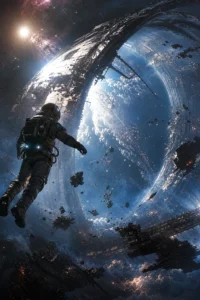
The bay doors opened beneath them in a widening rectangle of black and stars. The Ardent’s artificial gravity released its grip as Survey Three slid out of the ark’s belly and into the hard radiance of orbit. Mara’s stomach lifted. Loose dust motes and one of Jun’s styluses spun upward, catching the cockpit glow like tiny satellites.
Kepler filled the forward windows.
No projection had prepared her for it.
The planet was not Earth. It was too deliberate. Cloud bands curled in repeating intervals across the southern hemisphere, their spirals nested like fingerprints. The oceans did not glitter in natural chaos; vast sections lay dark and smooth, then fractured into luminous grids where tides rose along invisible seams. At the terminator, night poured over continents slowly, revealing constellations of blue-white phosphorescence beneath the sands, not cities lit from within but buried geometry answering the dark.
Mara forgot to breathe until her suit collar tightened in warning.
Kade whispered something in Yoruba. It sounded like a prayer, or an equation.
“Look at the western basin,” Talia said, all irritation gone. “Those aren’t waves.”
Rook braced one hand against the cockpit frame. “What are they?”
“I don’t know. But waves don’t turn corners.”
The shuttle rolled, heat shield toward the atmosphere. The planet swung out of view, replaced by the burning edge of dawn and the Ardent above them.
Mara had seen the ship in diagrams, in internal corridors, in archival footage from Earth orbit before launch. She had never seen it whole.
It hung against the stars like a cathedral made of knives and seedpods. Twenty kilometers of habitation rings, cryo vaults, agricultural spines, engine bells blackened by relativistic dust. Its hull was patched in places with darker plates where micrometeoroids had bitten. Running lights flickered unevenly along its length. One of the great radiator fins drooped several degrees out of alignment, glowing a sickly orange.
Ten thousand people slept inside it. Nine thousand eight hundred and twelve now, if the casualty lists had stopped growing. Humanity’s wager against extinction, arriving late to a world that already knew their language.
The shuttle hit atmosphere.
Flame swallowed the windows.
Conversation died under the roar. The cabin shook so hard Mara’s teeth clicked. Plasma crawled across the glass in orange sheets, and for several long minutes the universe became vibration, heat, and the animal knowledge that they were falling very fast through a sky no human lungs had ever breathed.
She closed her eyes.
In the red dark behind her lids, a memory surfaced unbidden: her mother’s kitchen on the lunar relay station, kettle hissing, old rain recordings playing from cracked speakers because her mother had missed weather she had never experienced. Mara at nine years old, tracing extinct alphabets on condensation. Every language is a fossil of fear, her mother had said, guiding her hand through the curve of a Phoenician letter. Find what frightened them, and you find the door.
The shuttle bucked. Her eyes snapped open.
“Descent angle nominal,” Cassian said, maddeningly calm. “Thermal load within tolerances. Dr. Venn, your heart rate has exceeded recommended parameters.”
“Then recommend a different planet.”
Jun made a strangled laughing sound that turned into a cough as the shuttle lurched.
Cloud tore away. Light flooded in.
The glass desert rose to meet them.
It stretched from horizon to horizon, a frozen sea of translucent dunes. Not sand, not exactly. The surface had melted and fused and fractured and melted again, forming ripples of pale green glass veined with threads of gold and black. In places, dunes rose like waves caught at the instant before breaking, their crests sharp enough to slice sunlight. Dust moved over them in thin white ribbons, whispering against the shuttle hull.
And beneath it—
Mara leaned forward until her harness bit into her shoulders.
The city appeared first as shadow.
Lines under the glass. Angles too regular to be geological. Curves repeating at scales her eyes could not reconcile. As the shuttle descended, parallax gave depth to the buried streets. Towers lay entombed upright beneath the translucent crust, their tops only meters below the surface, their lower reaches vanishing into amber murk. Bridges arched between them like ribs. Circular plazas opened under the dunes, each containing a central pit dark as an eye.
“There,” Kade said. “The excavation window.”
Ahead, the desert dropped into a crater three kilometers wide, not natural but carved with mathematical patience. Its sloped walls shone like cut emerald. At the bottom, half-uncovered by some ancient impact or more recent upheaval, stood an entrance.
A door.
Mara knew it before scale resolved, before instruments annotated the display. It had the grammar of passage: threshold, lintel, flanking supports. It was set into a low structure of dark stone or metal, its surface untouched by the glass around it. And it was not vast, not alienly colossal, not made for giants or crawling things or creatures with no concept of upright bodies.
It was a little over two meters high.
Human-sized.
Nobody spoke.
Talia broke the silence with a curse that sounded more weary than surprised. “Of course it is.”
The shuttle settled onto a shelf of black substrate fifty meters from the entrance. Landing struts touched down one by one. Dust lifted in slow, glittering clouds and drifted across the windows. Engines wound down, leaving a silence so complete Mara heard the pulse in her own ears.
Then the outer hull ticked as it cooled.
Rook unlatched his harness. “Seal check.”
Routine returned like armor. They moved through it with practiced hands. Helmets on. Neck rings locked. Pressure integrity confirmed. Suit oxygen green. Comms green. Biometrics green, though Mara suspected the suit was being generous. Anika passed out sidearms none of them except Rook and Talia wanted to touch.
“Rules,” Rook said, standing in the cramped aisle as the airlock cycled. “Nobody enters a structure alone. Nobody touches an interface unless Mara, Kade, and Cassian’s instance agree it won’t kill us in an interesting way. Lieutenant Vale has final call on retreat.”
Anika raised an eyebrow. “Not you?”
“If I’m the reason we need to retreat, I’m unlikely to be objective.”
“That’s the first sensible thing you’ve said since orbit.”
The inner hatch opened. They filed into the airlock two by two.
When the outer hatch split, Kepler entered by degrees: a blade of white light, a curl of glass dust, a breath of atmosphere filtered through suit sensors and translated into numbers.
EXTERNAL ATMOSPHERE: NITROGEN-OXYGEN MIX WITH TRACE ORGANICS. PRESSURE: 0.91 EARTH STANDARD. BIOHAZARD: UNKNOWN. HELMET REMOVAL PROHIBITED.
Mara stepped onto the surface.
The ground rang.
Not crunched. Not shifted. Rang, a faint crystalline note traveling through her boots and up her bones. The desert around them glittered with cruel beauty. Each step sent tiny fractures of light racing beneath the surface, as though the glass remembered impact and passed it onward.
The sky was a deep bruised blue shading toward violet at the zenith. Kepler’s red sun hung low and swollen, gilding the crater walls. No birds crossed it. No insects rasped. Wind hissed softly over the rim, carrying charged dust that sparked against Mara’s visor in pale green flecks.
At the crater’s heart, the entrance waited.
From orbit, it had looked like architecture. Up close, it looked like an accusation.
The doorway stood in a facade of matte black material that swallowed glare. Its edges were beveled with exquisite precision. No corrosion. No sand abrasion. No scorch marks from whatever cataclysm had turned the desert to glass. The frame was carved with parallel grooves at hand height, as if worn by fingers entering over and over—except the grooves were too even, too intentional.
Jun extended a scanner wand. “No obvious radiation spike. Surface temperature seventeen degrees Celsius. That’s warmer than ambient by nine degrees.”
“It’s heated?” Talia asked.
“Or alive,” Jun said, then winced. “Sorry. Inside thought.”
Kade knelt, gloved fingers hovering above the threshold. “This material isn’t stone. It’s not metal either.”
“What is it?” Rook asked.
“Patient.”
Mara looked at him.
Kade’s face was half hidden behind reflections on his visor, but his mouth had gone tight. “The surface is repairing at the molecular level. Dust strikes it, and the lattice reorders. Very slowly. But it reorders.”


0 Comments