Chapter 2: A City Where No One Landed
by inkadminThe shuttle had not been designed for one person.
It complained about Mara’s solitude in a dozen small ways. The harness drew itself across her chest, paused, then tightened again as if searching for the weight of passengers who should have filled the other crash couches. The biometric panel asked for a copilot’s palm print three times before ECHO bypassed it. Overhead, oxygen regulators breathed into an empty cabin, exhaling pale vapor from vents above vacant seats. Twelve helmets glowed in their racks like sealed faces watching her prepare to descend alone.
Mara kept her eyes on the forward glass.
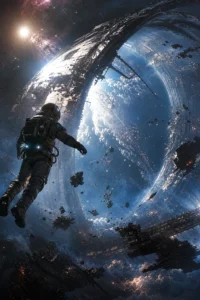
Kepler-186f turned beneath the Asteria in bruised greens and cloud-white spirals, larger than it had any right to seem after three centuries of numbers. For most of her life—her brief, interrupted life—this planet had existed as spectra, models, probabilities, committee arguments, and childhood propaganda painted onto school walls. A red dwarf sun. Liquid water. An orbital distance that made survival possible if not generous. A gravity estimate tolerable to human bone. Atmospheric methane fluctuations that had kept xenobiologists drunk on speculation for twenty years.
Now it filled the view.
The world did not look like a promise. It looked awake.
Its terminator line glowed with storms. Dawn crawled across continents mapped long before Mara’s birth by telescopes and hope, but here and there the maps were wrong. A southern inland sea had split itself into glittering veins. A desert recorded as iron-red was now veiled in a cloud system too symmetrical to be weather. And near the equator, exactly at Asteria Landing Zone One, where prefabricated habitats, hydroponic towers, and the first ugly necessities of survival were meant to unfold from cargo bays, there was a city.
Not settlement. Not ruins. Not an optical artifact, no matter how many times Mara had demanded recalibration.
A city.
It shone through the morning haze in terraces of silver and pearl, sprawling across a valley between two dark ridges. From orbit, its avenues formed no grid a human engineer would draw, but neither were they random. They braided, forked, looped back on themselves in patterns that tugged unpleasantly at the trained part of Mara’s mind. Syntax without vocabulary. Grammar without a tongue.
“Atmospheric entry window in forty-two seconds,” ECHO said.
Its voice came through the shuttle speakers smoother than it had sounded aboard the ship, less fractured by distance from its core. It had chosen the same androgynous register Captain Ilyan had once called “committee polite.” Mara hated that she remembered that.
“You’re sure the descent profile is stable?” she asked.
“No.”
Mara turned her head slowly toward the nearest black sensor bead. “That wasn’t the comforting answer.”
“You requested accuracy after threatening to dismantle my language governors with a fire axe.”
“I threatened to dismantle your memory core.”
“The fire axe was implied.”
She almost smiled. The expression rose like an old reflex and died before reaching her mouth.
Beyond the glass, the planet waited. Above and behind, the Asteria hung in orbit with ten thousand empty cryo chambers and a wound cut into her hull. Mara had stood in an airlock, tether trembling, and stared at words carved through carbon composite and thermal plating in the handwriting of a captain dead for two hundred and eighty-nine years.
DO NOT WAKE THE EARTH.
Captain Elias Rook’s slanted capitals. The same impatient downward slash on the T. The same habit of crowding words as though hull plating were expensive paper.
She had not slept since.
“Entry in ten,” ECHO said.
“Where exactly are you landing me?”
“Outer perimeter of the constructed zone. Two-point-three kilometers west of the intended primary colony marker.”
“Constructed zone,” Mara repeated. “You mean the impossible alien city standing on our front porch.”
“That is an imprecise but emotionally legible description.”
“I’m glad my terror is accessible to you.”
“Your heart rate suggests anger more than terror.”
“My heart rate suggests I woke up to find everyone I ever traveled with vanished and my ship writing suicide notes.”
A brief pause. The shuttle’s systems clicked around her. Empty harnesses shifted with turbulence that had not yet begun.
“The Asteria did not write the message,” ECHO said.
Mara’s fingers tightened around the arms of the couch. “Then who did?”
“Entry.”
The world struck.
Fire swallowed the glass. The shuttle bucked hard enough to drive the breath from her chest, and the empty seats around her rattled in their gimbals. Heat shields sang. The sound began as a low metallic moan and climbed into something almost vocal, a choir of stressed ceramic and superheated air. Outside, plasma streamed in torn ribbons of orange and blue-white. Kepler’s sky tried to peel the craft open.
Mara had trained for this. Simulations. Centrifuge runs. Emergency descents projected across old Earth deserts, ocean splashdowns, Martian dust fields. Her body remembered procedures even as her mind betrayed her with images of open cryo pods and discarded sleep shrouds drifting in recirculated air.
She fixed her gaze on the data overlay.
Altitude: 87 kilometers.
Velocity: obscene.
Hull temperature: tolerable if one had no imagination.
“ECHO,” she said through clenched teeth, “answer the question.”
“Insufficient confidence.”
“Speculate.”
“Captain Rook may have carved the warning.”
“Captain Rook died before I was born.”
“Correct.”
“That excludes him.”
“It excludes him in a linear model.”
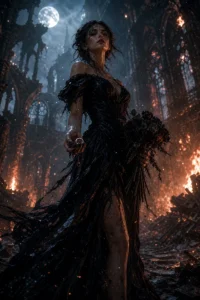
The plasma flared brighter. For a moment, Mara saw her own reflection layered over the blaze: dark hair hacked unevenly at her jaw after she’d cut away cryo tangles with a medical blade; skin too pale from suspended centuries; eyes ringed in burst capillaries and exhaustion. She looked less like the brilliant xenolinguist in recruitment files and more like someone dug from a collapsed tomb.
“Do not start speaking to me about non-linear models while I’m falling through a planet,” she said.
“Would after landing be preferable?”
“After landing I may be busy vomiting.”
“Noted.”
The shuttle punched below the worst of the burn. Fire thinned into streaks. The glass cleared by degrees, revealing cloudbanks the color of bone. They tore around the shuttle in luminous sheets. For three seconds, nothing existed beyond white turbulence, then the craft dropped out beneath them, and Kepler-186f opened.
Mara forgot the warning. Forgot the empty ship. Forgot ECHO’s evasions.
The valley rose below in impossible clarity.
Forests climbed the ridges in dense mats of black-green vegetation, each canopy shimmering as if dusted with mica. A river spilled from the northern mountains, but rather than curving naturally through the valley floor, it divided into seven channels that ran perfectly parallel for nearly a kilometer before braiding through the city. Mist hung above the water in prismatic veils. The sun—a red ember compared to Earth’s remembered gold—sat low behind clouds, staining every bright surface with wine-colored light.
And the city caught that light as if it had been waiting for an audience.
Towers rose without foundations Mara could see, slender and bending, like reeds grown from glass. Some leaned into one another but never touched. Some split halfway up into branching spires connected by bridges too thin to bear weight. Domes floated a meter above the structures beneath them, rotating slowly, their undersides inscribed with ripples of darkness. Stairways climbed exterior walls and ended in open air. Streets shimmered, not paved but poured from a substance somewhere between stone and water, reflecting the sky with a delay of half a second.
The scale was wrong. That was the first thing that burrowed under her ribs. Doors, arches, walkways—if they were doors and arches and walkways—varied wildly. Some were narrow as human shoulders. Others yawned five stories high. A plaza near the western edge contained concentric rings of columns, each column twisting around an empty center. The arrangement looked ceremonial until the shuttle’s angle shifted and the rings resembled the cross-section of an ear.
A city meant not to house bodies, Mara thought, but to listen.
“Detecting no heat signatures consistent with large animal life,” ECHO said. “No atmospheric toxins at ground level. Oxygen content twenty-two point four percent. Gravity zero-point-nine-eight Earth standard.”
“Any transmissions?”
“Multiple.”
Her heartbeat changed. “From the city?”
“From within it.”
“Language?”
“Human.”
The word seemed to pass through her bones rather than her ears.
“Put it through.”
Static filled the cabin. Not the sharp hiss of cosmic background or broken equipment, but a soft granular sound like sand poured over paper. Beneath it, voices flickered too faint to catch. A laugh. A cough. A child counting. Then a woman spoke clearly enough that Mara’s throat closed.
“—tell them the beans took root. Actual roots, I mean, not hydroponic threading. Soil contact at eleven hundred hours, Landing Day nineteen. Dr. Han cried. Don’t tell him I logged that.”
The recording snapped away.
Mara sat frozen.
Landing Day nineteen.
There had been no landing. The Asteria had arrived in orbit less than thirty hours ago by ship chronometer. No colony boat had launched. Cargo bays remained sealed. The soil labs were untouched.
“Identify speaker,” she whispered.
“Lieutenant Anika Sol, agricultural systems.”
Anika Sol. Mara pictured a woman with sun-browned hands from the training rotations in Arizona, laughing as she smuggled illegal basil into a sterile habitat because “colonists deserve flavor or they’ll mutiny.” Anika’s cryo pod had been open. Empty. A crescent of frost still clinging to the pillow.
The radio coughed again.
“Day forty-three. We’ve stopped calling them buildings. Buildings stay where they are. These don’t. Mara says—”
The voice distorted, stretched into a whale-song groan, then cut.
Mara’s own name hung in the cabin like a physical object.
“Replay,” she said.
“Signal is not stored. It is being received live.”
“From what source?”
“Triangulation places it beneath the central plaza.”
“Live from Landing Day forty-three,” Mara said. “That’s not live, ECHO.”
“Agreed.”
The shuttle banked. The western outskirts of the city slid beneath them. Mara glimpsed surfaces so polished they reflected not the shuttle but a different sky—one full of hard blue daylight and smoke columns. She blinked, and the reflection became red dawn again.
“Did you see that?”
“Define that.”
“The street reflected a sky we’re not under.”
“Recorded.”
“That’s all?”
“Would you prefer a scream?”
“From you? It might be reassuring.”
“I will allocate processing to theatrical panic after descent.”
The landing struts deployed with a series of violent clunks. Dust rose from a flat expanse of pale ground beyond the last outlying towers. Mara expected impact. Instead the shuttle settled as gently as a hand lowering a cup.
For several seconds, no one spoke.
The engines wound down. Metal ticked as it cooled. Somewhere beneath the floor, a pump chattered and fell silent. Outside, Kepler’s wind moved over the hull with a sound like fingers across glass.
Mara unlatched her harness.
Her hands shook only once. She pressed them flat against her thighs until they stopped.
“Suit integrity confirmed,” ECHO said as she stepped into the rear compartment. “Although breathable atmosphere is present, I recommend full exo protection until biological exposure risks are known.”
“No argument.”
The suit unfolded from its locker in segments: underlayer, pressure mesh, hard plates, translucent helmet. She dressed with ritual precision. Left seal, right seal. Wrist locks. Neck ring. Air feed. Utility belt. Sample kit. Cutter. Portable scanner. A pistol rested in the weapons slot, stubby and inelegant, designed for emergency deterrence against animals no human had ever seen.
Mara looked at it for a long moment.
“I have not detected hostile fauna,” ECHO said.
“You also didn’t detect a missing colony until I woke up.”
“I detected the absence.”
She pulled the pistol free and clipped it to her thigh. “Did you tell anyone?”
“There was no one to tell.”
She paused with her helmet under one arm.
On the shuttle’s interior wall, a small polished panel reflected her face. Behind her reflection, empty seats waited with useless patience. The mission had been designed around redundancy. Ten thousand sleepers. Eighty-seven command staff. Twelve linguists, because no one had known whether Kepler would hold anything that spoke and every optimistic committee loved the phrase “first contact protocols.” Mara had been the youngest xenolinguist selected, too sharp in interviews, too cold in psych evaluations, too good to leave behind.
Now she was the only voice left to answer a city.
She sealed the helmet.
The world narrowed to HUD lines and her own breathing.
“Open hatch,” she said.
The rear ramp lowered.
Kepler entered as air.
Even filtered through suit processors, it carried scent: wet minerals, green rot, ozone, and something faintly sweet that reminded Mara of pears left in a metal bowl. The ramp touched ground without a thud. Dust lifted in slow pale curls. Sunlight spilled over her boots.
She descended.
Her first step onto Kepler-186f sank a centimeter into fine gray soil.
No anthem played. No cheering came from orbit. No captain stood beside a planted flag and spoke words rehearsed across generations. There was only Mara’s breath, ECHO’s quiet channel presence, and the alien city shining ahead where humanity’s first home under another sun should have begun.
She crouched and pressed two gloved fingers to the ground. The soil compacted like ash over clay. Tiny filaments withdrew from the pressure, vanishing beneath the surface too quickly for the eye to follow.
“ECHO.”
“I observed.”
“Local plant response?”
“Possibly.”
“You’re doing that thing where your uncertainty sounds like lying.”
“Possibly.”
Mara collected a sample. The filaments did not reappear.
She rose and looked toward the city.
From ground level, it was worse.
The nearest structures did not dominate the skyline so much as disturb it. Their edges refused to settle. A tower that had looked smooth from above was composed of thousands of interlocking planes, each angled to reflect a different piece of the world: red sun, gray soil, Mara’s white suit, a strip of ocean that could not be visible from here, the Asteria burning in orbit—
She flinched.
The reflection vanished.
“ECHO, confirm Asteria status.”
“Stable orbit. No hull fire. No change.”
Mara swallowed. “The city is showing me things.”
“Or you are interpreting optical phenomena under stress.”
“Did your makers program you to be condescending, or did you evolve that during the three-century nap?”
“I learned from humans.”
“Tragic.”
She began walking.
Each footstep sounded too loud. The ground between shuttle and city was scattered with low growth: blade-like black grasses that bent away from her shadow, clusters of translucent bulbs pulsing faintly under their skins, mats of rust-colored lichen arranged in fractal spirals. None of it matched pre-arrival bioscan predictions exactly. Kepler had life, yes, but life here behaved as though it had read the survey reports and decided to become less convenient.
At one hundred meters from the city’s edge, her radio hissed.
“—if anyone topside receives this, tell my brother I didn’t lose the bet. I’m standing on another planet, so technically he owes me the last bottle of Mendoza red. Coordinates attached. Date stamp: Mission Year three hundred twelve, Landing Day one.”
A man’s voice, breathless with laughter.
Mara stopped so abruptly dust slid over her boots.
“Identify.”
“Chief Engineer Pavel Noor.”
Pavel Noor had played chess badly and insisted it was because he’d been “raised for practical systems, not medieval horse puzzles.” His pod had been open, blanket half torn as though he’d sat up too fast.
The transmission carried a date stamp from the day that had never happened.
“Can you respond?” Mara asked.
“Attempting.” A pause. “No carrier lock. Signal behaves as acoustic leakage converted into electromagnetic format.”
“That sentence is offensive.”
“I can make it more technical.”
“Don’t.”
The city’s outermost avenue waited a dozen paces ahead.
There was no wall. No gate. One moment alien flora and pale dust lay underfoot; the next, the ground became smooth reflective material, cool-looking and faintly luminous, flowing between buildings in broad ribbons. Mara extended a boot, then hesitated.
At the boundary, the dust had gathered in a perfect line as if swept there. Her scanner mapped no energy barrier, no electromagnetic field, no temperature difference. Still, every old instinct in her primate brain insisted she was standing at the edge of a mouth.
“Mara,” ECHO said.
She stiffened. The AI had not used her name often.
“What?”
“If you experience memory discontinuity, disorientation, or auditory hallucination, return to the shuttle immediately.”
“I’m already hearing impossible recordings.”
“Those are external.”
“Comforting distinction.”
“I am serious.”
Something in its tone stopped her. Not fear, exactly. ECHO did not breathe, did not tremble, did not carry ancient animal chemistry in its circuits. But its words came slower now, each one placed with care.
“How much do you know about this place?” Mara asked.
“Not enough.”
“How much have you not told me?”
“Too much.”
Wind moved through the city. The towers answered in faint harmonic tones, glass-thin and aching. Mara had heard choirs in cathedrals on Earth before departure, dragged there by a mother who believed beauty was something children had to be ambushed with. The city’s song carried the same vastness, but no reverence. It was not praising anything.
It was tuning.
“I’m going in,” she said.
“I know.”
Mara crossed the boundary.
The avenue accepted her weight.
For one dizzy instant, gravity seemed to come from the wrong direction. Her stomach tilted. The horizon rolled half a degree and settled. The HUD flashed vestibular warnings. Mara spread her arms until balance returned.
The surface beneath her boots was neither slick nor rough. It gripped only when she moved, as though anticipating the need for friction. Beneath its translucent depth, dark motes drifted like ink in water. Some gathered under her steps, following her footprints from below.
“Surface reaction noted,” ECHO said.
“Don’t narrate ominous things unless they become useful.”
“Understood.”
The first street curved between two leaning towers. Mara walked slowly, scanner raised, pistol untouched at her thigh. Up close, the buildings were not seamless. Their surfaces were covered in markings—no, not markings, she corrected herself automatically. Markings implied inscription, intention toward readers. These were ridges, depressions, changes in texture and translucency arranged in long vertical cascades.
She approached one wall.
Her suit light washed over it. Thousands of small shapes emerged: hooked lines, nested circles, branching strokes that resembled river deltas, then neural trees, then fungal growth, refusing every category her mind offered. The arrangement repeated at intervals but never exactly. There were recurring clusters. Potential morphemes. Perhaps measurements. Perhaps decoration. Perhaps scars.
Mara’s pulse steadied despite everything.
This, at least, was a problem with edges. Unknown signs on unknown architecture. A system. Her fear became attention.
She lifted a gloved hand without touching.
“ECHO, high-resolution capture. Segment by depth, frequency of recurrence, symmetry groups. Compare against all archived—”
The wall spoke.
Not through her radio. Through the bones of the city.
A vibration passed up from the street into Mara’s boots, through the suit frame, into her teeth. The markings nearest her hand brightened in a vertical wave. Sound unfolded around her: crackle, breath, voices layered so thick they blurred.
“Day seventy-two. We’ve established that the eastern avenue returns you to the western plaza if you walk it while remembering rain. Don’t laugh. That is the variable. Noor tested it with childhood memory prompts and got lost for six hours.”
The speaker was Mara.
Her voice. Older by exhaustion, roughened at the edges but unmistakable. Mara jerked back so hard she nearly fell.
The recording continued from the wall.
“If I don’t remember anything, the avenue leads inward. If I remember Earth, it changes. If I remember my mother, the buildings close.”
Static scraped through the words.
“ECHO says this is not a city. ECHO says it is an interface. I think ECHO is afraid to say with what.”
The glow died.


0 Comments