Chapter 6: Rules for a Wolfe Wife
by inkadminThe rain had not stopped since Seraphina found the dead girl beneath the soot.
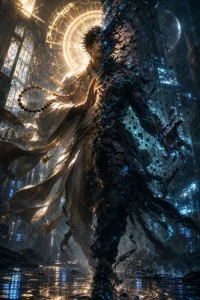
It came down in silver ropes outside the chapel windows, threading the bruised evening sky to the black cliffs below. Water crawled over the old stained glass in shivering sheets, warping the saints until their eyes seemed to weep blood and blue fire. The little chapel smelled of wet stone, smoke, linseed oil, and the sharp mineral tang of disturbed plaster. Dust clung to Seraphina’s throat. Her fingertips were black to the knuckles.
On the wall before her, half-emerged from centuries of grime and one deliberate layer of oily soot, the portrait watched her with eyes she had not seen in twelve years.
Her own.
Not exactly. Younger. Softer. A child’s rounded cheeks and solemn mouth, a ribbon caught crookedly in dark hair, a mole just below the left eye that Seraphina did not have—but the likeness was close enough to hook under her ribs and pull. Close enough that when she had first cleared the girl’s face with a damp swab, she had stepped backward so fast her heel had struck the scaffold leg and the whole structure had shuddered.
The inscription beneath remained only half-revealed, but the name was clear.
Liora Wolfe. Beloved lamb. Returned to God, winter 12 years past.
Seraphina had stared until the letters blurred.
Liora.
The name was a nail driven through the door she had spent her entire life holding shut.
She heard Cassian before she saw him.
Not footsteps—he moved too quietly for that—but the silence altered when he entered the chapel. The air tightened. The rain sounded farther away. Even the guttering candles on the altar seemed to lean from their flames as if recognizing a colder fire.
Seraphina did not turn.
“You took longer than expected,” she said, because her voice had always been a blade she reached for first. “I was beginning to think the manor had finally swallowed you.”
“It has tried before.”
Cassian’s voice slipped through the chapel like black silk drawn over a wound. Calm. Controlled. Too close behind her. She felt it at the base of her neck before she felt his shadow fall across her shoulder.
He did not look at her at first.
He looked at the portrait.
For one bare instant, all the cruelty went out of his face.
It was not softness. Cassian Wolfe did not soften. It was worse than that. Something in him emptied, as if the sight had opened a trapdoor beneath his ribs and everything human had fallen through. The candlelight touched the brutal line of his cheekbones, the cut of his mouth, the faint white scar near his temple. His eyes fixed on the child’s painted face.
Seraphina saw him as he must have looked at graves.
Then he blinked, and the emptiness vanished behind polished obsidian.
“Who told you to uncover this?” he asked.
Not why. Not how.
Who.
Her pulse gave a hard, ugly thud.
“No one.”
“Seraphina.”
The way he said her name made the chapel smaller.
She turned then, wiping her stained fingers on the linen rag tucked into her apron. Her wedding ring flashed beneath the soot, a black diamond set in white gold, chosen to look like a bruise disguised as a star.
“I was hired to restore the chapel,” she said. “Layers lift. Secrets come with them. If you wanted an obedient woman to dust around your ghosts, you should not have married a restorer.”
Cassian’s gaze dropped to her hands. The blackened pads of her fingers. The tremor she could not quite hide.
“And if you wanted to survive in this house,” he said, “you should have learned not to touch what was buried.”
“I have never found survival especially interesting.”
A faint spark came into his eyes. Irritation, perhaps. Or something closer to reluctant amusement. It vanished almost before she could name it.
He stepped past her and lifted one gloved hand toward the portrait, stopping inches from the girl’s face. He did not touch it. The restraint was so severe it looked painful.
“Cover it.”
“No.”
The word rang sharper than she intended.
Rain struck the glass in a sudden furious burst. Somewhere high in the rafters, wood groaned.
Cassian turned his head.
“Excuse me?”
Seraphina folded her arms, though the posture pressed damp fabric against her chilled skin. “It’s a historically significant mural hidden beneath modern concealment. I won’t cover it because you dislike being reminded that people in this house had faces before they became forbidden subjects.”
“This is not a subject.” His voice lowered. “It is a grave.”
“Then why was it buried in smoke instead of prayer?”
For the second time, something moved across his face before he could kill it. A flinch so small another woman might have missed it.
Seraphina never missed damage. It was her profession.
Cassian took one step toward her. She held her ground though her body remembered, with traitorous precision, the heat of him from their wedding night—the way his hand had closed at her waist in the ballroom, possessive and unhurried, while every watcher in the room pretended not to stare. He had not kissed her then. Not properly. Only bent to her ear and promised that if she ran, he would find her before she reached the river.
Now he smelled faintly of rain, cedar, and expensive smoke.
“You will leave the chapel,” he said.
“I’m working.”
“You are finished for the evening.”
“My contract—”
“Your contract became irrelevant the moment you became my wife.”
It should not have hurt. She knew exactly what she was in this house. Debt paid in flesh. A signature in an old family ledger. A name traded across an altar beneath black glass while the city’s most powerful predators smiled from pews polished by generations of sin.
Still, the words found soft tissue.
Seraphina raised her chin. “Then perhaps your mistake was thinking marriage made me less of what I am.”
Cassian looked at her for a long moment, rain-dark eyes unreadable.
Then he said, “Come.”
It was not a request.
She almost refused out of principle. Almost stayed beneath the painted gaze of Liora Wolfe, beloved lamb, and forced him to drag her away. But the name on the wall burned too bright. Her thoughts had begun moving too fast, snagging on memory fragments she had spent years sanding smooth.
A girl laughing in snow.
A hand over her mouth.
The iron smell of blood in a nursery.
A woman whispering, If anyone asks, your name is Seraphina Vale.
She set down her tools one by one with deliberate care. Scalpel. Pigment brush. Solvent tin. Rag.
Cassian watched every movement.
“Afraid I’ll steal something?” she asked.
“You already have.”
Her fingers paused on the clasp of her tool case.
The chapel seemed to tilt.
When she looked up, his expression gave nothing away.
“My patience,” he said.
Seraphina breathed again, silently and with hatred for herself. “How tragic for us both.”
His mouth curved by a fraction. “That remains to be seen.”
He led her from the chapel through the covered cloister that connected it to Blackglass Manor. The passage was narrow and ribbed in Gothic arches, each window glazed in dark, reflective panes that turned the storm into a smear of ink. Their reflections walked beside them: Cassian tall and severe in a black coat, Seraphina pale beside him in her stained work dress, a bride disguised as a laborer, or a criminal disguised as both.
Guards stood at the far end of the cloister.
Two of them. Wolfe men. Black suits, earpieces, hands loose near concealed weapons. They had been discreet during her first days in the manor, appearing at corners, opening doors, vanishing before she could ask questions. Tonight they did not pretend.
Seraphina stopped.
“Am I under arrest?”
Cassian did not slow. “No.”
“Then why do I suddenly have an escort?”
“Because you are my wife.”
“That sounds remarkably like arrest with jewelry.”
One of the guards coughed. The other stared straight ahead, wisely devoted to survival.
Cassian glanced back. “Keep up.”
“Or what? You’ll add it to the list of my sins?”
“No,” he said. “I’ll carry you.”
Heat struck low in her stomach, unwelcome and instant.
She despised him for noticing.
His gaze dipped to the pulse beating at her throat, and the corner of his mouth sharpened as if he had felt it beneath his teeth.
Seraphina moved first, sweeping past him into the manor before she did something unforgivable, like blush, or strike him, or ask why the dead girl had her face.
Blackglass Manor received them with cold grandeur.
The entrance hall rose three stories beneath a vaulted ceiling of black leaded glass. Rain slid over it in ceaseless veins, turning the chandelier light into drowned gold. Mirrors paneled the walls between dark oak columns, some antique and foxed with age, others polished so perfectly they seemed less like glass than openings into another house where other versions of them moved with the same careful violence.
Seraphina had hated the mirrors from the moment she arrived.
They made secrecy feel impossible.
Cassian’s household waited as if summoned by the storm: Mrs. Crane, the housekeeper, rigid in a high-collared black dress; Elias, Cassian’s driver and sometime shadow; a maid with frightened eyes; and at the bottom of the grand staircase, leaning on a silver-topped cane, Cassian’s uncle Octavian Wolfe.
Octavian’s smile was an old cut reopened.
“Ah,” he said. “The bride returns from her devotions. How industrious.”
Seraphina disliked him with the purity usually reserved for poison ivy and municipal tax offices. He had the powdered elegance of an antique corpse and the eyes of a man who enjoyed watching birds strike windows.
“Not devotions,” she said. “Work.”
“In this family, dear girl, the two are often indistinguishable.” His gaze slid to Cassian. “I hear the chapel yielded a surprise.”
The temperature changed.
Cassian removed his gloves slowly, finger by finger. “Do you?”
Octavian’s smile did not move, but his grip tightened on the cane. “Servants whisper. Stone remembers. Houses are vulgar that way.”
“Then dismiss yours before I decide to teach the house manners.”
Mrs. Crane lowered her eyes. The maid went colorless.
Octavian chuckled. “Still so dramatic over old paint.”
Seraphina looked between them. Something passed in the mirrored hall, invisible but felt: a wire drawn tight enough to sing.
“If it was only old paint,” she said, “I doubt everyone would be so pale.”
Octavian’s gaze returned to her, and for a moment the old man’s amusement thinned into something sharper. Recognition? Calculation?
“You have clever hands, Mrs. Wolfe,” he said softly. “One hopes you know when to keep them closed.”
Cassian moved.
Not far. Only one step, placing himself between Seraphina and his uncle with the elegance of a blade leaving its sheath.
“Enough.”
Octavian lifted his brows. “Protective already?”
“Territorial.” Cassian’s voice was ice over deep water. “There is a difference.”
The words should have repulsed her.
They did. Mostly.
But behind Cassian’s back, shielded from Octavian’s gaze, Seraphina allowed herself one brief glance at the line of his shoulders. He had positioned himself so naturally, so completely, that she almost believed it had nothing to do with ownership.
Almost.
“How romantic,” Octavian murmured. “Do let me know when the honeymoon ends. I should like to send flowers.”
“Send chrysanthemums,” Seraphina said. “They suit funerals.”
The old man’s eyes brightened.
Cassian looked back at her, and there it was again—that dangerous flicker at the edge of his composure, unwilling approval like a match struck in a crypt.
“Mrs. Crane,” he said without taking his eyes off Seraphina, “have dinner sent to the west study. No interruptions.”
Mrs. Crane curtsied. “Yes, sir.”
Octavian tapped his cane once against the marble. “No interruptions. How ominous.”
“If you find it ominous,” Cassian said, “leave.”
The smile returned. “This is still my brother’s house.”
“My father is dead.”
“Yes,” Octavian said. “And yet the house continues to make his preferences known.”
Seraphina felt the words land somewhere in Cassian, though he did not move. His father’s portrait hung above the stair: Alaric Wolfe, gaunt and severe, painted with one hand resting on a black hound’s skull. His eyes followed no one. They accused everyone.
Cassian’s jaw flexed once.
Then he touched Seraphina lightly at the small of her back.
A command disguised as courtesy.
She considered stepping on his foot. Instead she let him guide her across the hall, partly because Octavian watched with too much interest and partly because Cassian’s hand, even through damp fabric, radiated heat like a brand.
The west study lay behind double doors carved with wolves and thorn vines. Inside, the room glowed amber against the storm. Shelves climbed every wall, crammed with leather-bound ledgers, art catalogues, devotional texts, and small locked cabinets. A fire burned low in a black marble hearth. Above it hung no family portrait, but a cracked mirror framed in tarnished silver.
Seraphina’s reflection entered with Cassian behind her.
For a second, the mirror made it look as though his hand rested at her throat.
She moved away.
“If this is where you interrogate me,” she said, “I prefer tea.”
“If I were interrogating you, you would not be standing.”
“Charming.”
“Accurate.”
A tray had already been set on a low table near the fire: covered dishes, tea, a cut-crystal decanter of dark liquor, two glasses. Blackglass Manor anticipated its master’s desires with unsettling efficiency.
Cassian crossed to a lacquered cabinet and withdrew a narrow folder bound in gray silk.
“Sit.”
Seraphina remained standing. “No.”
He looked at her.
She looked back.
The fire snapped between them.
At last he set the folder on the desk. “Very well. Stand and be difficult. It seems to nourish you.”
“It does wonders for the complexion.”
“Your complexion is currently soot, rain, and fury.”
“And yet you can’t stop looking.”
The room stilled.
It was reckless. She knew it the moment the words left her mouth. But terror had always made her insolent, and the portrait in the chapel had awakened a terror old enough to have roots.
Cassian’s gaze darkened.
Slowly, he came around the desk. Not stalking. Not rushing. Simply taking possession of the space between them until Seraphina had to tip her head back to keep his eyes.
“That,” he said quietly, “is true.”
Her mouth went dry.
He lifted one hand. She stiffened but did not retreat. His fingers stopped near her cheek, close enough that she felt warmth but not touch. A fleck of soot clung beneath her eye.
He brushed it away with his thumb.
The contact was brief.
It was nothing.
It detonated anyway.
Seraphina’s breath caught before she could chain it. Cassian heard. Of course he heard. His thumb paused a fraction longer than necessary on the curve of her cheekbone. His eyes traced the path of his own touch, then returned to her mouth.
“You should be more careful,” he murmured.
“With soot?”
“With provocation.”
“Maybe I enjoy discovering where men draw their lines.”
His thumb fell away. “Then tonight should please you.”
He turned back to the desk and opened the gray folder.
Inside lay a single sheet of heavy paper, typed in precise black ink.
Seraphina recognized the format at once. Not a contract. Not quite. A household memorandum dressed like a legal threat. At the top, embossed in faint silver, was the Wolfe crest: a wolf beneath a shattered halo.
“Rules,” she said flatly.
“Boundaries.”
“Prisons often call their walls architecture.”
Cassian slid the page toward her. “Read.”
She did not pick it up. She leaned forward, palms on the desk, and read upside down by the firelight.
Rules for Mrs. Cassian Wolfe
Her stomach twisted at the title.
Mrs. Cassian Wolfe. Not Seraphina. Not even Mrs. Wolfe. His name swallowed hers whole.
The first line was underlined.
1. You do not leave Blackglass Manor or its grounds without approved security.
She laughed once, without humor. “Approved by whom? The weather? The hounds? Your sense of masculine fragility?”
“By me.”
“Of course.”
“The city knows you are my wife now. That makes you valuable to people who would enjoy hurting me through you.”
“How touching. I’m an accessory to your enemies’ emotional development.”
“You are a target.”
“Because you made me one.”
“Yes.”
The simple admission cut through her sarcasm.
Cassian did not soften it. He did not apologize. He stood behind the desk with the firelight catching on his cufflinks—black onyx wolves’ heads—and let the truth sit between them, ugly and unadorned.
“You want me watched,” she said.
“I want you alive.”
“Those are not the same thing.”
“In this house, they often are.”
She read the second rule.
2. You do not enter the east wing under any circumstances.
There it was.
The door at the end of the mirrored gallery. The locked corridor. The wing the servants avoided naming. The part of the manor that seemed colder even through walls, where once, during her first sleepless night, she had heard music from a room that Mrs. Crane later insisted had been empty for twelve years.
Seraphina kept her expression still. “What is in the east wing?”
“Nothing that concerns you.”
“That is the worst possible answer to give a woman who uncovers hidden paintings for a living.”
“Then consider this professional development in restraint.”
“Consider telling me the truth.”
His eyes sharpened. “The east wing is sealed.”
“Sealed things rot.”
“Some things deserve to.”
The portrait flashed in her mind. Liora’s dark eyes. The inscription. Beloved lamb. Returned to God.
“Was it hers?” Seraphina asked.
Silence.
Cassian’s face became a door locking from the other side.
“Was the east wing Liora’s?” she pressed.
“Do not say that name as if you found it in a book.”
The words were quiet, but the threat inside them was not.
Seraphina’s nails bit into the desk. “Then tell me how I should say it.”
His gaze held hers.
For a moment, she thought he might answer. The fire hissed. Rain battered the windows. Somewhere beyond the study walls, the manor settled with a long, wounded creak.
Then Cassian looked away.
“Rule three,” he said.
She hated that the deflection felt like loss.
She looked down.
3. You do not speak to the press, the police, city officials, private investigators, members of rival families, or anyone representing the interests of the Veyr Society.
The last name struck her like cold water.
She had seen it once before, though never spoken aloud in Blackglass Manor. A serpent biting through a stained-glass sun. A mark scratched into the underside of her father’s desk two nights before men came to collect a debt he claimed he did not owe. A whisper in the cathedral crypt from a benefactor who had paid in old banknotes and worn gloves indoors.
Veyr.
Cassian watched her.
“You recognize the name.”
“Should I?”
“That was not an answer.”
“It was a question.”
“A bad one.”
She straightened. “Who are they?”
“A superstition wealthy men use to excuse organized appetites.”
“That sounds rehearsed.”
“Because I have had to say it to fools.”
“Am I one of them?”
His eyes moved over her face, too closely. “No.”
The answer should not have pleased her.
It did anyway, a small treacherous warmth beneath the cold.
She returned to the page.
4. You do not enter locked rooms, open sealed correspondence, remove household records, question staff about family matters, or interfere with Wolfe business.
Seraphina raised an eyebrow. “You forgot breathing without permission.”
“I considered it.”
“You must have been exhausted typing all this with one hand while clutching your paranoia with the other.”
“My paranoia keeps people alive.”
“Does it? How many?”
Again, she knew immediately that she had struck bone.
Cassian’s expression did not change, but the study felt suddenly airless.
“Continue,” he said.
Rule five waited at the bottom like a blade left on a pillow.
5. You will keep no secrets from your husband.
For several seconds, Seraphina heard nothing but rain.
Her secret stood behind her reflection in the cracked mirror, wearing a child’s face.
A stolen name.
A dead girl.
A fire somewhere in winter.
A mother who was not her mother pressing a blood-warm locket into her hand and whispering, Never remember where they can hear you.
She felt Cassian watching.
“No secrets,” she repeated.
“None.”



0 Comments