Chapter 12: The Woman in the Portrait
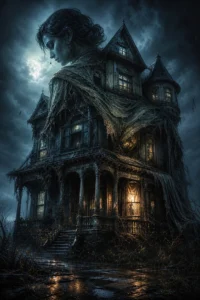
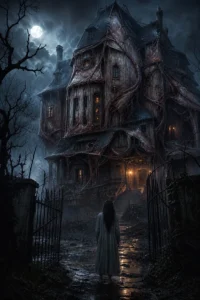
by inkadminBy noon, Blackwater House had settled into one of its rare, deceptive silences.
The storm from the night before had been dragged westward over the sea, leaving behind a silver-gray sky and a wind that pressed damp fingers against the windows. The corridors were dim despite the daylight, the old house holding onto its shadows as if they were heirlooms. Seraphina moved through them with the key ring Cassian had given her clutched in her palm, the metal cold enough to sting.
Every key was different. Some were polished brass, some iron-black with age, one slender little thing with a mother-of-pearl head that seemed too delicate to belong in a place like this. She had spent the morning turning them over at the breakfast table while Mrs. Wren had hovered in the doorway, silent and watchful as a warden. No one had said east wing aloud, but the prohibition hung in the air like a curse.
Do not go there.
Which meant, naturally, that she could think of nothing else.
She had learned in childhood that forbidden rooms were never really about the rooms themselves. They were about what lived inside them, the knowledge waiting in the dark like a blade laid neatly on velvet. The locked doors of Blackwater House seemed to promise exactly that.
She passed a gallery of marine paintings—black water, white foam, ships splitting through storms with their sails snapped like broken bones—and followed the house’s long spine toward the older section of the mansion. The air grew cooler with each step. The new rugs and freshly polished banisters gave way to warped floorboards, antique wallpaper curling at the seams, and the smell of dust so old it seemed to have turned into another substance entirely, something dry and almost sweet.
At the far end of the hall, half hidden behind a pair of curtain-thick velvet drapes, stood a narrow door she had not noticed before.
No brass plaque. No decorative molding. Just a plain painted panel the color of bone, its handle dulled with age.
Seraphina stopped in front of it, listening.
The house breathed around her—pipes ticking, distant water running through old copper veins, the faint cry of gulls outside somewhere over the cliffs. Nothing moved. No footsteps. No voices. Even Mrs. Wren was gone.
She drew one of the keys from the ring and tried it. The first fit nothing. The second, nothing. The third—small, black iron, teeth worn almost smooth—slid into the lock with a soft, reluctant click.
Her pulse jumped.
The door opened inward on a breath of stale air that smelled of linen dust, turpentine, and age. She stepped into darkness and felt for a pull cord. When her fingers found it and tugged, a low wall of lamps around the room flickered awake one by one, amber light blooming beneath green glass shades.
The room was not a bedroom, as she had half expected, nor a study. It was a gallery.
Long and narrow, it stretched deeper than the hall had suggested, lined with portraits hung in a disciplined sequence from floor to ceiling. Some were mounted in heavy gilt frames, others in dark carved wood. Their subjects watched her from various centuries—stern men in naval coats, women in pearls and mourning black, children with solemn, almost uncanny eyes. The floor was covered in a faded Turkish runner, the pattern worn almost invisible under a layer of white dust.
And at the far end, where the gallery narrowed beneath a high arched window crusted with sea salt, stood a single easel draped in a drop cloth the color of old linen.
Seraphina’s breath caught.
The room felt abandoned, but not empty. It had the charged stillness of a sealed crypt.
She took a cautious step inside. The floorboards responded with a muted creak, then another. She glanced over her shoulder, half expecting to find a servant in the doorway ready to reprimand her, but the hall behind her remained empty. The door stood open just enough to let in a strip of pale light.
She shut it softly behind her.
Her shoes whispered over the runner as she moved from one portrait to the next. Family likenesses emerged in the wash of lamplight: the same sharp bone structure recurring across generations, the same pale eyes, the same severe mouths set against the endless gray of sea and sky. Blackwater lineage, preserved in oil and varnish, each face rendered as if the painter had been instructed to remove warmth.
One woman in particular drew her gaze. She wore mourning black and sat with her hands folded in her lap, the dress trailing over a carved chair. Her expression was composed, though not gentle. There was a hardness around her mouth, a refusal. The painted label beneath the frame read: Marian Thorne, née Vale.
Vale.
Seraphina stepped closer. Her throat had gone tight.
The woman in the portrait had her mother’s eyes.
Not merely similar. Not an echo. The same tilt, the same dark-lashed, watchful gaze that had haunted Seraphina from old photographs and memory-frayed dreams. Her mother’s mouth, her mother’s narrow wrists, her mother’s small pointed chin. But there was something else, too—a severity in the painted face that Seraphina had never seen in the smiling pictures at home. The woman in the portrait looked as though she had already been betrayed and had decided to survive it anyway.
Seraphina’s fingers curled against the frame.
No.
Her mother had died in a hospital bed when Seraphina was sixteen. Her name had been Elara Vale then, before the pills and the doctors and the long collapse of the family fortune had reduced her to a photograph in a gilt frame on the mantel. Seraphina had spent years staring at that photo and wondering what else had been taken from her mother besides health and time.
She looked again at the portrait.
The label was not new. The brass plaque was dark with age, screwed neatly into the frame as if no one had ever thought to question it. Marian Thorne, née Vale. The name struck her like a slap.
She lifted her hand to her mouth.
The room seemed to tilt around her. There were other Vales, of course. Her family was not ancient but respectable enough to have branches, cousins, dead aunts, old property records sealed in county archives. But this woman—this exact likeness—could not be a coincidence. The painter had known her mother, or known someone who had owned her mother’s face long before Seraphina ever existed.
She heard, in memory, her father’s voice at the dining table years ago, strained and impatient after too much whiskey: Your mother had a talent for disappearing into rooms she did not belong in.
At the time Seraphina had assumed he meant social climbing, or grief. Now the words felt like they had been spoken through a crack in a wall.
She leaned closer to the plaque, as if the brass might yield some hidden inscription if she stared hard enough. Nothing. Only the name.
Marian Thorne, née Vale.
As if the woman had belonged to both houses. As if she had been traded between them.
A draft moved through the gallery and kissed the nape of her neck. Seraphina turned sharply, but there was only the line of portraits and the dim mouth of the hall beyond the open door.
Then she noticed the easel.
Someone had left the cloth over the painting with imperfect care. One corner drooped lower than the others, catching on the carved leg. Dust lay thick across the fabric, disturbed only where a pale handprint had once brushed it away.
Her heartbeat thudded harder.
The room had been used recently.
She crossed to the easel, each step measured now, and reached for the cloth. The air seemed to thicken around her fingers. She paused only a moment, then pulled the fabric free.
The portrait beneath was nearly life-sized.
A woman sat before a dark sea, turned three-quarters toward the viewer, her hands folded around a ring of black jet. She wore a high-necked dress in pearl gray, the fabric rendered in such detail that Seraphina could almost hear the brush drag through the silk. Behind her, the horizon dissolved into storm. A silver necklace gleamed at her throat, delicate and severe.
Her face stopped Seraphina’s breath cold in her chest.
It was her mother.
Not almost. Not maybe. Her mother as she might have appeared ten or fifteen years before Seraphina was born—before illness had thinned her, before time had hollowed her cheeks. The same eyes, the same sharp mouth, the same narrow, aristocratic hands.
But beneath the portrait, the painted inscription read:
Adelaide Thorne
Seraphina staggered back as if the name had struck her physically.
Adelaide.
Not Elara. Not Marian. Adelaide Thorne.
Her fingers went numb. She pressed her palm to the edge of the easel to steady herself, the wood rough under her skin. Her gaze flew over the portrait again, hunting for signs of forgery, of cruel imitation, of some grotesque joke. But the detail was too exquisite, the likeness too intimate. This had not been copied from memory. Someone had painted the woman they knew.
He will make our daughters pay.
Seraphina froze.
The words were not spoken aloud. They were written.
She had seen them only a blink later, when her gaze dropped to the back edge of the canvas where the frame lifted slightly from the wall. A line of ink, almost lost in the shadow there, had been scrawled on the wood in a hurried, slanted hand. She circled the easel and crouched, heart pounding so violently she could hear it in her ears.
The message was there, scratched into the back of the painting with something sharp enough to splinter the grain.
He will make our daughters pay.
Below it, in smaller letters, a date had been written and half smeared by age.
17 October 1994.
Her stomach turned.
That year had been before she was born.
Before, perhaps, her mother had ever become Elara Vale.
Before whatever secret had been buried under names and marriages and inheritance papers.
Seraphina’s skin prickled with a cold so profound it seemed to seep from the floorboards themselves. She reached for the edge of the canvas, as though touching it might anchor her to something solid, but the linen was brittle with age and dust. The frame gave a little under her fingers. Someone had taken care to keep this hidden, yet had left the message exposed to whoever was curious enough to pull back the cloth.
Not hidden from everyone.
Hidden from the right eyes. Or perhaps, from the wrong ones.
She looked again at the portrait’s face and felt the world contract to a single point. There was no way this could be coincidence. Her mother had worn another name. She had been here. Or been painted here. Or both. And Cassian had known enough to tell her nothing about the east wing except that she must not enter it.
The muscles in Seraphina’s jaw clenched until they hurt.
What exactly are you keeping from me, Cassian?
The question came with a flash of anger so clean it almost steadied her. Not because she had no suspicions left, but because suspicions had finally found shape.
Behind her, the gallery door creaked.
Seraphina spun around so quickly her skirts brushed the easel. For one dreadful second she thought she would find Cassian standing there, beautiful and unreadable in his black coat, catching her in the act like a crime scene come to life.
But it was only Mrs. Wren.
The housekeeper stood in the doorway, one hand still on the knob, her expression unreadable beneath her severe silver hair. She wore a gray dress buttoned to the throat and held herself with the rigid composure of someone who had spent a lifetime learning not to look surprised.
“Mistress Vale,” she said. Her voice was soft enough to belong in a chapel. “I thought I heard movement.”
Seraphina had not realized she was breathing too quickly until the housekeeper’s eyes narrowed almost imperceptibly at her chest rising and falling.
“I was looking for the conservatory,” Seraphina said, the lie coming out smoother than she expected. “I seem to have taken a wrong turn.”
Mrs. Wren’s gaze moved past her, over the uncovered easel, over the portrait, and came to rest on the nameplate beneath it.
For the first time, something flickered across her face. Not surprise. Not quite. Recognition, perhaps. Or the exhaustion of someone seeing an old wound opened anew.
“This part of the house is seldom used,” she said carefully.
“And yet the lamps were lit.”
“They are on a timer.”
“Of course they are.”
Mrs. Wren did not smile. “You should return to the main hall. Mr. Thorne dislikes…” She stopped, then corrected herself with visible effort. “He prefers not to be disturbed in this section.”
“Because there are portraits here?” Seraphina asked lightly. “Or because there are names?”
For a long moment, Mrs. Wren said nothing. The silence stretched, taut and brittle. Then she stepped fully into the room and gently shut the door behind her, though not all the way. Just enough that the hall beyond was reduced to a thin stripe of light.
“You should not touch anything in this gallery without permission,” she said.
“Is that what he told you to say?”
“It is what I am telling you to hear.”
Something in the woman’s voice—weariness, warning, pity—cut through Seraphina’s rising temper and made her more careful. She looked once at the portrait, then at Mrs. Wren, whose gaze had not strayed from the painted face.
“Do you know who she is?” Seraphina asked.
Mrs. Wren’s mouth tightened. “I know the name on the frame.”
“That’s not the same thing.”
“No,” Mrs. Wren said. “It is not.”
Seraphina caught the faint tremor beneath the housekeeper’s composure. A private grief, perhaps. Or fear. She had spent enough of her life among the rich to recognize the difference between obedience and complicity. Mrs. Wren was obedient in the way a locked door was obedient. There had been a key somewhere once.
“What happened to her?” Seraphina asked.
Mrs. Wren’s eyes closed for a breath. When they opened again, they were blank as frosted glass. “I was not employed here then.”
“But someone was.”
“Yes.”
“Who?”
“You ask questions as if answers are owed.”
“And you answer as if you’re afraid of them.”
A beat. Then Mrs. Wren’s gaze sharpened, and something like steel entered her voice. “You would do well to be afraid, Mistress Vale. Not of this house. Of the men who built it.”
Seraphina felt her skin go colder. “Cassian’s one of them.”
“Cassian is the last of them.”
That answer landed like a stone in deep water, ripples spreading in every direction.
Before Seraphina could ask what she meant, Mrs. Wren took a step forward and lowered her voice.
“If you are wise, you will leave this room untouched. If you are very wise, you will forget what you have seen.”
“And if I’m neither?”
Something almost like sadness passed over the older woman’s face. “Then the house will remember you.”
She turned to go.
Seraphina blurted, “Wait.”
Mrs. Wren paused at the door but did not turn back.
“What does the east wing hold?” Seraphina asked.
The housekeeper was still for a long moment. Then, without looking over her shoulder, she said, “The past.”
And she was gone.
Seraphina stood alone in the gallery, staring at the closed door, pulse beating hard against the base of her throat. The room had gone suddenly colder, as though Mrs. Wren’s presence had been the only thing keeping the air warm.
She turned back to the portrait.
Adelaide Thorne.
The name on the canvas now seemed to burn. Seraphina approached it slowly and traced the painted edge of the frame, her fingers stopping where the wood had been nicked, perhaps by the very tool that had carved the message into the back.
He will make our daughters pay.
The line repeated itself in her mind until it became less like text and more like prophecy. He. Not they. Not the house. A man. Some man from the past, with enough power to turn women into pawns and daughters into debts.
Her mother had never spoken of her own family. Not once. Not in all the years of illness and arguments and forced smiles before the end. Seraphina had assumed there was little left to say, that the silence had been born from estrangement or shame. But now silence looked different. It looked deliberate. Strategic.
She thought of her father too, of the tremor in his hand when he signed the marriage contract. Of his desperate insistence that this was the only way to save the family name. He had looked less like a patriarch then than a man standing on the edge of a grave he had helped dig. What debts had followed him? What old sins had Cassian inherited?
The portrait answered none of it. It only stared back with her mother’s face and a name she did not know.


0 Comments