Chapter 37: Under Stone and Salt
by inkadminThe key Eveline had pressed into Seraphina’s palm was colder than the dead woman’s fingers.
It lay there now, a narrow black thing against the lifeline of her hand, its teeth cut in an old-fashioned pattern no locksmith in the city would have used for half a century. The bow of it was shaped like a thorned rose, worn smooth by years of being hidden, carried, feared. There was salt crusted in one groove. Or perhaps that was only the way the moonlight made metal look through rain-streaked glass.
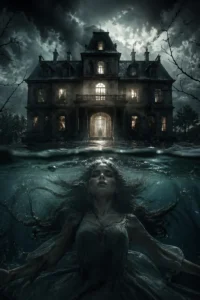
Behind her, Blackwater House breathed.
The corridor outside Eveline’s room had gone unnaturally still after the servants carried the body away. Too many doors shut too softly. Too many footsteps faded before they should have. Even the house seemed to have folded its wings around the death and was waiting to see what Seraphina would do with it.
Cassian stood at the end of the hall, a black shape beneath the wall sconces, his shirt open at the throat and his hair damp from the storm. He had arrived too late to hear Eveline’s confession. Too late to catch the words that had crawled out of the dying woman’s mouth like things desperate to live.
Under the family crypt. The truth is buried where they thought grief would keep everyone away.
Seraphina closed her hand around the key until its teeth bit into her skin.
“You’re bleeding,” Cassian said.
His voice was low, but it carried in the corridor as if the walls had been built for him. He did not move toward her. That was what frightened her most—not his anger, not the violent stillness in his face, but the restraint. Cassian Thorne had always made control look effortless. Tonight it looked like something he was holding by the throat.
Seraphina tucked her fist against the folds of her black robe. “It’s nothing.”
His eyes dropped to her hand. “Nothing is a word people use when they mean they are preparing to lie.”
She almost laughed. It would have come out as something jagged and ugly. “Then you should be the greatest expert alive.”
The cut landed. She saw it, though he did not flinch. His mouth tightened by a fraction. The storm rolled over the roof like stones dragged across a coffin lid.
“Seraphina.”
Her name in his mouth had once felt like a door opening. Now it sounded like a warning posted on the edge of a cliff.
She took one step back. “Not tonight.”
“What did Eveline tell you?”
There it was. Not comfort. Not grief. Not even apology. A question, sharp and immediate, because Cassian’s world had always been made of secrets and leverage, and someone had died with one between her teeth.
Seraphina looked at him through the dim gold of the hall. He was beautiful in the cruel way of winter seas—silver-eyed, hard-boned, a man sculpted by old grudges and newer sins. Her husband. Her jailer. Her only shield in a house that had been trying to swallow her since the day she arrived in white lace and debt.
“She told me,” Seraphina said softly, “that the dead aren’t always the ones buried deepest.”
Then she turned before his expression could change, before his voice could catch her, before the ache in her chest could betray her into staying.
She went down the servants’ staircase because the main halls had too many portraits and too much memory. Her bare feet found the narrow stone steps without sound. The house was colder below, its warmth thinning as she descended past the kitchens, past the shut doors of storage rooms, past the old wine cellar where the air smelled of cork, damp wood, and expensive rot. Somewhere overhead, voices murmured. A man coughed. A maid wept once and was hushed.
Seraphina kept going.
Blackwater House had been built on a cliff above the marsh, its foundations thrust into black rock veined with salt and old water. The family crypt crouched behind the estate chapel, but the oldest passage to it ran beneath the house, made for winters when wind could flay skin from bone and for funerals too important to be delayed by weather. She had learned that from Margaret, who had offered the fact while polishing silver with the expression of someone naming a sin.
The Thornes never liked to let even death leave by the front door.
The passage waited beyond a warped oak door behind the laundry. Seraphina found the iron latch slick with condensation. It resisted her, groaning as if disturbed from sleep. Beyond it, darkness smelled of wet stone and extinguished candles.
She should have brought a lantern.
She should have gone back.
She should have told Cassian.
Instead, she reached for the candle stubs kept on a shelf beside the door, struck a match with hands that trembled only after the flame caught, and watched light climb the walls in a thin orange shiver.
The tunnel sloped down.
Water threaded through cracks overhead and fell in patient drops. The stones sweated. Salt glittered in white scales along the mortar, making the walls look diseased. Seraphina held the candle before her and watched her shadow stretch long and thin at her feet, a dark bride walking into the earth.
Every few steps, niches appeared in the walls. Some held rusted sconces. Some held small marble plaques engraved with names so old the letters had blurred: Alaric Thorne, Beloved Son. Meredith Thorne, Taken by Fever. Infant Daughter, Returned to God.
Infant daughter.
The words snagged in her mind.
She moved faster.
The passage opened at last into the crypt beneath the chapel, a low chamber pillared in stone. The air was colder here, dense with wax, mildew, and the faint mineral tang of old bones behind sealed walls. Above, through the vaulted ceiling, thunder spoke in muffled judgment. Rows of sarcophagi stood like sleeping beasts, their carved lids softened by time. Some bore swords. Some roses. All bore the Thorne crest: a thorn branch wrapped around a black wave.
Seraphina’s candle flickered as she stepped inside.
She had come here once before, on the day after her wedding, when Margaret had shown her the chapel and its undercroft with a face as pale as candle grease. Then, Seraphina had thought the place theatrical, another Gothic affectation of a family too rich to die normally. Tonight there was nothing theatrical about it. The dead seemed crowded around her, listening.
“Under the family crypt,” she whispered.
Her voice went nowhere.
She turned slowly. Stone floor. Stone walls. Names. Dates. The central aisle ended at the largest tomb, a raised black marble monument beneath the carved angel of Lucien Thorne, patriarch, judge, executioner if half the rumors were true. His marble face looked upward with an expression of sanctified boredom. At the base of his tomb, an inscription had been cut deep:
What is owed shall be returned.
A chill ran along Seraphina’s spine.
She crouched and held the candle close to the inscription. The words had collected dust in their grooves, but one letter—the first o in owed—was clean. Not just clean. Hollow.
Her heart began to knock harder.
She drew Eveline’s key from her robe. The thorned rose bow rested against her fingertips like a pulse. She slid the key toward the hollow letter.
It fit.
For one breath, nothing happened.
Then something shifted inside the tomb with a deep, reluctant clunk.
Seraphina froze.
The sound rolled through the crypt. Dust trembled down from the angel’s wings. Somewhere within the wall, mechanisms older than her father’s empire groaned awake. The black marble slab at the base of the tomb sank half an inch and slid inward, revealing a narrow seam of darkness that breathed up air so cold it carried the taste of iron and sea brine.
The candle guttered.
Seraphina nearly dropped it.
Behind the tomb, a section of floor had opened. Not wide. Not inviting. A set of steps descended into blackness, their edges slick with salt.
She stared at them, every instinct in her screaming.
This is where the house keeps its real dead.
A sound came from the tunnel behind her.
Seraphina spun, candle held high.
Nothing but the passage. Nothing but pillars and shadow.
Yet she had heard it. A scrape. A breath. Perhaps only stone settling after the hidden door opened. Perhaps Cassian had followed. Perhaps someone else had.
“Hello?”
The crypt returned the word in pieces.
No one answered.
Her fist tightened around the key. If she turned back now, she would spend the rest of her life wondering which truth had been close enough to touch and too terrifying to claim. She thought of her mother’s face in the one photograph Seraphina had hidden from her father: laughing in profile, hair unpinned, pearls at her throat that did not look like Vale pearls, did not look like anything purchased but inherited. She thought of Eveline’s bloodless lips shaping the confession.
Your mother was not who they made her become.
Seraphina stepped onto the stairs.
The descent was narrow enough that her shoulders nearly brushed both walls. The salt here grew thicker, blooming in jagged white feathers from the stone, crunching under her feet. The candle flame shrank to a blue-edged tear. The air grew wet, heavy, subterranean. She counted the steps without meaning to.
Seven.
Twelve.
Twenty-three.
At thirty, the stairs ended.
The chamber beneath was smaller than she expected and far more terrible.
It had not been built as a room for mourning. There were no statues, no inscriptions, no offerings of dried flowers. It was a vault, low-ceilinged and ribbed with beams blackened by age. Stone shelves lined three walls. Iron boxes sat stacked in careful rows, their locks furred with green. A heavy table occupied the center, its surface scarred by knife marks and ink stains. Chains hung from one wall, but not for prisoners—at least, Seraphina hoped not. They supported oil lamps, empty hooks, canvas-wrapped bundles, and sealed document cases.
Against the far wall stood a cedar chest bound in iron.
On its lid, the Thorne crest had been burned deep into the wood. Beneath it, someone had carved three words with a shaking hand.
Let her live.
Seraphina stopped breathing.
The words were not elegant. Not official. Not done by a craftsman. They looked frantic, scored again and again until the letters split the grain.
She crossed the chamber slowly.
The cedar chest had no lock. It had been nailed shut, then pried open, then nailed again. One hinge hung crooked. Seraphina set the candle on the table and lifted the lid.
The smell that rose from inside struck her like a hand.
Lavender, ancient paper, cedar, and beneath it a dark, unmistakable metallic ghost.
Blood.
At the top of the chest lay a christening gown.
It had once been white. Fine cotton lawn, hand-smocked at the collar, edged with lace so delicate it looked made of frost. Tiny mother-of-pearl buttons ran down the back. A blue ribbon, faded nearly gray, had been threaded through the bodice. But the front of the gown was stained brown-black from collar to hem, the fabric stiffened in places where blood had dried and time had made it permanent.
Seraphina’s hand hovered above it.
She did not want to touch it.
She could not stop herself.
The cloth was cold and brittle beneath her fingertips. Too small. Too intimate. A garment meant for an infant held up before a congregation, blessed with water, kissed by family. Instead it lay folded in a secret chamber beneath a crypt, marked by violence no laundering had erased.
Something inside Seraphina bent until it nearly broke.
Beneath the gown lay documents wrapped in oilcloth and tied with black ribbon.
She pulled the first bundle free. The ribbon fell apart at her touch. Papers slid across the table in a dry whisper—ledgers, letters, certificates sealed with wax, pages covered in neat columns of names and sums. Some bore the Thorne crest. Some bore the stamp of the city’s civil registry. Some were written in a hand she recognized from old invitations framed in the Blackwater study: Lucien Thorne’s precise, cruel script.
Seraphina unfolded the first certificate.
Her eyes moved over the words once.
Then again.
The chamber seemed to tilt.
Certificate of Live Birth
Name: Aurelia Maren Thorne
Sex: Female
Date of Birth: 14 October
Father: Lucien Ambrose Thorne
Mother: Isolde Maren Thorne, née Wycliffe
Status: Legitimate Issue, Firstborn
Aurelia.
Not Adeline Vale.
Not the woman her father had spoken of in careful, brittle fragments. Not the social climber from nowhere, not the beautiful mistake who had married above herself, not the inconvenient dead wife whose belongings had vanished before Seraphina was old enough to ask why.
Aurelia Maren Thorne.
Seraphina pressed a hand to her mouth.
There were two more certificates beneath it. One for Cassian’s father, born six years later. One for Eveline, born after that. Beside Aurelia’s name in a later registry copy, someone had written in red ink: deceased in infancy.
But there was no death certificate.
There was a ledger instead.
Its cover was cracked black leather, the corners reinforced in tarnished silver. Seraphina opened it with shaking fingers. Inside, columns of dates marched like soldiers. Payments to doctors. Payments to a midwife. Payments to a convent on the northern coast. Payments to a judge. Payments to E. Vale.
Her father’s initial. Her father’s name in full on the next page, bold and damning.
Edward Vale — compensation for fosterage and silence, initial sum transferred.
She turned the page.
Additional settlement upon marriage to subject, name changed to Adeline Vale. Public narrative secured. Registry amended.
Seraphina gripped the table until splinters pressed into her palm.
The room blurred, then sharpened with vicious clarity.
Her father had not married her mother out of love. He had been paid to take her. Paid to bury a Thorne daughter alive inside a new name. Paid to smile in public beside a stolen heiress and pretend she had never belonged to Blackwater at all.
Another document slid loose from the ledger. It was a letter, folded twice, the paper thin as dried skin. The handwriting was different, rounder, hurried. Seraphina knew it before she knew how.
Her mother.
She unfolded it.
If this reaches anyone with blood enough to remember mercy, know that I am alive. My name is Aurelia Maren Thorne. They have called me Adeline for so long that sometimes I wake with the wrong name on my tongue. My daughter has my eyes. She has the mark at her left shoulder, as I did, as my mother did. If I die, they will try to make her nothing. They will say she is Vale and only Vale. They will bury me twice and call it inheritance.
Seraphina could not read for the shaking in her vision.
She forced herself onward.
But the entail is clear. Firstborn line. Legitimate female issue not barred. If my father’s sons take Blackwater while my child lives, they are thieves wearing mourning rings.
A sound escaped Seraphina’s throat—half laugh, half sob, too quiet for how much damage it did.
She touched her left shoulder through the robe. Beneath fabric and skin waited the small birthmark she had spent her life ignoring: a dark crescent near her collarbone, the shape of a wave breaking against stone. Her mother had called it her moonbite. Her father had hated when anyone mentioned it.
There were photographs beneath the letters.
Old Polaroids, their edges yellowed. A young woman holding a baby outside a chapel door, her face turned away but the curve of her cheek achingly familiar. A stern woman with silver hair—Isolde, perhaps—standing beside a cradle with one hand possessively on the rail. An infant swaddled in the same bloodstained gown, clean then, ribbon bright blue.
Another picture made Seraphina go cold.
A little girl of perhaps seven sat on the steps of Blackwater House, wearing a white dress and scowling at the camera as if she had already learned not to trust whoever held it. On the back, written in fading ink:
Aurelia, before removal.
Before removal.
Not death.
Removal.
Seraphina lowered herself into the chair before her knees gave way. It creaked beneath her, loud in the buried room. She could feel the weight of the house above her—the chapel, the crypt, the generations of Thornes sealed in stone, all pressing down as if to keep this truth from rising.
A Thorne.
Her mother had been the eldest legitimate Thorne daughter.
Seraphina was not merely Cassian’s purchased bride, not merely a Vale debt dressed in silk. She was blood of Blackwater. Older blood, if the documents were true. A claim carried through a woman they had erased.
Her marriage shifted around her in her mind, becoming something monstrous.
Cassian had known.
Hadn’t he?
He had said he married her to protect her. He had said many things while touching her like a confession and commanding her like property. Every kindness, every threat, every moment his eyes lingered on her as though she were a wound he could not stop reopening—what had it all been? Love? Strategy? Guilt?
Had he taken her as a wife because she was the key to Blackwater? Because marrying her bound her claim to his? Because if anyone discovered what she was, he could control it through vows?
The thought cut so cleanly that for a moment she did not feel it.

0 Comments