Chapter 6: Salt on the Windowpanes
by inkadminThe corridor behind the library shelves smelled of old paper, damp stone, and the dust that gathered in places no servant ever touched. Elara had only a second to take in the narrow seam of darkness before Lucien’s hand caught her wrist and yanked her backward with a force that stole her breath.
The shelf slid shut with a muffled thud.
Then there was only the library: the storm rattling the high windows, the fire crackling low in the hearth, and Lucien standing too close, his expression stripped bare by fury.
“Who told you where to look?” he asked.
Elara wrenched against his grip. “You can’t just manhandle me whenever you wish.”
“Answer me.”
His voice was not loud. That was somehow worse. It had the clipped, precise edge of a blade drawn halfway from its sheath. In the dim, his face was all shadows and hard angles, the black sheen of his wet hair falling loose at his temples. He had been out in the rain. She could smell it on him—salt, cold air, and the faint metallic bite that clung to him when he was angered.
She lifted her chin. “I found it myself.”
“Liar.”
“You say that as though I ought to be impressed by your certainty.”
Something dangerous flickered in his eyes. Not surprise. Not amusement. Something that looked too much like alarm, quickly caged.
He released her wrist as if he had just noticed he was touching her. The skin there burned where his fingers had been.
“This house is not a place for wandering,” he said. “Especially not into locked passages.”
“Then perhaps you should stop hiding them behind your books.”
His jaw tightened. “Who told you?”
“No one.”
“Elara.”
Her name in his mouth carried a warning and, infuriatingly, a plea. She resented both. “Why are you so afraid of what I saw?”
“I am not afraid.”
“You look afraid enough for the both of us.”
He gave her a long, level look, and she felt it in places she refused to name—down her spine, in the pulse at her throat, in the restless ache of being stared at as though she were a problem he could not solve by force alone.
“Come,” he said at last.
It was not a request.
Elara folded her arms. “Where?”
“Away from the library before my patience expires entirely.”
“How charitable of you to warn me.”
His mouth twitched, but whether in irritation or some darker humor, she could not tell. He moved first, and after a heartbeat of stubbornness she followed, because there were certain battles even pride could not win when a house full of secrets loomed around her and the storm made every corridor feel like the throat of some great sleeping beast.
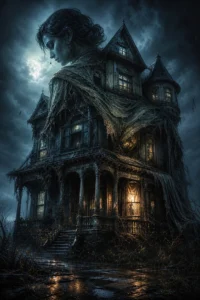
They crossed the hall in silence. The sconces along the walls had been trimmed low against the evening, and the glass panes of the windows were white with rain. Blackwater House seemed to shiver under the weather, old bones flexing in their walls. Somewhere deeper in the house, a door closed. A servant’s footsteps passed and vanished. Every sound was swallowed quickly, as if the manor itself were listening.
Lucien’s study lay at the end of the west corridor, a room she had not yet entered. He opened the door, stepped aside, and gestured her in with the barest incline of his head.
She paused on the threshold.
The study smelled of leather, tobacco gone cold, cedar, and something sharper beneath it—ink, perhaps, or the metallic scent of paper cut cleanly by a knife. Books lined one wall from floor to ceiling. Dark wood. Green lampshades. A broad desk beneath a pair of storm-lashed windows. The room felt less like a place to read than a command center for deciding other people’s fates.
“You want me in here now?” she asked.
“You have a problem with doors?”
“Only when they shut behind me in your house.”
He glanced at her once, cool and unreadable. “Then I suggest you learn to be less fascinated by things you are not meant to find.”
“You say that as though it’s a virtue.”
“In Blackwater House, it usually is.”
Before she could retort, the lights flickered.
Once. Twice.
Then the world gave a violent, breathless lurch into darkness.
The storm swallowed the house whole.
For one suspended moment, Elara heard only rain hammering the windows and the furious tick of her own pulse. Then somewhere in the depths of the manor came the soft, startled exclamation of a servant and the clatter of something dropped on stone.
Lucien swore under his breath.
A thin glow sputtered to life on the desk as he struck a match. The small flame caught the end of a black candle and he lit it with a steady hand. Another match. Another wick. Soon the room held three trembling pools of amber light, their edges trembling in the draught that threaded beneath the door.
“Power line’s down,” he said. “The generator may take a few minutes.”
Elara stared at him. “You speak of it as if the island’s drowning and you’ve misplaced a spoon.”
“If the island were drowning, I’d have greater things to worry about than a spoon.”
“Such as whether your guests survive the night?”
He looked at her across the candlelight. “You are not a guest.”
The words landed with an odd, weighty force, as though he had not meant them to sound like accusation or fact or something dangerously close to possession. Elara hated the way her skin warmed at the implication.
“Then what am I?” she asked before she could stop herself.
He did not answer at once.
The candles made hollows of his cheekbones, cut his gaze into something unreadable and severe. He removed his coat and tossed it over the back of a chair. Beneath the wet fabric, his shirt clung darkly to his shoulders and throat, collar open at the neck. He looked less like a respectable heir and more like a man who had spent the evening wrestling with weather, sin, or both.
“An inconvenience,” he said finally.
Elara laughed once, sharp as broken glass. “How honest of you.”
He stepped to the desk and began to sort through the papers there, as if she were not standing in the room at all. “You may sit, if you intend to stay.”
“And if I do not?”
“Then you’ll walk into a dark house full of unstable servants, unlit staircases, and a storm that could peel the roof off in pieces.”
“That sounded almost like concern.”
“Do not indulge yourself.”
She crossed her arms and leaned against the edge of a bookcase, refusing the chair on principle. The room was warm from the fire, but the candle flames left shadows in every corner, long and watchful. There were maps rolled in a brass stand, ledgers stacked with exacting care, a decanter of amber liquor untouched near the hearth. On one shelf stood a row of leather-bound volumes and, tucked beside them, a small silver-framed photograph turned facedown.
Elara’s gaze snagged on it.
Lucien saw the movement. Of course he did.
His hand covered the frame before she could ask.
“You hide trinkets now?” she said.
“You look in too many places.”
“And you answer too few questions.”
“You should be grateful. Answers from me tend to have unpleasant consequences.”
“For whom?”
He gave her a look that made the air between them seem to tighten. “Usually for the people foolish enough to ask them.”
Thunder cracked hard enough to make the windowpanes shudder. Elara turned instinctively toward the sound. Rain ran in white sheets across the glass, obscuring the black Atlantic beyond. The house groaned somewhere overhead.
Lucien moved to the fireplace and fed it another log. Sparks rose and died in the dark throat of the chimney. “Sit,” he said again, and this time there was something in the command beyond impatience. “You are pale.”
“You notice?”
“It’s difficult not to.”
She should have refused purely out of spite. Instead, the room’s warmth, the dim candlelight, and the bone-deep exhaustion of the day coaxed her toward the armchair near the fire. The leather was smooth and cold beneath her palms. She perched on its edge, still too angry to relax.
Lucien remained at the desk, reading one of the papers with swift, exacting focus. The silence stretched.
He is trying to make this ordinary.
It was not ordinary. Nothing in Blackwater House ever was. Even the quiet felt staged, arranged to conceal some deeper movement beneath the floorboards.
Elara watched him over the rim of a candle flame. “If you’re planning to interrogate me, at least have the decency to do it properly.”
He set the paper down. “You want procedure now?”
“I want the truth.”
“No,” he said, almost gently. “You want the sensation of uncovering it yourself.”
She frowned before she could stop it.
His mouth, for one brief and maddening second, curved faintly. “There,” he murmured. “That expression. You hate being understood.”
“You mistake irritation for intimacy.”
“Do I?”
The question sat between them with the weight of something unwise.
Elara looked away first, hating herself for it.
The candles hissed softly. Rain battered the windows. Somewhere in the house the generator coughed into life and died again. Lucien swore under his breath a second time and pressed two fingers to the bridge of his nose, weary now in a way she had not seen before. For a moment, the rigid mask of him slipped, and she saw beneath it a man under strain, sleepless and driven by something that had carved itself into his bones long ago.
“You should have let me see the corridor,” she said quietly.
His hand dropped. “No.”
“Why?”
“Because it is locked for a reason.”
“Everything in this house is locked for a reason.”
“Yes.”
“And every reason is apparently your own private secret.”
He looked at her then, really looked, with the kind of stillness that made her feel abruptly very aware of her own breathing. “You think secrecy is a game. It is not.”
“No,” she said. “I think it’s a weapon. You’re the one who keeps wielding it.”
Something flashed in his eyes—approval, perhaps, or annoyance that she had said aloud what he preferred left unnamed.
He came away from the desk and crossed the room to the window. The firelight caught the clean line of his throat as he looked out into the rain-black night. For once his back was turned to her, and the sight of it—broad shoulders, tense posture, the faint tension in every line of him—made the room feel unexpectedly intimate, as if she had stepped inside a private moment and found him unguarded within it.
It was absurd.
He was still Lucien Voss. Still the man who had stared at her with cold, assessing eyes across a marriage contract. Still the heir whose name made other men lower their voices. Still the husband who had not yet told her why he had chosen her, and yet whose silence had begun to feel less like indifference than restraint.
“What did you see?” he asked without turning.
Elara hesitated.
He heard it. “Answer me.”
“A passage,” she said. “Stone. Narrow stairs. And a portrait.”
His shoulders stilled.
“The woman in it looked like me,” she added, because she would not let him hide behind silence forever. “So unless you keep a gallery of coincidences in your house, I think I deserve an explanation.”
He turned slowly. The candlelight flattened his expression into something carved and hard.
“You should not have been there,” he said.
“That is not an explanation.”
“It is the only one you need.”
“You are insufferable.”
“And yet you keep asking.”
“Because you keep making yourself suspicious.”
He said nothing. The fire shifted with a low pop. Outside, the storm pressed harder against the house, rain dragging in silver claws across the glass. Elara caught herself watching the line of his mouth, the faint shadow at his jaw where he had not shaved cleanly, the wet sheen on his cuffs where he had not bothered to change. It was infuriating to notice details like that, let alone care about them.
“If you think I am trying to deceive you,” he said at last, “then you have every right to be angry.”
Her brows rose. “How generous.”
“But you are not entitled to every truth simply because you asked for it.”
“And you are entitled to mine?”
His gaze dropped, briefly, to her throat, where her pulse betrayed her in quick little beats. Then back to her eyes.
“No,” he said. “I am not.”
Something in her chest tightened unexpectedly. It had been easier when he was only cold. Easier when every interaction with him could be filed neatly under contempt, when she could call him cruel and mean it without complication. But this—this measured control, this careful boundary—was worse. It suggested he was not merely denying her. He was resisting her for reasons she could not yet see.
“Then why did you marry me?” she asked softly.
The question seemed to fill the room. Even the fire seemed to lower itself in response.
Lucien’s gaze did not leave hers. “Because I had to.”
“That is another non-answer.”
“It is the truth.”
“No,” she said. “It is the shape of one.”
He gave a faint exhale, one almost like a laugh, except there was nothing amused in it. “You have a talent for making every answer bleed.”
“Then stop giving me wounded things to examine.”
For a moment he looked almost tired enough to be human.
“You should go to bed,” he said.
“In the dark?”
“The generator will not fail forever.”
“And if it does?”
“Then you may spend the night here.”
She blinked. “Here?”
He looked around the study as if she had suggested he share his boots. “It is warmer than the guest wing. Safer too, if the storm worsens.”
Elara stared at him. “You want me to sleep in your study.”
“I want you to stop standing there looking as though you plan to set the house on fire out of spite.”



0 Comments