Chapter 35: The Fire He Remembers
by inkadminAdrian’s words did not leave the room after he did.
They remained behind like smoke.
Blackwater, the empire, Elara—all mine by blood.
The parlor seemed to shrink around that declaration, its velvet walls pressing inward, its gilt-framed ancestors staring down from their places above the mantel with painted eyes that had witnessed generations of beautiful lies. Rain needled the windows in silver streaks. Somewhere below, the sea struck the cliffs with a violence that made the old house tremble through its bones.
Adrian had gone through the double doors laughing softly, as if he had merely excused himself from dinner rather than split open the foundation of every secret in Blackwater House. His footsteps had faded. The servants in their dark masks had vanished from the hall as if swallowed by the paneling. Only the overturned letters remained on the carpet, scattered at Elara’s feet like dead birds.
Seraphine’s handwriting curled across one page.
He must never know whose blood runs in him. Not until the house is weak enough to be claimed.
Elara could still feel the paper beneath her fingertips. Thin. Brittle. Damning.
Across the room, Lucien stood motionless before the cold fireplace.
He had not chased Adrian. He had not called for guards. He had not reached for the gun Elara knew he wore beneath his jacket, close to his ribs like a second heartbeat. That frightened her more than rage would have.
Lucien Voss was never still unless something inside him had gone very, very quiet.
The lamplight carved hollows beneath his cheekbones. His black hair was damp from the storm, a curl clinging to his brow. One hand rested on the mantel, long fingers spread over black marble veined with white. His wedding ring caught the light.
Elara watched his reflection in the dark glass of the window.
He was looking at her.
Not directly. Never directly when the truth came too close. His gaze met hers through rain and reflection, through a pane of glass that turned them both into ghosts.
“Say something,” she said.
Her voice sounded steadier than she felt. Her heart had become an animal in a cage, flinging itself against bone.
Lucien’s fingers tightened on the mantel. “What would you like me to say?”
“That he’s lying.”
Silence.
Elara took one step toward him, the letters crackling under her heel. “Lucien.”
His eyes closed.
The small surrender of it cut deeper than any confession.
“Not about everything,” he said.
The room tilted.
Elara’s breath left her slowly, carefully, because if she let it go too fast, she might make a sound she could not take back. “Then about what?”
Lucien turned from the window. The man who faced her was the one the city feared, the one whose name made smugglers lower their voices and bankers forget their courage. Yet beneath that immaculate black suit, beneath the cold architecture of his face, there was something raw, something old, something burned until it had become almost unrecognizable.
“Adrian is Seraphine’s son,” he said. “That much is true.”
Elara’s mouth went dry.
“And Blackwater?”
His jaw flexed.
“He has Voss blood,” Lucien said. “Enough to make men listen. Enough to make old houses open doors that should remain sealed.”
“And you?”
The question struck harder than she intended. Lucien did not flinch, but his stillness changed. A blade turning in the hand.
Elara felt the answer before he gave it.
“I have worn the name,” he said, “long enough that it answers when I call.”
A coldness slid beneath her skin.
Not fear. Not exactly.
Something worse.
Recognition.
All the locked doors. The whispers that bent around him. The servants who obeyed him with devotion sharpened by terror. The chapel without a priest. The way he had never once spoken of childhood without making the word sound like an injury.
“Who are you?” she whispered.
Lucien looked at her then, truly looked, and the hunger in his eyes had nothing to do with possession. It was the desperation of a man standing on the edge of a cliff, holding out the only piece of himself he had not yet thrown into the sea.
“Come with me,” he said.
Elara laughed once, disbelieving and brittle. “No. You don’t get to do that. You don’t get to lead me down another corridor and show me another locked room and expect the walls to speak for you.”
“They will speak better than I can.”
“Try.”
His gaze dropped to the letters at her feet. Rain battered the windows harder, and for a moment the room filled with the roar of water and wind.
Then he said, “I was not born Lucien Voss.”
Elara had known. Somehow, in the instant before he spoke, she had known, but the words still landed like a fist in her chest.
“Who were you?”
A faint, humorless curve touched his mouth. “No one.”
“That is not an answer.”
“It was the answer Blackwater gave me.”
He stepped away from the mantel. Shadows moved with him. “My mother cleaned ash from the west hearths. My father loaded contraband off Voss ships until the sea took him and no one bothered to bring the body home. I slept in a room under the kitchens with six other children and learned early that rich men do not see small boys unless they need someone to blame.”
Elara’s throat tightened.
“Your name,” she said.
Lucien hesitated.
The hesitation was so small she might have missed it if she had not been watching his mouth.
“Luca,” he said. “Luca Marr.”
The name was softer than him. Younger. It sounded like bare feet on servant stairs, like stolen bread tucked under a coat, like a child whispering to himself in the dark.
Elara had to look away.
“The real Lucien?” she asked.
His face changed.
Not much. The world would not have noticed. But Elara did. She saw the grief pass through him like firelight behind black glass.
“He was eight,” Lucien said. “I was nine.”
Elara pressed one hand against the back of a chair. Its carved edge bit into her palm.
Lucien crossed to the parlor doors and opened them. The hall beyond was dim, the sconces turned low, the black-and-white marble floor gleaming with reflected stormlight. No servants waited there.
“If I tell it here,” he said, “you will think it is another story arranged for your benefit.”
“And if you take me somewhere terrible?”
His eyes returned to hers. “Then perhaps you will finally understand what made me.”
She should have refused.
Every lesson stitched into her by her mother, every caution sharpened by her father’s political dinner tables, every instinct that had survived Blackwater’s corridors told her not to follow a man who had just admitted his name was stolen.
But Elara had never been saved by obedience.
She lifted her chin. “Walk in front of me.”
Lucien’s mouth tightened, and something almost like admiration flickered in his expression. “Always.”
They left the parlor.
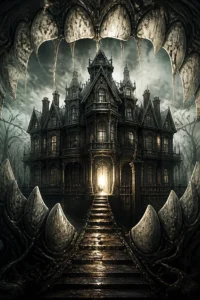
The house had changed while they spoke. Or perhaps Elara had. The familiar corridors seemed stranger now, their dark paneling slick as wet bark, their portraits less like ancestors than witnesses prepared to perjure themselves. The storm pressed against every window. Blackwater House groaned with it, pipes ticking in the walls, old beams creaking overhead, the occasional distant slam of a shutter echoing like a gunshot.
Lucien did not take her toward the grand staircase or the east wing where guests were permitted to lose themselves under chandeliers and oil paintings. He led her through a narrow servants’ passage concealed behind a tapestry of ships at war, down a flight of steps worn hollow in the center by generations of invisible feet.
The air changed.
It cooled. Dampened. The smell of polish and old flowers gave way to stone, rust, and something faintly bitter.
Elara gathered her skirt with one hand as the passage narrowed. The walls sweated. A single line of electric bulbs buzzed overhead, throwing jaundiced light over pipes and brickwork. Their footsteps sounded too loud.
“Where are we going?” she asked.
“The west wing.”
Elara stopped.
Lucien paused three steps below her but did not turn.
“The burned wing?”
“What remains of it.”
She remembered the sealed doors. The servants crossing themselves when they thought no one watched. The blackened windows visible from the cliffs like empty eye sockets.
“You told me it was unsafe.”
“It is.”
“Of course.” A laugh slipped out, too sharp. “Naturally, the truth is in the condemned part of the murder house.”
He glanced back then. For one impossible second, amusement softened him. “You married into Blackwater. We have poor habits.”
It should not have steadied her.
It did.
They continued down.
The passage ended at an iron door without a handle. Lucien removed a key from inside his jacket. It was not on his usual ring. This one hung from a thin black cord, old iron darkened by use.
“How many secrets do you carry on your body?” Elara asked.
“Fewer than I used to.”
He unlocked the door.
The hinges protested in a long, low shriek.
Cold air breathed out.
Elara smelled it at once.
Smoke.
Not fresh. Not living. A dead smell, old and soaked into stone beyond washing. Char. Wet ash. Burned wood trapped inside walls for decades.
Her skin prickled.
Lucien stepped through first.
Beyond the door, the west wing waited in ruin.
Moonless stormlight spilled through gaps where windows had been boarded and torn open again by weather. The corridor had once been elegant; Elara could see traces of it in the fractured marble, the warped wainscoting, the ceiling medallions blackened by heat. Now soot climbed the walls in wild handprints. A chandelier lay collapsed at the far end, its crystal drops melted into cloudy tears. Ferns had pushed through cracks near the outer wall, green and obscene amid the devastation.
Lucien did not look at any of it like a man seeing a ruin.
He looked like a man returning to a room where his own body had been left.
Elara followed him across the threshold.
The floor sighed beneath her weight.
“Careful,” he said immediately.
“I am.”
“Not there.” His hand caught her wrist before her foot settled on a dark plank.
The touch was quick, firm, instinctive. Beneath her shoe, the board dipped with a rotten groan.
Elara froze.
Lucien pulled her gently to the left. “Stay where I step.”
His hand remained around her wrist one heartbeat too long.
Neither of them mentioned it.
They moved through the corridor in silence. Rain came through the broken places in the roof, dripping into buckets someone had placed there long ago and forgotten. Each drop struck with a hollow metallic note. The sound followed them like a clock counting backward.
At the end of the hall stood a door, its lower half charred nearly black, its brass knob melted into a warped lump.
Lucien stopped before it.
For the first time since leaving the parlor, he seemed unable to move.
Elara stood beside him and watched the pulse beat in his throat.
“What was this room?” she asked softly.
He did not answer at once.
When he did, his voice had lost all its edges.
“The nursery.”
The word entered the burned corridor and seemed to make the house hold its breath.
Lucien pushed the door.
It opened inward with a dry scrape.
Elara expected blackness.
Instead, the room beyond was silvered by rainlight.
The outer wall had partially collapsed, exposing a view of the cliffs and the heaving Atlantic below. Vines crept over the broken stone. The remains of a painted ceiling showed clouds and cherubs half-consumed by soot. A small bed frame stood against one wall, twisted by heat. Near the hearth, a rocking horse lay on its side, one wooden eye burned away.
Something in Elara twisted painfully.
Children had been here.
Not portraits. Not names in ledgers. Children who had slept beneath painted clouds while the sea roared outside. Children who had been told monsters were not real by adults who became them.
Lucien crossed to the hearth.
There, the stones were blacker than the rest, scorched deep enough that no storm had cleansed them. He crouched and touched two fingers to the floor.
“I hid there,” he said.
Elara did not move.
“Behind the coal box. I was small enough then. The old cook had sent me up with milk because the heir wouldn’t sleep. He was afraid of thunder.”
His mouth tightened around the memory.
“The heir,” Elara said. “The real Lucien.”
Lucien nodded once.
“What was he like?”
The question seemed to strike him in an unguarded place.
He looked toward the ruined bed. Rain silvered his profile. For a moment he was not the man whose ships moved contraband beneath coast guard radar, not the husband who had threatened entire bloodlines with a murmur. He was Luca Marr, nine years old, barefoot in a room that smelled of milk and fear.
“Kind,” he said, and the word was almost accusation. “Lonely. Spoiled in the careless way of children who have never been told no, but not cruel. Never cruel.”
A muscle jumped in his cheek.
“He used to ask me questions. Where did servants sleep? Did the kitchen cat have kittens? Had I ever seen the mainland? Once, he gave me a silver button from his coat because he thought I liked it. I sold it for bread for my mother and lied to him that I had lost it. He cried for an hour because he thought his father would punish me.”
Elara swallowed.
“That night,” she said.
Lucien’s fingers curled against the burned stone.
“That night, his father was not supposed to be home.”
“Adrian’s father?”
Lucien looked at her then.
“No. Adrian’s father was never Voss by name. He was Seraphine’s lover. Her instrument. A man named Malcolm Thorne.”
Elara remembered the name from the letters, half-hidden between ink blots and rage. Thorne. A gentleman parasite at the edges of the Voss empire. A man with debts, ambitions, and a face handsome enough to open foolish doors.
“Malcolm came through the servant stairs,” Lucien said. “He knew them well. Men like that always know the hidden ways into houses they claim to despise.”
The rain intensified, hissing through the collapsed wall.
Lucien’s voice lowered.
“I heard him arguing with the governess first. Miss Ansel. She tried to keep him out. She told him the child was sleeping. He hit her so hard she struck the wardrobe and did not get up.”
Elara’s hands curled at her sides.
“Why?”
Lucien laughed once, but there was no humor in it. “Because the Voss patriarch had changed the succession papers that afternoon. He meant to name Lucien sole heir and cut Seraphine out of the shipping trust. Whatever hold she thought she had over him had failed. So Malcolm came to remove the obstacle.”
The obstacle.
An eight-year-old boy afraid of thunder.
Elara looked at the little bed frame and felt bile rise in her throat.
“He killed him here?”
Lucien did not answer.
He did not need to.
The room answered.
The charred hearth. The broken window. The rocking horse on its side.
“I was behind the coal box,” Lucien said. “I thought if I stayed still, he wouldn’t see me. Children believe stillness makes them invisible. Sometimes servants do too.”
His gaze fixed on something Elara could not see.
“Lucien woke when Malcolm dragged him out of bed. He kept asking for his nurse. He did not understand. Malcolm put one hand over his mouth.”
Lucien stopped.
The silence that followed was terrible.
Elara wanted to cross the room, to touch him, to anchor him to the present. But his body had gone rigid in a way that warned her not to startle him. He was not fully standing in the ruined nursery. Part of him was back in the smoke, knees tucked to his chest, one hand clamped over his own mouth while the world taught him what men could do.
“He saw me,” Lucien whispered.
Elara’s heart clenched.
“The boy?”
Lucien nodded.
“He saw me behind the coal box. Just for a second. He knew I was there. And he didn’t make a sound.” His eyes shone, but no tears fell. “He could have screamed my name. He could have pointed. He could have dragged me into death with him simply by being afraid. But he looked at me, and he kept quiet.”
Elara covered her mouth.
Lucien’s expression did not change, but his voice roughened.
“I think he understood before I did.”
“Lucien…”
He flinched at the name.
Not violently. Just enough.
Elara felt it like a door closing between them.
“Luca,” she said instead.
His eyes snapped to hers.
The name hung in the burned room, fragile and dangerous.
For one breath, she thought he might tell her never to say it again.
Instead, his face cracked.
Only slightly. Only enough to reveal the abyss beneath.
“Malcolm smothered him,” he said. “Then he carried him to the hearth and made it look like he had fallen. He kicked over the lamp. The curtains went first. Miss Ansel woke while the fire was spreading. She crawled. I can still hear her nails on the floor.”
Elara’s vision blurred.
“She saw you?”
“Yes.”
“Did she help you?”
Lucien’s mouth twisted. “She did more than that.”
He rose and crossed to the far wall where the nursery mural had peeled away in blistered curls. Beneath the flaking paint, a small iron panel sat hidden near the floor. Lucien knelt, pressed his thumb into a catch, and pulled it open.
Inside was a cavity no larger than a breadbox.
From it, he withdrew a bundle wrapped in oilcloth.
Elara’s pulse quickened.
He unwrapped it with hands that did not tremble, though something in him surely did.
Inside lay a child’s nightshirt, yellowed with age and darkened at one sleeve by old blood. A small silver button rested atop it, tarnished nearly black.
Elara knew before he spoke.
“The button,” she whispered.
“He had sewn it into his cuff after I told him I lost the first one,” Lucien said. “He said if anyone tried to take me away for stealing, he would prove he had given it to me.”
The tenderness of it broke something in her.
Lucien stared at the button as if it were a relic from a religion he could no longer practice.
“Miss Ansel took his signet ring,” he said. “She took the chain from his neck. She put them on me while the room burned. I tried to fight her. I thought she was punishing me. She kept saying, ‘Be him. Be him, or they will kill you too.’”
Elara imagined it too clearly: a dying governess, smoke thick as wool, fire devouring curtains, a servant boy coughing and blind while adult hands forced a dead child’s life over his head like a shroud.
“Why would they believe it?” she asked, though the answer already crawled toward her.
Lucien’s eyes lifted.
“Because the face they found was burned beyond recognition. Because no one counts servants unless they are missing silver. Because my mother died in the kitchens that same night when the lower hall collapsed. Because the patriarch wanted his heir alive more than he wanted the truth.”
Elara felt the room sway.
“The Voss patriarch knew?”
“Not at first.”
“But later?”
Lucien wrapped the nightshirt again, slowly, precisely. “Later, he knew enough.”
“And he let you keep the name?”



0 Comments