Chapter 19: The Ballroom of Knives
by inkadminThe rain had followed them to London.
It came needling down against the tinted windows of the Thorne town car, turning Mayfair into a smeared oil painting of gaslit porticos, black umbrellas, wet stone, and the slow crawl of wealth arriving in silence. Elara sat with her gloved hands folded over the black satin of her lap, the contractually provided wedding ring cold beneath the silk. Across from her, Dorian watched the city pass with the stillness of a man who expected knives from every doorway.
He had not spoken since they left the hotel.
Neither had she.
The shape of his confession still sat between them like a third passenger.
She was murdered after she betrayed me.
The words had altered the architecture of the world. Before, Dorian’s first wife had been a shadow at the edge of every room: the burned bride, the whispered scandal, the ghost servants would not name. Now she had flesh. Treachery. Blood. A death designed by hands that had understood exactly where to cut.
And Dorian, who could snap a man’s pride in half with one quiet sentence, had looked away when he spoke of her.
Elara hated that she had noticed.
She hated even more that the memory made something in her chest ache with a bitterness too soft to be anger.
The car turned through wrought-iron gates flanked by stone lions garlanded in white roses. Beyond them, Apsley House burned with light. The charity ball had taken possession of the old mansion, transforming it from aristocratic museum into a gleaming trap. Floodlights painted the columns ivory. Footmen in black coats hurried beneath umbrellas. Women glittered beneath masks feathered, jeweled, sculpted like predatory birds. Men emerged from cars with white teeth and hard eyes, their laughter too polished to belong to joy.
“Remember what I told you,” Dorian said at last.
His voice slid through the dark cabin. Low. Roughened at the edges, as if he had been silent not from indifference but restraint.
Elara did not look at him. “You told me not to speak unless spoken to, not to drink anything I don’t see poured, not to leave your sight, and not to trust anyone who smiles with both rows of teeth.”
A corner of his mouth moved. It was not quite amusement. “You were listening.”
“I listen for a living.”
“Tonight you listen to survive.”
The car slowed behind a procession of vehicles. Beyond the glass, cameras flashed behind a velvet barricade where society photographers called names with trained delight. Lord and Lady This. Countess of That. Sir Somebody in a velvet dinner jacket beside a woman young enough to be his daughter and bored enough to be his judge.
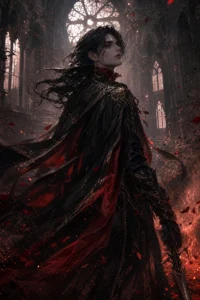
Elara turned then. Dorian wore black as if the color had been tailored around him rather than the other way around. His evening coat cut sharp across broad shoulders. His mask was simple, matte black, covering the upper half of his face and leaving his mouth unbearably visible. That mouth had issued orders, threats, bargains. It had nearly kissed her in a corridor outside a room full of death certificates, and she had not forgotten the exact space of air he had left between them.
“You forgot one rule,” she said.
His gaze fixed on hers through the mask. “Which?”
“Don’t ask questions about your dead wife.”
The air changed.
Outside, a footman opened the door of the car ahead. Laughter gusted in with wet wind, then vanished as the door closed.
Dorian’s gloved hand tightened once on the silver head of his cane. He did not need the cane. Elara had seen him move without it, swift and silent as a blade drawn in darkness. The cane was theatre. A warning. A weapon pretending at civility.
“That rule,” he said, “is for your own safety.”
“How convenient that every locked door in your life protects me.”
“Not convenient. Exhausting.”
She should have looked away. She did not. The last hour had left splinters under her skin, and his nearness pressed them deeper.
“Did you love her?”
The question escaped before caution could close its fingers around her throat.
Dorian’s face did not change, but something moved behind his eyes—a cold animal turning in its cage.
The car stopped.
For a heartbeat, rain hammered the roof like applause.
“Tonight,” he said, “you are my wife.”
Elara’s laugh was quiet and sharp. “Only tonight?”
His gaze dropped to her mouth.
It was not the look of a man caught in sentiment. It was darker than that. Hungrier. As if the word wife had teeth and had bitten them both.
“Especially tonight,” he said.
Then the door opened, and the world flooded in.
Cold rain kissed Elara’s bare shoulders before Dorian’s coat shielded her. He stepped out first, a black figure beneath the white glare of camera flashes. The calls began at once, rising like gulls over carrion.
“Lord Thorne!”
“Dorian, over here!”
“Is it true Blackwater Hall is reopening its charitable trust?”
“Lady Thorne—this way!”
Lady Thorne.
The name struck Elara between the ribs. She had signed no vows in a church, spoken no promise before God, received no blessing except the dry scratch of a solicitor’s pen and Dorian’s hard hand closing around hers in a room full of ancestral portraits. Yet the world was eager to name her. To cage her in syllables.
Dorian offered his arm.
Elara took it.
The instant her fingers settled on his sleeve, his body shifted closer. Protective, possessive, and so convincing that even Elara, who knew this marriage was a debt dressed in silk, felt the subtle heat of him through wool and glove. His hand covered hers for a moment as they climbed the rain-dark steps.
“Smile,” he murmured.
She bared her teeth.
“Less murder,” he said.
“I’m taking inspiration from my surroundings.”
His thumb moved once across her knuckles. The gesture was too fleeting for the cameras, too intimate for pretence.
Inside, the mansion opened around them in a roar of wealth.
The ballroom had been dressed like a cathedral to vanity. Chandeliers spilled tiered fire over gilt moldings and marble columns. Garlands of white orchids twisted around balconies where a string quartet played something mournful beneath the chatter. Hundreds of candles burned in glass cylinders, their flames reflected in mirrored walls until the room seemed ringed by watchful stars. The scent of lilies, champagne, hot wax, and expensive perfume pressed against Elara’s senses until the air itself felt jeweled.
Masks turned toward them.
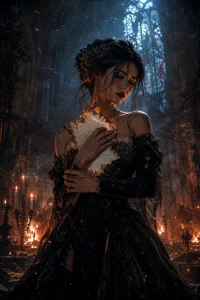
Elara felt it as a physical thing—the ripple of attention, the tightening of curiosity. Conversations thinned, altered course, resumed under cover. She saw the calculation first in the women, the hunger second in the men. They took in her dress: black satin falling from a structured bodice, the neckline severe but not demure, her throat bare except for a Thorne heirloom necklace Dorian had fastened there with hands that had not trembled. Rubies rested at her collarbone like drops of blood. They took in her hair, pinned low with antique jet combs. They took in her wedding ring.
And then, inevitably, they looked to Dorian.
Something passed through the crowd. Fear, yes. But not only fear.
Dependence.
Men who owned newspapers and banks nodded too quickly. Women with family names older than legislation smiled as if their survival depended upon his amusement. A cabinet minister in a dove-gray mask excused himself mid-sentence to make room. An art dealer paled. A viscount’s son, drunk enough to be stupid but not enough to be suicidal, lowered his gaze.
Elara had known Thorne influence was vast. She had seen its footprint in archives, its ink in trust deeds, its ghost behind land transfers and sealed inquests.
But here it breathed.
Here it wore diamonds and drank champagne and leaned toward Dorian like flowers toward a poisonous sun.
“Lord Thorne.”
A woman in silver approached, her mask a delicate sweep of filigree that failed to hide the sharpness of her eyes. She was perhaps sixty, preserved by wealth into something lacquered and immaculate. Diamonds trembled at her ears.
“Duchess,” Dorian said.
No warmth. No bow beyond the minimum required to prevent war.
The duchess turned her smile on Elara. “And this must be your bride. My dear, London has been famished for a glimpse of you.”
“How unfortunate for London,” Elara said. “I’m not very nourishing.”
The woman blinked.
Dorian’s hand tightened almost imperceptibly over Elara’s. A warning or approval; she could not tell.
The duchess laughed an instant too late. “Wit. How refreshing. Thorne men have always preferred difficult women.”
“No,” Dorian said. “We marry them. Preference is irrelevant.”
Elara shot him a sideways look.
The duchess’s smile thinned. “A charity ball is such a romantic place to debut a marriage. Or whatever one calls these modern arrangements.”
“One calls it private,” Dorian replied.
“Nothing is private tonight.” The duchess lifted her champagne. “Not with half the papers here and the other half pretending not to be. Which reminds me—Lord Ravenscar arrived early.”
Dorian went very still.
Elara felt it through his arm before she understood. The subtle locking of muscle. The chill entering his posture.
“Did he?”
“With his usual entourage. One would think grief might make him more tasteful.” The duchess leaned closer to Elara, voice lowering into false confidentiality. “Cassian has always loved an audience.”
Cassian.
The name moved through Elara like a draft under a door.
Lord Cassian Ravenscar. Dorian’s cousin, enemy, rival—too many titles for one smiling monster. The man who had appeared at Blackwater Hall with elegant hands and a voice like honey poured over broken glass. The man who knew things he should not have known about Elara’s mother. The man who had looked at Elara as if she were a document he meant to burn after reading.
Dorian’s gaze swept the ballroom.
“Where?” he asked.
“On the east side. Near the auction gallery.” The duchess sipped. “Try not to break anything valuable. The trustees become hysterical when blood touches the provenance.”
Dorian did not answer. He guided Elara away, the crowd parting without appearing to do so.
“You didn’t say Cassian would be here,” Elara murmured.
“I did not know.”
“You know everything.”
“Not everything.”
His mouth hardened, and she remembered the dead woman between them. The unanswered question. The grief he refused to name.
The ballroom swallowed them deeper. Everywhere, conversations snared at Elara as they passed.
“…Blackwater’s ports, of course…”
“…the Thorne Foundation underwrites the entire ward…”
“…old blood, older debts…”
“…her mother was nobody, wasn’t she?”
Elara’s fingers curled.
Dorian stopped so abruptly a man behind them nearly stepped into his back.
The voices died.
Slowly, Dorian turned his head toward a cluster of women near a champagne tower. They wore pastel gowns and masks shaped like butterflies, delicate creatures with predatory mouths. One of them went white beneath her powder.
“Repeat yourself,” Dorian said.
The room did not fall silent. It only pretended not to listen with such concentration that the quartet’s violins seemed indecently loud.
The woman’s lips parted. “Lord Thorne, I—”
“No.” His voice remained soft. “You had courage a moment ago. Spend the rest of it.”
Elara’s heart kicked once, hard.
She should have been embarrassed. She should have resented the way his protection wrapped around her like a chain. Instead, the savage pleasure of it warmed some neglected part of her that had spent a lifetime pretending not to care when people mistook loneliness for insignificance.
The woman’s companion intervened, breathless. “My lord, I’m sure Felicity meant no insult.”
“I am sure Felicity meant precisely what she said.” Dorian looked at Felicity until her eyes shone. “Fortunately for her, my wife has better taste in enemies.”
Elara slid her hand down his sleeve and pressed her fingers once against his wrist.
Not gratitude. Not quite restraint.
A reminder.
He looked at her then, and the edge in him shifted. Not vanished. Shifted, as fire shifts when shut behind glass.
“Come,” he said.
They moved on.
“You enjoyed that,” she whispered.
“Not nearly enough.”
“Dorian.”
“She insulted your mother.”
The words were quiet. Too quiet.
Elara looked at him sharply, but his face had turned away toward the crowd. His jaw was set.
“You don’t know what my mother was.”
“Neither do they.”
It struck harder than it should have.
For a moment Elara saw not the ballroom but a cramped flat in Bristol, unpaid bills stacked beneath a chipped mug, her mother’s name on forms and death certificates and the empty space where answers should have been. Her mother had left behind debts, mysteries, a signature on a marriage contract that had sold Elara’s future into Blackwater’s keeping. And still—still—Elara could not bear strangers making her small.
A waiter appeared with champagne. Dorian waved him away before Elara could reach.
“I can refuse my own drinks,” she said.
“You can. You won’t always see what’s in them.”
“And you will?”
“Yes.”
“That certainty must be very comfortable.”
“It is not comfort. It is practice.”
Before she could answer, a man stepped into their path with an open-armed smile and the self-assurance of someone who had never been denied a room.
“Dorian, you bastard. You made us all wait.”
He wore a gold mask that framed merry blue eyes, and his tuxedo was cut with careless perfection. Elara recognized him from photographs in old society pages: Sebastian Vale-Finch, whose family had once owned half of Cornwall and lost most of it to horses, divorces, and maritime law. No relation to Elara despite the echo of her surname; she had checked twice when his name appeared in the Blackwater correspondence.
Dorian accepted the offered handshake as if humoring a hostage. “Sebastian.”
“And Lady Thorne.” Sebastian turned to Elara with an exaggerated bow. “At last. You are the most discussed woman in three counties and one encrypted group chat.”
“Only one?” Elara said.
He grinned. “The others are less flattering but better spelled.”
“Sebastian,” Dorian warned.
“Oh, let me be charming. It’s my only remaining asset.” Sebastian plucked two glasses from a passing tray, remembered himself, and set them both back under Dorian’s stare. “Right. Poison. How provincial of me to forget.”
Elara’s brows lifted. “Does everyone know?”
“Everyone suspects everything,” Sebastian said. “Knowledge is rarer. And less fun.” His gaze flickered between them, quick despite the levity. “Ravenscar is here.”
“So I heard.”
“He brought a journalist.”
Elara’s pulse stumbled.
Dorian’s expression did not change. “Name.”
“Mara Voss.” Sebastian’s smile faded by degrees. “Investigations. Formerly The Sentinel, now freelance. Writes devastating profiles of men who deserve worse. I assumed she was yours.”
Elara kept her face still with effort.
Mara Voss.
The name was printed in black ink on the card currently tucked into the hidden seam of Elara’s glove.
Three days ago, in the village below Blackwater Hall, Elara had found a note folded inside the newspaper left outside the archive door. Not delivered by Dorian’s people. Not marked by Thorne wax. Just a plain rectangle of paper tucked into the financial pages.
If you want your mother’s story told before they bury you with it, speak to me. M.V. — Serpentine Ball, east gallery, midnight. Wear black. Bring proof.
Elara had burned the note, but not before memorizing the number written beneath it. She had sent one message from a pay phone in London while Dorian argued with his solicitor behind the hotel’s soundproof doors.
I can get names. Not tonight. Need safe channel.
The reply had come instantly.
Then give me a thread. I’ll pull quietly.
Elara had spent the afternoon stitching a sliver of paper into her glove: three initials, two dates, and the name of a chapel beneath Blackwater Hall that did not appear on any public survey. Enough to tempt a journalist. Not enough to damn Elara if intercepted.
At least, that was what she had believed.
Dorian turned slightly toward her.
Not much. Only enough for his shoulder to block Sebastian’s view.
“Do you know her?” he asked.
Elara felt the ballroom tilt. In the chandelier light, his mask made his eyes unreadable, but his voice was too even.
She had lied to him before. By omission, by deflection, by the careful arrangement of truth into harmless shapes. But now something more dangerous stood between them than suspicion.
Trust, half-formed and ugly as a newborn thing.
“By reputation,” she said.
Dorian watched her one second too long.
Sebastian, either oblivious or merciful, clapped his hands once. “Well. If a blood feud begins, try to steer it away from the silent auction. I’ve bid on a hideous sculpture for my mother.”
“Why?” Elara asked, grateful for the distraction.
“Because she hates sculpture and I hate my stepfather.” He winked. “Marriage advice, Lady Thorne: never squander an opportunity to weaponize décor.”
Dorian’s hand settled at Elara’s lower back.
The touch was light. Publicly proper. Privately ruinous.
“We are dancing,” he said.
“Are we?” Elara managed.
“Yes.”
Sebastian’s grin returned. “How ominous.”
Dorian guided her toward the floor before she could protest.
The quartet surrendered to a small orchestra hidden behind palms, and the music changed. A waltz uncurled into the ballroom, lush and old-fashioned, meant for candlelight and arranged marriages. Couples gathered under the chandeliers, silk and black wool turning in practiced circles.
Elara stopped at the edge. “I don’t know the steps.”
“You do.”
“No, I know parish registers, inheritance fraud, and how to tell when a nineteenth-century vicar forged a baptism record to cover his illegitimate nephew.”
“Useful skills. Less so here.”
“I’ll step on you.”
“I have survived worse.”
He took her hand.
The world narrowed to contact.
His palm was warm through the glove. His other hand held her waist with infuriating certainty, fingers spread over the satin as if he knew exactly how close he could draw her before propriety became something else. The first turn caught her unprepared. She stiffened; he absorbed it. The second turn found her feet. By the third, her body had begun, traitorously, to listen.
Dorian led like he commanded everything else: with precision, restraint, and the unspoken assumption that resistance would become part of the pattern. He did not drag her. He gave pressure and space, invitation and consequence. Elara followed because not following would have required making a scene, and because some small, furious part of her wanted to know what it felt like to move with him instead of against him.
It felt dangerous.

0 Comments