Chapter 30: Crown of Thorns
by inkadminThe road to Blackwater Hall had always looked less like a road than a warning.
It uncoiled along the cliff’s edge in a slick black ribbon, vanishing and reappearing through curtains of rain, hemmed in by gorse, stone walls, and the white fury of the sea below. The Rolls moved through it like a hearse that had forgotten its corpse, headlights carving pale tunnels through the downpour. Beyond the glass, the world blurred into slate and silver. Waves battered the rocks at the base of the headland with such violence that Elara could feel the impact in her teeth.
She sat in the back beside Dorian Thorne, her wet gloves folded in her lap, her fingers clenched so hard the leather creaked.
The scent of the ruined chapel still clung to her: damp stone, candle wax, incense, and beneath it all, the bitter almond ghost of poison. Sister Agnes’s voice rasped in her skull with each turn of the wheels.
Your mother was Mara Valewyn.
The name had split her open.
Mara, not Margaret. Valewyn, not Vale. Whistleblower. Infiltrator. Ferryman. A woman who had not merely abandoned her daughter, but buried her inside a false life like contraband.
And then Sister Agnes had collapsed before she could say who had betrayed her.
Elara’s gaze drifted to the rain-veiled reflection in the window. Her own face stared back at her, too pale against the black wool of Dorian’s coat draped over her shoulders. A smudge of soot marked her jaw where she had wiped at tears she refused to shed. Her hair, hastily pinned after the chaos at Saint Orla’s, had come loose in dark tendrils against her neck.
Beside her, Dorian looked untouched by weather or murder. Severe in charcoal, his profile carved by passing headlights, he held a folded paper in one gloved hand and a silver cigarette case in the other. He had not smoked. He had simply opened and closed the case twice since they left the convent ruins, a small metallic click that punctuated the silence like a blade tapping bone.
“You’re doing it again,” Elara said.
The case stilled.
“Doing what?”
“Planning someone’s funeral.”
Dorian’s mouth, that cruelly beautiful line, moved almost into a smile. Almost. “Only one?”
Elara looked at him then. “A nun was poisoned in front of us.”
“I noticed.”
“She was going to tell me who betrayed my mother.”
“I noticed that as well.”
“And you’re sitting here like—” Her voice caught, more from fury than grief. “Like this is a chessboard.”
His eyes cut to hers. In the dimness of the car they were not black, not truly, but the deep iron-gray of sea water beneath storm clouds. “It is.”
“She died.”
“Yes.” His gaze did not soften, but something beneath it shifted, old and bruised. “And if you continue believing death interrupts the game rather than advances it, you will be dead before sunrise.”
The words struck cold. She turned toward the window again, throat tight.
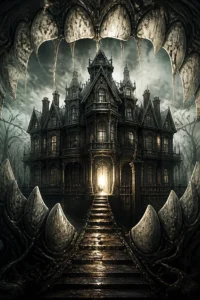
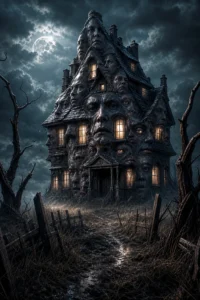
Rain streamed over the glass, turning Blackwater’s distant silhouette into a wavering monster on the cliff. Towers, chimneys, the broken crown of its roofline. Windows glowed in uneven constellations across the facade, more than usual. The Hall was awake.
Waiting.
“Why are the east windows lit?” Elara asked.
Dorian closed the cigarette case. Click. “The family council was summoned.”
She went still.
“When?”
“Before we left Saint Orla’s.”
“You summoned them while Sister Agnes was dying?”
“While you were being carried out because you had gone white enough to shame a corpse.”
“I wasn’t carried.”
“You swayed with intent.”
Despite everything, a laugh almost broke out of her. It died unborn. “Why?”
Dorian slid the folded paper into the inner pocket of his coat. “Because whoever silenced Agnes acted knowing she was with us. That means the Ferryman’s hand reaches into the church, the village, and perhaps this car.” His gaze moved briefly to the driver’s still shoulders beyond the glass partition. “I prefer my enemies assembled where I can see their teeth.”
“Family council,” she repeated. The words had a taste: iron, old wine, dust. “What does that mean?”
“It means bloodlines gather to pretend they are civilized.”
“Dorian.”
He leaned back, one arm resting along the seat behind her, not quite touching. The warmth of him was near enough to trouble the cold soaked into her bones.
“The Thornes, the Caulfields, the Veyrs, the Ashcrofts, the remaining Blackwater trustees, and the old houses still bound by charter. Those with voting blood. Those with debts. Those who have spent the last decade waiting for me to become either mad, married, or dead.”
“And which have you chosen?”
This time the smile came, faint and dangerous. “All three, if the evening becomes tedious.”
Elara looked down at her hands. The marriage ring on her finger caught a passing flare of lightning and flashed like a captured star. She had worn it as armor, shackle, accusation, lie. Lately it had begun to feel worse than any of those things: like a promise she was afraid to believe.
“Why summon them tonight?”
The car passed beneath the gatehouse arch. Iron teeth rose on either side, the Thorne crest glistening overhead—three black thorns twisted around a pale crown.
“Because I am going to seat you beside me,” Dorian said.
Elara’s breath stopped.
The Rolls slowed over gravel. Through the rain, Blackwater Hall loomed larger, its walls dark with centuries of weather, its windows blazing gold. Figures moved behind curtains. Servants or spies. At the main steps, two footmen waited beneath black umbrellas while Mrs. Hawthorne stood between them in rigid silhouette, her keys glinting at her waist.
“Seat me,” Elara said, carefully, “as your wife?”
“As my wife.”
His pause was so slight most would have missed it.
Elara did not.
“And?”
The car stopped.
Dorian turned to her fully. Rain hammered the roof. The sea roared below the cliff as if trying to claw its way inside.
“As my chosen heir.”
For a heartbeat the world narrowed to the dark space between them.
Then Elara laughed once, sharp and disbelieving. “No.”
“I wasn’t asking.”
“You never are.”
“Not when asking wastes time.”
She leaned toward him, anger flaring hot enough to burn through shock. “You cannot walk me into a nest of people who already want me dissected for my mother’s secrets and announce that I inherit your power.”
“I can.”
“Dorian.”
“I will.”
“They’ll kill me.”
His face changed.
Only slightly. Only in the tightening at the corners of his eyes, the stillness that came over him like frost sealing a lake. But the interior of the car seemed to lose several degrees.
“They were already going to kill you,” he said softly. “Now they will have to get through me in public to try.”
“That’s not protection. That’s provocation.”
“Sometimes they are the same thing.”
The footman opened the door. Rain-laden air rushed in, smelling of salt, wet earth, and the faint coal smoke of the Hall’s chimneys.
Dorian stepped out first and turned back, extending one black-gloved hand.
Elara stared at it.
Behind him, the house watched with a hundred amber eyes.
Every instinct she possessed told her to refuse him. Refuse the hand. Refuse the entrance. Refuse the crown of thorns he meant to press upon her brow. Yet Sister Agnes’s dying fingers had clutched at Elara’s sleeve. Mara Valewyn’s buried name had risen from thirty years of fear. Somewhere inside those walls, there were records, enemies, answers.
And Dorian, ruthless as a blade and twice as cold, had placed himself between her and the dark often enough that she no longer knew how to hate him cleanly.
She put her hand in his.
His fingers closed around hers, warm through the leather. Possessive. Steady.
“Chin up,” he murmured as she stepped onto the gravel. “They can smell doubt.”
“Let them choke on it.”
That earned her a glance. Something like approval flickered there.
“There she is.”
They ascended the steps together beneath a vast black umbrella. Mrs. Hawthorne bowed her head, but her eyes darted to Elara’s ring, then to Dorian’s face.
“My lord,” she said. “The council has gathered in the Long Gallery.”
“All of them?”
“All who matter.”
“And those who don’t?”
Mrs. Hawthorne’s mouth tightened. “They arrived early.”
Dorian removed his gloves one finger at a time. “Of course they did.”
Inside, Blackwater was feverishly lit. Chandeliers burned in the entrance hall, casting fractured light over black-and-white marble. The portraits of dead Thornes lining the staircase seemed stirred from their painted graves, their faces rendered crueler by candle flame. Servants moved with unnatural precision through the hall, carrying decanters, silver trays, folded cloths. No one spoke above a murmur.
The house smelled of beeswax polish, rain-damp wool, and roses beginning to rot in their vases.
Elara handed Dorian’s coat to a waiting maid and felt instantly colder without it.
“Your dress,” Mrs. Hawthorne said.
Elara looked down at herself. Her dark blue wool was travel-creased, mud-splashed at the hem, still damp from the chapel. “What about it?”
“A council seating requires formal attire.”
“The council can admire my mud.”
A muscle in Mrs. Hawthorne’s cheek betrayed either horror or amusement.
Dorian’s gaze slid over Elara, lingering just long enough at the hollow of her throat to send unwanted heat beneath her skin. “She goes as she is.”
“My lord—”
“Let them see she came from a murder.” His voice sharpened. “Let them wonder who sent her there.”
Mrs. Hawthorne bowed her head again. “As you wish.”
They crossed the entrance hall. With each step toward the east wing, the murmur grew. Voices layered over one another: refined, brittle, hungry. Men laughing without mirth. Women lowering tones around names. A glass struck wood too hard and rang like a bell.
Elara’s pulse began counting down.
At the doors to the Long Gallery, Dorian stopped.
“Listen to me.”
She looked up.
Close like this, beneath the stare of ancestral portraits, he was all shadowed angles and impossible restraint. There was a faint cut along his right cheekbone from the broken glass at the chapel, a thin red line marring the aristocratic severity of his face. She wanted, absurdly and fiercely, to touch it.
“Once we enter,” he said, “do not let go of my hand unless I release you.”
“Is that an order?”
“Yes.”
“You’re insufferable.”
“Frequently.”
“And if I let go?”
His eyes dropped to her mouth, then returned to hers. “Then every wolf in that room will know you can be separated from me.”
The anger in her faltered.
Not because he commanded. Because beneath the command lay calculation wrapped around terror so tightly it had no room to tremble.
Elara swallowed. “What aren’t you telling me?”
“Too much.”
“Dorian.”
His thumb brushed once across her knuckles. So quick she might have imagined it.
“If I fall tonight,” he said, “you take the black chair and you do not stand from it until sunrise.”
Her blood turned to ice. “If you what?”
The doors opened.
Noise spilled out, then died.
The Long Gallery stretched before them in a blaze of firelight and old gold, its walls crowded with portraits, weapons, and tapestries depicting hunts no animal had survived. Tall windows along one side showed only rain and darkness. Along the other, a line of chairs faced inward toward a massive table carved from black oak. Candles burned in iron branches, making every face look half alive, half condemned.
There were perhaps thirty people gathered, but the room felt crowded with far more than bodies. Bloodlines had weight. Old crimes had presence. Elara felt them press against her skin as every gaze turned.
She recognized some from glimpses, dossiers, overheard names.
Lady Octavia Thorne sat near the hearth in emerald silk, her silver hair coiled like a coronet, one hand resting on a cane topped with a raven’s skull. Dorian’s aunt. The sort of woman who could smile while ordering a child drowned for poor posture.
Beside her lounged Julian Veyr, blond, fox-faced, all insolent beauty and polished venom. He lifted a glass in silent greeting to Elara, his pale eyes shining.
Across from him, Miriam Ashcroft watched through a black lace veil, her gloved fingers worrying a strand of pearls. Sir Alistair Caulfield stood by the mantel, military straight despite his age, his expression carved from contempt. A handful of younger cousins clustered near the windows, whispering until Dorian’s eyes passed over them. Then they stopped breathing.
At the far end of the gallery stood the black chair.
It was not a throne. That would have been too honest. It was high-backed and severe, carved with thorns along the arms and crowned at the top by the same twisted emblem from the gatehouse. Beside it was a second chair, smaller, long unused. Dust had been wiped from it recently, but polish could not disguise abandonment.
Dorian led Elara toward them.
The room parted without being told.
She felt every stare rake over her damp dress, her mud-stained hem, the ring on her finger, the pulse beating visibly at her throat. Her mother’s name seemed to move with her through the room though no one spoke it aloud.
Mara Valewyn.
Whistleblower. Betrayer. Key.
Dorian did not stop at the table’s edge. He brought her to the black chair and turned, facing the council.
“You were summoned,” he said.
Lady Octavia’s smile unfolded slowly. “So we gathered. Though with unusual haste, nephew. One might think the house was on fire again.”
The first bride. The fire. The old accusation slipped into the air like perfume.
Elara felt Dorian’s hand tighten once around hers. His face remained unreadable.
“If I burn the house, Aunt, you will receive an invitation.”
A few startled laughs died quickly.
Octavia’s smile held. “How considerate.”
Sir Alistair Caulfield stepped forward. “We were informed this concerns the succession. If this is another theatrical attempt to remind us that you hold the charter—”
“I do hold the charter.”
“By sufferance of blood and vote.”
“By law.”
“Our law,” Alistair snapped. “Not Parliament’s. Not whatever fiction your London solicitors have spun around the matter.”
Elara watched the exchange as she might examine a parish register. Names mattered. So did tones. Alistair spoke like a man invoking rights he feared had already decayed beneath him. Octavia watched Dorian not as an aunt, but as a creditor assessing an asset. Julian Veyr watched Elara.
That was worse.
Dorian released her hand.
For one vertiginous second, she almost reached for him again.
Then he placed his palm on the back of the smaller chair.
“Sit,” he said.
The room changed temperature.
Whispers hissed to life.
Lady Octavia’s cane tapped once against the floor. “No.”
Elara did not move. Not out of obedience. Out of calculation. “Dorian.”
He looked at her.
Whatever she had meant to say lodged behind her ribs. His eyes were not asking her to be meek, not asking her to be ornamental. He was setting a blade in her hand and trusting she would cut before she bled.
Elara turned and sat in the chair beside the black one.
The uproar was immediate.
“Obscene.”
“She is not blood.”
“A contracted wife has no seat—”
“This is a council, not a bridal breakfast.”
“Remove her.”
“Try,” Dorian said.
Silence fell so violently it seemed to crack the air.
He remained standing between Elara and the room, tall and dark and terrifyingly calm.
“Elara Vale Thorne,” he said, and at the name a new current ran through the gathered families, “is my lawful wife. From this night forward, she is also named my chosen heir under the Blackwater provisions, witnessed before council and house.”
Lady Octavia rose.
It was a slow motion, aided by her cane, but no one mistook her frailty for weakness. The emerald silk whispered around her like a snake through grass.
“You cannot mean that.”
“I rarely speak by accident.”
“She is a Vale.”
Elara’s fingers curled around the thorn-carved arm of the chair.
Dorian’s voice sharpened. “Careful.”
Octavia’s eyes gleamed. “Or what? Will you forbid history from speaking? The woman’s mother was a thief, a seductress, and if rumors from Saint Orla’s are to be believed, something worse.”
Elara stood.
Dorian shifted slightly, not blocking her, but close enough that his sleeve brushed her arm.
Every face turned.
Elara’s heart hammered. Her lungs felt too tight. But the heat rising in her was not fear now.
It was inheritance.
“My mother,” she said, “is not here to answer your rumors. I am.”
Julian Veyr smiled into his glass. “How brave.”
She looked at him. “How rehearsed.”
The smile faltered for less than a second.
Good.
She turned back to Octavia. “If you have an accusation, make it properly. Names. Dates. Records. I’m told this family worships blood. Surely it can manage evidence.”
A murmur swept the gallery, different from the first. Less outrage. More interest.
Octavia’s nostrils flared.
“Evidence?” she said softly. “You sit in a chair built by men who understood that evidence is what survives after the fire. Your mother ensured very little did.”
Dorian moved.
Not much. Not enough for anyone else to read the violence in it. But Elara felt it—felt the restraint snap taut beside her.
“Say her name,” Elara said.
Octavia went still.
“You wanted to speak of my mother,” Elara continued. “Say her name.”
A log collapsed in the hearth, sending sparks up the chimney.
Octavia’s jaw tightened. Around the room, eyes darted. There were people here who had not known. People who suspected. People whose surprise was real, whose fear was not.
At last Julian set down his glass with a soft click.
“Mara Valewyn,” he said.
The name landed like a body on stone.
Someone gasped. Miriam Ashcroft crossed herself, then seemed furious with her own hand and lowered it.
Elara held Julian’s gaze. “Thank you.”


0 Comments