Chapter 2: A Monster in Black
by inkadminThe rain had not stopped since dawn.
It came down in silver sheets over the Vale estate, flattening the rose garden, drowning the gravel drive, turning the marble steps slick as bone. The old house seemed to endure it rather than shelter from it—its black slate roof gleaming beneath the storm, its tall windows lit from within like watchful eyes. Water streamed from the mouths of stone lions along the gutters and splashed into the courtyard below, where six Vale guards stood soaked through their wool coats, rifles tucked beneath their arms and eyes fixed on the iron gates.
Mara watched them from the second-floor gallery window and wondered which of them her father expected to shoot first.
The enemy.
The husband.
Or her, if she tried to run.
Behind her, the house was being prepared like a corpse for viewing.
Maids moved quickly through the halls with trays of polished silver and cut crystal. Footmen lit candles despite the early hour, coaxing weak gold from the chandeliers. Somewhere below, the housekeeper was berating a kitchen boy for dropping a platter. The sound carried up through the bones of the estate, sharp and brittle, then vanished beneath a roll of thunder.
Her father had ordered every curtain drawn back. Every portrait dusted. Every visible sign of decay hidden behind flowers or firelight.
The Vale estate had always been a theater. Today, it was dressed for surrender.
Mara rested her fingertips against the window glass. Cold bit through at once. Beyond the gates, the road twisted down through the cliffs toward Blackwater City, where the harbor lay beneath a veil of fog and the old families sharpened their smiles in private rooms. Somewhere along that road, Lucien Cross was coming.
The man who had taken three syndicates apart in a winter.
The man whose name made her father’s voice thin.
The man she had been told she would marry.
A car appeared at the bend.
Then another.
Then five more, black and low, their headlights cutting through the rain like blades.
Mara did not move.
The convoy rolled toward the gates without slowing. Even through the storm, she saw the Vale guards stiffen. One of them stepped forward, hand lifted, as if the gate itself could argue. The first car stopped inches from the ironwork. For a heartbeat, nothing happened.
Then the gates began to open.
Slowly.
Groaning.
Obedient.
Mara’s mouth curved before she could stop it.
Of course.
Her father had not merely invited the monster in. He had given him keys.
“Miss Vale.”
She did not turn.
Her maid hovered near the archway, hands folded so tightly the knuckles shone white. Elsie had been crying earlier. Her eyes were red beneath a careful application of powder, and one of the pearl pins in her cap had been placed crookedly. She looked seventeen, though she was twenty-five. In this house, fear made everyone younger.
“Your father is asking for you,” Elsie said.
Mara watched the convoy glide up the drive. The cars were immaculate despite the rain, polished black bodies swallowing the estate in their reflection. “Is he?”
“He says Mr. Cross has arrived.”
Mr. Cross.
The name was too small for the shadow it cast.
“Then it would be rude to keep him waiting.” Mara finally turned from the window. “We Vales pride ourselves on manners.”
Elsie flinched as if irony were another form of broken glass.
Mara had been dressed in mourning blue.
Her father had chosen it. Not black—black would have made her look too much like a widow, and the wedding had not happened yet. Not white—Lucien Cross would never be given the satisfaction of purity as a costume. So they had wrapped her in midnight silk instead, a gown with long sleeves, a high throat, and buttons down the spine too tiny to undo without help. The bodice fitted her like an accusation. The skirt fell soft and heavy to the floor, whispering around her ankles when she moved.
A bride presented as tribute.
A daughter packaged as peace.
Mara passed the mirror and paused only long enough to check the pins in her dark hair. She looked exactly as she had been trained to look: composed, pale, unapproachable. Her eyes were her mother’s—gray as the sea before a storm—and her mouth, according to every aunt who had ever disliked her, was too quick to be beautiful.
Good.
Let the monster find a blade under the silk.
“You do not have to go down at once,” Elsie whispered.
Mara met her reflection’s gaze. “Don’t I?”
Elsie swallowed. “I could say you were unwell.”
“I am unwell. I have been sold to a man who probably keeps a ledger of graves.”
“Miss Mara.”
There was such quiet horror in Elsie’s voice that Mara softened despite herself. She turned and crossed the room, taking the maid’s cold hands between hers.
“If I am late, my father will panic,” Mara said. “If my father panics, he will blame the nearest person beneath him. That would be you.”
Elsie looked down.
“And if Lucien Cross is half as terrible as everyone says, I would rather know the shape of the knife before it touches my throat.”
“What if he hurts you?”
Mara’s smile thinned.
“Then he will discover I hurt back.”
She let go before Elsie could answer and stepped into the corridor.
The gallery stretched long and dim, lined with portraits of dead Vales who had lied, stolen, married well, murdered quietly, and been rewarded with oil paint and gilt frames. Men with fox eyes. Women with gloved hands resting on the shoulders of children they had traded into alliances. Mara’s mother’s portrait had been removed from the gallery eleven years ago, after the night no one spoke about unless they were drunk or cruel. A pale rectangle remained where it had hung, the wallpaper beneath preserved from smoke and age.
Mara glanced at it as she passed.
Do not let them see where they cut you.
She had no memory of her mother saying those exact words. But over the years, she had built a voice out of fragments—perfume and lullabies, cold fingers fastening a necklace, blood on a white sleeve—and given it advice when no one living would.
Downstairs, the house held its breath.
The receiving hall had been transformed into a battlefield that pretended to be a parlor. Candles burned in iron sconces. A fire roared in the hearth though the air remained damp. Two long arrangements of white lilies sat on either side of the marble table, filling the hall with their heavy funeral sweetness.
Her father stood at the foot of the stairs.
Alistair Vale had aged ten years since the previous night.
He wore a charcoal suit and a silver tie, every line precise, every strand of graying hair combed back from his face. But powder could not hide the shadows beneath his eyes. His right hand trembled against the head of his cane, the old gold ring on his little finger clicking faintly against polished ebony.
Beside him stood Mara’s brothers.
Julian, the eldest, handsome and hollow-eyed, already smelling faintly of gin though noon had barely passed. He watched the front doors with the blank resignation of a man who had gambled away more than money. Theo, two years younger than Mara, leaned against a column with his arms folded and his jaw clenched, trying to look dangerous and succeeding only in looking terrified enough to bite.
Aunt Lenora had come too, all black lace and poisoned pearls, though no one had asked her. She sat near the fire with a fan in one hand, watching the proceedings as if expecting entertainment.
And everywhere—guards.
Vale men along the walls. Vale men near the doors. Vale men on the stairs behind Mara, their boots too loud against the marble.
She descended slowly.
Her father’s gaze flicked over her with the cold assessment of a merchant inspecting a delivery. Hair pinned. Dress proper. Face composed. No obvious weapons.
He should have checked her mouth.
“Mara,” he said.
“Father.”
“You will be gracious.”
“I am the soul of grace.”
His eyes hardened. “This is not a morning for your wit.”
“No? I had thought it might be all I was allowed to bring.”
Julian made a sound that might have been a laugh if it had not died so quickly.
Alistair stepped closer, lowering his voice until it became a thin blade meant only for her. “You will not provoke him.”
Mara looked past him toward the front doors, where rainwater had begun to seep beneath the threshold. “Does he startle easily?”
“He kills easily.”
There it was.
Not a warning.
A plea.
Mara turned her eyes back to her father. For a moment, she saw him not as the patriarch of the Vale dynasty, not as the man who had sent others to bleed for him, but as a frightened creature caught in machinery he had built and no longer controlled.
It should have moved her.
It did not.
“Then perhaps,” she murmured, “you should not have invited him to tea.”
The doors opened.
Wind knifed through the hall, carrying rain and the smell of wet stone, sea salt, and gasoline. The candles guttered. One of the maids gasped from somewhere behind the stairs.
Men entered first.
Not guards, Mara thought. Soldiers.
They wore black coats over dark suits, rain beading on their shoulders, eyes moving with quiet precision over windows, balconies, staircases, hands. Two took positions inside the door. Two more flanked the hall. None reached for weapons because none needed to. Violence rested on them as naturally as perfume.
Then Lucien Cross stepped into the Vale estate.
The room changed.
It was absurd, how quickly everything yielded to him. The fire seemed dimmer. The guards seemed louder in their breathing. Her father, who had ruled this house for three decades with a raised brow and a closed fist, appeared suddenly like a man standing on land that had already been purchased beneath him.
Lucien removed his gloves one finger at a time.
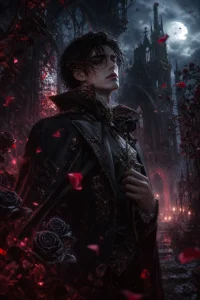
He was taller than Mara expected. Not bulky, not broad in the obvious way of hired muscle, but lean and exact, his body cut into elegant lines beneath a black tailored coat. Rain shone in his dark hair, which had been combed back but not tamed; a single strand had fallen near his temple. His face was almost indecently beautiful, not soft, never soft—high cheekbones, a straight nose, a mouth made for secrets rather than smiles. His skin held the cool undertone of winter mornings. His eyes were a shade so dark they seemed black until the fire caught them and revealed a faint, impossible blue at the edges.
Not a monster in a mask.
A monster who had learned the value of symmetry.
Behind him came a woman in a white coat.
She was perhaps forty, perhaps older, with copper hair pinned at the nape of her neck and a face that had been taught never to betray surprise. She carried a slim leather folder against her chest. Her eyes found Mara almost immediately, lingered, then moved away. Not dismissive. Measuring.
A second man followed, silver-haired and smiling with too many teeth. He wore a plum silk pocket square and looked as if he had stepped out of a velvet club at dawn after convincing three men to ruin themselves. A thin scar split his left eyebrow.
“Alistair,” he said warmly. “Still fond of lilies, I see. How funereal.”
Aunt Lenora’s fan paused.
Mara liked him immediately and trusted him not at all.
Her father’s jaw tightened. “Silas.”
“Careful,” the silver-haired man said. “You’ll make me think I’m unwelcome.”
Lucien lifted one hand slightly.
Silas fell silent.
That, more than the armed men, told Mara something worth knowing.
Alistair stepped forward. “Mr. Cross.”
“Vale.”
Lucien’s voice was low, smooth, and cold enough to make the warmth of the hall feel borrowed. He did not offer his hand.
Neither did her father.
Their civility stood between them like a corpse neither wished to acknowledge.
“You know my sons,” Alistair said. “Julian. Theodore.”
Julian gave a shallow nod. Theo held Lucien’s stare a moment too long and then looked away first. Mara saw the muscle jump in her brother’s cheek and felt a flicker of pity. Boys raised around wolves often mistook growling for strength.
“And my sister, Lenora Vale.”
“Mrs. Ashcombe,” Lucien said.
Aunt Lenora’s brows lifted above her fan. “How flattering. Most men forget the married name.”
“Most men were not named in your late husband’s will.”
Her fan snapped shut.
Silas smiled at the carpet.
Then Lucien looked at Mara.
It was not dramatic. There was no thunder at precisely that moment, no candle extinguished, no string inside her snapping with musical tragedy.
It was worse than that.
His gaze simply landed on her, and every inch of her skin became aware of itself.
Mara had been looked at all her life. Appraised by tailors, judged by matrons, evaluated by men old enough to have held her as an infant and shameless enough to discuss the worth of her hips over brandy. She had learned to let gazes slide from her like rain from glass.
Lucien Cross did not look at her as if she were beautiful.
He looked at her as if she were a locked door.
And as if he already had the key.
“Mara,” her father said, a warning tucked beneath the syllables. “This is Lucien Cross.”
She stepped off the last stair.
Lucien’s eyes did not dip to her gown, her throat, her hands. He kept them on her face. Somehow that felt more intimate.
“Mr. Cross,” she said.
“Miss Vale.”
“I would say welcome, but everyone in the room would know I was lying.”
A silence fell so hard it seemed to crack the marble.
Theo’s head jerked toward her. Julian closed his eyes. Somewhere behind Lucien, one of the Cross men shifted his weight.
Her father’s face drained of color.
Lucien did not move.
Not at first.
Then his mouth changed.
It was not a smile. Not quite. Only the faintest suggestion of amusement, a shadow touching the corner of his lips and vanishing before anyone could accuse it of warmth.
“I prefer honesty,” he said.
Mara tilted her head. “How inconvenient for a criminal.”
Silas gave a delighted cough.
The woman in white looked down at her folder as if hiding an expression.
Alistair’s cane clicked once against the floor. “Mara.”
Lucien did not look away from her. “No. Let her continue.”
His tone was soft.
The order inside it was not.
Mara felt it move through the room. Her father’s mouth shut. Her brothers stilled. Even Aunt Lenora, who could skin a bishop with etiquette, went quiet.
The power in that should have frightened her.
It did.
But fear had always sharpened her faster than comfort.
“I’m afraid I’ve spent most of my good material upstairs,” Mara said. “Had I known my future husband enjoyed insults, I would have prepared a proper welcome speech.”
“Improvisation reveals more.”
“Does it?”
“Always.”
“Then what have I revealed?”
Lucien drew one step closer.
Not enough to be improper. Enough to make the air between them feel touched.
Rain clung to the black wool of his coat. A droplet slid from his hair to his temple, then down along the clean edge of his cheek. Mara had the absurd impulse to follow it with her eyes. She refused.
“That you are angry,” he said. “That you are intelligent. That you are frightened.”
Her smile cooled. “Careful, Mr. Cross. One correct guess out of three is poor work.”
“Two,” he said.
“Which two?”
His gaze moved at last—briefly—to her right hand, where her fingers had curled against the silk of her skirt.
Mara released the fabric at once.
Lucien’s eyes returned to hers.
“You tell me.”
Heat rose in her throat, not embarrassment precisely, but fury at being seen in even that tiny way.
Her father stepped between them with the desperation of a man throwing his body over a lit fuse. “We have arranged refreshments in the east parlor. The weather has made travel unpleasant, I’m sure.”
“The weather is weather,” Lucien said.
Silas leaned toward the woman in white and murmured, “Poetry. He’s been practicing.”
Lucien’s eyes flicked sideways.
Silas straightened happily.
Alistair gestured toward the parlor. “Shall we?”
The procession moved.
That was the only word for it. No one walked naturally. Not the Vales, brittle with pride and dread. Not the Cross men, who arranged themselves like shadows near exits and windows. Not Lucien, whose every step seemed unhurried because he had already decided the outcome of every room he entered.
Mara fell into place beside her father, but before she crossed the threshold, Lucien paused.
“Miss Vale.”
She looked back.
He held out his hand.
Not palm up like a gentleman requesting the honor of escorting a lady.
Palm slightly angled. A command disguised as courtesy.
Her father’s breath caught beside her.
Mara looked at Lucien’s hand. Long fingers. Pale scars across the knuckles, nearly hidden unless one knew how to look. A signet ring on his smallest finger, black stone engraved with a cross bisecting three waves—the old Blackwater mark. The ring of a man who owned men who owned guns who owned graves.
“How traditional,” she said.
“You object to tradition?”
“Only when it expects me to be grateful while being led.”
“Then don’t be grateful.”
His hand remained between them.
Everyone watched.
Mara could refuse. She knew that. She could leave his hand hanging in the candlelight and give the room another scandal to choke on. It would be satisfying for perhaps three seconds.
Then her father would pay for it. Elsie might pay for it. Some guard with a mother in Southwater might pay for it in an alley before midnight.
This was the shape of power in Blackwater. It never struck only the person who swung.
So Mara placed her gloved hand in Lucien’s.
His fingers closed around hers.
The contact was brief, controlled, perfectly acceptable.
It hit her like stepping too close to a flame.
His hand was warm despite the rain. Strong without squeezing. He did not pull her. He did not trap her.
He simply held her as if letting go would be his decision.
Mara lifted her chin and walked beside him into the east parlor.
The room had always been her mother’s favorite.
No one said that anymore.
It faced the sea, though today the windows showed only storm and the blurred suggestion of cliffs beyond the glass. The walls were papered in faded green silk. A grand piano stood near the far corner, its lacquered surface reflecting candle flames. Shelves of old books lined the left wall, their spines cracked from generations of hands that had used knowledge mostly as decoration.
Tea had been laid out on the low table.
Delicate cups. Lemon slices. Silver tongs. Little sandwiches with the crusts cut away, as if crusts were the most offensive violence the room would be asked to host.
Lucien released Mara only when they reached the settee.
Her glove retained the shape of his touch for several seconds after.
She hated that she noticed.
The seating became its own negotiation. Her father took the armchair nearest the fire. Lucien chose the chair opposite, giving him a view of both doors and the windows. Mara sat on the settee between them because the world had a taste for symbolism and no mercy.
Silas took a chair without asking and stretched one leg out as though attending a comedy. The copper-haired woman remained standing behind Lucien’s right shoulder, folder in hand.
“Will your associates be joining us?” Alistair asked stiffly.
“No,” Lucien said.



0 Comments