Chapter 3: The Ring That Bites
by inkadminRain turned the glass roof of the Vale conservatory into a dark, trembling sea.
It fell in silver lashes over the panes, distorting the chandeliers into drowned stars and making every candle flame shiver as if the house itself were afraid. Beyond the arched windows, the gardens bowed beneath the storm—black hedges, white roses, marble saints with water streaming down their blind faces. Inside, the engagement dinner glowed gold and poisonous.
Mara Vale sat between two dynasties and felt the teeth of both at her throat.
Her father had chosen the conservatory because it made the Vale estate look soft. Romantic, even. A room for brides and champagne and expensive lies. Vines curled along iron ribs overhead. Orange trees stood in porcelain tubs, glossy leaves beaded with humidity. The air smelled of rain, wax, citrus, and roasted lamb gone cold on porcelain plates no one had the appetite to finish.
At one end of the table, Alistair Vale held court with the stillness of a man who had ordered deaths between courses and slept soundly afterward. His silver hair was combed back from his narrow face, his cufflinks were small sapphires, and his smile had been affixed for the evening like a blade tucked beneath a napkin.
At the other end sat Lucien Cross.
He had not removed his black gloves.
Mara noticed that first and hated herself for noticing anything about him. The gloves were lambskin, matte beneath the candlelight, fitted to long fingers that rested beside his untouched wineglass. He wore a charcoal suit so dark it swallowed the gleam of the room, the line of his shoulders severe, his black hair swept back with a careless precision that suggested no one living had ever been allowed to see him uncomposed.
He did not look like a groom.
He looked like the reason churches kept burial registers.
His men stood against the walls among the ferns and orange trees, silent as cutthroats in mourning clothes. Vale men stood opposite them, hands folded in front of their jackets. No one reached for a weapon. No one needed to. The entire room was a weapon—every glance honed, every courtesy loaded.
Mara lifted her glass and did not drink.
Across from her, Lucien’s eyes moved to the motion. Gray. Not pale, not silver, not the romantic nonsense poets wrote for men who ruined women in candlelit rooms. His eyes were the color of the harbor before bodies surfaced. Cold water under a low sky.
He had been watching her all evening with the patience of a man examining a locked door he already knew how to open.
“You are quiet tonight, Mara,” her father said.
The name landed like a summons.
Conversation thinned at the edges. Forks paused. A crystal glass touched the table too softly near Lucien’s right hand.
Mara turned her head and smiled at Alistair as she had been trained to do since childhood—politely, prettily, with no blood on her teeth. “I was told brides should be demure.”
Her father’s smile sharpened. “And since when have you done as you were told?”
“Since I discovered disobedience could be scheduled,” she said. “Apparently tonight is fully booked.”
Someone on the Vale side gave a strangled cough. Her cousin Elise stared into her soup as though praying to drown in it.
Alistair’s jaw worked once.
Lucien, infuriatingly, looked amused. Not in his mouth. His mouth remained a cruel, composed line. But something changed in his eyes—some minute flare, like a match struck in a crypt.
“A disciplined household,” said Gideon Cross, Lucien’s uncle, from two seats down. He was a large man with white hair and a ruby signet ring, his voice rich with old tobacco and older violence. “How refreshing.”
“We pride ourselves on it,” Alistair replied.
Mara lowered her gaze to her plate before her expression betrayed her. Discipline. In the Vale house, discipline meant locked doors without handles on the inside. It meant piano practice until her fingers bled because her mother had once played better. It meant learning to sit through strategy meetings at twelve while men discussed dowries, alliances, and revenge as though she were a porcelain vase waiting to be moved to another room.
And now she was being moved.
To Blackwater House. To Lucien Cross.
Her future husband sat opposite her beneath dripping glass and said nothing while the older men discussed peace.
Peace.
Such a graceful word for exhaustion.
The Vale-Cross feud had eaten twenty years and filled enough graves to keep Blackwater’s undertakers in silk. Dock fires. Missing shipments. Judges bought and butchered. A cousin shot through the mouth on the steps of St. Aurelia’s. A Cross lieutenant found hanging from a crane at Pier Nine, his chest carved with the Vale crest. Then the retaliations, then the retaliations for the retaliations, until the city learned to sleep through gunfire the way it slept through rain.
Now, because men eventually tired of paying for wars with sons, they had decided a daughter would be cheaper.
Mara knew her price. Her face, her blood, her last name, her womb whispered about over cognac as if it were contested territory. No one had asked if she wished to be a treaty. Treaties did not wish. They were signed.
“The harbor commission will accept the transition after the wedding,” Alistair said, slicing into his lamb. “Our shipping lanes remain under Vale oversight until the spring.”
“They remain stable,” Lucien said.
His voice altered the room.
It was low, even, almost gentle. That was the danger of it. Men like Alistair sharpened their anger so everyone saw the blade. Lucien sheathed his. You only knew he had cut you when you looked down and found yourself open.
Alistair’s knife paused. “Stable, yes. Under Vale oversight.”
“No,” Lucien said. “Stable.”
Rain hammered the glass.
Mara watched her father decide whether to make a scene. He wanted to. His fingers flexed against the knife handle, the sapphires at his cuffs flashing like cold eyes. But the conservatory held too many Cross men, and Lucien had brought not only soldiers but proof of restraint. He had arrived without pomp, without threats, without raising his voice. Men like that did not bluff in public because they preferred to kill in private.
Alistair set down the knife. “We can discuss wording later.”
“We just did,” Lucien said.
A small silence followed, delicate and vicious.
Mara almost laughed.
Lucien’s gaze cut to her, as if he had heard the laugh still unborn in her chest. The storm painted faint shadows under his cheekbones. For one irrational instant, she imagined he could hear everything she did not say. Every insult pressed behind her teeth. Every fear dragged beneath her ribs. Every furious beat of her heart chanting, Not yours. Not yours. Not yours.
Then a servant appeared at her shoulder with the next course, and the spell broke.
The dinner crawled onward.
There were oysters served on beds of black salt. There was venison with cherry glaze the color of fresh arterial blood. There were spun sugar cages over lemon custard, each delicate lattice cracked open by silver spoons while men spoke of unity, honor, and the future of Blackwater as if they had not spent years making widows of it.
Mara answered when spoken to. She kept her spine straight. She let the candlelight find the emeralds at her throat—Vale emeralds, chosen by her father, heavy enough to remind her of a collar. Her dress was ivory silk with a high neckline and sleeves that clasped at the wrists, bridal in implication, funeral in discipline. She had pinned her dark hair low, with three pearl needles that could be used, in an emergency, to puncture an eye.
She had considered this carefully during the soup course.
Lucien had noticed those too.
Of course he had.
His gaze had lingered on the pearl needles for half a breath before returning to her face. No smile. No warning. Just acknowledgment, as though he approved of a bride who came to dinner armed.
It made her want to throw a knife at him.
It made her want to ask why.
By the time the servants cleared dessert, the conservatory smelled of extinguished wicks and expensive fatigue. The orange trees breathed their bitter perfume into the damp air. Outside, thunder rolled low over the cliffs.
Then Alistair rose.
Mara’s stomach tightened.
She had been waiting for it all night, though no one had told her when it would come. The toast. The display. The symbolic clasping of hands over the corpse of choice.
Her father lifted his glass.
“Tonight,” he said, “we gather not merely as families, but as custodians of Blackwater’s future.”
Mara stared at the rain sliding down the glass beyond his shoulder and imagined it washing the whole estate into the sea.
“For too long, our houses have stood divided. Blood has answered blood. Grief has been inherited like property. But the time has come to build what our enemies believed impossible.” His gaze moved to Lucien. “An alliance.”
Lucien did not lift his glass.
Neither did Mara.
Alistair’s eyes flicked toward her. Warning, bright as a slap.
Mara raised her champagne.
“My daughter,” Alistair continued, and something in his voice softened for the room, never for her, “has always understood duty.”
Liar.
“She carries her mother’s grace and her family’s strength. In joining her life to Lucien Cross, she becomes the bridge over troubled water.”
That almost made Mara laugh again. A bridge, yes. Something men marched across. Something burned when convenient.
Gideon Cross stood next. “And my nephew honors his house by accepting this bond.”
Accepting.
As if Lucien had plucked her from a tray.
“The ring,” Gideon said.
The words fell softly.
Every Cross man in the room seemed to go still.
Mara felt it before she understood it—the subtle tightening of air, the inward draw of breath from someone behind Lucien, the way Gideon’s jovial mask thinned. Even Alistair’s expression changed, his triumph tempered by curiosity.
Lucien remained seated for one heartbeat.
Two.
Then he pushed back his chair and stood.
He moved with controlled economy, no wasted flourish, no attempt to soften what he was. The candlelight followed him as he came around the long table. Mara forced herself not to turn until he stood beside her chair, tall enough that his shadow crossed her lap.
A servant approached carrying a small lacquered box on a silver tray.
The box was old. Older than the table, older than the marriage contract upstairs in her father’s study. Black lacquer, worn at the corners, with a silver clasp tarnished almost blue. The kind of object that had been held too often by dead hands.
Lucien took it.
For the first time that evening, Mara saw a flaw in him.
It was nearly nothing. A pause before his thumb touched the clasp. A tightening at the corner of his mouth. His gloved fingers closed around the box with such precise pressure she imagined the lacquer cracking.
Then it was gone.
He opened it.
The ring inside did not glitter.
It drank.
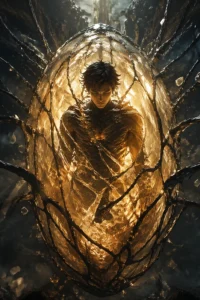
A black diamond sat at its center, oval-cut and deep as midnight water, held in a setting of old platinum vines. Smaller white stones surrounded it like frost clinging to thorns. Under the candlelight, the diamond did not catch fire the way gems were supposed to. It swallowed gold, swallowed flame, swallowed Mara’s breath.
Something cold moved down her spine.
It was beautiful.
It was terrible.
It looked less like a promise than a curse someone had polished.
Gideon’s voice carried from the far side of the table. “The Cross betrothal ring. Worn by the women who carried our name.”
Not wives. Not brides.
Women who carried.
Mara looked up at Lucien. “How heavy.”
A few of the Vale relatives shifted. Her father’s stare cut into her cheek.
Lucien’s expression did not change. “Most things worth wearing are.”
“Chains, for example.”
His eyes held hers. “Armor.”
“Coffin lids.”
That match-flare again, deep in gray water. “Only if you stop breathing.”
Mara hated the way her pulse reacted to him. Not softened. Not warmed. Reacted, the way a struck nerve reacted. She extended her left hand because everyone was watching and because refusal here would not free her. It would only give her father cause to punish someone weaker.
Lucien removed his right glove.
The intimacy of it unsettled her more than it should have. He drew the leather off finger by finger, revealing a hand pale beneath the candlelight, strong and scarred across the knuckles. A thin white line cut from the base of his thumb to his wrist, old and clean. Another scar disappeared beneath his cuff.
Mara’s gaze caught there.
Lucien noticed.
“Looking for evidence?” he murmured, low enough that only she could hear.
“Of humanity,” she said just as softly. “But scars are inconclusive.”
His bare fingers closed around hers.
Heat shot through her palm.
It was absurd. The conservatory was damp, her hands cold from untouched champagne, his skin merely skin. Yet the contact struck with humiliating force. His grip was careful, not gentle exactly—Lucien Cross did not seem built for gentleness—but precise. He held her as if measuring the fine bones of her hand and memorizing where they would break.
“Then keep looking,” he said.
He took the ring from the box.
For one second, the black diamond passed through candlelight, and something dark red flashed beneath its setting.
Mara’s breath caught.
Lucien slid the ring onto her finger.
It bit.
A sharp sting pierced the tender skin just below her knuckle. She flinched before she could stop herself.
Lucien’s fingers tightened around hers.
Applause broke over them.
Polite. Controlled. The sound of enemies striking their palms together because custom demanded it. Mara barely heard it. Her attention had narrowed to the sudden pain in her finger, the cold weight settling against her hand, and the black diamond staring up at her like an opened eye.
She looked closer.
There, beneath the central stone, caught in the delicate cage of platinum vines, was a dark crust.
Not tarnish.
Not shadow.
Blood.
Old, dried blood, almost black, tucked beneath the gemstone where no polishing cloth had reached.
For a moment the conservatory tilted.
The candles stretched tall. The rain became a hiss. Mara saw not the ring but a woman’s hand, pale and limp. A diamond dark against dead skin. Blood drying under the setting because no one had bothered—or no one had dared—to clean it.
She jerked her gaze to Lucien.
He was already watching her.
He knew she had seen.
The applause faded.
Alistair crossed the room with the satisfaction of a man admiring a locked vault. He took Mara’s shoulders and kissed the air near her cheek. “Beautiful,” he said.
She smelled cognac on his breath and the lavender soap he had used since her childhood. Beneath it, something metallic clung to her imagination.
“Yes,” she said. “It has character.”
Her father’s fingers dug once into her shoulder before he released her.
Gideon approached next, smiling broadly. “Welcome to the family, my dear.”
Mara looked at the ring. “Does it usually draw blood before the vows, or is that a special courtesy?”
The smile fell from Gideon’s face.
Only slightly. Enough.
A woman near the Cross side—a pale aunt with diamonds at her throat and fear in the hollows beneath her eyes—made the sign of the cross so quickly Mara might have missed it if she had not been watching for weakness.
Lucien stepped closer.
“The setting is old,” he said smoothly. “I’ll have it adjusted.”
“How thoughtful.” Mara lifted her hand, letting the candlelight strike the black stone. The sting had sharpened into a tiny throb. “And cleaned?”
The conservatory died.
No other word suited it. Sound did not fade; it was killed. Cut at the throat. Rain beat against the glass with sudden obscene loudness. Somewhere, a servant’s breath trembled.
Lucien’s face emptied.
It was the most frightening thing Mara had seen all evening.
Not anger. Anger she understood. Men used anger when they wanted the world to know they had been wounded. Lucien gave her nothing. No heat, no pride, no warning flare. Only a blankness so complete it felt like looking through a window into a room where something had just been murdered.
“Mara,” Alistair said quietly.
She did not look away from Lucien. “I’m only asking what any bride might ask when handed jewelry with a history.”
“History is what makes it valuable,” Gideon said, but his voice had roughened.
“Blood does have a way of appreciating,” Mara replied.
Lucien closed the lacquered box with a soft click.
The sound moved through her bones.
He leaned down until his mouth was near her ear. To the room, it might have looked like a lover’s whisper, a groom sharing some private tenderness with his bride. His breath stirred the fine hairs at her temple. He smelled of rain, cedar, and something darker beneath—smoke, perhaps, or gunmetal warmed by a hand.
“Enough,” he said.
One word.
It should not have made her pulse kick. It did.
Mara turned her face a fraction, bringing her mouth dangerously close to his cheek. “You haven’t answered me.”
“You asked in a room full of men who would prefer to survive dinner.”
“How considerate of you to protect them from a question.”
His eyes dropped briefly to her lips, then returned to her gaze with a discipline that felt like another kind of violence. “I am protecting you from the answer.”
“I didn’t ask for protection.”
“You rarely will.”
“And yet?”
“And yet,” he said, so softly the words nearly disappeared beneath thunder, “you will receive it.”
Mara’s fingers curled. The ring pinched again, a small bright pain. She welcomed it. Pain was clarifying. Pain did not pretend to be romance.
Lucien straightened.
“My bride is tired,” he said to the room.
The possessive landed before the noun did.
My bride.



0 Comments