Chapter 5: A Debt Written in Blood
by inkadminRain had a way of making Black Orchard Manor sound alive.
It moved through the gutters in a low, ceaseless whisper. It tapped skeletal fingers against the leaded windows. It slid down the black slate roof and gurgled in the mouths of stone gargoyles hunched above the eaves, pouring itself into the courtyard below like the manor was bleeding water from a hundred old wounds.
Mara lay awake in a bed too large for one body and listened to the house breathe.
The hour had gone soft and shapeless. Somewhere between midnight and dawn, when servants became shadows and even criminals slept with their sins tucked beneath their pillows. The fire in the hearth had collapsed into a bed of red eyes. Her silk nightgown clung to the backs of her knees where the air had gone damp. Beyond the windows, the orchard tossed in the storm, branches scraping glass with the persistence of fingernails.
Cassian had not come to bed.
That should have relieved her.
Instead, the empty half of the mattress seemed to accuse her.
At dinner he had sat beside her like a king carved from winter, black suit immaculate, silver ring catching candlelight as he turned the entire room against Lord Emmerich with nothing but a smile. He had defended her honor, if that was what one called drawing blood without lifting a knife. He had made the man tremble. He had made Mara feel, for one treacherous moment, like she was not alone in a room full of wolves.
Then he had brought her back to Black Orchard Manor and disappeared behind a locked door.
Protection, she had decided while unpinning diamonds from her hair, was simply another kind of ownership. A leash could be made of gold. A cage could have someone standing outside it with a gun.
She rolled onto her side and stared toward the adjoining door that connected her rooms to his. It was closed, as always. The polished brass handle gleamed faintly in the dying firelight.
On her vanity, tucked beneath a porcelain tray of hairpins and perfume bottles, lay the key she had stolen that morning.
Not to his bedroom. That would have been too simple, and Cassian Vale did not build his life out of simple things. The key belonged to his study, or so Mara had guessed after watching him use it twice from the corner of her eye. Small. Iron. Old-fashioned enough to belong to a ghost.
He wore it on a chain inside his shirt during the day.
He had removed it last night before dressing for dinner and left it for eight careless seconds on the washstand while a valet adjusted his cuffs. Eight seconds was not long. It was, however, enough for a woman who had learned forgery from copying her father’s signature before she turned twelve, and lock work from a maid who used to pick the liquor cabinet when grief made Lord Veyne unbearable.
Mara had pressed the key into a sliver of warm candle wax hidden inside her palm. Later, she had made a copy from a box of old household blanks taken from the linen room.
It was crude.
It might work.
If it did not, Cassian would know.
Her heart beat once, hard.
Then she threw back the covers.
The floorboards were cold beneath her bare feet. She dressed by touch, pulling on a dark wool dress with buttons down the front, then stockings, then the soft-soled shoes she had worn as a girl when sneaking through galleries after bedtime. She braided her hair quickly and coiled it at the nape of her neck. No jewelry. Nothing that would catch on wood or metal or betray her with a careless glimmer.
At the door, she paused and looked back at the room.
The bed was rumpled only on one side. The windows shivered. On the table beside her pillow sat the glass of water a maid had left her, untouched. The room looked like a stage set for an abandoned wife.
Mara smiled without humor.
“How tragic,” she whispered.
Then she opened the door and slipped into the hall.
Black Orchard Manor did not sleep so much as pretend to.
The corridor outside her chambers stretched long and narrow, paneled in old black oak that drank the light from the wall sconces. Portraits of dead Vales watched from their gilt frames, all pale hands and merciless eyes. Men in hunting coats. Women in high collars. Children painted with expressions too solemn for their ages, as if even the infants of this family had been born knowing where the bodies were buried.
Mara moved past them with her breath held.
The servants’ passages would have been safer, but she did not yet know their full web of turns and stairs. The main hall was dangerous, open, watched by whatever invisible system Cassian had threaded through the estate. Cameras, perhaps, though she had seen none. Men in dark suits who appeared and vanished with priestlike silence. Housekeepers with keys at their waists and faces like locked drawers.
She chose speed over certainty.
Down the west corridor. Past the long gallery where rain-streaked windows reflected her like a ghost in mourning. Down the narrow stairs that smelled of beeswax and old smoke. Across the landing where a marble statue of some Vale ancestor held a stone apple in one hand and a dagger in the other.
The study stood at the end of the north wing, behind double doors carved with branches heavy with fruit. Mara had seen Cassian enter only after dismissing everyone around him. No servant crossed that threshold without invitation. No guest had been shown near it. Even during the dinner party, when politicians and bankers had wandered drunk and curious through the lesser rooms, two of Cassian’s men had remained posted near the passage.
Tonight the hall was empty.
That made her more afraid.
Mara knelt before the lock and pulled the copied key from the hidden pocket sewn inside her sleeve. It was still rough along one edge. She slid it in with the patience of a prayer.
The key stuck halfway.
Her mouth went dry.
Somewhere far off, a pipe groaned inside the wall.
She breathed through her nose, eased the key back a fraction, tilted it, and pushed again. Metal grated. For one terrible moment she imagined the key snapping inside the lock, leaving its accusation behind.
Then the tumblers shifted.
A small, intimate click.
Mara closed her eyes.
“Thank you,” she breathed to no god in particular, and opened the door.
Cassian’s study smelled like him.
Not the expensive cologne he wore for society—the clean, dark scent of bergamot and smoke—but something deeper. Leather warmed by fire. Ink. Rain on wool. A trace of applewood ash from the hearth. The room was larger than she expected, two stories high with a wrought-iron gallery around the upper shelves. Books climbed every wall in severe black rows, their spines stamped in gold. A massive desk sat before the tall windows, its surface neat enough to look unused except for a fountain pen, a closed silver lighter, and a crystal glass holding a finger of untouched liquor.
There were no family photographs.
No trophies. No sentimental clutter.
Only books, locked cabinets, ledgers, and a map of the coast pinned behind glass with a series of black and red markers stabbed into different harbors.
Mara shut the door behind her and stood very still, listening.
The rain hid small sounds but not large ones. No footsteps. No voices. No dogs.
She crossed to the desk first.
The drawers were locked.
Of course they were.
She almost laughed. Cassian probably locked his nightmares before sleeping.
From her pocket she withdrew a narrow strip of metal shaved from a corset busk. It had taken her half an hour to file it properly with a stolen nail tool, and even now it was inelegant, but inelegance had opened more doors in history than beauty ever had.
The top drawer yielded after three minutes and a scrape that made her pulse jump. Inside lay stationery embossed with the Vale crest, sealed envelopes, a stack of black calling cards, and a pistol.
Mara stared at it.
It rested on dark velvet as casually as another man might store a letter opener. Compact, matte black, ugly in its efficiency. Beside it sat a spare magazine.
She did not touch it.
The second drawer held files arranged by name. Politicians. Judges. Shipping companies. Charities. Names she knew from newspapers and names she knew from whispers at Veyne House, men who had kissed her father’s rings and women who had smiled too widely over champagne.
The third drawer was empty except for a small ivory-handled knife and a child’s red ribbon.
Mara’s fingers hovered over the ribbon.
It was faded, the satin fraying at one end. A thing kept not for utility, but because memory had teeth.
She left it there.
The cabinets along the wall were worse. Each one locked. Each one labeled only by a number etched discreetly into brass: I, II, III, IV. She chose the fourth because it bore more scratches around the keyhole than the others, as if used often by hands that did not always have time for gentleness.
It opened too easily.
That frightened her more than resistance would have.
Inside were ledgers.
Not modern binders. Not tablets or encrypted drives. Thick leather-bound books with gilt edges and ribbon markers, the sort of old-world accounting relics men used when they believed paper could outlive servers and silence could be purchased by the pound.
Mara lifted the first one down.
It was heavier than it looked.
She carried it to the desk, opened it beneath the green-shaded lamp, and began to read.
At first it looked like business. Dates. Initials. Amounts. Vessel names. Port codes. Offshore accounts listed under shell corporations with innocuous names: Halcyon Imports, Saint Brigid Holdings, North Lantern Trust. Columns of numbers moved across the page in a disciplined march.
Her father had ledgers like this. Veyne Maritime had been built on columns. Cargo. Insurance. Docking fees. Fuel. Men like Lord Veyne liked numbers because numbers did not cry when ruined.
Then she saw the first name.
Elise Harrow. 19. Transferred: Asterion route. Payment cleared through NLT. V.M. authorization.
Mara stopped breathing.
She bent closer.
The entry was written in a clean, narrow hand she did not recognize. The ink had browned slightly with age. The date was seven years ago.
Below it:
Lena Ortiz. 22. No family claim. Medical complete. Shipment delay due to inspection. V.M. authorization.
And below that:
Sabine Cole. 17. Document correction required. V.M. authorization.
Her stomach turned cold.
Not cargo.
Women.
Girls.
Mara flipped the page, then another, then another. Names swam beneath the lamplight. Some had ages beside them. Some had descriptions in a shorthand cruel enough to be efficient. Blonde. Scar left knee. Pregnant? Check. Others had initials in place of full names, as if by abbreviating a person one could abbreviate the sin.
V.M. appeared again and again.
Veyne Maritime.
Her father’s company.
The room tilted.
Mara gripped the edge of the desk until the carved wood bit into her palms.
No. No, there had to be another explanation. V.M. could be anything. Vale Management. Vessel Manifest. Vicious Men. She almost laughed, but the sound lodged in her throat like broken glass.
She turned back to the index.
There were account numbers tied to banks in the Caymans, Malta, Singapore. There were percentages marked beside initials: V.M. 30, V.F. 25, O.C. 15, “Garden” 10. The Vale family had its own column, marked not as a buyer or seller, but as something worse.
Security. Collection. Disposal.
Mara’s fingers shook as she reached for the next ledger.
This one was newer.
The handwriting changed halfway through, the older script giving way to sharper lines, darker ink. Cassian’s hand, perhaps. She had seen it on the marriage contract: elegant, controlled, every letter like a blade laid flat.
The entries shifted, too.
Less movement. More cancellations. Names crossed out. Accounts frozen. Payments rerouted into what looked like dummy charities and legal funds. Beside several entries, a single word appeared in Cassian’s handwriting.
RETRIEVED.
Not sold. Not transferred.
Retrieved.
Mara’s pulse beat hard in her throat.
She turned pages faster now, dread and hope tangling so tightly she could not separate them. Some names were marked with locations. Safe houses? Clinics? Cemeteries? One page listed settlements paid to families under false accident claims. Another listed “orchard burials” with dates stretching back decades.
Her hand froze.
Orchard burials.
She thought of the apple trees outside, black branches tossing in the rain. Of whispers at boarding school. Of Cassian Vale, who buried enemies beneath the fruit trees.
The dead fed the orchard. That was what people said.
She had assumed it was myth.
Black Orchard Manor did not seem like the sort of place where myths bothered remaining untrue.
On the final page of the second ledger, a folded paper had been tucked between the leaves. Mara slid it free.
It was a photocopy of an old police report.
The heading blurred at first because her eyes refused to focus. She forced herself to read.
Incident: Vehicle fire. Coastal Road 9. Deceased: Isolde Veyne. Surviving minor: Mara Veyne, age eight. Possible witness statement incomplete due to shock.
The lamp hummed faintly.
Rain struck the window like thrown sand.
Mara stared at her mother’s name until it became ink and nothing more.
There was a note in the margin.
Not from the police. Written in the same sharp hand.
She was not meant to be in the car. Find out who changed the route.
The study door opened behind her.
Mara did not scream.
She went still so completely that even her terror seemed to hold its breath.
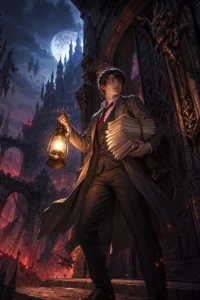
Cassian stood in the doorway wearing a white shirt open at the throat, black trousers, and no coat. Rain darkened his hair, curling it slightly at the ends, and water clung to the sharp line of his jaw. He looked as if he had walked out of the storm fully formed, a man made of night and discipline and terrible patience.
His eyes went to the open cabinet. The ledgers. The police report in her hand.
Then to her face.
The silence that followed was not empty. It was crowded with every weapon in the room.
Mara’s fingers tightened around the paper.
“You should oil your locks,” she said. Her voice came out lower than she expected. “They’re embarrassing.”
Cassian closed the door behind him.
The click was soft.
Final.
“I will tell the housekeeper to add it to the list,” he said.
He did not move toward her. That was almost worse. He remained by the door, one hand resting at his side, rainwater slipping from his hair onto the collar of his shirt. His sleeves were rolled to his forearms, exposing lean muscle and a small scar near his wrist shaped like a crescent moon.
Mara kept the desk between them.
“Are you going to call your men?”
“No.”
“Threaten me?”
“Would it help?”
“It would be predictable.”
His mouth curved, but there was no amusement in it. “I try not to bore you.”
Her laugh came out brittle. “How considerate of my captor.”
Something moved across his face, too quick to name. Annoyance. Pain. Hunger. It vanished before she could seize it.
“If I were your captor,” he said, “you would not have made it past your bedroom door.”
“And yet here I am, locked in your house, married under duress, finding ledgers full of missing women and my father’s initials.” Mara lifted the police report. “So forgive me if the distinction feels academic.”
Cassian’s gaze dropped to the paper.
The room seemed to darken around him.
“Put that down.”
There it was. The command beneath the velvet.
Mara’s fear sharpened into something cleaner. Anger. She knew what to do with anger. It fit her hand better than terror.
“No.”
His eyes returned to hers.
“Mara.”
Her name in his mouth was not a plea. It was a warning wrapped around an ache.
“No,” she repeated. “You don’t get to have this in your drawer and tell me to put it down like I’ve touched your private correspondence. This is my mother.”
“I know.”
“Do you?” She stepped around the desk before she could stop herself, the report crumpling slightly in her grip. “Did you know her? Did your family put her name in a ledger too? Was she a shipment? A disposal? An orchard burial?”
“Do not say that.”
“Why? Does it offend your family’s branding?”
He crossed the room then.
Not fast. Not lunging. But the space between them vanished with frightening economy, and suddenly he was on the other side of the desk, close enough that she could see the rain caught in his lashes.
Mara refused to step back.
Cassian reached for the report.
She jerked it away.
His hand stopped midair. Long fingers. Clean nails. No rings tonight except the black band on his right hand and the wedding ring she had not once seen him remove.
“I am not going to take it from you,” he said.
“Then what are you doing?”
“Trying very hard,” he said softly, “not to frighten you more than I already have.”
The honesty of it struck like an unexpected slap.
Mara hated that it worked. Hated that something in her chest faltered because he looked, for the first time since she had met him, not invincible but restrained. Not a wolf at the door, but a wolf holding itself back from the lamb with blood already in its mouth.
She looked away first and cursed herself for it.
The ledger lay open on the desk, accusing them both.
“V.M. authorization,” she said. “Over and over. That’s Veyne Maritime.”
“Yes.”
The answer was so immediate she almost missed it.
She looked at him again. “You don’t deny it?”
“No.”
“My father trafficked women.”
Cassian said nothing.
The silence was answer enough.
Mara’s knees threatened to loosen. She locked them. “And your family?”
His jaw tightened.
“My grandfather built the roads they moved along,” he said. “My father guarded the gates. Men like your father wore white gloves and signed papers in private clubs. Men like mine made sure no one talked afterward.”
The words fell between them like stones dropped into a grave.
Mara heard her own breathing, too shallow, too loud.
“And you?”
Cassian’s eyes did not leave hers. “I inherited the gates.”
“That isn’t an answer.”
“No,” he said. “It is not.”
She searched his face for guilt and found something older, something more corroded than remorse. “The entries changed,” she said. “Your handwriting starts here.” She touched the ledger without looking away from him. “Retrieved. Frozen. Settled. You stopped some of it.”
“Some.”
“How noble.”
“There is nothing noble in arriving late to a fire and saving only the people who can still scream.”
The image burrowed under her skin.
Fire.
A road at night.
The smell of petrol.
For a second the study vanished.
She was small again, or felt small, strapped into the back seat of a car that was not moving properly. Her mother’s hair had come loose from its pins. There had been rain then too, rain silvering the windshield, rain in the headlights. Isolde Veyne’s hand reaching back between the seats, elegant fingers slick with blood.
Don’t look, little fox.
Mara blinked hard.
The study returned. Cassian’s face had gone very still.
“What did you just remember?” he asked.
Her skin prickled.
“Nothing.”
“That was not nothing.”
“You don’t get to interrogate me.”
“I am not interrogating you.”
“Then what would you call cornering your wife in the middle of the night after she found evidence of human trafficking in your study?”
“Trying to keep her alive.”
Her laugh was a small, ugly thing. “How many times do you rehearse these lines? Do you practice them in the mirror? I’m dangerous, Mara, but only because the world is worse. Is that it?”
His eyes flashed. “The world is worse.”
“So you keep telling me.”
“Because you do not listen.”
“Because you do not explain.”
“Explanations are leverage in this house.”
“Then consider me well armed.” She held up the report. “Start talking.”
For a moment she thought he might refuse. Cassian Vale seemed built from refusals. Refusal to soften. Refusal to confess. Refusal to be anything but the shape the world had carved for him.
But then he looked toward the window, where rain blurred the orchard into black veins against the glass.
“Your mother found out,” he said.
Mara felt the words before she understood them. “Found out what?”
“That Veyne Maritime was not merely laundering money. That ships under your father’s flag moved girls through private ports. Some were runaways. Some were debt collateral. Some were taken from families who were told they had drowned, overdosed, vanished with lovers. Your mother began copying records.”
Mara’s fingers went numb around the paper.
“No.”
“She sent pieces to my mother.”
That landed strangely, a door opening onto a room Mara had not known existed.
“Your mother?”
“Seraphine Vale.”
The name had the weight of a legend. Mara had heard it in fragments: Cassian’s mother, dead before he turned twenty; a beautiful woman who had thrown herself from the east tower, or taken poison, or been murdered by her husband depending on who had drunk enough to speak. The Vales bred rumors the way the orchard bred rot.
“Why would my mother trust yours?”
Cassian’s expression shuttered. “Because they were friends before they became wives.”
Mara stared at him.


0 Comments