Chapter 1: The Bride Wore Ash
by inkadminOn the morning of her wedding, Seraphina Vale hid a knife beneath her dress and promised herself she would not fall in love with the man she had come to destroy.
The blade was small enough to disappear against her thigh and sharp enough to open a throat if she found the right angle. It had belonged to her father once, back when he still had steady hands and a laugh that could fill the cold rooms of their rented flat. A restorer’s knife, he had called it, meant for scraping centuries of grime from saints’ faces and teasing gold leaf from the jaws of angels. Seraphina had used it to pare rot from cathedral beams, lift old varnish from painted eyes, and carve her initials into the underside of the worktable where she and her sister had once shared oranges stolen from the market.
Now she used a length of ivory ribbon to secure it beneath layers of silk, lace, and tulle.
The garter sat high on her left thigh. The knife lay flat against her skin, warmed quickly by her body, its presence both comfort and accusation. If she moved too fast, the hilt kissed her flesh. If she breathed too deeply, she felt the pressure of it reminding her that she had not come here as a sacrifice.
She had come as a blade.
Outside the bridal chamber, bells began to toll.
The sound rolled through the old cathedral like thunder trapped in stone. It trembled through the carved saints along the walls, rattled the narrow panes of stained glass, and stirred dust from rafters darkened by five hundred years of candle smoke. Seraphina knew every inch of this cathedral. She had spent three years restoring its wounded beauty, climbing scaffolds before dawn, cleaning soot from the wings of archangels, mending cracked halos with breath held between her teeth. She knew where the north transept floor dipped near the memorial tombs. She knew which gargoyle wore the face of a bishop’s mistress. She knew where the choir screen had been burned during the Reformation and later painted over to hide the scars.
She had not imagined she would be married beneath it.
Her reflection waited in the tall cheval mirror, pale and still as a saint sealed behind glass.
The gown had been chosen by the Blackthornes.
Of course it had.
Nothing about this day belonged to her except the knife.
The dress was a masterpiece of cruel elegance: ivory silk cut close through the bodice, with sleeves of gossamer lace that clung to her wrists like frost. The skirt fell in heavy, fluid folds, embroidered with thorned vines in thread so pale it could only be seen when the light touched it at an angle. White roses crowned her dark hair, woven into a veil fine enough to blur the world without concealing it. Around her throat rested no jewels, only a narrow ribbon of pearls that felt unsettlingly like a collar.
Seraphina lifted her chin.
The woman in the mirror looked obedient. Beautiful, perhaps. Breakable, certainly. Her mouth had been painted a soft rose, her cheekbones brushed with warmth, her lashes darkened until her gray eyes appeared larger than usual. The effect was devastatingly delicate.
A lie well crafted was still a lie.
Behind her, Aunt Miriam drew in a trembling breath.
“You look like your mother,” she whispered.
Seraphina looked away from the mirror before the words could wound her.
Miriam Vale stood near the dressing table with both gloved hands clenched around a handkerchief. She was a small woman, all sharp bones and black wool, her face hollowed by grief and bad weather. She had raised Seraphina and Isolde after their mother died, feeding them soup stretched thin with water, brushing their hair before school, teaching them that men with old names always wanted payment in blood or silence.
Today, Miriam had said very little.
Her fear had done the speaking.
“Don’t,” Seraphina said softly.
“Don’t what?”
“Look at me as if I’m being buried.”
Miriam’s mouth tightened. “You are marrying into Blackthorne Hall.”
“That is not the same thing.”
“Isn’t it?”
The bells tolled again, deeper this time, as if the cathedral itself had decided to answer.
Seraphina crossed the room and took Miriam’s cold hands in hers. The lace at her wrists whispered. The bouquet waited on the table beside them, twelve white roses bound with silver ribbon. Their petals were perfect, waxy and scentless, like flowers arranged for a corpse.
“I know what I’m doing,” Seraphina said.
Miriam’s eyes searched her face with a desperation that made Seraphina’s chest ache. “That frightens me more.”
Neither of them said Isolde’s name.
It stood between them anyway, vivid as blood on snow.
Isolde Vale, with her wild copper hair and laugh like church bells on a feast day. Isolde, who had loved danger because danger had the courtesy to admit what it was. Isolde, who had vanished eleven months ago from a charity gala at Blackthorne Hall, last seen descending the west stairs with a man no one could agree on seeing. Some said she had left drunk with a banker from London. Some said she had gone out to the cliffs to smoke and fallen. Some said, very softly and never twice, that Lucian Blackthorne had fastened his signet on a chain around her throat that night.
The police found her coat on the rocks below the estate.
They did not find her body.
Seraphina had not believed in death without proof. Not for Isolde. Not when her sister had once picked three locks before breakfast because she hated being told any door was not for her.
But then the letter had arrived.
Heavy cream paper. Black wax. A proposal written like a legal summons. Lord Edmund Blackthorne, the dying patriarch of a dynasty that owned half the coastline and the debts of the other half, had chosen Seraphina Vale as bride for his only son. There had been no courting. No request. Merely terms. Her aunt’s house would be spared seizure. Her father’s old debts would vanish. The cathedral restoration fund would receive enough money to save the south nave from collapse.
And Seraphina would become Mrs. Lucian Blackthorne.
A punishment. A bargain. An opening.
She had accepted within the hour.
Miriam had wept for three days.
Seraphina had not wept at all.
“If something happens,” Miriam whispered, her fingers tightening until Seraphina’s bones pressed together, “if you need to leave, you run. You don’t think about the money. You don’t think about me. You understand?”
Seraphina smiled, and because she had practiced it in mirrors, it did not break. “I will send word as soon as I arrive.”
“That wasn’t what I asked.”
“It is what I can promise.”
Miriam closed her eyes.
A knock came at the door.
Both women turned.
The handle moved without waiting for permission, and Mrs. Finch entered in a wash of lavender perfume and black silk. She had been sent by the Blackthornes three days ago, ostensibly to assist with arrangements. In reality, she had watched Seraphina with the chilly diligence of a gaoler inspecting a condemned prisoner. She was a severe woman in her late fifties, with iron-gray hair pinned so tightly it seemed to pull her brows toward disapproval.
“It is time,” Mrs. Finch said.
Her gaze flicked over Seraphina from veil to hem. Nothing in her expression changed, but Seraphina caught the brief pause at her left hip, the faint narrowing of eyes. Too observant. Too trained.
Seraphina let one hand drift casually to her bouquet.
“Does Mr. Blackthorne often keep such exact time?” she asked.
“Mr. Blackthorne does not like to be kept waiting.”
“How fortunate for him that the whole world is so eager to obey.”
Miriam made a small sound of warning.
Mrs. Finch’s lips thinned. “Wit is charming in a girl. Less so in a wife.”
Seraphina lifted the bouquet and inhaled the roses’ empty perfume. “Then I shall endeavor to become very dull.”
For the first time, something like interest disturbed Mrs. Finch’s face. Not approval. Never that. But recognition, perhaps, of a creature with teeth.
“See that you do,” she said. “The Blackthorne family pew is full.”
As if Seraphina might have forgotten she was marrying before enemies.
The corridor outside the bridal room was narrow and stone-cold. Two cathedral attendants waited beneath a flickering sconce, both boys trying very hard not to stare. Seraphina moved past them with her veil drifting behind her like smoke. Her shoes made almost no sound. The knife remained hidden. Her heart, traitorous thing, beat hard enough to bruise.
They descended the spiral stair from the clergy chambers toward the nave. The air grew colder with every step. Old stone breathed damp into her lungs. Incense unfurled below, sweet and choking, mingled with beeswax, rain-soaked wool, rose stems, and the mineral scent of ancient walls.
The storm had begun before dawn.
Rain slashed against the cathedral windows, turning the stained-glass saints into weeping smears of ruby, sapphire, and gold. Wind pressed at the western doors like a living thing demanding entry. Somewhere high above, in the ribs of the roof, a loose chain struck stone with a slow, irregular chime.
At the foot of the stairs, the great nave opened before her.
Seraphina stopped.
For one moment, the cathedral she knew became strange.
Every pew was full.
Politicians in dark suits sat beside old families wearing pearls and mourning diamonds. Reporters lined the rear beneath the watch of Blackthorne security, their cameras held low but ready. Villagers from Ashcombe filled the side aisles, faces tight with curiosity and superstition. Some had come to watch a fairytale. Others had come to witness an execution.
And at the front, beneath the pale gaze of the restored Madonna, stood Lucian Blackthorne.
Seraphina had seen photographs, of course.
Newspapers adored him in the hungry way they adored ruined men with good bone structure and inherited violence. They called him the Iron Heir. The Last Blackthorne Prince. The young magnate who had taken a collapsing family estate and transformed its debts into weapons. Grainy images showed him outside courtrooms, charity galas, corporate acquisitions, funerals where he never smiled. Yet none of those photographs had prepared her for the stillness of him.
Lucian stood as if the world had been built around his refusal to move.
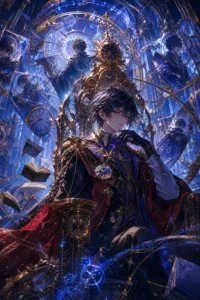
He wore black. Not charcoal, not midnight, but a dense, immaculate black that swallowed the candlelight. His morning coat fit the breadth of his shoulders with dangerous precision. A white rose marked his lapel, the only softness on him, and even that looked less like a flower than a threat. His hair was black too, swept back from a face carved in hard planes: high cheekbones, straight nose, mouth severe enough to be cruel before it ever spoke. But his eyes held her.
They were not black, as rumor claimed.
They were a gray so dark they seemed cut from storm clouds over deep water.
He looked at Seraphina as though he had been expecting not a bride, but an adversary.
A murmur moved through the cathedral.
Mrs. Finch touched Seraphina’s elbow. “Miss Vale.”
Seraphina realized she had not moved.
The organ began.
The first notes rose from the pipes with magnificent sorrow, shaking dust from the vaulted ceiling. All around her, people stood. Hundreds of eyes turned toward the woman in white at the end of the aisle. Seraphina tightened her grip around the bouquet until a thorn pierced the ribbon and bit into her palm.
Pain steadied her.
She stepped forward.
The long aisle had never seemed so long when she crossed it in work boots with plaster dust in her hair. Now every flagstone became an accusation. She passed beneath arches she had cleaned with her own hands, beneath saints whose cracked faces she had restored while thinking of Isolde. St. Agnes watched her with lamb-soft pity. St. Catherine held her wheel of knives. St. Michael stood above the rood screen with sword uplifted, forever seconds from judgment.
I am not afraid.
The thought rang false.
She was afraid.
Only fools and corpses felt nothing at the edge of a precipice. Seraphina’s fear lived bright in her blood, sharpening every detail. The whisper of silk against her knees. The wet gleam of umbrellas collapsed near the entrance. The flash of a camera quickly hidden. The scent of lilies too sweet beside an old woman’s medicinal lavender. Lucian’s gaze, unblinking, tracking every step as if he could hear the knife under her skirts.
Halfway down the aisle, she saw Lord Edmund Blackthorne.
He sat in a wheeled chair in the front family pew, a tartan blanket over his knees despite the cathedral’s formal warmth. Illness had hollowed him into an elegant corpse that had not yet received instructions to lie down. His skin clung yellow-white to his skull. His silver hair shone. A signet ring massive as a small relic weighed down one hand.
Beside him sat a woman in garnet silk.
Vivienne Blackthorne.
Lucian’s stepmother.
She was too young for Lord Edmund and too beautiful to have made that mistake accidentally. Red hair gleamed beneath a small black hat. Her mouth curved when she saw Seraphina looking, a smile delicate and venomous. On her throat rested a diamond collar that flashed like ice.
Behind them, a row of Blackthorne relations sat in predatory silence: cousins with foxlike faces, aunts wrapped in fur, men with the polished emptiness of knives kept in velvet-lined drawers. Not one of them smiled.
Good, Seraphina thought.
Smiles made lies harder to count.
Near the front, she found one face that did not belong.
A young man leaned against the end of a pew rather than sitting properly, his blond hair falling into eyes too bright for the solemnity of the occasion. He wore the Blackthorne black, but badly, as if formality offended him. When Seraphina’s gaze passed over him, he gave the faintest bow, almost mocking.
Adrian Blackthorne. Lucian’s cousin. Gambler, disgrace, favorite of gossip columns, and according to one of Seraphina’s paid sources, the last person known to have argued with Isolde before she vanished.
Her grip tightened again.
Blood welled beneath the rose thorn in her palm.
Then she reached Lucian.
The organ softened into a trembling chord.
The vicar waited beneath the carved screen, his prayer book open, his face pale and shining with sweat. He had christened Seraphina in a smaller church twenty-six years ago. Now he would sell her to the Blackthornes with scripture and trembling hands.
There was no father to give her away. No brother. No one claimed that right.
Lucian stepped forward.
He offered his hand.
Seraphina looked down at it. Long fingers. Pale scars across the knuckles. The signet ring on his right hand was not Lord Edmund’s heavy ancestral seal but a darker piece: black onyx set with a thorned B in silver. Isolde had worn a ring like that on a chain, according to the girl from the coat check who had wept while saying it.
Seraphina placed her gloved hand in his.
His fingers closed around hers.
Not tenderly.
Possessively.
Heat moved through the thin satin of her glove, shocking in the cold cathedral. Lucian leaned the slightest fraction closer. To everyone watching, it might have appeared like gallantry, a groom steadying his bride. His breath brushed the edge of her veil.
“Careful,” he murmured.
His voice was low enough that only she could hear it, smooth as polished stone dragged over velvet.
Seraphina did not move.
Lucian’s thumb pressed once against the pulse in her wrist.
“Knives are difficult to reach beneath all that silk.”
The world narrowed.
The organ. The rain. The waiting cathedral. All of it fell back from the sharp, impossible edge of his words.
He knew.
Seraphina lifted her face to his.
Behind the veil, her mouth softened into the shy curve expected of a bride. Her heart slammed once, hard. Then again.
“That depends,” she whispered, “on how badly I need it.”
Something flickered in Lucian’s eyes.
It might have been amusement.
It might have been warning.
The vicar cleared his throat. “Dearly beloved, we are gathered here today in the sight of God…”
Lucian did not look away from her.
Neither did Seraphina.
The ceremony began as a thing of incense and iron.
Words rose around them, ancient and familiar. Marriage. Covenant. Flesh. Faithfulness. Death. The cathedral swallowed them and gave them back with echoes, layering sanctity over transaction until the difference became difficult to hear.
Seraphina had restored the painted border above the altar herself. Tiny roses twined through Latin prayers, their petals faded by smoke and time. She remembered standing on scaffolding at midnight, alone but for Isolde sprawled below with a thermos of coffee, reading scandalous passages from restoration records in a priestly voice.
“Listen to this,” Isolde had said, laughter bright in the hush. “In 1843, a mason claimed the Blackthornes paid him to seal a screaming woman behind the chapel wall.”
“That is not in the official records.”
“That is because official records are where truth goes to be strangled.”
Seraphina had looked down, smiling despite herself. “You spend too much time with dead gossip.”
“Dead gossip is the only kind old families can’t sue for.”
A memory, and then gone.



0 Comments