Chapter 2: Blackthorne Hall
by inkadminThe rain began before the carriage left the city.
It worried at the windows like fingernails, first in scattered taps, then in long silver lashes that blurred the world beyond the glass into lamps, iron railings, wet stone, and the smeared ghosts of faces watching from cathedral steps. Seraphina Vale sat with her spine straight and her gloved hands folded in her lap, the bridal lace at her wrists still damp with holy water and another woman’s perfume.
Across from her, Lucian Blackthorne did not move.
He had removed his wedding gloves. His hands rested on his knees, long-fingered and still, the black signet on his right hand catching stray light whenever the carriage lurched past a gaslamp. The ring was old gold, worn smooth at the edges, set with a dark stone engraved with the Blackthorne crest: a thorned branch curved around a flame.
Seraphina’s gaze had returned to it too many times.
Once, three years ago, she had found that same crest pressed into red wax on the last envelope her sister had ever sent home. Once, in the drawer of a dead priest who had sworn he had never met Ophelia Vale, she had found a charcoal sketch of the same ring hanging on a chain around a woman’s throat.
Ophelia’s throat.
Now the man who wore it sat opposite Seraphina as her husband, and the knife sewn into the seam of her garter pressed cold and narrow against her thigh.
Lucian looked at her, suddenly, as if he had felt the weight of her attention slide over his hand.
“You stare at it as though it might bite,” he said.
His voice belonged to candle smoke and locked confessionals. Low. Cultured. Almost indifferent. It made her think of marble warmed briefly by a passing hand, then left to winter again.
Seraphina lifted her eyes to his. “Does it?”
Something that was not quite amusement touched his mouth. “Only when asked politely.”
“Then I shall be careful never to ask.”
“Careful,” he repeated, tasting the word. “Yes. I imagine you have made a religion of that.”
The carriage turned sharply. Seraphina caught herself before she tipped toward him. Her bouquet lay discarded on the seat beside her, white roses bruising at the edges, the ribbon trailing over the leather like a fallen vein. With the cathedral behind them and the witnesses swallowed by weather, the wedding had become something stranger than a ceremony. A transaction completed in public. A sentence to be carried out in private.
“How far is Blackthorne Hall?” she asked.
“Far enough.”
“That is not an answer.”
“It is the only one that matters.”
She turned toward the window. Beyond it, London thinned into soot-dark terraces, then warehouses hunched along canals, then fields drowned in rain. Telegraph poles rose and vanished like gallows. In the distance, the last light of evening dissolved behind a lid of iron cloud.
She had imagined the journey a hundred times since the contract had been placed before her uncle, its clauses dense as scripture and twice as cruel. She had imagined Lucian asking questions, issuing threats, perhaps even attempting the charm men like him wore as naturally as tailoring. Instead he watched her in silence and let the storm speak for him.
By the third hour, the road had narrowed into a ribbon of mud between hedgerows. The carriage wheels sank and struggled. The horses snorted clouds into the dark. Seraphina smelled wet earth, old leather, candle wax guttering in the carriage lantern, and beneath it all the faint trace of Lucian’s cologne—cedar, clove, and something metallic, like rain on iron gates.
“You are shivering,” he said.
“I am not.”
“You are.”
“Then the carriage is cold.”
Lucian reached behind him and drew a dark wool blanket from the compartment. He held it out without leaning forward. The gesture was practical, not tender. She did not take it.
“I have survived colder things than weather,” she said.
His eyes moved over her face. Not her body. Not the elaborate dress chosen for her by women who had measured her like a parcel and never once asked whether she liked silk. Her face. The faint scar at her temple from falling scaffolding at St. Bartholomew’s. The shadow of exhaustion beneath her eyes. The mouth she had been careful to soften into bridal obedience before the altar and had since allowed to harden.
“I know,” he said.
The words should not have unsettled her. Men claimed knowledge of women constantly, usually as proof of stupidity. But Lucian said it quietly, without boasting, and for an instant she felt the narrow corridor of her own past open behind her—the convent school, the dust of ruined chapels, Ophelia laughing through a mouthful of stolen cherries, Ophelia gone, her bed stripped, her name turning to ash in every room where Seraphina spoke it.
She took the blanket.
Their fingers did not touch.
Outside, the land began to rise.
It happened gradually at first: the hedges grew taller, the trees more twisted, the wind fiercer where it rushed between stone walls furred with moss. Then the carriage climbed a long road cut into a black hillside, and the world opened in a flash of lightning.
The sea appeared.
Not blue, not romantic, not the glittering wash painted behind saints and martyrs, but a vast heaving darkness tearing itself against cliffs. White foam exploded far below. Gulls wheeled like scraps of ripped paper. The road ran along the edge of it, separated from the drop by a low wall that looked older than safety and less reliable than prayer.
Seraphina leaned closer to the glass despite herself.
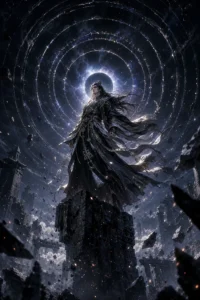
On the cliff ahead, Blackthorne Hall rose from the storm.
It did not sit upon the land so much as grow out of it, black stone and broken battlements fused with the rock beneath. Towers stabbed into the bruised sky. Chimneys leaned like watching figures. Windows glowed here and there with dim amber light, too few for the size of the place, making the darkness between them seem inhabited. Ivy crawled over the walls in veins thick as ropes. At the western edge, joined to the main house by a covered cloister, a chapel hunched close to the cliff, its spire crooked, its stained glass blind.
Seraphina’s pulse struck once, hard.
The family chapel.
The rumors had spoken of that chapel in lowered voices. Buried enemies. Buried lovers. Brides who sickened before producing heirs. A crypt sealed during the plague and never reopened. Nonsense, her uncle had said. Village superstition. Aristocratic theater.
But her uncle had never stood beneath Blackthorne Hall while thunder rolled through its stones like a hunger waking.
“Your home is dramatic,” she said.
Lucian looked past her to the house. “It has had centuries to practice.”
“Do you love it?”
“No.”
The answer came too quickly.
Seraphina turned back. “Yet you brought me here.”
“I did not bring you anywhere. You signed.”
“Under pressure.”
“Pressure reveals structure.” His gaze returned to hers. “Some things crack. Some things cut.”
“And which am I?”
The carriage crossed beneath an arch of leaning yews. For a moment the interior went dark enough that she saw only his eyes, pale and fixed on her.
“That,” he said, “is what I intend to find out.”
The wheels crunched onto gravel. The carriage slowed before a pair of wrought-iron gates fashioned in the shape of interlocking thorns. They stood open, though no gatekeeper was visible. Beyond them stretched a drive lined with statues, their features eaten by salt and rain. Saints, perhaps, or ancestors pretending to be saints. One held a sword. One held a book. One had no head.
As they passed, Seraphina felt their blind stone faces turn.
The house swallowed the carriage beneath a porte cochere supported by columns carved with roses and flames. Servants waited on the steps in a row, black uniforms stark against the storm. Not many—too few for a house of that size. Their faces shone pale in the lantern light. No one smiled.
The carriage door opened before the footman touched it.
Lucian stepped out first and turned back. Rain struck his shoulders, darkening the already-black wool of his coat. He offered Seraphina his hand.
She stared at it.
Husband. Captor. Suspect.
His palm remained steady in the rain.
To refuse would be childish. To accept felt like placing her wrist into a shackle.
Seraphina set her gloved hand in his.
His fingers closed around hers. Warm. Firm. Possessive enough for the servants watching. Not tight enough to bruise. He helped her down, and the moment her slippers touched Blackthorne gravel, the wind seized her veil and flung it backward. Rain kissed her face like a warning.
A woman stepped forward at the top of the stairs.
She was tall and spare, with silver hair braided so tightly it seemed to pull the skin from her cheekbones. Her black dress buttoned to the throat. A ring of keys hung at her waist, dozens of them, iron and brass, whispering against one another whenever she moved.
“Mr. Blackthorne,” she said, bowing her head.
Not my lord. Not sir. Mr. Blackthorne.
Lucian’s hand did not leave Seraphina’s. “Mrs. Hawthorne.”
The housekeeper’s eyes flicked to Seraphina, paused on the veil, the wet roses in the carriage, the small line of her mouth. She curtsied.
“Mrs. Blackthorne.”
The name landed like damp earth over a coffin.
Seraphina inclined her head. “Mrs. Hawthorne.”
The woman did not meet her eyes for more than a second. None of them did. Not the footman who took the trunks. Not the maid with red knuckles clutching a lamp. Not the driver as he climbed back onto the box, his face carefully blank. Every gaze slid toward Lucian first, seeking instruction, permission, mercy.
Fear had a smell. Seraphina had learned it in churches after fires, when people came searching for bodies and found only charred pews. It smelled of sweat trapped beneath wool, stale breath, extinguished candles.
Blackthorne Hall reeked of it.
“Have the east rooms been prepared?” Lucian asked.
Mrs. Hawthorne’s keys trembled once. “Yes, Mr. Blackthorne.”
“And the blue room locked?”
“As instructed.”
Seraphina looked at him. “The blue room?”
“Not yours.”
“I assumed that from the locking.”
A footman’s mouth twitched before he smothered it. Lucian did not look away from Seraphina.
“Curiosity is an expensive appetite in this house.”
“Then I hope your kitchens are well supplied.”
For the first time since the cathedral, the faintest expression crossed his face—there, gone, a blade catching light.
“Take her upstairs,” he said to Mrs. Hawthorne. “She will dine in one hour.”
“We will dine,” Seraphina said.
Lucian released her hand. The absence of his touch felt sudden in the cold.
“No,” he said. “You will dine. I have business.”
“On our wedding night?”
The words silenced the steps, the rain, even the restless shifting of the horses. A maid’s eyes widened. Mrs. Hawthorne went very still.
Lucian bent closer, and though he did not touch her, the air between them tightened as if pulled by a thread.
“If you are attempting to embarrass me with marital expectation, Seraphina, you will discover I am disappointingly difficult to shame.”
Her name in his mouth was a match struck in a crypt.
“I was attempting to understand the schedule of my confinement.”
“This is not a prison.”
She looked past him at the iron gates, the locked doors visible through the open entrance hall, the servants standing as though awaiting sentence.
“Of course not,” she said softly. “Prisons are usually better lit.”
His eyes darkened. For one reckless second, she thought he might laugh. Or seize her wrist. Or kiss her in front of them all just to prove that he could turn defiance into spectacle.
Instead, Lucian straightened.
“Mrs. Hawthorne,” he said.
The housekeeper moved at once. “This way, madam.”
Seraphina gathered the soaked hem of her gown and climbed the stairs into Blackthorne Hall.
Warmth did not greet her. The entrance hall was cavernous and dim, its ceiling lost in rafters where shadows clung like bats. The floor was black-and-white marble, cracked in places, polished in others by centuries of feet. A great staircase rose at the far end, splitting halfway into two wings like a forked tongue. Above it hung a chandelier crusted with candles, only half of them lit.
Portraits covered the walls.
They were everywhere—men in hunting coats with hounds snarling at their knees, women in pearls whose hands rested protectively over their stomachs, children with solemn eyes and pet birds chained to perches. Each painting bore the same family severity: long bones, dark hair, mouths unwilling to soften. But it was the eyes that held Seraphina. Varnish had yellowed them, candle smoke had deepened the shadows around them, yet they seemed bright. Watchful.
As Mrs. Hawthorne led her through the hall, Seraphina felt herself counted by the dead.
“How many Blackthornes have lived here?” she asked.
“All of them,” the housekeeper said.
Seraphina waited for elaboration. None came.
“And died here?”
The keys at Mrs. Hawthorne’s waist gave another soft, uneasy chime. “Most.”
They passed a set of double doors banded in iron. Locked. A smaller door under the stairs. Locked. A corridor to the left barred by a gate worked with thorn patterns. Locked. Blackthorne Hall seemed less constructed than restrained, each chamber sealed against the next as though the house might otherwise spill its secrets into the open.
“Does every door have a lock?” Seraphina asked.
“Only the ones that require one.”
“That answer sounds well practiced.”
Mrs. Hawthorne glanced at her then, and for the first time something like pity showed through the discipline in her face. It vanished quickly.
“Many answers are, madam.”
They climbed the staircase. Seraphina’s wet skirts whispered over the runner, leaving dark kisses on the faded red fabric. Halfway up, she stopped before a portrait larger than the rest.
A young woman stood in a painted garden, one hand resting on the back of a stone bench, the other holding a sprig of blackthorn blossom. She wore a white dress severe enough to be mourning clothes. Her hair was copper-dark, her eyes pale. Around her throat hung a gold chain.
Not the signet. Seraphina forced herself to breathe. Not Lucian’s ring. Only a locket, oval and closed.
“Who is she?”
Mrs. Hawthorne did not turn. “Evelyn Blackthorne.”
“Lucian’s mother?”
“Yes.”
“She looks young.”
“She was.”
“When she died?”
The housekeeper’s silence became answer enough.
Seraphina looked closer. The painter had captured something in Evelyn’s expression that felt less like sadness than warning. Behind her in the painted garden, almost hidden by foliage, was a chapel window rendered in a few precise strokes of blue and red.
Mrs. Hawthorne said, “Mr. Blackthorne does not care for guests lingering before that portrait.”
“I am not a guest.”
“No, madam.” The housekeeper’s mouth tightened. “That is why I mentioned it.”
Seraphina followed.
The east wing smelled of beeswax, damp stone, and lavender placed too liberally to disguise disuse. Their footsteps echoed along a corridor lined with narrow windows overlooking the cliffs. Rain hammered the glass. Beyond it, the sea flung itself white-fanged against the rocks below. Lamps burned in sconces, each flame bending though there was no draft.
At the end of the corridor, Mrs. Hawthorne unlocked a carved oak door and pushed it open.
“Your rooms, madam.”
Seraphina stepped inside.
A sitting room waited in shadowed gold and faded blue. There were velvet chairs, a writing desk, a fireplace already lit, shelves of old books, and fresh flowers arranged on a table beneath a mirror gone black at the edges. Through an adjoining door she saw a bedchamber dominated by a bed with heavy curtains the color of dried blood. Another door stood beyond that, slightly ajar, revealing a dressing room where trunks were already being unpacked by the red-knuckled maid.
It was elegant. It was expensive. It was a cage with excellent upholstery.
Seraphina walked to the nearest window. The latch was brass, engraved with tiny thorns. She tried it.
Locked.
“For safety,” Mrs. Hawthorne said behind her.
“From the weather?”
“From the cliff.”
Seraphina turned. “Do brides often throw themselves out of east wing windows?”
The maid dropped a brush.
Mrs. Hawthorne’s face became waxen. “No, madam.”
“Then perhaps we needn’t insult one another with the word safety.”
The fireplace cracked loudly. The maid bent to retrieve the brush, hands shaking.
Mrs. Hawthorne drew herself straighter. “Mr. Blackthorne ordered the windows locked. If you wish them opened, you must ask him.”
“And if I ask you?”
The housekeeper’s eyes went, involuntarily, to the corridor, as though Lucian might have materialized there from the walls themselves.
“Then I will apologize,” she said quietly, “and keep my position.”
There it was. Not loyalty. Survival.
Seraphina softened her voice. “How long have you served this family?”
“Thirty-two years.”
“Then you must know where all the bodies are buried.”
Mrs. Hawthorne looked at her fully.
The room seemed to cool.
“In a house this old, madam, one learns not to step where the ground sinks.”
Before Seraphina could reply, the maid made a tiny sound, almost a whimper. Mrs. Hawthorne snapped her gaze toward the girl.
“Clara.”
“I’m sorry, ma’am.” The maid clutched the brush to her chest. She could not have been older than nineteen, with fair hair escaping its pins and eyes red from either cold or crying. “I didn’t mean—”
“Finish the trunks.”
“Yes, ma’am.”
Mrs. Hawthorne turned back to Seraphina. “Clara will attend you tonight. If she displeases you, inform me.”
“I am not in the habit of punishing women for being frightened.”
The maid froze.
Mrs. Hawthorne’s expression flickered again, pity and warning braided together. “A generous habit. Difficult to maintain here.”
She placed a key on the writing desk.
“This opens your bedchamber door from the inside. The sitting room door locks from without as well as within. You are not to enter the west wing, the north tower, the old nursery, the chapel after dusk, or any room with a blue ribbon tied to the handle.”
Seraphina looked toward her sharply. “Blue ribbon?”
“A household marker.”
“For what?”
“Rooms under repair.”
Seraphina almost smiled. “I restore cathedrals, Mrs. Hawthorne. If your rooms are unsafe, I may be the most qualified person in this house to enter them.”
“Qualifications are not permissions.”
“No. Men like my husband consider the two tragically unrelated.”
The maid made another strangled sound and disguised it as a cough.
Mrs. Hawthorne’s gaze sharpened. “Dinner in one hour. Clara will bring hot water.”
She left in a whisper of black skirts and iron keys. The door closed behind her. A moment later, Seraphina heard the lock turn.
Clara flinched at the sound.
Seraphina watched her in the mirror. “Does he lock all his brides in?”
The maid’s face drained. “There haven’t been any brides, madam.”
“No?”
Clara shook her head quickly. “Not Mr. Lucian’s.”
“But others?”
The brush trembled in the maid’s hand. “The family is old.”
“So I keep hearing.”
Seraphina crossed to the fireplace and held her hands toward the flames. Heat licked through her gloves but did not reach her bones. She could feel the house around her, settling, creaking, murmuring through pipes and stone like a beast digesting its latest meal.
Clara resumed unpacking with painful care. She lifted folded chemises, stockings, a silver-backed brush, a prayer book Seraphina had not packed and did not want. When she found the small wooden case of restoration tools beneath the bridal linens, she paused.
“Leave that,” Seraphina said.
Clara obeyed at once.
Too quickly.
Seraphina turned. “Are you from the village?”
“Yes, madam.”
“What is it called?”
“Blackmere.”
“And does everyone in Blackmere go silent at the Blackthorne name, or only those employed by it?”
Clara’s mouth opened, closed. She glanced toward the door.
“He is not listening through the wood,” Seraphina said.
The maid looked unconvinced.
“The walls carry,” Clara whispered.
Seraphina studied her. “Have you worked here long?”
“Seven months.”
“Did you know anyone who worked here before?”
Clara folded a ribbon with great concentration. “My cousin.”
“Does she still?”
The girl’s hands stopped.
“No, madam.”
Rain struck the window in a sudden hard burst. Seraphina let the silence breathe.
“What was her name?”
Clara swallowed. “Maggie.”
“Did she leave?”
“They said so.”
They. Not she.
Seraphina moved closer, lowering her voice. “Clara, did you ever hear of a woman named Ophelia Vale?”
The maid’s head jerked up.
The fear that crossed her face was not confusion. It was recognition sharpened into terror.
Then she shook her head too violently. “No, madam. I don’t know anyone by that name.”
“You are certain?”
“Yes.”


0 Comments