Chapter 1: The Bride Delivered in Chains
by inkadminOn the morning of her wedding, Seraphina Vale’s father locked her in a black car and told her not to scream when she met her husband.
The words landed with the soft finality of a coffin lid.
Rain streaked the tinted window beside her, blurring the pale cliffs and iron-gray sea beyond into a smear of storm and stone. The car smelled of leather, old tobacco, and the cold metal bite of the cuff fastened around her left wrist. Its twin circled her father’s hand where his knuckles rested on the seat between them, wedding-ring gold glinting against skin gone liver-spotted and thin.
Lord Cassian Vale did not look like a man delivering his only daughter to a monster. He looked as he always did—immaculate, remote, composed with the cruelty of expensive tailoring. His black suit had been pressed sharp enough to cut, his silver hair combed back from a face that had once been admired in Parliament portraits and charity galas. He had the Vale mouth: narrow, proud, built for withholding affection and issuing sentences.
Seraphina had that mouth too. She had spent twenty-four years learning not to let it tremble.
“You mistake me,” she said, voice low. “I wasn’t planning to scream.”
Her father’s gaze slid toward her. His eyes were the same winter blue as hers, but where hers still held sparks of unspent rage, his were glass over deep water.
“Good.”
The car descended the coastal road toward Blackhaven, tires hissing over wet asphalt. Beyond the cliff’s edge, the sea slammed itself against the rocks in white bursts of violence, and gulls wheeled like torn scraps of paper against the bruise-colored sky. The city waited below, half-drowned in rain and soot, its church spires and old bank towers stabbing up through fog. Blackhaven had always looked less built than unearthed—a place dragged from the bottom of the ocean with barnacles still clinging to its bones.
Seraphina had been seventeen the last time she had seen it.
That day had been bright. Too bright. Sunlight on broken glass. Smoke threading through summer air. Someone screaming her name from very far away.
Then nothing.
A locked ward. A doctor with kind hands and cautious eyes. Her aunt’s estate in the north, all quiet lawns and locked gates, exile dressed as convalescence. The official story had changed depending on who told it. Grief. Hysteria. A fragile constitution. A scandal best buried beneath silence and wealth. Seraphina had learned early that in the Vale family, missing memories were not an illness but an inconvenience.
Now Blackhaven rose to meet her again, slick and glistening beneath the rain, as if the city had waited patiently all these years to close its jaws.
She tugged at the cuff. The chain between her wrist and her father’s clinked once, delicate as a champagne flute.
“Was this necessary?”
“Yes.”
“Afraid I’ll leap from a moving vehicle in bridal silk?”
“Afraid?” Cassian repeated, and almost smiled. “No.”
His answer scraped worse than insult.
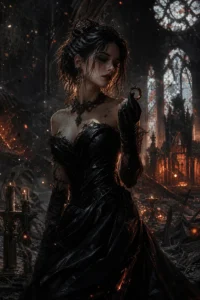
Seraphina looked down at herself with a hatred so cold it might have been calm. The gown was not white. That would have been too pure, too mocking. It was ivory, old lace fitted close to her throat and wrists, cinched brutally at her waist before falling in heavy silk over her knees. No veil. No flowers. No little cluster of laughing cousins to fuss over pearl pins and secret tears. Her hair, the dark red of wine held to candlelight, had been twisted low at the nape of her neck by a maid who could not meet her eyes. The only ornament she wore was the Vale heirloom necklace her father had clasped around her throat before dawn: diamonds like frozen tears, rubies like drops of arterial blood.
A bride prepared for sacrifice.
“You sold me,” she said.
“I saved you.”
A laugh escaped her before she could stop it. It sounded thin in the car’s hush.
“From what?”
Cassian looked out at the rain. “From the consequences of being born my daughter.”
For one impossible second, he sounded tired.
Then the moment passed, and he became marble again.
Seraphina leaned toward him as far as the chain allowed. “Then let me suffer them. I am very good at suffering quietly. You made sure of that.”
His jaw flexed.
In the front seat, one of the Vale men shifted. Not a driver. Not merely a guard. A family blade in a black coat with a scar at the back of his shaved head. Seraphina had woken before dawn to three of them in her bedroom, standing among the white curtains of her exile like undertakers. They had allowed her to dress. They had not allowed her to run.
Cassian’s voice dropped. “You will not embarrass me in that chapel.”
“Would bruising be an embarrassment?” she asked. “Because if your new ally expects gratitude, I may disappoint him.”
“Dante Marrow does not expect gratitude from anyone.”
The name slipped into the car like smoke.
Dante Marrow.
Even in exile, Seraphina had heard it. Whispered by servants when they thought her asleep. Printed beneath grainy photographs in newspapers that arrived with certain columns cut out. Murmured by men at charity dinners who lowered their voices as if the syllables might stain their teeth.
Marrow.
A criminal dynasty born in the ash heaps beneath Blackhaven’s docks. Smugglers first, then bookmakers, then arms, blood, secrets, judges, police, entire neighborhoods purchased one broken law at a time. They were the rot beneath the city’s velvet carpets. The blade behind closed doors. The family that had feuded with the Vales for three generations, each insult paid back with interest and funerals.
And Dante was their king.
They said he had taken the throne at twenty-one by burying his uncle alive beneath the west pier. They said he kept a chapel full of saints with their eyes burned out. They said no one had seen him bleed and lived to describe the color. In Blackhaven, mothers threatened disobedient children with his name and grown men checked locked doors after speaking it.
Seraphina had imagined him many times since her father’s letter arrived two weeks ago with its elegant lie.
Come home. There is a matter of family necessity.
She had imagined a brute with thick fingers and a butcher’s smile. A cruel-eyed prince in black. An old predator seeking a decorative wife to display among guns and debts. Every version had been simple enough to hate.
But her father’s warning—do not scream when you meet your husband—made something cold move at the base of her spine.
“Why?” she asked.
Cassian turned from the window.
“Why what?”
“Why would I scream?”
For the first time that morning, her father’s composure cracked. Not much. Just a tiny stillness, a nearly invisible retreat behind his eyes.
“Because,” he said softly, “you have always had an unfortunate habit of recognizing things you do not remember.”
Before she could demand what that meant, the car passed between two stone pillars crowned with winged lions blackened by rain. Iron gates swung inward. Beyond them, a private road curled through cypresses and skeletal winter gardens toward the church on Vale land where every heir for two hundred years had been christened, married, or buried beneath a stained-glass saint.
Seraphina’s stomach tightened.
The chapel crouched ahead in the mist, old and narrow, its gray stone walls veined with ivy, its bell tower lost in low cloud. Cars lined the drive—sleek black Marrow vehicles on one side, Vale silver on the other. Men with umbrellas stood in clusters under the rain, divided by bloodlines and mutual hatred. Their gazes turned as the car approached. No one smiled.
They had not come to witness a marriage.
They had come to see whether peace looked different from surrender.
The car stopped.
The locks clicked open.
Seraphina’s father removed a small key from his pocket and released himself first. Then her. The cuff fell away from her wrist, leaving a red ring in the skin.
“You will walk beside me,” he said.
“How generous.”
“You will speak when required.”
“I have had excellent practice.”
“And you will not look afraid.”
Seraphina held his gaze, then smiled with every ounce of Vale cruelty she had inherited and every ounce of survival she had earned.
“I thought you said you weren’t afraid.”
Something like anger passed over his face. Then the door opened, and rain-wet air rushed in.
The world outside smelled of damp stone, salt, and roses beaten rotten by weather. A guard offered his arm. Seraphina ignored it and stepped down into a shallow puddle, silk hem darkening where it kissed the gravel. A murmur rippled through the watching crowd.
Let them look.
She lifted her chin.
There were Vales near the chapel doors—cousins she had not seen since girlhood, aunts with carved faces, men whose voices she remembered from behind closed study doors. Their eyes slid over her like knives assessing a blade returned from rust. Some looked satisfied. Some ashamed. Most afraid.
The Marrows were easier to spot. They wore black without elegance, as if mourning had been stitched into them from birth. Broad-shouldered men with tattooed hands. Women with diamond throats and watchful eyes. Young soldiers whose scars were too fresh. They did not pretend civility; they stared openly, hungrily, as if wondering how much Vale blood might spill from so slender a body.
At the chapel steps stood a woman with silver-blond hair cut blunt at her jaw and a cigarette burning between gloved fingers despite the rain. She was stunning in a cruel, bright way, her red mouth curved around private amusement. When Seraphina passed, the woman exhaled smoke and said, “She’s smaller than I expected.”
Seraphina paused. Her father’s fingers tightened at her elbow.
She turned her head. “You must be accustomed to disappointment.”
The woman’s smile sharpened. A few Marrow men laughed under their breath.
Cassian dragged Seraphina onward before another word could be thrown.
“That,” he said through his teeth, “was Allegra Marrow.”
“A bridesmaid?”
“A viper.”
“Then she’ll feel at home.”
The chapel doors opened.
Warmth swallowed them first, then incense. Candles crowded every iron sconce and altar rail, their flames shivering in the draft. The nave was packed shoulder to shoulder, Vale on the left, Marrow on the right, a human aisle of old grudges and new calculations. Rain tapped against the stained-glass windows, turning saints and martyrs into dripping colors. Somewhere beneath the incense lingered another smell—wax, damp wool, gun oil.
Every face turned.
The sound died.
Seraphina felt her father’s hand on her arm. She felt the weight of silk, the bite of the necklace, the faint ache where metal had circled her wrist. She felt hundreds of eyes stripping her of exile, privacy, and personhood until she was only a symbol walking down a carpet the color of old blood.
Then she saw the man waiting at the altar.
Her breath stopped.
Not because he was ugly.
Because he was not.
Dante Marrow stood beneath the crucifix in a black suit that looked cut from the same darkness gathered in the chapel corners. He was tall—taller than the men beside him by inches—and lean in the way of a blade rather than a brawler, all controlled lines and stillness. His hair was black, worn slightly too long, falling in a damp wave over one brow. His face might have belonged to a saint if saints had ever been carved with a mouth like sin and cheekbones sharpened by violence.
But the scars ruined divinity.
Or perhaps they completed it.
One ran from the corner of his left eye down across his cheek, pale and raised, disappearing beneath the shadow of his jaw. Another tugged at the edge of his mouth, so that even at rest he seemed to be holding back either a smile or a snarl. The skin around his right hand, visible where it emerged from his cuff, was burn-scarred silver and white, stretched tight over knuckles that had learned ruin intimately.
And his eyes—
His eyes were gray.
Not soft gray. Not storm gray. Ash gray.
The instant they met hers, the chapel vanished.
Heat bloomed across Seraphina’s skin, sudden and sickening. A sound roared in her ears. Not the rain. Not murmurs. Fire. Wood splitting. A girl choking on smoke. A hand gripping hers so hard the bones ground together.
Run, Sera.
She swayed.
Her father’s hold clamped down, painful enough to bring the present back.
“Do not,” he whispered.
Seraphina inhaled through her nose. Incense. Wax. Damp wool. Gun oil.
Not smoke.
The man at the altar had gone very still.
For a heartbeat, Dante Marrow did not look like a king, a criminal, or a groom. He looked like someone who had seen a ghost and hated it for breathing.
Then the expression was gone.
His face closed.
The organ began.
Cassian walked her down the aisle.
Each step felt longer than the last. Whispers fluttered in their wake.
“She looks like her mother.”
“After all these years…”
“Vale bitch.”
“Marrow’s mad to take her.”
“Mad?”
“No. Hungry.”
Seraphina kept her gaze on Dante because looking away felt worse. He watched her approach without blinking. There was no triumph in him, no visible lust, none of the oily satisfaction she had expected from a man receiving a bride as payment. If anything, he looked furious.
Good, she thought. That made two of them.
At the altar, Cassian stopped.
The priest, Father Ansel, was so old that his hands trembled around the prayer book. He had baptized Seraphina beneath these same windows; she remembered his voice smelling of peppermint and wine. Now he would bind her to a Marrow under guard.
“Who gives this woman?” he asked, though every person in the chapel knew the answer was not love.
Cassian released her arm.
“Her father,” he said.
The words should have been ceremonial. Instead, they sounded like a confession and a threat.
Seraphina stepped forward alone.
Dante extended his hand.
She looked down at it.
The burn scars climbed over his fingers like pale roots. His palm was broad, his nails clean, the cuff of his shirt stark white against damaged skin. This was the hand of a man who had survived something that should have ended him.
She placed her hand in his.
His fingers closed around hers.
Heat struck her again—not memory this time, but him. He was warm, astonishingly so, and his grip was firm without hurting her. A strange tremor passed through his hand before he stilled it.
“Seraphina Vale,” he said quietly.
His voice was lower than she expected, rough at the edges, intimate enough that it seemed to move beneath the skin rather than through air.
“Dante Marrow,” she replied.
His scarred mouth shifted. “You know my name.”
“Blackhaven has few bedtime stories with happy endings.”
For the first time, something like amusement touched his eyes. It did not soften him. It made him more dangerous.
“And yet here you are.”
“Dragged, not enchanted.”
His thumb moved once against her knuckles, so briefly she might have imagined it. “That makes two of us.”
The priest cleared his throat.
Father Ansel began speaking of covenant and duty, of two houses joined before God, of the sanctity of vows. The words floated above Seraphina like dust in candlelight. She heard only pieces.
Honor.
Peace.
Obedience.
At that, her gaze cut to the priest so sharply that his voice faltered.
Dante noticed. “Careful, Father,” he murmured. “My bride appears allergic.”
A ripple moved through the front rows, shock and restrained laughter mingling like sparks thrown onto oil.
Seraphina did not look at him. “Only to poison.”
“Then you’ll find Blackhaven inhospitable.”
“I always did.”
His grip tightened almost imperceptibly.
The priest hurried on.
Seraphina studied the altar flowers to keep from studying the man beside her. White roses. Black calla lilies. Sprigs of ash leaves bound with red thread. A Marrow tradition, perhaps. Or an omen. Candlelight gilded the petals until they looked bruised.
When Father Ansel asked for the rings, a boy stepped forward from Dante’s side. No older than sixteen, with a shaved head, a split lip, and eyes too old for his face. He held a velvet box as though it contained a live snake.
Dante took the first ring.
It was not delicate. A band of dark metal, almost black, set with a thin line of tiny blood-red stones. Rubies, probably. Or something older and less clean.
Seraphina offered her left hand. It did not shake.
Dante looked at her fingers, then at the faint red mark the cuff had left on her wrist.
The temperature in his expression changed.


0 Comments