Chapter 5: Knives at the Breakfast Table
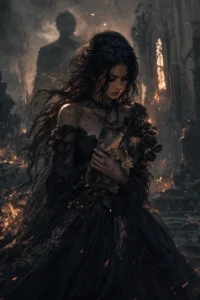
by inkadminRain combed its fingers down the windows of Ash House, turning the glass into shifting gray mirrors.
Seraphina woke to the sound of it and the ache of Dante Marrow’s hand still ghosted around her wrist.
For a moment she did not move. She lay beneath a coverlet too heavy for the season, staring at the ceiling where hairline cracks branched across the plaster like veins beneath old skin. Morning had not brought light so much as a paler shade of darkness. The room smelled faintly of smoke, beeswax, and the crushed lavender some maid had tucked into the linen as if scent could soften captivity.
It could not.
She raised her hand and watched the blue-black smudge of his fingers bloom above her pulse.
Dante had dragged her away from the hidden corridor without another word after the portrait. Not an explanation. Not an accusation. Only that terrifying stillness after the violence of his reaction, his face drained of whatever passed for warmth in him. He had shoved the panel closed, locked it with a key he wore beneath his shirt, and looked at her as if she had stepped barefoot into the center of a grave.
You don’t go looking for ghosts in my house, Seraphina.
He had said it softly. That was the worst part.
Men who shouted were easy. Men who smashed things announced the borders of their rage. Dante’s anger had drawn itself inward until it became a blade.
And the portrait—
She squeezed her eyes shut.
The little girl in the painting had stood in a field of ash beneath a burning sky. Dark hair. Pale face. One hand wrapped around the stem of a white flower. The brushwork had been old, the varnish cracked, but the resemblance had struck so violently that for one mad second Seraphina had thought she was staring through time at herself.
Except she had never been painted as a child.
Her father hated portraits.
A portrait is an invitation for enemies to remember your face, Alistair Vale used to say, while men in expensive suits bled on his carpets and her governess pretended not to hear.
Seraphina sat up slowly. The room swayed at the edges, not from sleep but from the restless, gnawing sense that the walls of Ash House had shifted during the night. Yesterday she had been a prisoner in a stranger’s mansion. Today she was something else. A trespasser in a story everyone seemed to know but her.
A knock came at the door.
Three neat taps. Polite enough to be threatening.
Seraphina pulled her robe over her nightdress and crossed the rug barefoot, the old floorboards cold as river stones beneath her feet. When she opened the door, a maid stood on the threshold holding a folded black dress over her arms.
The girl was younger than Seraphina, perhaps nineteen, with copper-brown skin and pale hazel eyes that never quite settled on one thing for long. She wore the Ash House livery: charcoal wool, high collar, silver buttons tarnished by age. At the sight of Seraphina’s face, the maid flinched so slightly that most people would have missed it.
Seraphina did not.
“Good morning, madam,” the girl said.
“Is it?”
The maid swallowed. “Mr. Marrow requests your presence at breakfast.”
“Requests?”
“Requires,” the girl corrected in a whisper, then looked as though she wished she could bite the word back.
Seraphina leaned one shoulder against the doorframe. “And you are?”
“Mara, madam.”
“Mara.” Seraphina let the name settle. “Did he send the dress as an apology or a leash?”
Mara’s eyes flicked up, startled. For a heartbeat something like reluctant admiration cracked through her fear. “In this house, madam, most things serve as both.”
Seraphina almost smiled.
Then Mara glanced down the corridor and paled. “I shouldn’t have said that.”
“No,” Seraphina said softly. “But I’m glad you did.”
The dress was black silk with a high throat and long sleeves, severe enough for mourning, tailored enough for war. It fit too well. Of course it did. Men like Dante Marrow did not guess at measurements; they acquired them. Mara fastened the row of tiny pearl buttons at Seraphina’s spine while rain hissed against the windows and the mansion groaned in its bones.
“Will there be many people at breakfast?” Seraphina asked.
Mara’s fingers hesitated at the top button.
“Some of the family,” she said.
“Some?”
“The ones allowed indoors.”
Seraphina turned her head. “What does that mean?”
Before Mara could answer, footsteps sounded in the hall. Not heavy. Not Dante’s. These were light, unhurried, almost musical against the old floor.
Mara stepped back instantly, hands folding before her like a schoolgirl caught stealing.
A man appeared in the doorway as if he had never needed permission in his life.
He was beautiful in the careless way only dangerous men and saints in old paintings were beautiful. Dark curls fell over his brow. His mouth looked made for laughter and lies. He wore a green velvet jacket over an open-collared white shirt, as though breakfast in a decaying cliffside mansion were an occasion for theater. A gold ring winked from one ear. His eyes—Marrow eyes, gray as a winter sea—swept over Seraphina and brightened with interest.
“Well,” he said. “No one told me the Vale bride was going to be pretty. That seems deliberately cruel.”
Mara went rigid.
Seraphina looked him up and down with the slow contempt she had learned from women who ruled rooms while men convinced themselves they did. “And no one told me Dante kept peacocks in the house.”
The man pressed a hand to his chest. “Wounded before breakfast. I may not survive.”
“Try.”
His smile widened. “Nico Marrow. Younger brother. Family disappointment. Occasional useful person. Perpetual delight.” He stepped inside and took her hand before she could withdraw it, bowing over her knuckles without touching them to his mouth. “And you are Seraphina Vale, who, according to all available gossip, was either raised in a convent, a madhouse, or a knife drawer.”
“The knife drawer had the best conversation.”
Nico laughed, delighted and real enough that for one dangerous moment the room seemed less cold.
“Dante said you were sharp.”
“Did he?”
“No. He said you were trouble. But he says that about anything he doesn’t immediately murder.” Nico’s gaze flicked to her wrist. His expression did not change, but the brightness in his eyes dimmed by a fraction. “My brother has never been especially gifted at welcoming guests.”
“I am not a guest.”
“No,” Nico said softly. “I suppose you aren’t.”
A silence opened. In it, rain scratched at the glass like fingernails.
Mara murmured something about fetching shoes and vanished with the speed of a rabbit fleeing a hawk.
Nico watched her go. “You’ve terrified the staff already. Impressive. It took me years.”
“She isn’t terrified of me.”
“No,” he said, gaze sliding back to Seraphina. “That’s what makes it interesting.”
Seraphina disliked him immediately for how quickly he noticed things. Charm was one thing. Observation was another. Charm distracted; observation dissected.
“Is Dante waiting?” she asked.
“Dante is always waiting. It’s one of his more exhausting hobbies.” Nico offered his arm. “Shall I escort you to the wolves?”
“Are you one of them?”
“Darling, I’m worse. Wolves are honest about their teeth.”
She did not take his arm.
His smile sharpened with appreciation. “Excellent. You may live a week.”
They walked together through the upper corridor, Seraphina keeping half a step between them. Ash House did not look gentler by day. Morning exposed the scars candlelight had hidden: water stains blooming across the wallpaper; places where portraits had been removed and left paler rectangles behind; a banister carved with vines and black birds, polished by generations of anxious hands. Every window showed the same view of Blackhaven beneath storm clouds—rooftops slick with rain, chimneys coughing smoke, the harbor bristling with masts like spears.
Somewhere far below, waves struck the cliffs with the dull, patient violence of a fist against a locked door.
“Do you always wander into women’s bedrooms uninvited?” Seraphina asked.
“Only when they’re married to my brother. It’s a very narrow vice.”
“How reassuring.”
“I knocked in spirit.”
“Did you?”
“My spirit is famously polite.”
She glanced at him. “You joke too much.”
“And you watch too closely.”
“One keeps me alive.”
“So does the other.”
They descended the main staircase. At the landing, Seraphina’s gaze caught on a smear of darkness near the carved newel post. Old blood, maybe. Or varnish. In Ash House, either seemed possible.
Nico followed her glance. “You should know something before we go in.”
Seraphina paused.
His frivolity had thinned. What remained beneath was not softness but something harder and far more tired.
“The Marrows are not what people outside think we are,” he said.
“Criminals?”
“Oh, that part is accurate.”
“Murderers?”
“Often.”
“Then what did they get wrong?”
He looked toward the closed double doors at the end of the hall. Two men in black suits stood on either side of them, hands folded, faces blank. “They think we move as one.”
“You don’t.”
“No family does. But most families don’t give their disagreements guns.”
One of the guards opened the door.
Warmth rolled out first: fire heat, coffee, toasted bread, butter melting into something sweet. Then came the undercurrent of metal polish, wet wool, and cigar smoke soaked into old wood. The dining room was long and narrow, paneled in dark oak that drank the light from the chandeliers. A table stretched down its center like an altar. Silverware glittered along both sides with military precision. White roses, the kind Seraphina had seen once at a funeral, filled black vases between covered dishes.
And at the far end sat Dante Marrow.
He did not rise.
He wore black, as always, the crisp severity of his suit making every other person in the room seem slightly unfinished. His hair was still damp, combed back from his face. In the gray morning, the scar at his jaw showed pale and cruel. One hand rested beside his coffee cup. The other turned a knife slowly between two fingers, blade flashing each time it caught the chandelier’s light.
His eyes found Seraphina’s wrist first.
Then her face.
Nothing changed in his expression, but the air did.
It tightened.
Nico swept into the room as if oblivious. “I found your wife wandering unattended. Scandalous. She might have stolen the silver or set fire to the curtains.”
“She prefers locked doors,” Dante said.
The words landed with quiet force.
Seraphina lifted her chin. “Only when people put secrets behind them.”
At the table, someone made a low sound—amusement or warning.
Seraphina looked away from Dante and took in the rest.
Three men sat along the left side. One was enormous, bald, with rings like brass knuckles and a broken nose that had healed poorly. He watched her with open dislike while tearing a roll apart between thick fingers. Beside him sat a narrow man with silver spectacles, thin lips, and ink stains on his cuffs, arranging slices of pear on his plate as if performing surgery. The third was older, his beard iron-gray, his posture military. A cane leaned against his chair, its handle carved in the shape of a raven’s skull.
On Dante’s right sat a woman who made the room feel colder than the windows.
She might have been forty or sixty; her age had retreated behind discipline. Her hair was white-blond and pinned so tightly it seemed to pull emotion from her face. Her eyes were pale blue, nearly colorless. She wore a high-necked dress of dove-gray wool without a single adornment except a small black cameo at her throat. Unlike the men, she did not bother to measure Seraphina subtly. She examined her as one might examine a crack in a foundation.
Nico leaned near Seraphina. “The court,” he murmured. “Try not to bleed on the carpet. Lenore hates stains.”
“I hate incompetence,” the woman said without looking at him. “Stains are merely evidence.”
Nico placed a hand over his heart. “Good morning to you too, Aunt Lenore.”
So this was Lenore. The adviser. The cold-eyed woman Dante trusted enough to seat at his right.
Seraphina looked at her and felt, with a certainty that prickled beneath her skin, that Lenore already knew where she would bury the body.
“Come here,” Dante said.
It was not loud. It did not need to be.
Seraphina crossed the room with every gaze tracking her steps. Her seat had been placed at Dante’s left, opposite Lenore. Wife on one side, counsel on the other. Trophy or hostage, depending on the eye.
Dante pulled the chair out for her.
The gesture should have been courteous. From him, it felt like a hand at the small of her back near the edge of a cliff.
As she sat, he bent close enough that his breath stirred the hair near her ear.
“Did you sleep?”
She looked straight ahead. “Like a woman in a house full of murderers.”
“Then lightly.”
“With a knife under my pillow.”
His mouth almost curved. “You were searched before you were brought here.”
“I said nothing about it being mine.”
For the first time that morning, he looked at her as if the storm outside had entered the room and taken a chair.
Nico dropped into the seat beside the enormous man. “I adore her.”
“You adore stray cats and failed revolutions,” Dante said.
“Both have better manners than this family.”
The bald man grunted. “She’s a Vale.”
There it was.
The word struck the table like a cup slammed down.
Seraphina turned to him. “And you are?”
“Bastian Crowe.” His voice sounded dragged over gravel. “I keep the docks breathing.”
“How poetic.”
“Don’t mistake me, girl. Nothing poetic about lungs filling with harbor water.”
“Bastian,” Dante said.
One word. A leash snapping taut.
Bastian looked at Dante, jaw shifting, then lowered his eyes to his plate.
Not obedient, Seraphina noted. Restrained.
The man with spectacles dabbed his mouth with a napkin though he had not yet eaten. “Silas Venn. Accounts, records, bribes, judges, priests, imports, exports, and most of the lies that keep Blackhaven polite.”
“That must be exhausting.”
“It is. Fortunately, I have no conscience to tire me further.”
The older man with the raven cane inclined his head. “Gideon Rusk. I served Dante’s father. I serve Dante now.”
There was a weighted pause before now. A grave between one master and the next.
Seraphina inclined her head in return. “And Lenore?”
“Lenore speaks for herself,” the woman said.
“I noticed.”
A servant approached with coffee. His hand trembled when he poured Seraphina’s cup, and a single drop splashed into the saucer. Lenore’s eyes moved to the spill. The servant went bloodless.
“Leave it,” Seraphina said before the boy could stammer an apology.
He looked at her, shocked.
“It’s only coffee,” she said.
Lenore’s gaze rose slowly to Seraphina’s face. “Small carelessness becomes large carelessness when indulged.”
“Then perhaps the poor boy should be grateful he spilled coffee and not blood.”
“Blood is often easier to clean.”
Dante set down his knife.
The tiny click was enough to silence the room.
Breakfast began.
Silver covers lifted to reveal soft eggs, smoked fish, black bread, stewed plums, sausages glazed dark with syrup, and tiny pastries dusted in sugar like frost. Seraphina’s stomach tightened with hunger despite herself. She had eaten little since the wedding. Pride did not nourish the body, no matter how often she had tried to live on it.
She reached for her coffee.
Dante’s hand closed over her wrist beneath the edge of the table.
Not hard. Not like last night. His fingers rested lightly over the bruise he had made, and the contact sent a bright, unwanted shock through her.
She went still.
Across from her, Lenore buttered toast with surgical calm.
Dante did not look at Seraphina. He lifted his own cup with his other hand and drank. Only then did he release her.
A warning.
Or protection.
Seraphina’s pulse began to beat too loudly.
She did not drink the coffee.
Instead, she selected a slice of black bread and watched the room through her lashes. Bastian ate with the aggression of a man punishing his plate. Silas picked delicately at his pear. Gideon drank tea and said nothing. Nico stole a pastry from Bastian’s plate and avoided losing his fingers by an inch.
“You’ll want to know why you’re here,” Dante said at last.
Seraphina looked at him. “I assumed you enjoyed surrounding yourself with people who hate me.”
“That too.”
Nico choked into his coffee.
Dante leaned back. “My marriage to Seraphina Vale is not gossip. It is law. It is contract. It is blood price. Anyone in this room who forgets that will answer to me.”
Bastian’s fork scraped porcelain. “Blood price for whose blood?”
The temperature dropped.
Seraphina felt the question in the others before she understood it. Silas stopped moving. Gideon’s hand tightened on his teacup. Nico’s grin vanished entirely.
Dante’s eyes did not leave Bastian. “Do you want to finish that thought?”
Bastian’s broad shoulders bunched. “Her father burned half our world and bought himself a bride truce with the other half. Now we’re meant to bow to his daughter because paper says she belongs at your side?”
Paper. Not vows. Not marriage. Ownership, sealed and witnessed.
Seraphina’s fingers curled around her knife.
Dante noticed.
Of course he noticed.
“My father burned plenty,” she said, voice smooth as poured cream. “But I have yet to see evidence the Marrows were innocent kindling.”
Bastian stared at her. Then he laughed once, ugly and loud. “She has Vale teeth.”
“And you have all the subtlety of a dockside brawl,” Lenore said. “Must every grievance arrive covered in mud?”



0 Comments