Chapter 5: Teeth Behind Silk
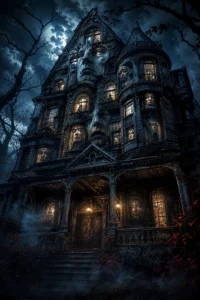
by inkadminRain turned the windows of Marrow House into black mirrors.
Elara stood before one of them in the dressing room adjoining the bedchamber that was hers by decree and not by comfort, watching her own reflection fracture beneath the water streaming down the glass. The woman staring back wore a gown the color of old bone, silk fitted close through the bodice before falling in a clean, severe line to the floor. Seed pearls glimmered at the wrists and throat like rosary beads. Her dark hair had been pinned away from her face by a silent maid with clever fingers, exposing the fine bones of her neck, the curve of her ear, the small birthmark at her collarbone shaped vaguely like a torn petal.
She looked less like a bride than an offering.
That, she supposed, was the point.
Behind her, the maid adjusted a silver clasp at the back of the gown and kept her eyes lowered. Every servant in Marrow House had the same careful way of moving: soundless, deliberate, as if noise itself could invite punishment. They appeared when summoned, vanished when dismissed, and never once lingered long enough to become human. Elara had begun to wonder if the house ate their names.
“Too tight?” the maid asked.
Elara inhaled. The silk pressed against her ribs like a hand.
“No,” she said. “It’s fine.”
The maid’s gaze flicked up for the briefest moment in the mirror. Young, freckled, frightened. “Lord Marrow requested the pearls.”
“Of course he did.”
The maid’s fingers stilled.
Elara softened her voice. “Thank you.”
The girl nodded and retreated, leaving the faint scent of starch and lavender behind. The door closed without a click.
Elara turned from the window to the room. Her own clothes—the charcoal wool dress she had arrived in, her worn boots, the coat that still carried a ghost of cathedral dust—had been taken away. In their place waited the costume of a woman someone else had invented. Pearls. Silk. A pair of pale satin shoes in which she could neither run nor stand comfortably for long.
On the dressing table lay a small folded card.
She had noticed it the moment the maid left, tucked half beneath the jewelry box as if placed there by accident. Marrow House was not a place where accidents survived.
Elara crossed the room and picked it up.
Smile only when necessary. Listen more than you speak. Do not drink anything handed to you by Cassian Rook.
No signature.
Lucian’s handwriting was spare and exact, every line cut with the same restraint as his voice. She recognized it from the list of rules he had presented the night before, the one she had returned with ink slashed through half his commands and three of her own written beneath.
Access to the library.
My restoration tools returned.
No locked door without an explanation.
He had looked at the list for a long time, his expression unreadable in the firelight. Then he had lifted his eyes and said, “You are either brave or impatient.”
“You’ll find they often look the same from a distance,” she had replied.
He had not smiled, exactly. But something had moved at the corner of his mouth, brief and dangerous as a blade catching light.
Now his warning rested between her fingers.
Do not drink anything handed to you by Cassian Rook.
She turned the card over. Blank. No comfort. No explanation. Only another locked door made of ink.
A knock sounded.
Elara slipped the card into the hidden pocket sewn into the side seam of the gown. “Come in.”
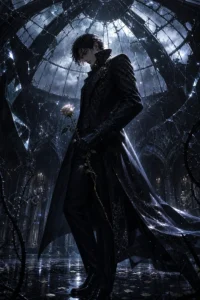
The door opened, and Lucian Marrow stepped inside as if darkness had been tailored around him.
He wore black evening dress without ornament, no boutonniere, no ring but the wedding band he had not removed since the ceremony. Against the pallor of his skin, the dark fabric sharpened him into something almost unreal. His hair, black and slightly damp at the temples from the rain, had been combed back, emphasizing the severe lines of his face. There was no softness in him tonight. No trace of the man who had known her mother’s lullaby. No flicker of the stranger who had stood at her bedroom door and told her there were worse prisons than Marrow House.
His gaze moved over her.
Not quickly. Not politely.
Elara felt it as a touch before she recognized it as inspection: the pearls at her throat, the bodice fitted to her waist, the exposed skin above the collar. His eyes paused there, on the small mark near her collarbone. The room seemed to narrow around the silence.
“Is something wrong?” she asked.
Lucian’s gaze lifted to hers. “No.”
“You look as though you’ve seen a ghost.”
“In this house, that would be unsurprising.”
“Does the ghost approve of the pearls?”
For a moment, his composure cracked—not enough to form amusement, but enough for her to glimpse the strain beneath. “The pearls were my mother’s.”
Elara’s fingers rose instinctively to the strand at her throat. The beads were cool and heavy. “You didn’t mention that.”
“Would it have changed your mind?”
“About wearing them?” She let her hand fall. “Perhaps.”
He crossed the room with measured steps, stopping just close enough that she caught the scent of him: cedar, rain, smoke, and something metallic underneath, like coins held too long in a warm palm.
“Then I was wise not to mention it.”
“You confuse wisdom with manipulation.”
“Often they produce the same result.”
“From a distance?”
His eyes sharpened. He remembered.
Elara refused to look away.
The rain beat harder against the glass. Somewhere deep in the house, a clock struck the hour, each chime rolling through the walls like a warning bell.
Lucian reached into his coat and withdrew a pair of gloves, but he did not put them on. He held them in one hand, black leather folded over his fingers.
“Tonight,” he said, “you will meet men and women who would flay you politely if it benefited them. They will compliment your dress while counting your pulse. They will ask questions that sound harmless. Nothing is harmless.”
“And what will you do?”
“Stand beside you.”
It should not have settled beneath her ribs the way it did.
“As my husband?”
His expression did not change, but his voice lowered. “As the man who brought you here alive and intends to keep you that way.”
Elara searched his face. The hard line of his mouth, the faint shadow at his jaw, the cold focus in his grey eyes. He did not speak like a man offering tenderness. He spoke like a man issuing a threat to the world.
“And if I fail to smile only when necessary?”
His gaze dipped, almost imperceptibly, to her mouth. “Then make sure the smile unsettles them.”
Despite herself, Elara felt a spark of laughter rise in her throat. She strangled it before it could become sound.
Lucian saw. Of course he saw.
“There,” he said quietly. “That one.”
“What?”
“Use that smile.”
The spark vanished, replaced by heat she had no patience for and even less desire to examine. “You are very free with instructions for a man who dislikes questions.”
“I dislike foolish questions.”
“How convenient. Who decides which are foolish?”
“Tonight? Me.”
Elara stepped closer, tilting her chin just enough to make defiance visible. “And tomorrow?”
His eyes darkened. “That depends on how well you survive tonight.”
The door opened again before she could answer.
A man stood in the threshold, broad-shouldered and scarred across one brow, his dark suit doing little to civilize him. Elara recognized him as Tomas, Lucian’s driver and, unless she was a fool, something far more lethal. He glanced at Lucian, then at her, then looked carefully at a point above her shoulder.
“They’ve started arriving,” Tomas said.
Lucian’s face became stone. “The Rooks?”
“First through the gates.”
A muscle moved in Lucian’s jaw.
“Of course they were,” he said.
Elara touched the hidden card through the silk of her gown.
Cassian Rook.
The name already felt like a finger trailing along the back of her neck.
Lucian offered his arm. The gesture was formal, almost old-fashioned. A painted groom leading his painted bride into a feast of wolves.
Elara looked at his arm, then up at him. “If I take it, am I agreeing to obey?”
“No.” His voice was dry. “I’ve abandoned hope of that.”
This time the smile escaped her, small and sharp.
Lucian’s gaze caught on it, and for one suspended second the storm, the house, the waiting enemies beyond the door—all of it thinned. There was only the space between them, bright with something unnamed and therefore dangerous.
Then he looked away first.
Elara placed her hand on his arm.
He was warm beneath the black wool.
Together, they descended into the mouth of Marrow House.
The reception had transformed the great hall into a cathedral of wealth.
Candelabras rose from long tables draped in black linen. White flowers spilled from tarnished silver bowls, their scent thick and funeral-sweet. Servants moved with trays of champagne, oysters, figs split open like wounds, and sugared plums arranged in concentric circles. Music drifted from a string quartet tucked beneath the curve of the grand staircase, the melody delicate enough to make every whispered threat sound cultured.
The hall itself had been built to intimidate. Ribbed arches climbed toward a vaulted ceiling painted with fading saints whose eyes had darkened with age. Above the fireplace hung the portrait of some dead Marrow patriarch, a hawk-faced man with one hand resting on a black dog and the other on the hilt of a sword. The flames below him made it look as though he were burning from the waist down and enduring it with family pride.
Guests filled the room in clusters.
They turned when Lucian appeared.
Elara felt the shift at once. Conversation softened, not stopping entirely but thinning into a hundred listening threads. Faces angled toward them. Jewels flashed. Gloved hands paused around crystal stems. She had been stared at before—by parish trustees evaluating her restoration estimates, by priests who thought women should not climb scaffolds, by men on street corners who mistook quietness for invitation—but this was different. This room did not look at her. It assessed the value of her bones.
Lucian’s hand covered hers where it rested on his arm.
Not affectionate. Possessive.
Warning and shield in one.
“Breathe,” he murmured.
“I am.”
“Your fingers disagree.”
Only then did she realize she had gripped his sleeve tightly enough to crease it. She loosened her hand, annoyed. “Your guests have a habit of looking as if they’re choosing where to bury me.”
“Most of them prefer the sea.”
“That was not reassuring.”
“It was not meant to be.”
They reached the foot of the stairs.
A woman in emerald silk broke from the nearest cluster and advanced with a smile so polished it might have been sharpened on a whetstone. She was in her late fifties, perhaps, though money and malice had preserved her beautifully. Her silver hair was swept into an intricate crown of braids, and a ruby pendant rested against her throat like a drop of fresh blood.
“Lucian,” she said, extending both hands.
He took them and bent his head, not quite kissing her cheek. “Madame Vey.”
“You insult me with formality. I held you when you were no bigger than a loaf of bread.”
“And threatened to smother me when I cried.”
Her laugh rang bright and false. “A sensible impulse. Children are dreadful.”
Her attention slid to Elara. The smile remained. The warmth vanished.
“And this must be our little miracle.”
Our.
Elara inclined her head. “Elara Vale.”
“Vale no longer, surely.” Madame Vey’s gaze dropped to the wedding band on Elara’s finger. “Marrow now.”
“Names leave stains,” Elara said softly. “Some take longer to wash out.”
Lucian’s hand tightened over hers for one fraction of a second.
Madame Vey’s smile widened. “How charming. She has teeth.”
“She has ears as well,” Elara replied. “And they function best when people speak to me rather than around me.”
A silence opened around them, small but hungry.
Then Madame Vey laughed again, this time with genuine amusement. “Oh, Lucian. What a dangerous bargain you’ve made.”
“I rarely make any other kind.”
“No. You don’t.” Her eyes lingered on him, and something old moved behind them. Grief? Resentment? Hunger? “Your father would have enjoyed this evening.”
“My father enjoyed many things best left dead.”
The woman’s expression cooled. “And yet dead men write such persistent contracts.”
Before Elara could catch hold of that sentence, Madame Vey turned, signaling to someone across the room.
Introductions followed like a procession of saints painted over rot.
Lord Anselm Draven, whose family controlled the shipping lanes and whose soft, manicured hands bore burn scars around the fingertips. The Belladonna twins, pale and identical, both dressed in white, both speaking in alternating sentences as if they shared one thought between them. Father Soren Pike, not a priest despite the title, with a gold cross at his ear and laughter that revealed a missing canine tooth. Each greeted Lucian with careful respect. Each greeted Elara with curiosity edged in appetite.
They spoke of weather, restoration work, the inconvenience of dock strikes, the beauty of Marrow House, the tragedy of old bloodlines thinning. Beneath every sentence ran another language.
How much do you know?
How easily do you frighten?
What did he pay for you?
Elara answered little. She watched hands. Mouths. The direction of glances. She had spent years on scaffolding beneath cathedral ceilings, learning to read damage where others saw only shadow. A hairline crack in plaster could reveal a century of water rot. A flake of gold leaf could betray the shape of a buried fresco. People, she was discovering, also cracked in patterns.
Lucian’s pattern was control.
He stood beside her like a locked gate, every response measured, every silence deliberate. Men twice his age deferred to him. Women with diamonds at their throats calculated around him. No one touched him without invitation. No one stood at his back.
And yet tonight, she sensed tension beneath his restraint. Not fear. Lucian Marrow did not seem built for fear in any ordinary sense. This was something colder. Anticipation before a knife fight.
She had just refused a glass of champagne from a servant—Lucian’s warning echoing in her mind—when the room changed again.
No music stopped. No one announced him.
Still, Elara knew the moment Cassian Rook entered.
It was in the subtle turning of heads, the way laughter dipped and rose too quickly, the way Lucian’s hand fell from hers as if freed for violence.
Cassian came through the arched doorway with two men behind him and the easy grace of someone who had never needed permission. He was beautiful in the way poisonous things often were: golden hair worn slightly too long, mouth shaped for secrets, eyes a clear blue that looked almost gentle until they settled on a person and began taking them apart. His evening coat was midnight velvet, his waistcoat silver, his cufflinks tiny black birds in flight.
Unlike the others, he did not look at Lucian first.
He looked at Elara.
And smiled as if they had been waiting years to meet.
“Mrs. Marrow,” he said, crossing the hall.
His voice was warm honey poured over broken glass.
Lucian stepped half a pace forward. “Rook.”
“Lucian.” Cassian’s smile widened. “You look well for a man everyone keeps trying to kill.”
“You look careless for a man who keeps failing.”
A few nearby guests went very still.
Cassian laughed softly, delighted. “Marriage hasn’t softened you, then. A pity. I brought congratulations.”
“Leave them with the coats.”
“And deprive your bride?” Cassian turned his full attention back to Elara and bowed with theatrical elegance. “Cassian Rook. A friend of the families, when the families are behaving.”
Elara did not offer her hand.
His gaze flicked to her bare fingers, then returned to her face. A lesser man might have shown annoyance. Cassian showed pleasure.
“You have been warned about me,” he said.
“Should I have been?”
“Constantly. By stern men in dark suits, by mothers hiding daughters, by creditors with limited imaginations.”
“And husbands?”
Lucian’s presence at her side became a blade.
Cassian’s eyes gleamed. “Especially husbands.”
He lifted a glass of champagne from the tray of a passing servant and held it toward her, casual as a dare.
Elara looked at the glass.
Lucian did not move. Did not speak. But the air around him tightened until the candles seemed to lean away.
She remembered the card.
Then she smiled the smile Lucian had told her to use.
“How thoughtful,” she said. “But I prefer to watch my enemies while sober.”
A ripple passed through the nearest guests. Cassian’s smile did not falter. If anything, it deepened, revealing the faintest edge of teeth.
“Oh, she is wasted on you,” he said to Lucian.
“Careful,” Lucian replied.
The single word was quiet. Men across the room heard it anyway.
Cassian set the untouched glass on the mantel. “Always.”
“Never,” Lucian said.
They stared at each other. Elara felt suddenly as though she stood between two storms, one made of ice, the other of golden lightning.
Madame Vey appeared at Cassian’s shoulder, as if drawn by the scent of blood. “Cassian, darling. I wondered if you would make an entrance or merely arrange an incident.”
“Why choose?” Cassian kissed the air near her cheek. “I hear efficiency is fashionable.”
“So is restraint.”
“Among the elderly, perhaps.”
Madame Vey’s ruby pendant flashed as she laughed. “Wicked boy.”
Elara watched them with a restorer’s eye. Their affection was varnish. Beneath it lay older paint, darker and chipped.
Cassian angled back toward her. “You restore cathedrals, I’m told.”
“Stone, plaster, fresco when funds allow.”
“How holy.”
“Not always. I’ve found obscene drawings beneath saintly murals.”
His laugh was quick and genuine. “Have you? How marvelous. The dead are rarely as dignified as we pretend.”
“No,” Elara said. “They leave evidence.”
For the first time, something in Cassian’s expression sharpened beyond charm.
Lucian noticed too.
“Elara,” he said, his voice smooth and warning. “Madame Vey wanted to show you the conservatory.”
“Did she?” Elara asked.
Madame Vey’s smile returned without delay. “Desperately.”
“How fortunate for us both.”
Lucian’s eyes cut to hers. Go.
Elara wanted to refuse simply because he expected obedience. But the hall had grown too crowded, too perfumed, too watchful. And Cassian Rook’s gaze had begun to feel like fingers testing the seams of her life.
She allowed Madame Vey to lead her away.
The conservatory opened from the east side of the hall through a pair of glass doors veined with lead. Inside, the air changed at once, warm and damp and green. Rain rattled against the glass roof, turning the night beyond into a smeared black sea. Ferns crowded marble planters. White orchids hung like pale moths from twisted branches. A fountain murmured at the center, its basin stained copper by age.


0 Comments