Chapter 3: The Graves at the Altar
by inkadminRain had turned Blackthorn City into a cathedral of its own.
It came down in silver ropes over the old stone facades, hissed along the gutters, and gathered in the mouths of gargoyles before spilling into the streets below. Every limousine that crept toward Saint Orphia’s Cathedral wore the weather like mourning silk, their polished black bodies reflecting the bruise-colored sky and the trembling gold of police barricade lights.
Seraphina Vale watched the city blur beyond the veil drawn over her face.
The veil had been her father’s choice. So had the cathedral. So had the guest list, the flowers, the quartet, the press release, and the lie that had been printed in every society column from here to the mainland:
In a gesture of peace between two historic families, Miss Seraphina Vale will wed Mr. Lucien Graves in a private ceremony this evening.
Private, apparently, meant three hundred armed men concealed beneath tailored coats, every crime lord in Blackthorn seated beneath the eyes of saints, and enough old blood in the pews to drown God twice.
Her father sat beside her in the limousine, one gloved hand resting on the silver head of his cane. Thaddeus Vale had dressed in charcoal and white, severe as a funeral notice. His hair, still thick and iron-gray, had been combed back from a face that looked carved by generations of entitlement. He smelled faintly of cloves, gun oil, and the expensive brandy he drank before breakfast when his hands hurt.
He had not spoken since they left Vale House.
That suited Seraphina. She had spent the morning being laced, pinned, painted, and arranged by women who would not meet her eyes. Her wedding gown had been chosen to make a statement: ivory silk clinging like poured cream, long sleeves of antique lace, a train heavy enough to feel like a sentence dragging behind her. Tiny seed pearls had been sewn into the bodice in the shape of thorn branches. Beautiful. Delicate. Barbed.
A Vale bride, presented for sacrifice.
Her fingers flexed in her lap. The gloves hid the half-moon marks her nails had left in her palms. They also hid the smudge of pencil lead on the inside of her right wrist, where she had written one word before the maids came in.
Survive.
The limousine slowed.
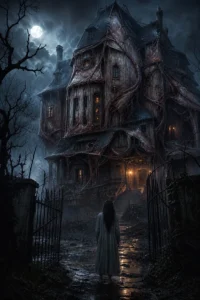
Through the rain-beaded glass, Saint Orphia’s rose ahead of them like a thing dredged from the sea. Black stone towers stabbed into the clouds. Flying buttresses curled like ribs. The rose window above the entrance burned with stained glass even beneath the storm—saints in jewel colors, angels with severe faces, a crowned martyr holding a blade against her own throat.
Seraphina had been baptized there. Her mother’s funeral had been held there. She had learned, at thirteen, that grief made a sound very much like organ music when trapped beneath vaulted ceilings.
Tonight, the cathedral doors stood open.
Men with umbrellas waited beneath the portico. Vale men in gray. Graves men in black. The city police pretended they were there for traffic control, but Seraphina recognized two captains who had taken envelopes from her father at Christmas and one judge whose son had vanished after gambling with the wrong syndicate.
Everyone belonged to someone.
Especially her.
Her father finally turned his head. “Do not embarrass me.”
Seraphina looked at him through the gauze of her veil. “I thought that was why you had me educated.”
His mouth tightened. “This is not one of your games.”
“No,” she said softly. “Games are usually played by people with choices.”
The silence sharpened.
Outside, a footman opened her door. Cold rain-scented air rushed in, carrying wet stone, engine exhaust, and the metallic bite of the sea beyond the harbor walls.
Thaddeus leaned close enough that she could see the pale cracks in his lips. “You will walk. You will smile. You will say your vows. And when this is finished, you will remember that blood built this family long before sentiment tried to ruin it.”
Seraphina held his gaze. “Is that what you told my mother?”
For one heartbeat, something moved in his face.
Not remorse. Never that.
Fear.
Then it was gone, shuttered behind aristocratic contempt.
“Your mother,” he said, “forgot where loyalty belonged.”
Seraphina’s breath stilled.
The footman extended his hand. Her father stepped out first, leaving her with those words hanging in the limousine like poison gas.
Her mother had forgotten where loyalty belonged.
Not died of fever. Not slipped quietly away as the family physician had sworn. Not wasted herself into silk sheets while rain clawed at Vale House windows.
Forgotten.
Seraphina gathered the front of her gown and stepped into the rain.
The umbrellas rushed over her at once, black canopies blooming like funeral flowers. Cameras flashed behind the barricades. The press had been told to keep their distance, but lenses peered through wrought iron and between shoulders. The world loved a wedding between monsters. It gave people permission to pretend monsters could be civilized by lace and vows.
Her father offered his arm.
She placed her gloved hand on it because knives were not allowed beneath bridal gloves.
They climbed the cathedral steps together.
Inside, Saint Orphia’s smelled of beeswax, incense, old rain, and expensive perfume. Hundreds of candles trembled along the nave, their flames reflected in polished marble floors. White roses spilled from urns at the ends of the pews, but blackthorn branches had been woven through them, their dark thorns glinting like little teeth.
Lucien’s doing, she thought.
Or a warning.
The pews were full.
On the left sat the Vales and their allies, pale women with diamonds at their throats, men with soft hands and predator eyes. Her cousins watched her with the same mild curiosity they gave horses at auction. At the front, her aunt Maribel dabbed at dry eyes with a handkerchief edged in lace, performing grief as though Seraphina had already been buried.
On the right sat the Graves family.
They did not look like a family so much as a court assembled before an execution. Men in black suits. Women in dark silk. Faces hard as coins. Silver rings. Scarred knuckles. A boy no older than fifteen with a serpent tattoo crawling from his collar. An old woman with a cane of polished ebony and eyes like winter glass.
At the end of the aisle, beneath the great crucifix, stood Lucien Graves.
Seraphina had spent all morning teaching herself not to react when she saw him.
It had been wasted effort.
He wore black. Of course he did. Black suit, black shirt, no tie, as though even a wedding could not persuade him to place anything around his throat. A white rose was pinned to his lapel, obscene in its purity. His dark hair had been combed back from his face, but one strand had escaped to brush his brow. The candlelight carved planes from his cheekbones and turned his eyes almost silver.
Beautiful, the rumors always said, as though beauty were the most important thing about a knife.
He was watching her.
Not the gown. Not the veil. Not her father’s hand where it trapped hers against his arm.
Her.
And the strange, irritating truth was that Seraphina felt it in her bones before she felt the eyes of the families. Lucien’s gaze did not crawl over her. It did not measure or appraise. It struck like a thrown blade and pinned her exactly where she stood.
The organ began.
Her father moved. Seraphina moved with him.
Every step down the aisle sounded too loud. Silk whispered over marble. Rain battered the stained-glass windows above. Her pulse kept time with the organ’s low thunder.
Faces turned as she passed.
Donatello Voss, king of the east docks, smiled around a gold tooth.
Madame Celeste, who owned half the pleasure houses below Halcyon Street, lifted one black-gloved hand in a gesture that might have been blessing or mockery.
Gideon Marr, old ally of the Vales and rumored butcher of three aldermen, watched Seraphina like he knew how much marrow her bones contained.
And in the third pew from the back, half-hidden behind a marble pillar, a man in a plain dark coat stood very still.
Seraphina’s gaze caught on him.
Not because he looked out of place. Everyone here looked like sin in formalwear. But his face—what little of it she could see beneath the brim of his hat—was covered by a black mask from nose to brow.
Not a masquerade mask. Not velvet or lace.
Matte black. Featureless. Wrong.
Her step faltered.
Her father’s hand tightened like a manacle. “Walk.”
When she looked again, the masked man was gone.
The aisle stretched on forever.
Lucien came into sharper focus with every step. The white rose on his lapel. The faint scar at the corner of his mouth. His hands clasped before him, long-fingered and still. No ring yet on his left hand.
Her father stopped before the altar.
The bishop, a skeletal man with a voice made for crypts, asked who gave the bride.
Thaddeus did not hesitate. “Her father.”
Not I do. Not her family. Not with love.
Her father.
Ownership, spoken before God.
He lifted Seraphina’s hand from his arm and placed it into Lucien’s.
The contact was a shock.
Lucien’s palm was warm through the thin silk of her glove. His fingers closed around hers—not crushing, not gentle. Certain. As though he had reached into a river and seized something before the current could take it.
Her father released her.
It should have felt like freedom.
Instead, she had the wild, absurd sensation of being passed from one fire to another.
Lucien turned slightly, positioning his body between her and the congregation. It was subtle enough no one in the back pews would notice. Seraphina noticed. She noticed everything. His shoulder blocked a clear line from the right balcony. His hand shifted hers inward, closer to his side. His eyes flicked once toward the choir loft, then back to the bishop.
She leaned close enough that her veil brushed his sleeve. “Checking for angels?”
His mouth did not move. “Angels don’t make it past my security.”
“Charming. I suppose that explains the guest list.”
A faint exhale. Almost amusement. “Try not to start a war before the vows.”
“I thought that was the purpose of the vows.”
His thumb pressed lightly against her knuckles. A warning. Or an answer.
The bishop began speaking.
Words filled the cathedral, solemn and hollow. Marriage. Covenant. Peace. Unity. God’s witness. Seraphina listened to none of it. Her senses had narrowed to fragments: the heat of Lucien beside her; the cold weight of pearls against her ribs; the sound of rain striking leaded glass; the restless rustle of armed men pretending they had come for romance.
At the edge of her vision, her father took his seat in the front pew. He did not look at her again.
Lucien’s grandmother, the old woman with the ebony cane, sat opposite him. Her hair was white, her lips painted blood-dark. Two men stood behind her with hands folded over their belts. When Seraphina’s gaze touched hers, the old woman smiled.
It was not welcome.
It was assessment.
The bishop’s voice rose. “Before these witnesses, if any soul knows cause why these two should not be joined, let them speak now, or forever hold their peace.”
A murmur ran through the cathedral like rats behind walls.
Seraphina almost laughed.
If everyone who knew a reason spoke, they would be there until the city sank into the sea.
No one stood.
No one wanted to be the first corpse at a wedding already dressed for funerals.
The bishop continued.
Lucien turned toward her.
A cathedral full of monsters vanished behind the veil between them. Up close, his beauty became less polished and more dangerous. There was a shadow beneath one eye, a small cut healing along his jaw, the faint bruising of sleepless nights. He looked less like a king and more like a man who had spent years learning how to survive the crown.
“Lucien Graves,” the bishop intoned, “will you take Seraphina Vale to be your lawful wife? To honor and keep her from this day forward, in peace and in peril, in plenty and in want, so long as you both shall live?”
Seraphina expected his answer to be cold. A formality. A word tossed like a coin to purchase her.
Lucien looked at her as though the cathedral had no ceiling and no God and no bullets waiting in any shadow.
“I will.”
The words were quiet.
They reached her anyway.
The bishop turned. “Seraphina Vale, will you take Lucien Graves to be your lawful husband? To honor and keep him from this day forward, in peace and in peril, in plenty and in want, so long as you both shall live?”
Her tongue pressed against the back of her teeth.
No sat there, bright and sharp. She could imagine it. The scandal. The gasps. Her father’s face. Lucien’s expression, unreadable at last because she had managed to surprise him. She could imagine turning and walking down the aisle alone, train dragging through rose petals and rainwater, every gun in the cathedral deciding whether she was worth the risk.
Then she remembered the tunnel beneath Vale House.
The sealed exit.
Lucien waiting in the dark with rain in his hair and a gun in his hand, telling her he had come because others were coming too.
Marry me publicly. Obey me privately. And I will keep you alive.
Her life had been a series of locked rooms. This vow was merely a different key.
Seraphina lifted her chin. “I will.”
Her father closed his eyes, satisfied.
Lucien did not.
The rings were brought forward by a little girl in white, one of Lucien’s cousins perhaps, her curls tied with black ribbon. She stared at Seraphina with solemn, enormous eyes, as though she had been warned not to get too close to the bride or she might bite.
Lucien took the first ring.
It was not a delicate band.
Black gold, smooth as shadow, set with a single pale diamond that caught the candlelight and fractured it into cold fire. The inside of the band flashed briefly as he lifted it—engraved. Seraphina caught only a glimpse.
Not their initials.
A phrase.
Lucien held her hand. “With this ring,” he said, “I bind my vow.”
He slid it onto her finger.
The fit was perfect.
Of course it was.
Her skin prickled beneath the glove. Had he had her measured? Bribed a maid? Taken some glove from her room? The intimacy of the knowledge irritated her more than the public possession.
She took his ring from the little velvet cushion.
His band was dark gold as well, heavier, engraved along the outer edge with a line of tiny thornwork. Seraphina held his hand and felt faint scars across his knuckles, ridges beneath her gloves.
“With this ring,” she said, because performance had always been one of her better weapons, “I bind my vow.”
She pushed the ring onto his finger.
For a moment, her thumb touched the inside of his wrist.
His pulse was steady.
Too steady.
It angered her, that steadiness. She wanted evidence that this cost him something too. A flicker. A tremor. Some fracture in the marble.
Lucien’s eyes lowered to her mouth.
Only for an instant.
Seraphina felt it as surely as if he had touched her there.
The bishop lifted his hands. “By the authority vested in me before God and this city, I pronounce you husband and wife.”
The cathedral held its breath.
“You may kiss the bride.”
A thousand tiny reactions moved through the nave. A shifting of shoulders. A soft intake of breath. The predatory focus of families who understood that affection could be strategy, that tenderness could be weakness, that a kiss could be a declaration of war depending on how it was given.
Lucien stepped closer.
Seraphina’s heartbeat betrayed her by stumbling.
He lifted her veil.
The world became clearer and worse.
Light struck her face. Every eye sharpened. She refused to look away from Lucien. If she looked at the guests, she might become what they wanted—a thing displayed, transferred, consumed.
Lucien’s hand rose to her jaw.
He did not grip. He did not force. His fingers rested just beneath her ear, cool from the air, warm at the skin. His thumb brushed a place along her cheekbone with such unexpected care that her throat closed around a retort she had not yet chosen.
“For them,” he murmured.
“Everything is for them,” she whispered back.
His gaze darkened. “Not everything.”
Then he kissed her.
It was meant to be ceremonial. A seal on a contract. A polished image for the city papers: the Vale heiress and the Graves king, feud ended beneath holy glass.
It was not ceremonial.
His mouth was warm and controlled and devastatingly alive. He kissed like a man who understood restraint because he had spent years putting leashes on hungers that would frighten lesser men. There was no softness in it, not exactly, yet neither was there cruelty. It was a promise held at the edge of a blade. A question she hated him for asking because some treacherous part of her answered.
Seraphina’s fingers tightened around the bouquet.
The white roses trembled.
Applause broke through the cathedral.
Not joy. Never joy.
Approval. Calculation. A thousand hands politely acknowledging that no one had died during the vows.
Lucien drew back first.
Seraphina was pleased to discover his breathing had changed.
Only slightly.
But she had seen it.
His thumb lingered at her jaw for half a heartbeat before falling away.
“Smile,” he said under his breath.
She smiled.
A blade could glitter too.
The cathedral doors opened for the recessional, revealing rain-dark steps and the ghostly flash of cameras beyond. The organ surged triumphantly. Lucien took her hand and tucked it into the crook of his arm.
The congregation rose.
As they turned to face the aisle, Seraphina saw the full shape of what had been arranged around them.
Vale guards at every third pillar. Graves guards mirroring them. Men in plain black near the side chapels who belonged to neither side if one judged by their posture—too loose, too watchful. Police at the doors. Snipers of their own, perhaps, in the bell towers. A wedding laid over a battlefield like lace over bone.
Lucien’s mouth barely moved. “Keep your left side close to me.”
“How romantic.”
“Now, Seraphina.”
Her name in his voice was not command alone. There was urgency beneath it, hidden but unmistakable.
She shifted closer.
They began down the aisle.
Applause followed them, echoing against the vaulted ceiling. White rose petals scattered beneath her shoes. Faces blurred past.
Her aunt’s painted sorrow.
Gideon Marr’s watchful hunger.
Madame Celeste’s knowing smile.
Lucien’s grandmother tapping one lacquered nail against her cane.
Then—there.
In the side aisle near the chapel of Saint Elias.
The masked man.
He stood between two columns, unnoticed by the guests around him, or perhaps noticed and deliberately ignored. His black mask swallowed the candlelight. His head tilted, and Seraphina had the impossible sensation that he was looking directly at her through every layer of lace, silk, and performance.
Her hand tightened on Lucien’s arm.
Lucien’s gaze flicked toward her, then followed the line of her stare.
The masked man lifted two fingers to the brim of his hat.
A salute.
Then he turned and vanished into the shadows beside the chapel.
Lucien went very still while walking.
It lasted less than a second, but Seraphina felt it through his arm. A hardening. A recognition.
“Who is he?” she whispered.
“No one you should follow.”
“That wasn’t an answer.”
“It was the only one you’re getting at the altar.”
“We’ve left the altar.”
“Not far enough.”
Their smiles never wavered.
They were almost halfway down the aisle when the first crack came.



0 Comments