Chapter 6: Silk, Steel, and Surveillance
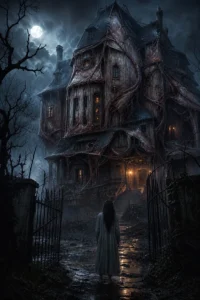
by inkadminRain stitched the windows of the Graves estate in silver thread, relentless and delicate, as if the sky had decided to embroider the whole monstrous house shut.
Seraphina woke to it before dawn, to the hiss against leaded glass and the low groan of old pipes inside the walls. For a moment, in the heavy half-dark, she did not remember where she was. The bed beneath her was too wide, the sheets too smooth, the air too cold and scented faintly of cedar smoke, iron, and roses dying in a vase somewhere beyond sight.
Then the events of the previous night returned in jagged pieces.
Lucien in the warehouse shadows, coat black as spilled ink. A traitor on his knees with blood on his teeth. Men whispering about the Ash Ledger as if it were a weapon, a ghost, a curse. Lucien turning his head at the last impossible second, silver eyes finding the darkness where Seraphina had hidden.
He had seen her.
Of course he had seen her.
The bedroom door opened without a knock.
Seraphina sat up, fingers closing around the nearest object on the bedside table—an antique silver letter opener shaped like a dagger. It was more decorative than deadly, but in the right hand, at the right angle, elegance could become violence.
Lucien stepped inside carrying neither apology nor explanation. Dawn turned him into a creature of ash and bone. His white shirt was open at the throat, his hair still damp from rain, and a faint bruise darkened one cheekbone where last night’s brutality had not left him entirely untouched. He looked infuriatingly beautiful and just as untouchable as the carved saints glaring down from the cathedral windows in the east gallery.
His gaze dropped to the letter opener in her hand.
“Planning to correspond with me?” he asked.
Seraphina tightened her grip. “I was considering a more direct form of communication.”
One corner of his mouth moved. Not quite a smile. Lucien rarely gave expressions freely; he rationed them like ammunition.
“Get dressed,” he said.
“Good morning to you too, husband. Did you come to ask how I slept after discovering you use midnight outings for torture and theatre?”
“I came to tell you that you will no longer be wandering my city alone.”
Seraphina’s pulse gave a sharp, traitorous kick. Not fear, she told herself. Anger. “Your city?”
“Yes.” He said it simply, and somehow the whole room seemed to adjust around the word. “And my house. And, at the moment, my problem.”
The letter opener left her hand before she thought better of it.
Lucien caught it by the handle inches from his chest.
For one suspended second, neither of them moved.
Then he looked at the blade, at her, and the faintest flicker of something hot passed through his eyes.
“You’re improving,” he said.
“You’re still breathing. I’ll try harder next time.”
He set the letter opener on the black marble mantel, far from the bed. “There will not be a next time. From now on, you do not leave the estate without permission. You do not enter the east wing, the lower levels, the garages, or my study. You do not use any phone that has not been given to you by Graves security. You do not receive visitors without my approval.”
Each sentence fell like a lock sliding into place.
Seraphina pushed back the covers and rose, silk nightdress whispering around her legs. She had learned young that dignity was a blade no one could confiscate unless she handed it over. So she stood barefoot on the cold rug and lifted her chin.
“Did our vows mention imprisonment?” she asked. “I must have been distracted by the blood feud and the cathedral full of armed men.”
Lucien’s expression did not change, but his attention moved over her face with the intolerable precision of a man reading coded ink. “Last night, three men saw you near the harbor. One of them is dead. One of them is missing. The third will sell what he saw if I don’t find him first.”
“You mean if you don’t hurt him first.”
“That too.”
Her stomach tightened. She hated that he did not flinch from his own ugliness. Men like her father dressed cruelty in polished speeches and family duty. Lucien wore it like a black coat in the rain, practical and well-cut.
“They think I have something,” she said. “The Ash Ledger.”
His silence was answer enough.
Seraphina stepped closer. “What is it?”
“A story men tell themselves when they need a reason to kill.”
“You’re lying.”
“Constantly,” he said. “But not about this.”
The door behind him opened again. This time, a woman entered.
She was tall, perhaps in her early thirties, with dark brown skin, close-cropped hair, and a scar slashing pale across her mouth like the ghost of a silenced smile. She wore a charcoal suit without ornament and carried herself with the deadly neutrality of a blade left on a table. Her eyes swept the room once, landed on Seraphina, and revealed nothing.
“This is Mara Voss,” Lucien said. “She will be with you whenever I am not.”
Seraphina stared. “You brought me a shadow.”
Mara’s scar shifted as if she might have smiled in another life. “Most people say bodyguard.”
“Most people have poorer vocabularies.”
“Mara was captain of my outer ring before she retired from field operations,” Lucien said.
“Retired?” Seraphina looked at the woman’s hands. Long fingers. Short nails. A faint ridge on one knuckle where it had healed badly after being broken. “She looks remarkably un-retired.”
“I got bored,” Mara said.
Lucien’s gaze remained on Seraphina. “She answers to me.”
“How romantic. Our marriage has acquired staff.”
“It has acquired rules.”
Seraphina laughed, because if she did not, she might do something stupid, like show him the raw panic crawling under her ribs. She had spent her life moving from one curated room to another, always watched, always dressed, always useful. The Vale mansion had been a cage with peeling gilt. She had mistaken the Graves estate for something larger because its halls were longer and its monsters more honest.
But a cage was still a cage, even if the bars were carved from black walnut and lined with silk.
Lucien crossed the space between them. Up close, he smelled like rain and cold smoke. A tiny cut marked the side of his throat. Her eyes betrayed her and went to it.
His voice lowered. “If you had been taken last night, Seraphina, they would not have ransomed you.”
“You don’t know that.”
“I know exactly what they would have done.”
Something in the room changed. The rain sounded louder. Mara looked toward the window as if granting them privacy without leaving.
Seraphina held Lucien’s stare and found, to her irritation, no triumph there. No pleasure in control. Only a dark exhaustion banked beneath discipline.
That almost made it worse.
“You can lock doors,” she said softly. “You can assign guards. You can make rules. But if you wanted an obedient wife, you should have married someone with less imagination.”
His eyes dropped to her mouth. The motion was brief. Damning. “I didn’t marry you because I thought you were obedient.”
Before she could answer, he turned away.
At the threshold, he paused. “Breakfast at eight. Wear something warm. The estate is old and drafty.”
“How thoughtful.”
“And Seraphina?”
She hated the way her body stilled when he said her name.
Lucien looked back over his shoulder, face half-shadowed. “If you steal from me again, make sure you understand what you’re taking.”
The door closed behind him with a soft, final click.
For several seconds, Seraphina stood in the cold room with her pulse beating hard in her throat.
Mara Voss broke the silence. “Do you usually throw cutlery at people who annoy you?”
“Only before breakfast.”
“Good to know.”
Seraphina turned. “Are you here to protect me or report on me?”
“Yes.”
Despite herself, Seraphina smiled thinly. “At least you’re efficient.”
“Efficiency keeps people alive.” Mara moved to the window and drew back the curtain two fingers’ width. Beyond the glass, the gardens drowned beneath rain, their winter hedges black and glossy. “Lord Graves has enemies who would peel this house apart board by board if they thought it would hurt him.”
“I wasn’t under the impression affection was involved.”
Mara glanced back. “Affection is irrelevant. Symbolism is not.”
Seraphina tasted bitterness. “I’m a flag planted in enemy territory.”
“You’re a Vale inside Graves walls.”
“That’s not protection. That’s display.”
“Sometimes display keeps knives sheathed.”
Seraphina crossed to the wardrobe and pulled it open. Inside hung garments she had not chosen: dark wool dresses, silk blouses, tailored trousers, coats lined in satin, all in colors that suited the house more than her. Black. Smoke. Wine. Ivory. Lucien’s staff had dressed her life before she had woken to live it.
She chose a high-necked dress the color of dried blood and shut the wardrobe harder than necessary.
“Turn around,” she said.
Mara did.
Seraphina changed quickly, used to maidservants and measuring eyes, though she had never grown used to the quiet theft of privacy. As she fastened the row of pearl buttons at her wrist, her gaze found the mantel.
The letter opener was gone.
Lucien had taken it without her noticing.
Her anger sharpened into something cleaner.
Fine.
If he wanted surveillance, he would learn what the watched could see from inside their cages.
Breakfast was served in a glass conservatory where rain drummed above like impatient fingers. The estate’s winter garden spread around the table in lush defiance: orange trees heavy with bitter fruit, white camellias blooming like secrets, dark ferns unfurling from copper pots. Everything smelled of damp soil and expensive coffee.
Lucien was not there.
At Seraphina’s place sat a black phone, a slim card embossed with the Graves crest, and a small velvet box.
She did not touch any of them.
Mara stood near the entrance, hands folded, gaze sweeping through reflections in the glass.
A footman poured coffee. Another served eggs with herbs, smoked fish, figs glistening with honey, and bread still steaming from the oven. The table could have fed six. It fed only Seraphina and the empty chair at the far end.
“Does he always make decrees and then vanish?” Seraphina asked.
Mara’s eyes remained on the garden. “Often.”
“How kingly.”
She lifted the card. It was heavier than it looked, matte black, with a silver strip along one edge.
AUTHORIZED ACCESS: RESIDENTIAL FLOORS, WEST GARDEN, CONSERVATORY, LIBRARY, CHAPEL, DINING WING
RESTRICTED: EAST WING, SECURITY LEVEL, MOTOR COURT, ARCHIVE, STUDY, ARMORY
Seraphina read it twice, then smiled.
“An itinerary for my humiliation.”
“Most guests receive less,” Mara said.
“I’m not a guest.”
“No.”
The word settled between them with unexpected weight.
Seraphina opened the velvet box.
Inside lay a bracelet.
At first glance it was exquisite: a slender band of white gold shaped like interlocking thorns, small diamonds set where dew might cling. It was beautiful in the way a snare could be beautiful when laid beneath moonlight.
She did not need Mara’s expression to know.
“Tracker?”
“And panic trigger,” Mara said. “Press the center thorn for three seconds.”
“Does it also tighten if I stray too far from the property line?”
“No.”
“How merciful.”
Mara came forward and picked up the bracelet. “May I?”
Seraphina considered refusing out of principle. Then she extended her wrist.
The metal was cool as Mara clasped it around her. It fit perfectly. Of course it did. Somewhere, someone had measured her while she slept or copied dimensions from Vale records. The thought made her skin prickle.
“Do you hate him?” Seraphina asked suddenly.
Mara’s fingers paused, then withdrew. “No.”
“Admire him?”
“Sometimes.”
“Fear him?”
Mara looked at her then. The scar across her mouth pulled tight. “Everyone sane fears Lucien Graves.”
“Do you?”
“I’m alive because I do.”
It was not the answer Seraphina expected. It sat with her through breakfast, through the bitter coffee and honeyed figs, through the footmen’s quiet movements and the rain blurring the world beyond the glass.
Afterward, Mara escorted her through the permitted parts of the estate.
Escorted. Such a civilized word for being followed.
The Graves estate had been built by men who believed God could be impressed by architecture. Its corridors soared and narrowed by turns, all pointed arches, carved banisters, marble saints, and ancestral portraits whose eyes had been painted with predatory patience. Electric sconces glowed like captive candles. Cameras hid in corners behind filigreed grilles. Seraphina counted them as she walked.
One above the music room door.
Two in the long gallery.
One tucked in the throat of a bronze gargoyle near the stairwell.
A motion sensor beneath the console table holding lilies too fresh for such a dead house.
Lucien had given her a prison, but every prison had habits. Every lock had a maker. Every guard had a rhythm.
By noon, she knew Mara favored her right ear, likely because the left had been damaged. She knew the footmen changed posts on the quarter hour. She knew the west garden doors required the black card but not a thumbprint, while the library doors unlocked automatically when approached from inside the hall.
And she knew Lucien’s study was not merely restricted.
It was protected like a reliquary.
They passed it once on the second-floor corridor, a pair of black oak doors banded in steel. No visible handle. A small brass plate held the Graves crest: a thorned crown above a burning tree. Above the door, almost invisible beneath carved molding, a camera angled downward.
Mara did not slow.
Seraphina did.
“What’s in there?”
“Paperwork,” Mara said.
“Men do kill for paperwork.”
“In this family? Frequently.”
Seraphina let her fingers brush the wall as they walked on. The paneling near the door vibrated faintly, a buried hum of electronics. Good. Not antique locks, then. Codes, cards, perhaps biometric confirmation. Modern bones under gothic skin.
Lucien Graves had secrets, and he had made the mistake of surrounding Seraphina with locks.
Locks had always soothed her. They were honest. They did not pretend to be anything other than a challenge.
The library became her battlefield.
It occupied two floors, with wrought-iron balconies and rolling ladders, its shelves rising into shadow. A fire burned in a hearth large enough to roast a saint. Rain trembled against tall windows. The air smelled of leather, paper, and old smoke.
Mara stationed herself near the door.
“Do you read?” Seraphina asked.
“When no one is trying to kill me.”
“That must be limiting.”
“You have no idea.”
Seraphina selected a book at random, a crumbling volume on maritime law, and sat at a long table beneath a green-shaded lamp. She opened it. Inside, the pages were brittle, the language dry enough to desiccate the soul.
Perfect cover.
From the corner of her eye, she watched reflections in the dark window glass.
At twelve fifteen, a footman appeared with tea. At twelve twenty, Mara accepted a cup and stood with it in her right hand. At twelve twenty-three, she lifted her left hand to touch the scar near her mouth. At twelve twenty-five, her gaze shifted toward the hall at the sound of distant footsteps.
Seraphina reached into her sleeve.
During breakfast, she had palmed a silver dessert fork and snapped off one slender tine beneath the edge of the table while pretending to cut a fig. Now that polished sliver rested against the inside seam of her cuff.
She withdrew it and used it to worry loose the brass corner of the lamp’s base.
The movement was tiny, hidden by the book and her bent head. Her father had once said her hands were her mother’s hands—pretty, useless things made for piano and prayer. He had never noticed how quickly they learned other work in rooms where men ignored daughters.
Under the lamp base, she found what she had hoped for: a maintenance plate, two small screws, and a cable threaded through the table into the floor. The library had been renovated recently. The green lamps were not merely lamps. They were networked, probably part of the estate’s internal system, perhaps controlling light, audio, maybe even silent alerts.
Seraphina smiled at maritime law.
“Interesting book?” Mara asked.
“Devastating. I may never recover from subsection twelve.”
“Try not to die. It creates paperwork.”
By the time tea had cooled, Seraphina had loosened the plate enough to see a tiny service port. Not useful by itself. But useful if one knew someone would eventually come to repair the lamp.
So she made sure it would need repairing.
A subtle twist. A scrape of metal. A wire nicked just enough.
The lamp flickered once, twice, and went out.
Seraphina sat back with a sigh. “How tragic.”
Mara’s eyes narrowed.
“It was like that when I found it,” Seraphina said sweetly.
Within eight minutes, a maintenance technician arrived.
He was young, sandy-haired, and nervous in the way all lower-level Graves employees became nervous when placed within ten feet of the new Vale wife. His name badge read OWEN KERR. A tool roll hung from one hand; a tablet from the other.
Mara stood beside him as he worked.
Seraphina continued reading about maritime disputes while listening to every tap on his tablet.
“Internal lighting fault,” Owen murmured. “Need override.”
“Use your own credentials,” Mara said.
“Can’t for the library grid. It’s tied to central. I need a supervisory code.”
Seraphina turned a page.
Mara sighed and tapped her earpiece. “Voss requesting temporary maintenance override, library north table.”
A pause.
Owen shifted his tablet, angling it poorly. Seraphina saw only the reflection in the polished table.
Six digits appeared.
Not enough.
Then Mara leaned in, thumbed something at her wrist, and the full authorization string flashed mirrored beneath the lamp’s dead shade.
VOSS-M7 / 491173 / GARDEN-WEST TOKEN ACTIVE / EXP 13:00
Seraphina did not look at it directly. Direct looking was for amateurs and guilty people. She looked at the book, at subsection twelve, and stored each character in the quiet room of her mind where she kept useful things.
VOSS-M7.
491173.
Garden-west token active.
Expiration thirteen hundred.
A temporary token. Limited access. But tokens had pathways, and pathways had doors at both ends.
Owen fixed the lamp. Seraphina thanked him with a smile calibrated to produce mild devastation. He blushed to his ears and nearly dropped a screwdriver.
Mara did not appear amused.
When Owen left, Seraphina closed the book. “I’d like to walk in the garden.”
“It’s raining.”
“I noticed. The windows have been screaming about it all morning.”
“Lord Graves said—”
“West garden is permitted.” Seraphina held up her black card between two fingers. “It says so right here. Unless the card is decorative, like my marriage.”
Mara stared at her long enough that most people would have wilted.
Seraphina did not.
At last, Mara said, “Coat.”
The west garden lay behind wrought-iron doors and a corridor lined with frost-clouded glass. Rain softened the world outside into shades of slate and green. Box hedges formed geometric paths around skeletal rosebushes. Stone angels stood with moss in their wings and water running like tears down blind faces.
Seraphina pulled her hood up and stepped into the storm.
Cold struck her cheeks. Mud sucked at the soles of her boots. The estate rose behind her, all turrets and black windows, more fortress than home. Somewhere beyond the walls, Blackthorn City breathed in smoke and neon, its harbor bells muffled by rain, its alleys full of men whispering about ledgers and blood.
Mara followed at a measured distance.
The tracker bracelet pressed against Seraphina’s wrist like a second pulse.
“You don’t have to walk behind me,” Seraphina said.
“Yes, I do.”
“Do you ever tire of obedience?”
“Less than I tire of burying reckless people.”
Seraphina stopped beneath a leafless arbor. Rain dripped from the lattice overhead. “Did Lucien tell you what happened last night?”
“Enough.”
“Did he tell you they said I have the Ash Ledger?”
Mara’s face altered so slightly most would have missed it. A tightening around the eyes. A breath held half a beat too long.
Seraphina missed very little.
“You know what it is.”
“I know better than to discuss ghost stories in the rain.”
“How poetic.”
“How practical.” Mara stepped nearer. Water beaded on her lashes. “Listen carefully, Mrs. Graves. There are words in this city that are not words. They are tripwires. Say them in the wrong room, and people start dying.”

0 Comments