Chapter 3: Blackthorne House
by inkadminThe rain followed Seraphina Vale all the way to Blackthorne House.
It clung to the windows of the carriage in crooked silver veins, blurring Thornwick into a smear of gaslamps, wet cobblestone, and mourning-black rooftops. Behind her lay the city—the cathedral where her father’s coffin still sat beneath wilting white lilies, the townhouse that no longer belonged to her, the servants who would be paid off or threatened into silence by dawn. Behind her lay the last hour in which she had been a Vale instead of a Blackthorne.
A ring weighed on her finger like a shackle.
It was not ornate. That surprised her more than it should have. No gaudy diamond, no declaration of wealth meant to dazzle the envious. Lucian Blackthorne had slid onto her hand a band of blackened gold set with a single shard of dark red stone that looked less like a ruby than a clot of hardened blood. It had been warm when he touched her, as if it had come from his own body.
She had not flinched.
Not when the magistrate muttered the vows in a chapel so empty the echoes seemed embarrassed. Not when Lucian spoke his answers in that low, beautiful voice of his, each word precise enough to cut glass. Not when he signed the marriage register after her, and his name devoured hers in ink.
Lucian sat across from her now, one ankle crossed over the other, gloved hands resting on the silver head of his cane. The carriage lantern threw gold across the sharp planes of his face and left his eyes in shadow. He had not spoken since they left the chapel.
Seraphina preferred it that way.
Silence had always been easier to endure than lies.
Outside, the horses climbed a road that curled along the cliffs north of the city. The sea roared somewhere beyond the curtain of rain, not visible but always present, a beast dragging chains against the rocks. Wind struck the carriage hard enough to make the wood groan. Seraphina braced one hand against the seat, then immediately hated herself for showing she had been moved.
Lucian noticed. Of course he noticed. His gaze flicked to her fingers, to the white pressure of her knuckles, and then back to her face.
“You’ll grow accustomed to the road,” he said.
“I have no intention of growing accustomed to anything about you.”
One corner of his mouth lifted, barely. Not a smile. A blade remembering it had an edge.
“That will make your life tiring.”
“I have endured funerals, creditors, and your proposal in the same day. I suspect tiredness and I are now intimate acquaintances.”
His eyes, pale as winter sea glass, held hers. “You should rest when we arrive.”
“How considerate. Do you allow all your prisoners a nap after abduction?”
“Only the expensive ones.”
She hated the small, traitorous spark his answer struck in her. Not amusement. Never that. It was simply that Lucian Blackthorne did not speak like a brute, and she wished he would. It would be easier if he snarled. Easier if he reeked of gin and violence, if he wore his cruelty as visibly as the bruised clouds over Thornwick.
Instead he sat opposite her like a portrait of a fallen saint, all elegance and restraint, as if men did not whisper his name in back rooms, as if entire docks did not go quiet when his carriages rolled past, as if her mother’s blood had not once dried under the shadow of his family crest.
Seraphina turned away first.
Through the rain, Thornwick’s last lanterns disappeared behind them. The road narrowed, flanked now by black pines that bent under the storm. Their branches scraped the carriage roof with skeletal fingers. Somewhere in the trees, a crow cried once and was swallowed by the wind.
Then the estate appeared.
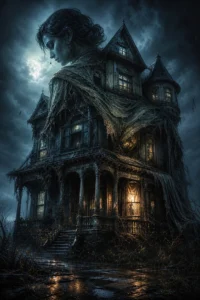
Blackthorne House did not rise from the cliff so much as crouch upon it, a vast structure of dark stone and iron-laced glass, its towers thrusting into the storm like broken spears. It had been built before Thornwick learned to pave its streets, before the Vale merchant princes bought their first ships, before the city’s old families decided bloodlines mattered more than bodies. The house had watched generations drown below its cliffs and had never once looked away.
Lightning tore across the sky, and for one breath Seraphina saw everything: the steep slate roofs shining black with rain, the gargoyles hunched along the gutters, the narrow windows glowing like watchful amber eyes. Beyond the house, the sea churned white against jagged rocks far below. A wrought-iron gate stood open ahead of them, each bar tipped with thorns.
At the center of the gate, worked in metal, was the Blackthorne crest: a raven with its wings spread over a crown of brambles.
The carriage passed beneath it.
Seraphina felt the old world close behind her with a sound no louder than a breath.
Marry him by midnight, or Elias disappears into a debt no court will ever acknowledge.
Her brother’s face flashed in her mind—pale, furious, pretending not to be frightened as Lucian’s man described numbers their father could not have paid in three lifetimes. Elias, fifteen and too thin in his funeral suit, still believing rage was protection. Elias, who had squeezed her hand when the coffin lid closed.
Seraphina curled her fingers into her palm until the ring bit skin.
I will survive this house. I will learn every weakness in its walls. And then I will bring it down.
The carriage halted before a stone portico supported by pillars carved as twisting trees. Servants waited under the overhang, lined in two rows, their black uniforms severe and their faces carefully empty. Not one held an umbrella.
The footman opened the door. Rain swept in with a cold, briny slap.
Lucian stepped down first. He did not offer his hand.
Good, Seraphina thought. She would rather fall onto the gravel than accept his assistance.
She gathered the skirts of her black mourning dress and descended into the storm. The wind caught her veil and tore it back from her face. Salt stung her lips. The hem of her gown drank rain at once, growing heavy around her ankles.
Lucian stood beside her, untouched in the absurd way of men who had convinced the world to fear inconveniencing them. His dark coat snapped in the wind, and dampness turned his black hair to ink at his temples. He looked at the house, not at her.
“Welcome home, Lady Blackthorne.”
The name struck worse than rain.
Seraphina looked toward the servants. Several dropped their eyes at once. One older woman near the front did not. She was tall, narrow, dressed in severe charcoal, with silver hair twisted into a knot so tight it seemed painful. Her face bore the disciplined calm of a person who had seen fires start and decided whether to fetch water based on who was burning.
Lucian turned to her. “Mrs. Hawthorne, this is my wife.”
The older woman inclined her head. “My lady.”
Her voice was dry paper and iron filings.
“Mrs. Hawthorne manages the house,” Lucian said. “If you require anything, ask her.”
Seraphina met the woman’s gaze. “Anything?”
For the first time, a flicker crossed Mrs. Hawthorne’s face. “Anything appropriate.”
“How quickly you’ve learned my limitations.”
A whisper traveled through the row of servants like a match flame under a door. Lucian’s eyes moved, and the sound died instantly.
Seraphina noted it.
Fear did not merely live here. It had been trained.
Lucian ascended the steps. “Come in before you freeze out of spite.”
“Spite keeps me warm.”
“Not on these cliffs.”
She followed him beneath the portico and through doors tall enough for giants. The entrance hall swallowed her.
Blackthorne House smelled of rain-soaked stone, beeswax, old smoke, and flowers on the edge of rot. The floor was black-and-white marble, veined like bone, stretching toward a grand staircase that split halfway up and curled toward opposite wings. Above them hung a chandelier of antlers and crystal, every candle lit, every flame wavering though Seraphina felt no draft.
Portraits covered the walls.
Generations of Blackthornes stared down from gilded frames: pale men with long fingers and colder eyes; women with throats draped in pearls, their mouths painted as if they had never laughed; children dressed like small corpses in velvet and lace. The painted faces might have been beautiful once. Some still were.
But their eyes had been scratched out.
Not all. Not even most. But enough.
A woman in emerald silk near the staircase had deep gouges torn across both eyes, the canvas shredded to threads. A young man with Lucian’s cheekbones wore a slash from temple to jaw, the paint peeled away in angry curls. Two children in a single portrait had been mutilated so savagely their faces were nearly gone.
Seraphina stopped.
Rain dripped from her veil to the marble.
Lucian paused two steps ahead, back turned.
“Your decorator has an unusual relationship with ancestry,” she said.
The servants behind them went still.
Lucian looked over his shoulder. In the candlelight, his face was unreadable. “Some ancestors deserve worse than damage.”
“And yet you keep them on the walls.”
“Reminders are useful.”
“Of what?”
His gaze settled on a portrait high above the staircase—an older man with white hair and a mouth like a locked door. His painted eyes remained intact. They had been rendered so pale they almost disappeared.
“That blood is not the same as loyalty.”
Something in his voice cooled the hall more thoroughly than the storm.
Mrs. Hawthorne stepped forward. “Your rooms have been prepared, my lady. If you will come—”
“No.” Lucian’s cane touched the marble with a soft click. “I will show her.”
The housekeeper’s composure did not crack, but it tightened. “As you wish, my lord.”
Seraphina caught it—the fraction of hesitation, the faint narrowing of the servants’ mouths. Lucian escorting her himself was not expected. Perhaps wives were ordinarily delivered like parcels. Perhaps wives did not last long enough to learn the way.
“How charming,” Seraphina said. “A tour from the executioner.”
Lucian began walking. “Executioners are generally punctual, at least.”
“I was at my father’s funeral.”
“I know.”
Two words. No apology. No defense. No tenderness. Yet for one treacherous instant she remembered the way he had stood in the cathedral doorway, rainwater on his shoulders, eyes fixed not on the coffin but on her—as if he had arrived too late to stop something and hated the entire world for it.
She crushed the thought beneath her heel and followed.
The entrance hall opened into a corridor lined with dark wainscoting and more portraits. Their footsteps carried strangely, sometimes too loud, sometimes muffled as if the house chose when to listen. On their left, an arch revealed a drawing room where furniture huddled under white dust sheets despite the lit fire. On the right, double doors stood chained shut, the brass handles bound with an old padlock.
Seraphina slowed.
Lucian did not.
“Do you lock away many rooms?”
“Enough.”
“An exact answer. How generous.”
“You’ll find I am generous only when it serves me.”
“Then I will take nothing from your hand.”
“You already have.”
He did not look back, but his words slid between them and tightened around her throat. The ring. The name. The terrible bargain made under church candles while her father’s body cooled in the next room.
She quickened her pace until she walked beside him. “Do you enjoy it?”
“You’ll need to be more specific.”
“Cornering people. Buying them. Watching them choose the blade because you’ve set fire to every door.”
His jaw shifted once. “No.”
“Liar.”
“Often.” He glanced down at her. “Not now.”
The simplicity of it struck harder than another cruel answer would have. Seraphina hated that, too.
They passed a narrow window where lightning flashed over the cliffs. For a second, her reflection appeared beside his in the glass—her face pale beneath damp dark hair, his tall shadow angled toward her. They looked like strangers caught inside the same frame.
At the base of the east staircase, Lucian stopped. “Your rooms are in the south wing. Mine are in the north.”
“Separate rooms? Already the happiest portion of our marriage.”
“Do not mistake distance for freedom.”
“Do not mistake a ring for obedience.”
His eyes sharpened, and the space between them seemed to lose air. “I don’t require obedience from you, Seraphina.”
Her name in his mouth felt indecently intimate, though he had spoken it softly.
“What do you require, then?”
“That you stay alive.”
The storm groaned against the windows.
Seraphina’s pulse stuttered, then steadied. “How romantic. Most husbands ask for fidelity.”
“Most husbands are fools.”
“And you are not?”
“Not about survival.”
He turned before she could answer and led her up the south staircase. The carpet runner was burgundy, worn in the center by generations of feet. Along the landing, more paintings watched. Some had black cloth tied around their frames. One portrait had been turned entirely toward the wall.
Seraphina’s curiosity dug its nails into her.
“Who are they?” she asked.
“Dead people.”
“Your conversational skill is a wonder.”
“You asked a broad question.”
“Fine. Why are their eyes scratched out?”
Lucian’s cane clicked once, twice. “Because someone didn’t like being watched.”
“Who?”
“The dead ask fewer questions.”
“I’m not dead.”
“Then you should ask better ones.”
She nearly smiled. The impulse horrified her. She looked away and examined the corridor instead.
The south wing was warmer than the entrance hall, lit with brass sconces and carpeted in faded blue. Yet the warmth had the quality of a fever beneath skin. Doors stood closed at regular intervals, each marked by a small silver plaque. A maid carrying folded linens froze when she saw Lucian. Her eyes darted to Seraphina, widened, then dropped.
“Good evening,” Seraphina said.
The maid bobbed so quickly the linens almost slipped. “My lady.”
Her voice trembled.
“Your name?”
The girl glanced at Lucian.
Seraphina felt anger stir—hot, clean, useful. “I asked you, not him.”
The maid swallowed. She could not have been older than seventeen, with freckles scattered across her nose like spilled cinnamon. “Mara, my lady.”
“Thank you, Mara.”
The girl looked as though gratitude were a language she had forgotten. Lucian said nothing, but his gaze lingered on Seraphina with an expression she could not read.
They moved on.
“You frighten them,” Seraphina said when the maid’s footsteps faded.
“Yes.”
“You don’t deny it.”
“Would you respect me more if I pretended otherwise?”
“I wasn’t aware my respect was something you wanted.”
“It isn’t.”
A pause.
Then, quieter, he added, “But I would prefer not to have your contempt wasted on inaccuracies.”
She looked at him sharply. He continued walking, face turned forward, lashes casting shadows beneath his eyes.
Before she could find a reply sharp enough, they reached a pair of carved doors at the end of the corridor. Lucian opened them without ceremony.
The room beyond stole her breath, and she resented it.
Her bedchamber was vast, round-walled where it occupied the curve of a tower, with windows overlooking the sea. The storm pressed against the glass in sheets, but inside, a fire burned high in a black marble hearth. A four-poster bed draped in ivory stood upon a blue-and-silver rug. There were shelves of books, a writing desk stocked with paper, a dressing screen embroidered with moths, and a copper tub near an adjoining washroom where steam already curled into the air.
On the mantel stood a vase of white lilies.
Seraphina went cold.
Lucian’s gaze followed hers.
For the first time since the chapel, something like anger broke through his control. It was not loud. That made it worse. His voice dropped to a razor’s edge.
“Who placed those here?”
No one answered. The room was empty, yet the question seemed to strike the walls.
Mrs. Hawthorne appeared in the doorway as if summoned by the scent of blood. “My lord?”
Lucian did not turn. “The lilies.”
The housekeeper looked at the mantel. Something flickered across her face—surprise, then alarm so quickly suppressed Seraphina almost missed it.
“They were not on the list,” Mrs. Hawthorne said.
“Remove them.”
“At once.”
Seraphina stepped forward before the housekeeper could move. “Leave them.”
Lucian looked at her.
“My lady,” Mrs. Hawthorne said carefully, “perhaps—”



0 Comments