Chapter 1: The Funeral Bride
by inkadminSeraphina Vale met her husband for the first time beside her father’s open grave.
Rain fell like a punishment over Thornwick Cemetery, hard and silver and endless, drumming against the black umbrellas gathered in a crescent around the pit where Lord Edmund Vale was being returned to the earth he had spent his life pretending he owned. Water slicked the marble angels. It ran in trembling veins down their blind faces, filled the carved folds of their robes, and gathered at their stone feet like offerings.
Seraphina stood at the front of the mourners without an umbrella.
Let them see her soaked. Let them see the only daughter of Vale House with rain in her hair and mud at the hem of her mourning dress. Let them whisper that grief had made her careless, that ruin had made her mad, that she had inherited her father’s pride and none of his fortune. Their whispers were already moving beneath the rain—silk-soft, venomous, eager.
“Poor girl.”
“Poor? She still has the house, doesn’t she?”
“For now.”
“They say the creditors were at the gates before the body was cold.”
“They say many things when a Vale dies.”
Seraphina heard all of it.
She had a talent for hearing what people thought they had hidden. Half a syllable behind a glove. A truth tucked under a sigh. A lie dressed in perfume and sympathy. It had served her well in drawing rooms where women smiled like knives and men made fortunes by deciding which family would drown next.
Today, it only made her want to scream.
Beside her, her younger brother shivered under a too-large coat. Elias was fifteen, all sharp wrists and hollow cheeks beneath hair the same storm-dark brown as hers. He stared at the coffin as if willing it to open, as if their father might sit up laughing and declare the whole thing one of his crueler lessons. He had not cried. Seraphina wished he would. It would have been more human than the stillness that had settled over him since dawn.
She reached for his hand.
His fingers were ice.
The priest’s voice blurred beneath the downpour.
“—ashes to ashes, dust to dust—”
No.
The thought came cold and clear, sharper than sorrow.
Her father was not dust. Dust was harmless. Dust settled quietly on mantels and old portraits. Edmund Vale had been a storm in tailored wool, a man whose laughter filled rooms and whose temper emptied them. He had built investments on handshakes and threats, hosted dinners beneath chandeliers while his ledgers bled red, kissed Seraphina’s forehead with brandy on his breath and secrets in his pockets.
He had been dead for three days.
Already, Thornwick had come to feed.
They had arrived in black carriages with polished wheels, in motorcars that purred at the cemetery gates, in veils beaded with rain, in fur collars and gloves stitched from sins. The Ashcrofts, pale and refined. The Merrows, smiling despite their old feud with the Vales. Representatives from the harbor syndicate. Bank men with faces like wax. All of them gathered beneath umbrellas as dark as crows’ wings.
But there was one man no one stood near.
He waited beyond the iron fence at the edge of the cemetery, beneath the skeletal branches of a yew tree, untouched by the crowd’s murmurs though every murmur seemed to bend toward him. His umbrella was held by another man—a broad-shouldered shadow in a long coat—but the gentleman beneath it stood as if rain, cold, and grief were inconveniences meant for lesser creatures.
Seraphina noticed him because everyone else was pretending not to.
Lucian Blackthorne.
Even if she had not recognized his face from newspaper sketches and whispered descriptions, she would have known him by the way fear made room.
He was tall, dressed in black so precisely cut it made the mourning clothes around him look like costumes. The wind stirred the edges of his coat. His hair was as dark as wet ink, swept back from a face too composed to be handsome in any gentle way. Beautiful, yes, if one admired winter oceans and sharpened blades. His cheekbones seemed carved for candlelight; his mouth was unsmiling; his eyes, from across the distance, looked almost colorless.
A scar cut faintly through one brow, pale as a thread of lightning.
Seraphina’s fingers tightened around Elias’s.
Blackthorne.
The name tasted of old smoke.
In Thornwick, children were frightened into obedience with stories of the Blackthornes. Not monsters under the bed, no. Worse. Men in fine houses. Men who owned judges and docks and the loyalty of those too desperate to refuse them. Men whose enemies washed ashore in pieces after storms, though the coroner always found some polite way to blame the sea.
And Lucian Blackthorne was their current lord.
Ruthless. Young, compared to the men who bent their gray heads when he entered a room, but already feared more than his father and twice as controlled. He ran the Blackthorne syndicate from the cliffside estate north of the city, where the sea slammed itself bloody against stone and lamps burned at all hours behind iron-framed windows.
He was also the man Seraphina had been raised to hate.
The priest’s prayer ended. The final words were swallowed by thunder.
One by one, mourners stepped forward to drop white lilies onto the coffin. The flowers struck the polished lid and slid in the rain, their petals bruised almost immediately. Seraphina did not move. Her hand remained locked around Elias’s as the coffin began its slow descent.
Ropes creaked. Mud sucked. The pit accepted her father with a wet, obscene hunger.
Something in Elias’s throat broke.
Not a sob. Smaller. Worse.
Seraphina turned and pulled him against her. He came without resistance, stiff and trembling, his forehead pressing into her shoulder. She held him as she had when he was little and thunder shook Vale House, before their mother died, before their father became a stranger who measured affection in absences.
“I have you,” she whispered into his soaked hair. “Do you hear me? I have you.”
His hands clutched the back of her dress.
“Promise?” His voice was barely more than breath.
Seraphina looked over his shoulder at the open grave. Rain slid down her lashes, and beyond the veil of it she saw Lucian Blackthorne watching her.
Not the coffin.
Not the priest.
Her.
“I promise,” she said.
A promise was a dangerous thing in Thornwick. Her father had taught her that. Promises were hooks hidden under velvet. But this one she meant with every hard, grieving piece of herself.
The mourners began to disperse as soon as politeness allowed. Condolences came like damp paper pressed into her hands.
“If you need anything, dear child…” Lady Ashcroft said, leaning close enough for Seraphina to smell violet water and greed. Her gaze flicked over Seraphina’s dress, noting last season’s cut, the mended lace at one cuff. “Anything at all.”
“How kind,” Seraphina replied. “I will be sure to send for you when I require someone to count my spoons.”
Lady Ashcroft’s mouth tightened.
Elias made a strangled sound that might, on a better day, have become a laugh.
Mr. Pellar from the First Bank of Thornwick offered his gloved hand and eyes full of false moisture. “Your father was a remarkable man.”
“He was,” Seraphina said. “He owed everyone remarkable sums.”
The banker withdrew his hand as if she had bitten him.
Good.
Let them recoil. Let them remember she had teeth.
By the time the cemetery had emptied to a scatter of servants, gravediggers, and the most stubbornly curious, Seraphina’s boots were half-sunk in mud. The rain had softened the careful coils of her dark hair until strands clung to her cheeks and throat. Her black dress weighed on her like a second skin, cold and unforgiving.
“We should go,” Elias said.
His voice had returned to its flat, careful place.
Seraphina glanced toward the gate.
The Blackthorne carriage remained.
It waited like a hearse, drawn by two black horses with glossy flanks and iron-colored eyes. No crest gleamed upon the door. The Blackthornes did not need to announce themselves. People simply knew when death had arrived in better tailoring.
Lucian Blackthorne was no longer under the yew tree.
He was walking toward her.
The cemetery seemed to notice. The gravediggers lowered their voices. A footman near the path stopped moving entirely. Even the rain felt different around him, as if reluctant to strike too hard.
Elias went rigid beside her.
“Sera,” he whispered.
“Stand behind me.”
“I’m not a child.”
“Today you are whatever keeps you alive.”
He obeyed, though anger sparked briefly through his grief.
Lucian stopped three paces away. Close enough that Seraphina could see his eyes were not colorless after all, but a pale gray touched with blue, like the sea before it swallowed a ship. Rain clung to his lashes. None of it softened him.
“Miss Vale,” he said.
His voice was low, smooth, and carried beneath the storm as if it owned the air between them.
“Lord Blackthorne.” She did not curtsy. “You are far from your cliffs.”
“Not so far.”
“If you came to pay respects, you are late.”
His gaze moved briefly to the grave, then back to her. “I rarely pay what is not owed.”
Seraphina’s mouth curved without warmth. “How efficient. That must be why half the city fears you and the other half works for you.”
“There is a third half.”
“Thornwick arithmetic has suffered since you began buying schools?”
Something moved in his eyes. Not amusement. Something colder that recognized an edge and did not dislike it.
“The third half,” he said, “lies about both.”
Behind him stood the broad man who had held his umbrella, expressionless as a church door. A driver waited by the carriage. No one else approached.
Seraphina lifted her chin. “Then say what you came to say. My brother is cold, and I have reached my tolerance for men looming over holes today.”
Lucian looked past her.
“Elias Vale.”
Elias did not step out. “My lord.”
“You have your father’s eyes.”
Seraphina felt her brother flinch.
Her voice went soft. That was when people who knew her best became careful. “Mention my father to him again, and I will forget you are considered frightening.”
Lucian’s attention returned to her. The rain traced the hard line of his jaw.
“Come with me.”
She stared. Then laughed once, sharp enough to cut. “No.”
“This is not a request.”
“Then you have mistaken me for someone accustomed to obeying men in cemeteries.”
His gloved hand emerged from his coat. Between two fingers he held an envelope, thick cream paper sealed in black wax. The seal bore no crest. Only the impression of a thorned branch.
Seraphina did not take it.
“What is that?”
“Your future.”
“Burn it.”
“Your father already tried.”
The words landed with a weight she did not understand at first. Then the shape of them opened, revealing teeth.
Seraphina’s eyes narrowed. “Explain.”
Lucian glanced toward the nearest remaining mourners—two women pretending to adjust veils while straining to listen. “Not here.”
“Here is perfect. My father loved an audience.”
“Your father loved an escape.”
“My father is dead.”
“Not dead enough to stop causing trouble.”
For one violent second, Seraphina saw herself slapping him. The image was bright and satisfying. Her hand twitched.
Lucian noticed. Of course he did.
“Careful,” he murmured.
“Afraid I’ll bruise you?”
“Afraid you will enjoy it too much and forget we have urgent matters.”
Heat flashed under her wet skin, born of fury and something more humiliating because it had no place at her father’s grave. She hated him for putting it there.
“There is no we, Lord Blackthorne.”
“There will be before midnight.”
Elias stepped out from behind her. “What does that mean?”
Lucian’s gaze cut to him. “It means your father signed a contract.”
Seraphina’s heart gave one hard knock against her ribs.
Contracts. Debts. Midnight.
She had known ruin was coming. For weeks, perhaps months, she had known it by the servants’ wages arriving late, by silver disappearing from locked cabinets, by her father’s study smelling of smoke at dawn. She had found lists of creditors hidden inside old poetry books. She had seen names that should not have been written in the same ink as Vale.
But Lucian Blackthorne’s name had not been among them.
She would have remembered.
“My father signed many things,” she said. “Most of them after too much whiskey.”
“This one was signed in blood.”
Thunder cracked over the cemetery.
For a heartbeat, the world became white rain and black stone.
Seraphina reached for the envelope then, not because she wanted it, but because ignorance had always offended her more than pain. Lucian released it. Their gloved fingers did not touch.
The wax seal split beneath her nail.
Inside lay a folded document, the paper heavy and faintly warped as if it had once been damp. She opened it. Rain threatened the ink, but the words held fast—dark, deliberate, cruelly formal.
Her eyes moved over the lines.
Debt acknowledgment. Security pledged. Collateral named. Fulfillment required upon death or default. Witnessed by signatures she recognized only from the worst corners of Thornwick rumor.
Then she saw her own name.
Seraphina Lenore Vale.
Not as daughter.
Not as heir.
As bride.
The cemetery tilted.
She forced it still.
“No.” Her voice did not shake. She was proud of that. “This is a forgery.”
“It is not.”
“My father would never—”
She stopped.
It was the wrong lie, and Lucian heard it die in her mouth.
Her father would. If frightened enough. If cornered enough. If convinced there was no other way to save himself. Edmund Vale had loved his children in a manner both fierce and defective, like a man admiring fine glass while standing too close to the edge of a table. He would have sworn he was protecting her even as he sold her.
Seraphina looked at the signature.
Edmund Vale’s bold hand slashed across the bottom of the page. Beside it, a dark smear had dried to brown.
Blood.
Her stomach turned.
Elias grabbed the document from her before she could stop him. His face drained as he read.
“This says…” His voice broke. “Sera, this says you have to marry him.”
Lucian did not move. “By midnight.”
“That is absurd,” Seraphina snapped. “Women are not debts to be collected.”
“In polite society, no.”
“And in yours?”
“Debts are collected.”
“Then collect coin.”
“There is none.”
“Property.”
“Mortgaged.”
“Art.”
“Gone.”
“The house.”
“Already promised to three separate lenders and one man who feeds bodies to dogs.”
Elias made a sick sound.
Seraphina kept her gaze locked on Lucian. “How thorough of my father.”
“He was desperate.”
“Do not offer him pity while holding a leash he tied around my throat.”
Lucian’s jaw tightened almost imperceptibly. “I am offering you the facts.”
“Facts can be arranged to resemble threats.”
“This one is both.”
The broad man behind Lucian shifted. Seraphina caught the movement and realized he had been watching the cemetery gates, not the conversation. Guarding. Against whom?
She folded the contract with wet, numb fingers.
“And if I refuse?”
Lucian looked at Elias.
Seraphina stepped between them so quickly mud splashed her hem. “Look at me when you threaten my family.”
He did.
Up close, his stillness was worse than anger. Most men puffed and postured when they meant harm. Lucian Blackthorne simply existed, and harm gathered around him like weather.
“If you refuse,” he said, “the contract defaults to secondary collateral.”
Seraphina did not need to read the page again. Dread had already found the clause.
“No.”
“Yes.”
Elias whispered, “What does that mean?”
Seraphina’s hand closed around the paper until it crumpled. She did not answer him. She could not make her mouth form the words.
Lucian did it for her.
“Your father pledged your brother into service until the debt is considered paid.”
Elias went very still.
Rain, marble, mud, the open grave—everything narrowed to the sound of Seraphina’s breathing.
“Service,” she said.
“Yes.”
“What kind?”
“The kind boys do not return from unchanged.”
The bluntness of it struck harder than any embellishment. Thornwick’s underworld swallowed boys daily: errand runners, lookouts, knife hands, bodies thrown into debt pits with smiles still soft from childhood. Elias, with ink stains on his fingers from sketching mechanical birds and a terror of deep water he tried to hide, would last a week. Perhaps less. Perhaps they would keep him alive longer because of his name, and that would be worse.
Seraphina turned on Lucian with such cold fury that the nearest stone angel seemed to lean away.
“You vile bastard.”
“Yes.”
The answer startled her.
There was no shame in it. No pleasure either.
“You admit it?”
“I rarely waste time denying accurate descriptions.”
“Then hear another. Coward.”
His eyes sharpened.
Good. There. A crack.
“You come to me at my father’s grave,” she continued, voice low enough that Elias could not hear every word, “with ink and blood and the life of a child in your fist, and you call it business because that is easier than calling it what it is.”
“And what is it?”
“Kidnapping with stationery.”
The corner of his mouth moved. Not a smile. A warning that something in him had teeth too.
“If I wanted to kidnap you, Miss Vale, you would already be in my carriage.”
Her pulse jumped. She hated that too. “Try.”
“Do not tempt me in front of your brother.”
For a moment, the air between them tightened so sharply Seraphina felt it against her skin. Rain slid down Lucian’s face and into the collar of his immaculate coat. He did not blink.
Elias broke the silence. “Sera, don’t.”
She looked back at him.
He had read enough. The contract hung limp in his hand, ink bleeding slightly at the edges now. His eyes, their father’s hazel with their mother’s warmth nearly extinguished, were fixed on her with dawning horror.
“No,” he said. “You can’t.”
“Eli—”
“You can’t marry him.”
Lucian’s gaze flicked over Elias again, assessing, calculating.
Seraphina wanted to blind him.
“No one is marrying anyone in a graveyard,” she said.
“Correct,” Lucian replied. “The ceremony will take place at Blackthorne House.”
“You have arranged a ceremony already?”
“I arrange for all possible outcomes.”
“How comforting. Do you arrange flowers for your extortions as well?”
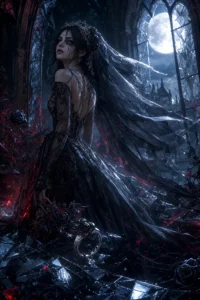



0 Comments