Chapter 5: The Husband’s Rules
by inkadminThe storm had not finished with Blackthorne House.
It crawled over the roof in sheets of rain and clawed at the windows with salt-stiff fingers. Far below, the sea threw itself against the cliffs as if it had been wronged, each impact sending a shudder through the old stone bones of the mansion. In the corridors, candle flames leaned and straightened, leaned and straightened, as though bowing to something that moved unseen through the walls.
Seraphina stood in the dining room doorway long after the last guest had gone.
The room looked like the aftermath of a beautiful crime.
Crystal glasses still held mouthfuls of wine the color of arterial blood. A cigar smoldered in a silver tray beside a plate of untouched figs. Someone had left a lipstick stain on the rim of a champagne flute, dark plum and too deliberate to be an accident. The long table, polished black and gleaming under the chandelier, reflected everything in fragments: the bones of candelabra, the torn white petals of roses, the smear of sauce where a knife had dragged too hard.
And at the head of it all, Damien Blackthorne sat like the house had grown him from its shadows.
He had removed his jacket. His white shirt was open at the throat, sleeves rolled to his forearms, cufflinks abandoned beside an untouched glass of whiskey. The stormlight made a blade of his profile. He did not look drunk. He did not look tired. If anything, the departure of the politicians, bankers, smugglers, and silk-wrapped killers who called themselves his family had stripped away the last layer of civility from him.
Seraphina hated that her pulse noticed.
She stood very still, one gloved hand resting on the doorframe, the other curled so tightly at her side that her nails bit through satin.
Damien did not turn his head. “Come in.”
“Am I summoned now?”
“You were summoned the moment you decided to linger in my doorway instead of running to your room.”
His voice was low, level, and cut with exhaustion sharpened into authority. Seraphina stepped inside because retreat would have looked too much like obedience, and because every locked room in this house breathed her mother’s name.
The door shut behind her without either of them touching it.
She glanced back.
Damien finally looked at her. “Draft.”
“Of course.”
“If the house intended to frighten you, Seraphina, it would be less polite about it.”
Her name in his mouth still felt stolen. Like he owned the sound of it more than she did.
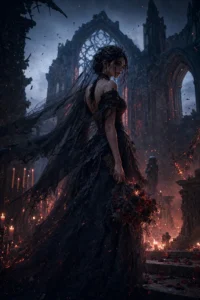
She crossed the room slowly. Her wedding gown had been exchanged after dinner for a gown of midnight silk that Mrs. Whitlock had laid out without asking, all severe lines and a neckline just modest enough to be insulting. The fabric whispered around her ankles. In the reflection on the table, she looked like a woman drowned and brought back wrong.
“Your friends are charming,” she said.
“They are not my friends.”
“Your enemies, then. Though it seems a thin distinction in this house.”
A faint curve touched his mouth. It was not amusement. It was the recognition a wolf gave another creature that had shown teeth.
“Sit.”
“No.”
For one second the storm seemed to pause, as though the house itself had inhaled.
Damien leaned back in his chair. “Do you think defiance is a personality, or have you been wearing it so long you’ve forgotten what is underneath?”
“Do you think command is a language, or did no one teach you how to speak to people who aren’t afraid of you?”
His eyes moved over her face. Not crudely. Not appreciatively, either. He watched her like he watched doors, ledgers, men with guns beneath their jackets—things that concealed mechanisms.
“Everyone is afraid of something.”
“And you?”
“I learned early not to feed mine.”
“How tragic.”
“How useful.”
The clock on the mantel ticked loud enough to count heartbeats. Outside, thunder rolled over the cliffs, deep and sullen.
Damien lifted two fingers. From the dim corner near the service entrance, a man emerged so silently Seraphina’s throat tightened before she could stop herself. Tall, gray-haired, dressed in black, his face narrow as a knife. Mr. Graves. Damien’s chief of security, if the whispers at dinner had been honest—and none of the people at that table seemed capable of honesty unless it wounded someone.
Graves set a black leather folder before Damien and vanished again.
Seraphina had not heard the door open or close.
“Does he sleep in the walls?” she asked.
“When necessary.”
“That wasn’t meant to be an answer.”
“Most questions in this house are unwise. You will find that out quickly.”
Damien opened the folder. Inside lay a single sheet of thick cream paper, embossed with the Blackthorne crest: a thorned branch coiled around a crowned raven. Beneath it, lines of elegant script marched across the page.
“Our marriage has legal terms,” he said. “The solicitors will parade those in front of you tomorrow with enough parchment to choke a priest. These are the terms that matter.”
Seraphina stared at the paper and refused to come closer.
“You wrote rules?”
“I wrote boundaries.”
“Men always call cages boundaries when they’re the ones holding the key.”
His gaze flicked to her gloved hands. “And women always pretend they were dragged into cages without smuggling in lockpicks.”
Her blood chilled so fast she nearly missed her breath.
Damien’s expression did not change. Had he meant it casually? No. Nothing about Damien Blackthorne was casual. Every word arrived sharpened and weighed.
He gestured to the chair on his right. “Sit, Seraphina.”
She wanted to deny him again. She wanted to remain standing until her bones gave out, to make a monument of refusal. But the mention of lockpicks—too close, too precise—had slid beneath her skin. She came to the chair and sat with all the grace her grandmother had beaten into her posture, back straight, chin lifted, hands folded in her lap.
Damien’s eyes darkened in something like approval.
She hated that more than his command.
“First rule,” he said. “In public, you obey me.”
Seraphina laughed. It left her sharper than she intended. “How biblical.”
“In public,” he repeated, not raising his voice. “You do not contradict me. You do not challenge me. You do not flinch when men attempt to bait you. You do not answer questions about your father’s debts, your family’s estate, or why the Vale bloodline suddenly matters to Blackthorne interests after twenty years of neglect.”
“And if someone asks whether my husband purchased me like a distressed property?”
“Smile.”
“With teeth?”
“If you must. But you smile.”
The chandelier trembled as wind struck the house. The flame of one candle guttered blue.
“Second rule,” Damien said. “You do not speak about this house to anyone outside it.”
“I’ve only been here a few hours. What exactly am I not meant to speak about? The tasteful funeral décor? The servants trained as phantoms? The way every corridor seems designed by someone with a guilty conscience?”
“All of it.”
“Afraid of gossip?”
“Afraid of carelessness.”
“How domestic.”
Damien leaned forward, the lamplight catching in his eyes. They were not black, as she had first thought at the altar. They were a dark, cold green, like seawater glimpsed beneath ice.
“Listen carefully. Blackthorne House has survived monarchs, wars, tax investigations, three attempted raids, two fires, and my grandfather’s habit of burying men where the roses grow best. It did not survive because the women inside it treated secrets as parlor entertainment.”
“What happened to the women who did?”
His silence was immediate and complete.
It spread between them like spilled ink.
Seraphina felt it then—the edge, the cliff hidden under his polished words. She had stepped too near something. Not danger. Memory.
Damien closed the folder halfway, then stopped.
“Third rule.”
The air changed.
Rain hammered the windows harder. In the walls, pipes groaned with old water and older cold. Seraphina’s fingers tightened together in her lap until bone pressed against bone.
Damien’s gaze held hers.
“You do not ask about your mother.”
Her lungs forgot the shape of breath.
For a moment she was not in the dining room at Blackthorne House. She was eleven years old again, standing barefoot on the rain-slick terrace of Valehaven, watching lanterns bob along the cliff path while men shouted over the storm. Her father’s hand had been clamped around her shoulder hard enough to bruise. Her mother’s scarf, blue silk embroidered with tiny silver birds, had been found tangled in the sea gate. No body. No goodbye. No grave.
Only the smell of wet stone and her father saying, over and over, She left us. Remember that. She left us.
Seraphina’s mouth went dry.
“What did you say?”
“You heard me.”
“Say it again.”
“No.”
She stood so quickly the chair legs screamed against the floor.
Damien did not move.
“You don’t get to speak of her.” Her voice came out too soft. That frightened her more than shouting would have. “You do not get to put my mother in one of your little rules like silverware placement or which knife to use while dining with murderers.”
“Sit down.”
“Tell me what you know.”
“No.”
“Did she come here?”
His jaw tightened.
The smallest movement. Anyone else might have missed it. Seraphina had been trained by violent men and polite women; she knew how truth looked when it tried to hide behind stillness.
She stepped closer. “She did.”
“You are making assumptions.”
“And you are making the face of a man deciding whether to lie.”
“If I intended to lie to you, Seraphina, you would already believe me.”
That should not have sounded like a promise. It did.
She braced both hands on the table, leaning toward him over the wreckage of dinner. “My mother disappeared nineteen years ago. My father drank himself meaner and meaner afterward. Our house rotted around us. Every servant who worked for us then was dismissed, paid off, or died with a convenient lack of relatives. And now you, my husband of less than a day, tell me not to ask about her.”
“Yes.”
“Why?”
“Because answers have consequences.”
“I am not a child.”
“No.” His eyes dropped, just once, to the pulse beating at the base of her throat. “You are a liability with excellent posture.”
“And you are a bastard with a house full of graves.”
“Likely.”
Her anger faltered at the flatness of it.
Damien rose.
He was taller than he seemed while seated, his presence gathering the room’s shadows as if they had been waiting for permission. Seraphina did not step back, though instinct screamed at her to preserve distance. He came around the end of the table slowly, stopping close enough that she caught the scent of him beneath whiskey and smoke: cedar, rain, something metallic like cold iron.
“Your mother,” he said, each word chosen with cruelty or care—she could not tell which, “is the most dangerous subject in this house.”
Seraphina’s heart struck once, hard.
“Because of what she did?”
His gaze sharpened.
There. Another crack.
“Or because of what was done to her?” she whispered.
The storm answered for him, thunder splitting so close the windows rattled in their frames.
Damien caught her wrist.
It was not rough. That made it worse. His fingers closed around the slender bones above her glove with controlled restraint, warm and unyielding. Seraphina looked down at his hand, then up into his face.
“Let go.”
“Not until you understand.”
“I understand men like you perfectly.”
“No,” he said, and for the first time that night, something raw flashed beneath his composure. “You understand men who want to own you. Men who want to break you into something small enough to fit inside their vanity. I am not one of them.”
“You married me for my name.”
“Yes.”
The honesty hit harder than any denial.
“You dragged me here under threat of my father’s ruin.”
“Your father was ruined before I arrived. I merely put a date on the corpse.”
“You humiliated me in front of your council.”
“I kept you alive in front of my council.”
She tried to pull her wrist free. His grip held. Not bruising. Not kind.
“They wanted me to look weak.” Her voice shook despite every lesson she had ever had in hiding emotion. “You helped them.”
“They wanted you to look disposable. I made you look claimed.”
“There’s a difference?”
“In my world? Yes.”
The heat of his hand seeped through the glove. She despised the awareness of it, despised the way her body catalogued danger as if danger and intimacy had once shared the same language and never stopped speaking.
“I don’t belong to you,” she said.
Damien’s thumb moved once over the inside of her wrist, where her pulse betrayed her.
“No,” he said quietly. “But until every man who sat at this table believes otherwise, you will behave as if you do.”
Seraphina’s breath caught.
Not from fear. Not only.
His eyes remained on hers, merciless and unreadable. “In public, obedience. About this house, silence. About your mother, no questions. Break the first rule, and I will correct you before anyone else does. Break the second, and I will lock every door you have not yet discovered. Break the third…”
He stopped.
“What?” she challenged. “You’ll punish me?”
Something dark crossed his face. “I will bury what little mercy I have left.”
A cold finger traced Seraphina’s spine.
He released her.
The absence of his grip felt obscene.
She stepped back, flexing her hand as though she could scatter the imprint of him. “You mistake yourself for fate.”
“Often.”
“Fate has better manners.”
“Fate has never had to manage the Blackthorne syndicate.”
Seraphina laughed once, breathless and humorless. “You’re afraid.”
Damien’s expression shut.
Good. There. Blood.
“Not of me,” she said, because cruelty had been handed to her by masters and she knew how to use it when cornered. “Not really. You’re afraid of a dead woman.”
His hand shot out, not to seize her this time but to slam flat against the table beside her hip. The crack of skin on polished wood made the candles jump.
Seraphina froze.
Damien leaned in until his mouth was close to her ear.
“If she were dead,” he murmured, “this would be simpler.”
The world tilted.
Before she could breathe, before she could turn that sentence over and expose its blade, he straightened. His face had become marble again.
“Go to bed.”
Seraphina stared at him.
If she were dead.



0 Comments