Chapter 4: Veil of Thorns
by inkadminThe cathedral had not burned cleanly.
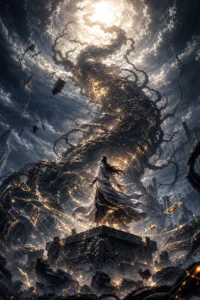
Ten years had passed since Saint Orison’s ribs split beneath flame and gunfire, since the great rose window burst outward in a glittering scream over Blackwater’s old quarter, since men with sacred names and bloodied hands dragged bodies across the marble and called it war. Ten years of rain had washed soot from the gargoyles. Ten years of donations from penitent criminals had mended the roof, reset the stained glass, polished the saints until their faces shone with gold leaf and lies.
But fire remembered where it had been.
It lived in the black veins running up the columns. In the warped edges of the pews that had been salvaged rather than replaced. In the faint, bitter smell that rose whenever the sea fog pressed low and damp against the stones—a smell like wet ash, melted wax, and something else Seraphina had spent half her life refusing to name.
The carriage stopped before the cathedral steps at eleven minutes to midnight.
Rain threaded silver over the windows, turning the world beyond the glass into a watercolor of iron gates, black umbrellas, and waiting men. Seraphina sat still as the driver climbed down. She did not move when her father’s gloved hand closed around the carriage handle from outside. She did not blink when the door opened and the night breathed in.
Cold air touched her face like the palm of a corpse.
“Come,” Lucien Vale said.
He wore mourning black to his daughter’s wedding.
Not the sleek black of the Dravens, cut sharp enough to draw blood, but old Vale black: velvet lapels, antique cufflinks, a cane with a silver fox head biting a ruby between its teeth. The rain had dampened his dark hair at the temples, and beneath the cathedral lamps his face looked carved from wax. Handsome still, in the cruel way ruined houses were handsome—bones intact, windows empty.
Seraphina looked past him to the church doors.
Saint Orison’s loomed above them, double doors of charred oak banded with iron. The restoration committee had insisted on keeping the originals. A symbol of survival, they had said in the newspapers, posing with their wives and their donations while men in basements sharpened knives over old grudges.
Seraphina knew those doors.
She had painted them in her nightmares for years.
“No,” she said quietly.
Lucien’s hand remained extended. Rain tapped softly against his knuckles. “We discussed this.”
“You discussed it.”
His mouth tightened. “Do not make a scene.”
A laugh almost escaped her. It caught somewhere behind her ribs and turned to a thin, aching breath. Around them, the night crawled with witnesses: Vale men stationed along the steps like crows; Draven soldiers beneath black umbrellas; priests in white collars pretending not to see the gunmetal glint beneath tailored coats. A wedding at midnight between two bloodlines that had buried sons, sisters, mothers, and saints in the same fire.
There was no scene left to make. They had staged the tragedy without her.
Seraphina looked down at her hands, gloved in ivory lace. Her fingers rested over the skirt of a gown she had not chosen. Silk the color of bone. Sleeves fitted to her wrists. A bodice that pressed the air from her lungs with tiny pearl buttons running like vertebrae down her back. Her mother’s veil lay over her hair and shoulders in a fall of old lace, delicate as frost, heavy as a shroud.
Lucien had sent it to her rooms at dusk in a cedar box.
No note. No apology. Only the scent of dried lavender and smoke when she lifted the tissue paper.
Her mother had worn the veil once, in a portrait that used to hang in the blue parlor before the fire. Celeste Vale, laughing at some secret beyond the painter’s skill, one hand pressed over her heart as if she were trying to keep it from escaping. Seraphina had been a child the last time she saw that painting. She remembered the red of her mother’s mouth. The gold thread stitched into the veil. The way her father had stood before the portrait after Celeste died, drunk and silent, until dawn bled behind him.
Now the lace brushed Seraphina’s cheeks like fingertips.
Mother.
The word did not comfort her. It opened something.
Lucien leaned closer, lowering his voice. “If you refuse him at the altar, Cassian will not punish only you.”
Seraphina lifted her gaze.
“There she is,” her father murmured. “My daughter.”
“Do not call me that.”
“What would you prefer? Clara?”
The dead girl’s name slid between them like a blade laid on velvet.
For ten years Seraphina had answered to it. Clara Ashford. Quiet restorer. No family. No history beyond forged documents and a grave that held someone else’s bones. She had signed invoices with that name. Rented rooms with it. Bought bread with it. Painted halos around martyred saints with hands that trembled whenever bells rang too loudly.
Lucien had found her anyway.
Or perhaps he had always known.
“You should have left me buried,” she said.
Something flickered in his face. Not regret. Not tenderness. A shadow crossing old ice. “I tried.”
Before she could answer, a bell tolled overhead.
Once.
The sound struck the carriage and rolled through her bones. Not a bright wedding peal. A funeral bell. Low, iron-throated, soaked in rain.
Then again.
Two.
Men shifted on the steps. Umbrellas tilted. The cathedral doors opened inward, releasing candlelight and incense.
Lucien’s hand did not move.
“Walk,” he said.
Seraphina stared at his hand until the glove blurred. She could refuse. She could sit in the carriage and let the bells count down to midnight. She could force Cassian Draven to drag her from the velvet seat in front of both families. She could split herself open on the church steps and show them all the cowardly animal beating inside her chest.
Then the rain shifted, and through the veil she saw a shape at the top of the stairs.
Cassian stood beneath the cathedral arch, untouched by the downpour.
No umbrella. No movement. Black suit, black shirt, silver cufflinks catching the candlelight behind him. His hair was dark and damp, combed back from a face beautiful enough to be mistaken for mercy from a distance. But even from the carriage, Seraphina could feel the cold of him. It gathered in the air around his body. It stilled men who were not easily stilled.
He watched her as if the rain, the bell, the waiting families, even God Himself were inconveniences between predator and prey.
Seraphina stepped down from the carriage without taking her father’s hand.
The hem of her gown touched the wet stone. Cold seeped through satin slippers at once, biting into her toes. Lucien’s jaw flexed, but he offered his arm instead. This time she took it, not because she needed balance, but because if she did not anchor herself to something she feared the cathedral would tilt and become the burning place she remembered only in shards.
The bell tolled a third time.
She climbed the steps.
Every footfall woke the past.
Rain on stone became oil hissing over flame.
The cathedral lamps became candles guttering in smoke.
Black umbrellas became wings.
At the threshold, Cassian did not step aside.
He waited until Seraphina was close enough to see the faint scar bisecting his lower lip, pale as a sliver of moon. Close enough to smell him beneath rain and expensive wool—cedar, smoke, and something metallic, like the air before lightning.
“You’re late,” he said.
His voice was quiet. It carried anyway.
Seraphina’s fingers tightened on Lucien’s sleeve. “Then leave.”
A murmur moved through the men behind him. Cassian’s eyes did not change, but his mouth softened at one corner, not into a smile. Never that. Something more dangerous. Amusement without warmth.
“And waste a perfectly good execution?”
“Weddings and executions are different ceremonies, Mr. Draven.”
“Not in Blackwater.”
Lucien cleared his throat. “Cassian.”
Only then did Cassian glance at him. “Lucien.”
No title. No respect. Her father accepted it with the strained patience of a man swallowing poison because the table was full.
Cassian’s gaze returned to Seraphina. It dropped to the veil.
For one breath, something shifted.
Not softness. Not pity. Recognition, perhaps. Or satisfaction.
“Your mother wore that the night she married a liar,” he said.
Seraphina felt the words like fingers under her chin. “And now I wear it to marry one of her murderers.”
The air stopped.
Behind Cassian, a priest’s hand flew to the cross at his throat. Lucien’s grip clamped over Seraphina’s arm hard enough to bruise.
Cassian leaned in, his face inches from the veil, his eyes dark as flooded crypts.
“Careful, little saint,” he whispered. “This church has a habit of punishing false testimony.”
“Then perhaps lightning will strike us both.”
For a moment the rain was the only sound.
Then Cassian stepped aside.
“After you.”
Seraphina entered Saint Orison’s on her father’s arm and crossed into a mouth of candlelight.
The nave stretched long and narrow before her, shadowed vaults rising into darkness. Hundreds of candles burned along the aisles, their flames trembling in glass cups red as open wounds. Incense coiled beneath the arched ceiling, sweet and suffocating, failing to mask the older smell embedded in stone. The pews were filled, but no one looked like a guest. Women in black silk watched from beneath veils. Men with dead eyes sat with their hands folded over weapons. Faces turned as Seraphina passed, pale ovals in the candle gloom.
On the left side sat the Vales. What remained of them.
Uncles whose fortunes had rotted. Cousins with expensive addictions and cheap souls. Widows dripping jet beads over throats that had once laughed at executions whispered across dining tables. Their eyes slid over Seraphina, measuring resemblance, usefulness, weakness.
On the right sat the Dravens.
They did not whisper.
They watched.
The Draven family had always known the power of silence. It made accusations louder. It made threats unnecessary. At their head sat Octavia Draven, Cassian’s grandmother, a woman thin as a blade and dressed in black lace from throat to wrist. Her white hair was braided around her skull like a crown of bone. Beside her, Dante Draven lounged with one ankle over his knee, smiling as if weddings, funerals, and public flayings all improved his mood equally.
Seraphina recognized neither from childhood, yet her body knew their blood.
It recoiled.
The aisle seemed longer than it should have been.
At its end, the altar rose beneath the restored rose window. The glass depicted Saint Orison holding a thorned branch in one hand and a flame in the other. Seraphina had worked on that window once, years ago, before she knew the commission’s patron had been a Draven. She had repaired the saint’s eyes with cobalt imported from Venice and painted the smallest fleck of white in each pupil to make them appear wet, alive, watching.
Now those eyes stared down at her.
You should have run farther.
Her steps faltered.
Lucien’s arm locked beneath her hand. “Keep moving.”
“You knew,” she whispered.
“What?”
She looked at the altar. At the right transept where the fire had started. At the blackened crack still running through the marble floor despite all efforts to seal it.
“You knew he would choose this place.”
Lucien’s expression did not change. “Dravens are sentimental creatures.”
“No. He wanted me afraid.”
“Then don’t be.”
The cruelty of simplicity almost made her stumble again.
At the front pew, a woman turned her head.
For a moment Seraphina saw another face overlaid upon hers—her mother’s profile in candlelight, lips parted in warning, one hand reaching across smoke.
Seraphina blinked.
The woman was only a Draven aunt with diamonds at her ears.
Her pulse began to climb.
Not now.
The veil clung to her mouth with every breath.
The cathedral expanded and contracted. Candle flames stretched into long orange tongues. The organ above the western doors shuddered into music, a low dirge that vibrated through the floor and into her bones. Not the wedding march. Of course not. Something older. Something meant to accompany martyrs toward knives.
She smelled smoke.
Not memory-smoke. Not damp-ash-in-stone smoke.
Smoke.
Her head snapped toward the side chapel.
A cluster of votive candles burned beneath a statue of the Virgin. One wick had caught a ribbon tied to a prayer rail. A tiny flame crawled up the silk, blue at the base, greedy and bright.
Seraphina stopped breathing.
The cathedral vanished.
Heat struck her face.
A hand crushed hers—small, sticky, child’s fingers.
Don’t let go, Sera.
A boy crying. Not far. Not near.
Gunshots splitting hymns.
Her mother’s veil whipping through smoke.
A man shouting, “The ledger—Celeste, where is it?”
Then a door slammed.
Then darkness under the altar steps, splinters in her palms, someone breathing beside her too fast, too loud.
Be quiet or they’ll find us.
Seraphina swayed.
Lucien caught her with a hissed curse. “Seraphina.”
She heard her name like it came from underwater.
At the altar, Cassian turned.
His gaze sharpened instantly. Not with concern. With recognition of opportunity.
The little ribbon flame in the side chapel was pinched out by a priest, leaving only a twist of smoke, but the damage had been done. Seraphina’s throat closed. The scent filled her skull. Her hands went cold inside the lace gloves.
She saw blood on white marble.
Saw a silver ring rolling beneath a pew.
Saw a boy with Draven eyes staring at her from behind a curtain of smoke.
Nikolai?
No.
The name shattered before it became sound.
She jerked back from the memory as if from a ledge.
Cassian had moved before she noticed. He stood three paces away now, having abandoned the altar. A murmur stirred through both families, but he ignored them. The priest hovered in bewildered horror, one hand still holding the open book.
“Is the bride ill?” the priest asked.
“No,” Seraphina said.
Her voice scraped out raw. She pulled herself upright, forcing air through her nose, then her mouth. Rain. Incense. Wax. Wool. Not smoke. Not fire. Not bodies. Not then. Now.
Cassian stopped in front of her.
“Remembering something?” he asked softly.
Seraphina looked at him through the veil. The lace blurred his features, making him almost holy, almost monstrous.
“You chose this church.”
“Yes.”
No denial. No coyness.
Honesty from Cassian Draven was not a gift. It was a hook with fresh bait.
“Why?”
“Because ashes keep what people bury in them.” His gaze moved over her face with surgical patience. “And because lies hate familiar rooms.”
Lucien said, “This is not the time.”
Cassian did not look away from Seraphina. “This is exactly the time.”



0 Comments