Chapter 5: The Draven House Rules
by inkadminThe sea followed them home.
It came in black sheets against the bulletproof glass, in salt-white claws scraping at the limousine doors, in the low, animal roar beyond the road as the procession climbed the cliffs above Blackwater. Seraphina sat with her gloved hands folded in her lap, feeling every mile drag her farther from the cathedral and deeper into the territory of the man beside her.
Cassian Draven had not touched her since the priest pronounced them husband and wife.
He sat inches away, all carved stillness and midnight tailoring, his wedding ring a dull gleam against the black leather of his glove. Rain traced silver veins down the window beside his profile. In the passing lamps, his face appeared and vanished like something glimpsed at the bottom of water—beautiful, merciless, unreal.
Seraphina could still taste incense at the back of her throat. Still feel the weight of her mother’s veil on her hair, though it had been removed the moment they left the church and folded into a cedar box by one of Draven’s silent women. Still hear the priest’s voice slipping between Latin and fear. Still hear the cathedral’s old stones whispering with heat and smoke and screams her mind refused to own.
She curled her fingers against her palm until the silk of her glove creaked.
Across from her, a man in a gray coat watched through lowered lashes. One of Cassian’s men. There were three vehicles in front of them and three behind, all black, all gliding like funeral carriages through the storm. The convoy had swallowed her without question after the vows. No rice. No cheers. No drunken blessing from the gathered houses. Only the wet flash of cameras kept behind police barricades and the rustle of armed men shifting under their coats.
A marriage did not need witnesses when it had hostages.
“You’re shivering,” Cassian said.
His voice did not rise above the rain, yet it cut through it cleanly.
Seraphina kept her gaze on the window. “It’s cold.”
“It’s June.”
“Blackwater never remembers.”
For the first time since they’d entered the car, she felt his attention sharpen on her. Not the casual assessment he gave enemies. Not the cool ownership he displayed before their gathered families. This was worse. This was the focus of a blade finding the seam in armor.
“No,” he said softly. “It doesn’t.”
The road curved. Below, the city spread like a drowned kingdom—gas lamps blurred by rain, cathedral spires stabbing the mist, rows of old brick houses crouched along canals black as oil. Somewhere under those streets were cellars where men screamed into cloth. Somewhere behind lit windows, wives served supper to murderers and kissed blood from their knuckles. Somewhere in the eastern quarter, Seraphina’s tiny rented room sat empty above a bookbinder’s shop, her jars of pigment labeled in another woman’s careful handwriting, her half-restored Saint Agnes waiting beneath linen.
Lydia Bell’s life had ended tonight.
Seraphina Vale’s had been dragged from its grave.
A drop of water slid from her hairline down her neck. She didn’t move to wipe it away. She had learned long ago that stillness could be mistaken for strength by men too impatient to know the difference.
The man in the gray coat’s phone buzzed once. He glanced at the screen, then toward Cassian.
“The west road is clear,” he said.
Cassian gave no visible acknowledgment. “And the house?”
“Locked down.”
“Staff?”
“Waiting.”
“My aunt?”
A pause, delicate as a crack forming in glass. “Also waiting.”
Something almost human moved over Cassian’s mouth. Not a smile. Not quite. “Of course she is.”
Seraphina looked at him then, against her better judgment.
He noticed immediately.
“Questions already?” he asked.
“Would you answer them?”
“Depends how clever they are.”
“Then no.”
The man in the gray coat flicked his eyes between them, assessing the temperature of the air. Cassian’s gaze remained on Seraphina, and in that narrow slice of darkness between them, she remembered his hand closing around hers before the altar. The cold pressure of his ring. The way he had leaned in, not to kiss her, but to murmur for her alone.
Remember carefully, wife. I paid dearly for what you know.
She had not replied. Her mouth had been full of ash.
Lightning tore open the sky.
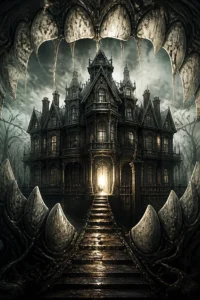
For an instant Thornfield House appeared on the cliff above them.
Seraphina had seen photographs, of course. Everyone in Blackwater had. The Draven estate belonged to the city’s private mythology as much as the drowned saints in the harbor or the plague bells beneath Saint Orlan’s. But photographs had lied politely.
The house did not stand on the cliff.
It brooded there.
Black stone and storm-gray towers rose from the headland as though the rock itself had grown teeth. Long windows burned gold behind rain-smeared glass. Gargoyles hunched at the roofline, their wings slick and shining. An iron conservatory clung to the eastern side like a rib cage of glass. Beyond it, she glimpsed cypress trees bending in the gale and the white violence of the sea smashing itself to pieces below.
The gates opened before they stopped.
Not swung. Opened.
Two immense panels of wrought iron peeled inward, serpents and thorned roses twisting across them, each bar tipped like a spear. Cameras turned. Men in dark coats stood beneath the gatehouse lanterns, rain sliding off their hats and shoulders. One held a rifle half-hidden by his coat. Another had a scar running from brow to jaw, pale against his weathered skin.
As the car rolled through, Seraphina felt the change in the air.
The city fell away behind the gates. Sound thickened. The rain seemed to strike harder inside the walls. Thornfield’s drive coiled through an overgrown garden where white statues watched from ivy, their faces worn smooth by years of salt wind. A marble woman held a broken urn. A boy saint pressed fingerless hands to his chest. A stag made of bronze bowed its antlered head beneath a veil of moss.
Then the house swallowed the road.
The limousine stopped beneath a porte cochere upheld by four black columns. Servants waited in a line beyond the shallow steps—six of them, perhaps seven, their faces pale ovals in the glow of iron lanterns. No one held umbrellas until Cassian’s door opened.
Then they moved at once.
The gray-coated man stepped out first. A guard opened Cassian’s door. Another came around for Seraphina, but before he could touch the handle, Cassian was there.
He held the door open himself.
Rain jeweled his dark hair and clung to his lashes. He offered his hand.
Seraphina stared at it.
A husband’s hand. A captor’s courtesy.
The servants watched. The guards watched. The house watched through dozens of lit windows.
So she placed her gloved fingers in his.
His hand closed over hers, warm despite the storm. That surprised her enough that she looked up. Cassian’s face was unreadable, but his thumb rested against the inside of her wrist, precisely where her pulse betrayed her.
“Careful,” he said.
The word might have been meant for the wet stone step.
It was not.
Seraphina stepped from the car. Her wedding dress, ivory an hour ago, had gone heavy with rain along the hem. It dragged behind her like something drowned. The wind caught at her veil-less hair and tossed it against her mouth. She tasted salt.
The servants bowed their heads as one.
“Mr. Draven,” said the woman at the center.
She was tall, narrow, and severe, with silver hair coiled at the nape of her neck. Her black dress fastened at the throat with an old cameo brooch. If the storm frightened her, she gave no sign. Her gaze moved to Seraphina with a precision that felt like measurement.
“Mrs. Draven.”
The name struck like a slap.
Seraphina’s fingers tightened involuntarily. Cassian felt it. Of course he did.
“Mrs. Vale,” he corrected lightly.
The servants did not move.
The silver-haired woman blinked once.
Cassian’s mouth softened at the edges. “For tonight.”
Seraphina hated him in that moment with such clarity it warmed her blood.
The woman inclined her head. “As you wish, sir.”
“This is Mrs. Hawthorne,” Cassian said to Seraphina. “She keeps Thornfield from collapsing under the weight of its own sins.”
Mrs. Hawthorne did not smile. “I keep inventory, sir.”
“Same thing.”
Another servant took Seraphina’s small case from the car. Not the trunk she had packed in her room—there had been no time for that, no permission—but the leather valise Cassian’s people had brought to the cathedral containing whatever they considered suitable for a bride bought in the dark.
Seraphina watched the case disappear into the house and felt an irrational pulse of panic.
Inside it were her sketchbook and the little tin box of pigments she had refused to release. The guard at the cathedral had tried to take them. She had told him, calmly, that if he touched the box again, she would break his thumb backward. He had laughed until Cassian, from behind them, had said, “Let her keep her saints.”
Now even those had been carried beyond reach.
Cassian tugged once on her hand.
“Come in out of the rain, Seraphina.”
Her name in his mouth was a room with no windows.
She crossed the threshold of Thornfield House.
Warmth hit first. Not comfort—never that. Heat from hidden vents and old fireplaces, carrying the smells of beeswax, smoke, leather, wet wool, and something floral decaying in crystal bowls. The entrance hall soared three stories high, crowned by a stained-glass skylight where stormlight flickered through red and blue saints. Black-and-white marble spread beneath her feet in a vast checkerboard. A staircase rose ahead, splitting halfway up into twin wings, its banister carved with thorns so lifelike they seemed ready to draw blood.
Every wall was crowded with portraits.
Dravens in oil and gilt frames stared down with pale eyes and hard mouths. Men in military dress. Women in mourning silk. Children with toys in one hand and knives in the other. Their faces bore echoes of Cassian’s bones—the sharp cheekbones, the dark hair, the winter-gray gaze. A dynasty of beautiful wolves.
Seraphina’s wet hem whispered across the marble.
Somewhere deep in the house, a clock began to strike one.
One bell.
Then another.
On the third, a woman spoke from the shadows near the grand staircase.
“You brought the bride in through the front.”
Seraphina turned.
The woman descended slowly, one gloved hand sliding over the carved banister. She was older, perhaps in her late fifties, with white-blond hair arranged in an elegant twist and pearls glowing at her throat. Her gown was the color of old wine. She moved like someone who had been taught from birth that floors existed to rise and meet her feet.
Cassian did not release Seraphina’s hand.
“Where else would I bring her, Aunt?”
“There is a service entrance for deliveries.”
The air changed.
Not much. A tightening among the servants. A stillness among the guards. Mrs. Hawthorne’s eyes lowered to the marble.
Seraphina felt Cassian’s thumb pass once over her pulse. Slow. Almost idle.
“Careful,” he said again.
This time, no one mistook it for anything else.
The woman on the stairs stopped two steps above them. Her smile did not alter, but something bright and poisoned appeared behind her eyes.
“It was a joke, darling.”
“No,” Cassian said. “It was an opening bid.”
Rain beat against the skylight. One of the candles along the wall guttered, though no draft touched it.
The woman’s gaze slid to Seraphina. It traveled from the damp ruin of her wedding dress to the bare finger where no Vale family ring sat, then up to her face with the leisure of someone inspecting a painting for hidden cracks.
“Seraphina Vale,” she said. “I knew your mother.”
Seraphina’s heart stumbled.
She had prepared for accusations. For hatred. For the old names—traitor, butcher’s daughter, fire-witch, ledger brat. She had not prepared for this.
“Did you?” she asked.
The woman smiled. “Everyone knew Aurelia Vale. She made certain of it.”
Cassian’s hand tightened. A warning? Possession? She could not tell.
“Seraphina,” he said, “my aunt, Octavia Draven.”
Octavia extended no hand.
Neither did Seraphina.
“Welcome to Thornfield,” Octavia said. “Do try not to set fire to it.”
The cathedral came back in a flash of white heat.
Paint blistering on saints’ faces. A child crying from somewhere beneath the choir loft. Smoke so thick it moved like velvet. Someone screaming her name—not Seraphina, not Lydia, another name she had buried so deep it had no shape. Blood on her palms. Blood on the altar. A ledger snapping shut.
Seraphina swayed.
Cassian turned his head slightly. “Enough.”
It was not loud.
Octavia went pale anyway.
For one strange instant, Seraphina saw the house’s power arrange itself around him. Not around age. Not around blood. Around fear. Cassian did not need to raise his voice because everyone in Thornfield had already imagined what would happen if he did.
“She is tired,” Cassian said.
“A bride should be,” Octavia replied, recovering silk over steel. “Though most earn it in more traditional ways.”
Seraphina felt heat rise to her face before she could kill it. Cassian saw. His eyes darkened—not with embarrassment, never that, but with something sharper.
“Leave us,” he said.
Octavia’s smile held a fraction too long. “Of course. Family matters.”
“No,” Cassian said. “Not yet.”
The words landed between them.
Not family. Not wife. Not truly.
Seraphina told herself she was relieved. The ache under her ribs did not listen.
Octavia descended the final steps and passed close enough that Seraphina caught her perfume—violets over venom, sweet and powdery. At Seraphina’s shoulder, she paused.
“This house remembers everything,” she murmured. “Even what its owners try to forget.”
Then she moved on, pearls whispering, and vanished down a corridor lined with ancestral faces.
Only when her footsteps faded did the hall breathe again.
Cassian released Seraphina’s hand.
The absence of his touch felt too sudden. Cold slid immediately into the space he’d occupied.
He removed his gloves finger by finger and handed them to Mrs. Hawthorne. His hands were elegant, long-fingered, bare now except for the wedding ring. A thin scar crossed the knuckles of his right hand, old and pale. He caught Seraphina noticing.
“Tour first,” he said, “or rules?”
“I was under the impression prisoners are shown their cells before being read the terms.”
A servant behind Mrs. Hawthorne sucked in a breath.
Cassian looked at Seraphina for a long second. Then he smiled.
It was the first true smile she had seen from him.
It made him look younger. Crueler. Devastating.
“Rules, then,” he said.
Mrs. Hawthorne’s face remained composed, but her eyes flickered once to Cassian. Concern, perhaps. Or warning. He ignored it.
He crossed to a table beneath the largest portrait in the hall. The man in the painting wore a naval coat and the expression of someone who had ordered drownings before breakfast. Beneath his painted hand sat a silver tray with crystal decanters, untouched despite the late hour.
Cassian poured whiskey into a glass. Not for her. For himself. The amber liquid caught the firelight.
“Rule one,” he said. “You do not leave Thornfield without my permission.”
Seraphina laughed once, quietly. “Efficient.”
“I try.”
“And if I decide to walk through the front gate?”
“You’ll be stopped.”
“By your men?”
“By the dogs first.”
As if summoned by the word, a low growl rolled from somewhere beyond the hall. Seraphina turned. In the darkness beneath the left staircase, two eyes reflected gold. Then another pair. Massive black hounds emerged from the shadows, ribs sleek under short fur, heads broad, jaws heavy. They moved silently to Cassian’s side and sat.
One looked at Seraphina as though deciding where she would be softest.
Cassian rested his hand on its head. “This is Mercy.”
“Charming.”
“The other is Saint.”
“You named your attack dogs Mercy and Saint?”
“I enjoy irony.”
“No,” she said. “You enjoy threats dressed as jokes.”
His gaze sharpened again. “And you enjoy pretending fear is contempt.”
Her throat closed.
He drank. The movement of his throat was slow, controlled. “Rule two. You will not enter the west wing.”
The house seemed to listen harder.
Seraphina looked toward the staircase, where the left corridor stretched into shadow beyond an arch carved with thorns. No lamps burned there.
“What’s in the west wing?”
“Grief.”
The answer was so bare, so unexpected, that she had no reply.
Cassian’s face gave nothing away. But the hound under his hand pressed closer, as if responding to pressure only it could feel.
“Whose?” Seraphina asked.
“Mine.”
A name lay unspoken between them.
Lucien Draven.
The brother everyone said Seraphina had murdered, though she had no memory of killing anyone. Lucien, who had died in the fire ten years ago with half the old families watching the cathedral burn and no one brave enough to enter. Lucien, whose photograph had appeared for years in newspapers on the anniversary—angelic boy, dark curls, bright grin, sixteen forever.
Cassian looked nothing like the boy in those photographs when he said, “If you cross that threshold, I will know.”
“More dogs?”
“Worse.”
“You?”
He set the glass down with a soft click. “Me.”
The word settled low in her stomach.
Rain scratched at the windows. Somewhere above, the house groaned under the wind.
“Rule three,” Cassian said. “Do not lie to me.”
Seraphina’s laugh died before reaching sound.
He watched her closely now. Too closely. “That one offends you?”
“It amuses me.”
“Because you’ve spent ten years living under a dead girl’s name?”
The marble floor seemed to fall away beneath her.
Mrs. Hawthorne shifted. The servants froze.
Cassian stepped toward Seraphina, leaving his whiskey behind. Mercy and Saint remained seated, but their heads turned in perfect unison.
“Lydia Bell,” he said. “Born in Southwark, died of fever at age nine. Buried in an unmarked plot behind Saint Clement’s. Someone revived her four years later with new papers, a quiet signature, and a talent for disappearing into restoration work.”
Seraphina’s tongue felt numb.
“You knew,” she said.
“I know many things.”
“And still married me.”
“I did not marry Lydia Bell.”
He stopped close enough that she could see the faint rainwater still clinging to the line of his jaw. He smelled of storm and smoke and expensive whiskey. Not cologne. Nothing soft enough to be remembered kindly.
“I married the girl who walked out of a burning cathedral with my brother’s blood on her dress,” he said.
Her breath vanished.
“I was fifteen,” she whispered.
“So was Lucien.”
The cruelty of it should have hardened her. Instead it cut clean through.
For a moment she was not in the black-and-white hall of Thornfield. She was barefoot on cathedral stone slick with water and blood. Someone’s hand gripped hers. A boy’s voice, hoarse with smoke, saying, Run, Sera. Don’t let him—
The memory tore apart before the sentence finished.
She flinched.
Cassian saw that too.
Something passed over his face—quick, involuntary, almost anger at himself. Then it was gone.
“Do not lie to me,” he repeated. “Not about where you’ve been. Not about what you remember. Not about who helped you vanish. I will forgive silence before I forgive a lie.”
“How generous.”
“I’m not generous.”
“No,” she said. “You’re a Draven.”
His eyes cooled. “And you’re a Vale.”
The words should have been equal. They were not. A Draven in Thornfield was a king in his keep. A Vale in Thornfield was a relic taken from a battlefield and hung on the wall.
Seraphina looked up at the portraits. All those pale eyes. All that inherited hunger.
“Are those all?” she asked.
“For now.”
“How merciful of Saint and Mercy.”
At her tone, the hound named Mercy stood. Cassian lifted two fingers, and the dog stilled instantly.
“You can mock me,” he said. “You can hate me. You can pray to whatever saints still take your calls. But understand this, Seraphina. Your father sold you because he thought marriage would settle his debt.”
A shard of her father’s face rose in her mind: gaunt, elegant, ruined by drink and desperation, unable to meet her eyes when he signed the contract. He had smelled of cloves and fear. I had no choice, little flame.
There was always a choice. Men like him simply named cowardice fate.
“Did it?” she asked.
Cassian leaned closer. “No.”
Her pulse jumped.
“Then why am I here?”
“Because your father owed blood. Money. Names.” His gaze dropped briefly to her mouth, so quickly she almost imagined it. “But you owe memory.”
“I can’t give what I don’t have.”
“Then we’ll find it.”
The softness of the phrase was worse than a threat.
Mrs. Hawthorne cleared her throat gently. “Sir. Mrs. Draven’s rooms are prepared.”
Cassian’s jaw tightened at the title. Seraphina noticed. He noticed her noticing.
“Show her,” he said.
“Separate rooms?” Seraphina asked before she could stop herself.
The question changed the hall more violently than Octavia’s insult had. A servant looked down. The gray-coated man by the door became very interested in the rain on his sleeve. Mrs. Hawthorne’s expression did not shift, but her silence spoke fluent discomfort.
Cassian’s gaze returned to Seraphina’s mouth. This time he did not hide it.
“Disappointed?”
She hated the heat that climbed her throat. “Relieved.”



0 Comments