Chapter 1: The Bride Price
by inkadminOn the morning Seraphina Vale was sold to Lucian Blackthorne, her father sent lilies to her room—the kind people laid on graves.
They arrived in a crystal vase carried by a maid who would not meet her eyes. Six white blooms, heavy-headed and obscenely pure, their waxen petals damp from the greenhouse mist. The scent filled the bedroom at once: sweet, funereal, cloying. It seeped into the silk curtains, into the pale blue walls her mother had chosen when Seraphina was a child, into the back of her throat until she tasted mourning.
“From Mr. Vale,” the maid murmured, setting them on the vanity as if placing evidence.
Seraphina sat at the edge of her bed, one stockinged foot on the cold floor, the other tucked beneath her nightgown. Rain worried at the windows in thin silver lines. Beyond the glass, the city of Merrowmere crouched beneath its weather—slate roofs shining black, chimneys dragging smoke into a bruised sky, the harbor bells tolling somewhere below the cliffs.
“Did he say why?” Seraphina asked.
The maid’s fingers tightened around the empty tray. “No, miss.”
“Did he look pleased?”
A pause. That was answer enough.
The maid swallowed. “He asked that you come down to breakfast as soon as you were dressed.”
Seraphina looked at the lilies. They seemed to lean toward her, listening.
“Of course he did.”
When the maid left, Seraphina rose and crossed the room barefoot. The old floorboards gave soft complaints beneath her steps. She touched one petal with the tip of her finger. Cold. She half expected it to bruise.
Her mother had hated lilies.
They pretend to be innocent, Evelina Vale had once said, kneeling in the garden with soil beneath her nails and a laugh like a secret, but they only bloom where something has ended.
Seraphina had been eleven then, all scraped knees and tangled hair, before grief had taught her how carefully silence could be arranged inside a house. Before her mother’s carriage had gone over the cliff road in a storm no worse than this one. Before her father had locked Evelina’s study and dismissed every servant who had been close to her. Before he had begun speaking of her as if she were a delicate illness from which they had all recovered.
Seraphina lifted the vase and carried it to the window. For a moment, she considered opening the latch and hurling the flowers into the rain. Let them shatter on the terrace stones. Let her father’s message lie broken in the mud.
But Vale House had ears. Vale House had always had ears.
She set the vase back down, then dressed in a gown the color of storm clouds, buttoning it herself because she could not bear another pair of careful hands near her throat. She pinned her dark hair at the nape of her neck and left one curl loose in deliberate defiance. In the mirror, her reflection looked composed enough to fool a stranger: pale skin, black eyes, mouth too soft for the sharpness behind it.
Only her hands betrayed her. They shook once as she fastened her mother’s pearl earrings.
By the time she descended the staircase, the house had changed its breathing.
Servants moved too quickly, then went still when they saw her. Doors closed a second too late. The silver in the hall had been polished until it reflected warped versions of her passing. In the dining room, the long table had been set for two, though her father rarely allowed breakfast to become a shared burden.
Edmund Vale stood at the far window with a newspaper folded in one hand and a glass of water untouched beside his plate. He wore black, as he often did, not from grief but from strategy. Black made him appear slimmer, colder, less human. At fifty-six, her father had the handsome ruin of a man who had sold his conscience in pieces and regretted only the poor exchange rate.
“You’re late,” he said without turning.
Seraphina glanced at the ormolu clock on the mantel. “It is eight oh three.”
“Then you are three minutes late.”
“How careless of me. Shall I apologize to the eggs?”
He folded the newspaper along an existing crease, slowly. “Sit down.”
She did.
The footman poured tea. Seraphina watched the amber stream tremble in the cup. The room smelled of buttered toast, bergamot, and the lilies upstairs, as though their perfume had followed her down like a pale ghost.
Her father waited until the servants withdrew.
“You will be engaged tonight,” he said.
Seraphina did not move. The rain tapped delicate fingers against the windows.
“To whom?”
Edmund finally turned. His eyes were gray and dry. “Lucian Blackthorne.”
The name landed between them like a knife laid carefully on linen.
Every child in Merrowmere grew up hearing the Blackthorne name spoken in two tones: envy and fear. Their ships had once carried tea, silk, and opium through fog-choked waters. Their banks had financed kings, wars, and the rebuilding of entire neighborhoods they had quietly burned down first. Blackthorne Hall stood north of the city on the cliffs, a gothic carcass of stone and iron where the windows glowed at night like watchful eyes.
And Lucian—Lucian was the heir who had come back from the Continent after his elder brother’s death and made powerful men lower their voices.
They said he had killed a man in a private club with a broken champagne flute and left before the blood reached the carpet.
They said a judge who ruled against the Blackthornes had disappeared between his front door and his carriage.
They said Lucian never raised his voice because he had never needed to.
Seraphina reached for her teacup. Her fingers did not tremble now. “No.”
Edmund’s mouth thinned. “This is not a negotiation.”
“You mistake me. That was not an opening offer. It was the entire conversation.”
“You will marry him.”
“I would rather marry the harbor.”
“The harbor would not take you. It has better instincts.”
There it was—the familiar little cruelty, polished smooth from use. Seraphina smiled as if he had offered her sugar. “Why?”
“The Blackthorne family requires an alliance.”
“They require many things, according to rumor. Silence. Bodies. The occasional judge.”
“You will not repeat vulgar gossip in my house.”
“Then give me facts.” She leaned forward. “Why Lucian Blackthorne? Why now?”
Her father looked toward the closed dining room doors, though no one stood there. When he spoke, his voice had dropped into something older than anger. “Because debts must be paid.”
Seraphina’s pulse struck once, hard. “What debt?”
“One you need not understand.”
“If I am the currency, I believe I am entitled to see the bill.”
His expression flickered. Not guilt. Something more dangerous—fear, quickly buried beneath contempt.
“You have lived in comfort because I have made difficult choices,” he said.
“I have lived in a mausoleum with excellent curtains.”
His hand came down on the table.
The china leapt. Tea shivered over the rim of her cup.
“Enough.”
Seraphina held his stare. The room seemed to narrow around them, all mahogany and ancestral portraits and the wet gray morning pressing at the glass. On the wall behind him, her grandfather glared out of a gilt frame, one hand tucked into his waistcoat as if guarding a secret even in paint.
Edmund drew a breath through his nose. “You will wear the ivory dress Madame Celeste delivered last week. You will greet our guests with grace. You will accept Lucian Blackthorne’s proposal before witnesses. And you will not humiliate me.”
“You should have thought of humiliation before selling your daughter.”
His gaze turned flat. “Careful, Seraphina.”
She stood, napkin falling to the floor like surrender.
“Or what? You’ll send more flowers?”
For the first time that morning, pain moved across her father’s face. It was gone almost before she recognized it, but it had been there—raw and startled, like an animal caught in a trap.
“You look like her when you do that,” he said quietly.
Seraphina went still.
Her mother was a forbidden country. Her name rarely crossed his lips unless wrapped in warning.
“Good,” Seraphina said. “Someone in this house should.”
She left before he could answer.
By noon, Vale House had become a theater preparing for tragedy.
Florists dragged in winter roses and black hellebores. Candelabras were polished, carpets beaten, mirrors cleaned until no ghost could hide in the tarnish. In the ballroom, footmen unrolled a carpet the color of dried blood. The engagement dinner would be held in the smaller dining salon, her father’s secretary informed her, as if intimacy could make a sacrifice more tasteful.
Seraphina spent the afternoon in her mother’s old bedroom.
It had been stripped after the funeral. The wardrobe emptied, the perfume bottles removed, the books boxed and taken God knew where. Yet the room retained Evelina in stubborn fragments: a scratch on the vanity from a dropped hairpin, a faded square on the wall where her portrait had hung, the faintest trace of violet sachet when rain made the air damp.
Seraphina sat on the floor before the cold hearth with her knees drawn up, an old habit from girlhood. In her lap lay the only thing she had managed to save before her father sealed the study: a silver locket on a broken chain.
Inside was not a portrait, but a scrap of paper folded so many times the creases had begun to split.
If they come for you, trust the thorns before the roses.
No signature. No explanation. Her mother’s handwriting.
Seraphina had found it tucked behind the locket’s glass three months after the funeral, when grief had made her reckless enough to break beautiful things. At thirteen, she had thought it nonsense. At twenty-two, she suspected it was the only honest inheritance she had been given.
Trust the thorns.
Blackthorne.
The thought crawled over her skin.
A knock sounded at the door.
She closed the locket in her fist. “Yes?”
Her father’s secretary entered with the bland confidence of a man who had never loved anyone enough to be compromised. Mr. Albright was narrow, balding, and perpetually damp around the edges, as though life made him perspire with suspicion.
“Miss Vale. Your father asked me to remind you that the hairdresser arrives at four.”
“How generous of him to outsource my hanging.”
Albright’s smile did not reach his eyes. “It is a fortunate match.”
“For whom?”
“For all concerned.”
“Then you marry him.”
His gaze dropped to her closed fist. “You have something there?”
Seraphina rose in one fluid movement. “A sense of humor. You wouldn’t recognize it.”
“Your father will not appreciate defiance tonight.”
“My father has rarely appreciated anything that did not increase in value after purchase.”
Albright’s face tightened. For one brief, ugly second, the mask slipped, revealing irritation sharp enough to cut. Then he bowed.
“The Blackthornes are not people one keeps waiting, Miss Vale.”
“And yet I hear Lucian Blackthorne does whatever he pleases.”
“That,” Albright said softly, “is precisely why wise people do not displease him.”
After he left, Seraphina stood listening to his steps fade down the corridor.
She opened her hand. The locket had pressed its oval shape into her palm.
“What did you know?” she whispered to the empty room.
The rain answered by striking harder against the glass.
By evening, the city had drowned in darkness.
Carriage lamps burned like floating embers along the drive as guests arrived beneath umbrellas. The elite of Merrowmere came wrapped in velvet, pearls, and predatory curiosity. Men who governed from club chairs. Women whose smiles had ruined reputations more efficiently than scandal sheets ever could. Bankers, magistrates, shipping heirs, an archdeacon with soft hands and colder eyes than any sinner in the room.
They passed through Vale House murmuring compliments while searching for blood.
Seraphina stood beside her father beneath the chandelier in the receiving hall, wearing the ivory dress as ordered. It fit too well. Madame Celeste had made the bodice severe, the neckline modest, the sleeves long and translucent as mist. She looked, Seraphina thought, like a bride sewn for burial.
“Smile,” her father murmured as Lady Ashcombe approached.
Seraphina bared her teeth.
Lady Ashcombe, draped in garnets the size of puncture wounds, clasped her gloved hands. “My dear girl. What joyous news.”
“Is it?” Seraphina asked.
Her father’s fingers brushed the back of her arm, warning light as a blade.
Lady Ashcombe’s eyes glittered. “Lucian Blackthorne is quite the catch.”
“So are certain fevers.”
The lady laughed too loudly, delighted and appalled. “Oh, Edmund, she is spirited.”
“Temporarily,” her father said.
Seraphina turned her head just enough to look at him. He did not look back.
In the dining salon, the long table blazed with candlelight. Crystal flutes stood in perfect ranks. Silver knives gleamed beside porcelain plates rimmed in gold. At the center, white lilies had been arranged with black roses and trailing ivy, a beautiful strangulation.
Seraphina stopped in the doorway.
Her father followed her gaze. “The florist said they were fashionable.”
“The florist has a talent for threats.”
“Do not begin.”
“I haven’t even been proposed to yet.”
“You will accept.”
She looked around the room at the guests pretending not to watch them. “Does everyone here know the price, or only the man collecting it?”
Her father’s face went bloodless.
Before he could answer, the butler announced, “Lady Octavia Blackthorne.”
A hush fell with the precision of a guillotine.
Lucian’s grandmother entered first.
Octavia Blackthorne was eighty if she was a day, though age seemed less to have weakened her than sharpened her into bone and diamonds. She wore black silk from throat to wrist, with a collar of jet beads that made her look like a widow at the funeral of someone she had personally arranged to outlive. Her white hair was swept high, her cane silver-headed, her eyes the pale blue of winter fires.
Behind her came two men Seraphina recognized from newspapers and whispered corners: Cassian Blackthorne, Lucian’s cousin, golden and careless in a way that felt expensive; and Mr. Gideon Rusk, the family solicitor, with a face carved from old legal threats.
But no Lucian.
Octavia crossed the room as if she owned not only Vale House but every breath taken inside it. Edmund bowed over her gloved hand.
“Lady Blackthorne.”
“Edmund.” Her voice was dry velvet over steel. “You look worse than your portraits.”
“You honor us.”
“I know.”
Her gaze shifted to Seraphina.
It was not the gaze of a woman assessing a future granddaughter-in-law. It was the gaze of an appraiser examining a jewel for flaws, theft marks, and curse residue.
“So this is Evelina’s child.”
The room seemed to tilt.
Seraphina felt her father stiffen beside her.
“Seraphina,” he said, voice tight, “Lady Octavia Blackthorne.”
Seraphina curtsied because manners were armor, and she had been trained in every form of war available to women. “Lady Blackthorne.”
Octavia touched Seraphina’s chin with two gloved fingers, lifting it slightly. The gesture was intimate enough to insult.
“Her eyes,” Octavia murmured. “Yes. Unfortunate.”
Seraphina smiled. “I’m told they work adequately.”
Cassian laughed under his breath.
Octavia’s mouth curved. “And her tongue.”
“Also adequate.”
“Careful, child. In our family, pretty tongues are often the first things cut out.”
“Then I am relieved not to be family yet.”
The old woman’s smile deepened. “Yet.”
Dinner began without Lucian.
His empty chair sat opposite Seraphina like an accusation. Blackthorne’s place card remained untouched; the wine before it dark and still. Every course arrived under silver domes. Oyster soup. Poached sole. Venison in blackberry reduction. Seraphina tasted none of it. The room hummed with conversation carefully arranged around the absence at the head of the table.
“Perhaps Mr. Blackthorne was delayed by business,” Lady Ashcombe said, her voice bright with malice.
Cassian lounged in his chair, spinning the stem of his wineglass between long fingers. “Lucian considers punctuality a virtue in other people.”
“How modern of him,” Seraphina said.
Cassian’s amber eyes slid to her. He was handsome in the way foxes were handsome—bright, lean, and always imagining the henhouse from the inside. “You’ll get used to it.”
“To being kept waiting?”
“To Lucian making a room feel full by not being in it.”
Across the table, Octavia’s spoon paused.
Seraphina pretended not to notice. “And here I thought men usually achieved that with cologne.”
Cassian grinned. “I may like you.”
“How unfortunate for us both.”
Her father cleared his throat. “Seraphina.”
“Yes, Father?”
His gaze promised consequences. Hers promised she had catalogued them and found them dull.
The archdeacon began speaking about charity hospitals. A magistrate mentioned harbor taxes. Lady Ashcombe speculated loudly about the season’s marriages while watching Seraphina for signs of collapse.
Seraphina gave them nothing.
She sat straight-backed beneath the candlelight, hands folded in her lap, the pearl earrings cold against her neck. Every now and then, she felt Octavia Blackthorne’s gaze touch her face like a needle.
When the third course was cleared, thunder rolled over the city.
A door opened somewhere in the house.
The conversation did not stop immediately. It faltered, as if everyone had felt a shift in pressure but did not yet know the storm had entered.
Footsteps sounded in the hall.
Slow. Unhurried. Certain.
The butler appeared in the doorway, pale around the mouth. “Mr. Lucian Blackthorne.”
He came dressed like mourning.
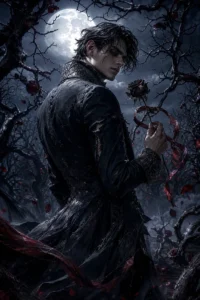
Black from collar to cuff, without ornament except a single signet ring and a silver watch chain disappearing into his waistcoat. Rain darkened his overcoat at the shoulders and clung to the ends of his black hair. He had not removed his gloves. He was tall, lean, and so controlled that stillness seemed less a habit than a threat.
Seraphina had expected brutality to announce itself loudly. She had expected a man made grotesque by rumor.
Lucian Blackthorne was worse.
He was beautiful in a way that offered no comfort. High cheekbones, a severe mouth, skin pale against the dark slash of his brows. His eyes were not black, as gossip claimed, but a strange storm-gray, bright as rain on steel. They moved over the room once, and every person inside it seemed to remember something they owed.
Then his gaze found Seraphina.
It did not slide away.
The air between them tightened.
Seraphina had been watched by men before—admired, measured, dismissed, desired. Lucian looked at her as if recognition was a wound he had reopened by accident.
For one unguarded second, something savage crossed his face.
Then it vanished.
He removed his gloves finger by finger. “Forgive me.”
His voice was low, even, and carried without effort. It stroked the candle flames flatter.
Octavia tapped her cane once against the floor. “You are late.”
“Yes.”
“We noticed.”
“I assumed you would.”
Cassian lifted his glass. “Cousin.”
Lucian ignored him.
Edmund rose. “Mr. Blackthorne, we are pleased you could join us.”
“Are you?” Lucian asked.
The silence afterward was delicate and lethal.


0 Comments