Chapter 3: The House That Watches
by inkadminThe first thing Seraphina noticed about Blackthorne Hall was that it did not appear all at once.
It emerged from the storm in pieces.
A spear of wrought-iron fence. The pale flash of a stone angel with its face eaten smooth by salt and time. A row of cypresses bending beneath the rain like mourners unwilling to leave a grave. Then, beyond the carriage window, through the watery blur of midnight glass, the house itself gathered shape on the cliffside—black roofs, narrow windows, chimneys like broken fingers clawing at a sky swollen with thunder.
Blackthorne Hall did not stand against the storm.
It watched from within it.
Seraphina sat with her gloved hands locked in her lap, the weight of the new ring on her finger impossible to ignore. It felt colder than the rain, colder than the vows she had spoken under chandeliers and hungry eyes, colder than Lucian Blackthorne seated across from her in the dim carriage as if carved from the same ancient darkness as the estate ahead.
Their wedding reception still clung to her in fragments: champagne untouched in crystal flutes, the stale perfume of old women whispering behind fans, her father’s hand like a clamp on her elbow, Lucian’s voice at her ear when he had found her in the rain.
You run, and the contract punishes more than you.
She had not asked him what that meant.
Cowardice, perhaps.
Or survival.
The carriage wheels hissed over the flooded drive. Beside Lucian, on the seat, his black gloves lay folded with unsettling precision. He had removed them sometime after they left the city, though she had not seen him do it. That was how he moved—without announcement, without waste, without granting the world the privilege of reacting.
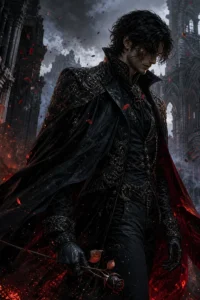
Lightning tore open the sky. For one white second, his face appeared in the carriage glass: dark hair damp from the earlier rain, cheekbones sharp enough to make shadows look intentional, mouth composed in a line that revealed nothing. Only his eyes broke the stillness. Pale gray, almost silver in the flash, fixed not on the house but on her reflection.
Seraphina turned from the window. “Do you intend to stare at me the whole way?”
“No.”
His answer was too calm to be satisfying.
“How generous.”
“I was considering whether you would attempt to throw yourself from a moving carriage.”
She smiled without warmth. “Have I become that predictable already?”
“Not predictable.” His gaze dropped briefly to her hands. To the ring. “Desperate.”
The word struck the small space between them like flint against steel.
Seraphina’s fingers curled. The ring bit her skin. “You know nothing about my desperation.”
Lucian leaned back, the shadows reclaiming the angles of him. “I know you ran through a storm in a silk gown with half the city watching. I know you calculated three routes out of the ballroom before the vows were finished. I know you hid a hairpin in your left sleeve and considered using it on the driver before you recognized the crest on his collar.”
Her mouth went dry.
Outside, iron gates groaned open.
“You watched me that closely?” she asked.
“I watched everyone that closely.”
“That must be exhausting.”
“It keeps people alive.”
Another thing he said like a door closing.
The carriage rolled beneath an arch of black stone. At its crown, something winged had been carved long ago—perhaps a raven, perhaps a heraldic beast distorted by weather into a creature half-bird, half-bone. Rainwater spilled from its beak in silver streams.
Seraphina refused to look impressed.
She had been raised among estates and private galleries, rooms lined with paintings older than governments, dining tables that could seat dynasties and conceal knives beneath linen. Vale House had marble floors and imported roses and a music room where her mother once played Chopin until dawn.
But Blackthorne Hall was something else.
Vale House had been built to be admired.
This place had been built to endure sieges.
The carriage stopped before a broad flight of steps slick with rain. Two lanterns burned on either side of the entrance, their flames caged behind smoky glass. The double doors rose high above them, black oak banded in iron, each handle shaped like a serpent swallowing its tail.
A footman appeared before the driver descended. Then another. Then a woman in severe black, holding a lantern against the storm as if she had been waiting there all night. No one spoke.
Lucian opened the carriage door himself.
The sound of rain rushed in, cold and immediate. He stepped down first, then extended his hand.
Seraphina looked at it.
Long fingers. Bare now. A signet ring on his smallest finger, black stone engraved with the same winged crest. A faint scar crossing the base of his thumb, pale against his skin.
“I can manage,” she said.
“I know.”
He did not withdraw his hand.
The servants watched without watching, eyes lowered in practiced obedience. Somewhere above, a curtain shifted in a dark upper window.
Seraphina placed her hand in his.
His palm was warm.
That irritated her more than it should have.
He helped her down, and the wind seized at her veil, her skirts, the loose strands of hair plastered against her throat. She had changed from the ruined wedding gown into a traveling dress the color of dove smoke, hastily provided by a maid who had trembled too visibly when Lucian entered the room. The dress was fine enough, expensive enough, and entirely not hers.
Like the ring.
Like the name.
The woman with the lantern dipped into a curtsy. She was older than Seraphina expected, perhaps fifty, with iron-gray hair wound tightly at the nape of her neck and a face composed of thin lines and hard decisions.
“Welcome home, Mr. Blackthorne.” Her voice was low, roughened by age or disuse. “Mrs. Blackthorne.”
Seraphina stiffened.
Lucian’s fingers tightened once around hers, warning or reassurance. She could not tell which.
“Mrs. Hawthorne,” he said. “Is everything prepared?”
“Yes, sir.”
“The east rooms?”
“As instructed.”
Something flickered across the housekeeper’s face—gone before Seraphina could name it.
Lucian saw it. Of course he did.
“Speak,” he said.
Mrs. Hawthorne’s grip tightened on the lantern handle. “There was a disturbance in the west corridor shortly after eleven.”
The rain seemed to grow louder.
Lucian went very still. Not visibly alarmed. Not surprised. Only still in a way that made the servants standing near the doors lower their eyes further.
“Who?”
“No one was found, sir.”
“Damage?”
“A mirror cracked. The third one from the gallery.”
Seraphina watched him. “Is that unusual?”
No one answered.
The silence was too quick, too complete, as though every servant had been trained to swallow breath at the same time.
Lucian released her hand. “Have it removed before morning.”
“Yes, sir.”
“And double the watch.”
Mrs. Hawthorne’s mouth tightened. “In the house?”
“Everywhere.”
Only then did Lucian turn to Seraphina, and whatever had passed through his expression was gone. “Come inside.”
The doors opened before them.
Warmth should have waited within. Firelight, perhaps. The smell of wax and polish, woodsmoke and supper. Instead, Seraphina stepped into a vast entrance hall where the air felt several degrees cooler than outside, as if the house did not permit weather to enter so much as transform it into something older.
The foyer rose three stories beneath a vaulted ceiling webbed with beams blackened by age. A staircase split the far wall in two curving sweeps, descending like the wings of some enormous beast. Candles burned in iron sconces, but their light seemed reluctant to touch the corners. Rain battered the stained-glass windows overhead, distorting the family crest into shifting shards of crimson and blue.
Along the walls hung portraits.
Dozens.
Men in dark coats and women in stiff gowns, children posed with hounds, old patriarchs holding canes capped in silver. They stared down with varnished eyes, their painted skin luminous in candlelight. Seraphina had grown up beneath portraits; they were supposed to be proof of lineage, wealth, permanence.
These felt like witnesses at a trial.
Lucian handed his coat to a waiting valet. “This is Blackthorne Hall.”
“I gathered.”
His mouth almost moved. Not a smile. The memory of one.
“Mrs. Hawthorne will show you the household tomorrow. Tonight you need rest.”
Seraphina looked around the cavernous hall, at the shadows under the staircases, at the closed doors tucked beneath arches. “How considerate. My jailer has prepared a pillow.”
A footman flinched.
Lucian did not.
“If I wished to keep you prisoner, Seraphina, you would know.”
Her name in his mouth unsettled her. No title. No ornament. Just the intimate curve of syllables, spoken as if he had a right to them.
“Do you expect gratitude because the cage is large?”
“I expect intelligence.”
“Then you should have married someone obedient. It requires less of you.”
This time, the ghost of a smile came close enough to be dangerous. “Obedience is rarely useful.”
Mrs. Hawthorne cleared her throat softly. “Shall I have tea sent to Mrs. Blackthorne’s rooms?”
Seraphina nearly corrected the name. Her tongue pressed against her teeth.
Not yet.
If she began bleeding over every small wound, she would have nothing left by morning.
“No tea,” Lucian said before she could answer. “Something stronger.”
“Brandy?” Mrs. Hawthorne asked.
“For me,” Seraphina said sharply. “Not because he decided.”
The housekeeper’s eyes lifted for the first time.
They were dark and assessing, and within them Seraphina saw something unexpected. Not pity. Not curiosity.
Approval, quickly buried.
“Of course, madam.”
Madam. Wife. Blackthorne.
Every word placed another stone in the wall rising around her.
Lucian turned toward the staircase. “I’ll take you up.”
“I thought Mrs. Hawthorne could do that.”
“She could.”
“But?”
He glanced at the portraits. “The house is easier to misunderstand at night.”
“Do houses often require interpretation in your family?”
“This one does.”
He began up the stairs without waiting to see whether she followed.
Seraphina hated that she did.
The staircase creaked beneath her slippers in soft, complaining notes. The banister was carved with vines so detailed she could feel the thorns beneath her palm. As they ascended, the portraits seemed to change their angle. Painted eyes found her from every wall. One woman in particular caught Seraphina’s attention—a pale figure dressed in deep green velvet, black hair falling unbound to her waist, one hand resting over a pearl choker at her throat.
Seraphina slowed.
There was something familiar about the woman’s face.
Not likeness. Nothing so simple. A feeling. A fracture of recognition under the ribs.
“Who is she?”
Lucian stopped two steps above her. He followed her gaze.
For the first time since they had arrived, something in him hardened beyond his usual control.
“Evangeline Blackthorne.”
“Your mother?”
“My aunt.”
“She looks sad.”
“Most portraits lie.”
“And this one?”
He looked at the painted woman for a moment too long. “This one warns.”
Before Seraphina could ask what that meant, a sound came from below—a low thud from somewhere deep within the house.
Not thunder.
Not the settling of old beams.
Something deliberate.
The servants in the hall stopped moving.
Every one of them.
Mrs. Hawthorne, halfway across the floor with the lantern, lifted her head. The footman at the door held a dripping umbrella mid-fold. The valet’s hands paused over Lucian’s coat.
They all looked toward a corridor beneath the western staircase.
A corridor swallowed in shadow.
Seraphina followed their eyes.
At the end of it stood a door.
Not grand. Not ornate. A narrow panel of dark wood, iron-bound, with no visible handle from where she stood. Above it hung no portrait, no sconce, no ornament. The wall around it looked older than the rest of the hall, stones rougher and darker, as if that part of the house had been built around a wound.
The silence stretched.
Then Lucian said, very softly, “Continue.”
The servants obeyed at once. Motion resumed with eerie precision. Umbrella folded. Coat carried away. Lantern lifted. Footsteps scattered.
Seraphina’s pulse beat in her throat.
“What is behind that door?”
Lucian’s face gave her nothing. “The west wing.”
“And everyone is afraid of architecture?”
“Some architecture deserves fear.”
She laughed once, though no amusement touched it. “You speak in riddles because you think it makes you interesting.”
“No. I speak in riddles when the truth would put you in danger.”
“How convenient for you.”
He descended one step, bringing them nearly eye to eye. The candlelight sharpened the shadows beneath his cheekbones. Rain gleamed in his hair, a dark strand fallen across his brow, and for one disorienting moment he looked less like the feared heir of a brutal dynasty and more like a man who had not slept properly in years.
“Nothing about this is convenient.”
His voice was quiet enough that no one below could hear.
“Then explain it to me.”
“No.”
“Because I am your wife?”
“Because you are alive.”
The answer stole whatever retort she had prepared.
He turned away first, continuing upward. After a moment, she followed, anger keeping pace with curiosity.
The second floor corridor stretched long and candlelit, papered in faded damask the color of old wine. Windows lined one side, each black with rain and the restless reflection of flames. The other side held doors. Too many doors. Some with brass nameplates gone dull, some with keyholes dark as watching eyes.
As they passed, a maid carrying folded linens emerged from one room, saw Lucian, and dipped immediately. Then she saw Seraphina and paled.
It was not the reaction of a servant seeing a new mistress.
It was the reaction of someone seeing a ghost wearing a wedding ring.
Seraphina stopped. “Have we met?”
The maid’s gaze darted to Lucian.
His expression did not change, but something passed between them. A command, silent and brutal.
“No, madam,” the girl whispered.
“Then why are you looking at me like that?”
“I—”
“Enough,” Lucian said.
The word cracked like a whip.
The maid bowed so low the linens nearly slid from her arms. “Forgive me, madam.”
She fled down the corridor, shoes soundless on the runner.
Seraphina stared after her. “How many people in this house know something about me that I don’t?”
“Too many.”
She turned on him. “That was not comforting.”
“It wasn’t meant to be.”
“Do you ever answer a question directly?”
“When the answer won’t make you reckless.”
“You keep mistaking my desire for the truth as a character flaw.”
“No.” His eyes held hers. “I keep recognizing it as something that can be used to hurt you.”
For one breath, she could hear only the rain against the windows and the soft tick of some unseen clock.
Then, from behind one of the closed doors, came the faint sound of music.
A piano.
Three notes. Slow, delicate, almost drowned by the storm.
Seraphina went cold.
She knew those notes.
Her mother had played them in the blue parlor on nights when she thought Seraphina was asleep. Not a full piece. Never more than a few bars before she stopped, hands hovering over the keys, eyes wet in the lamplight.
Seraphina moved toward the door.
Lucian caught her wrist.
Not hard. He did not need to be hard.
The contact stopped her as surely as iron shackles.
“Let go,” she said.
“No.”
Another three notes drifted through the wood.
Seraphina’s breath shuddered. “Who is in there?”
“No one you need to meet tonight.”
“That song—”
“Is old.”
“My mother played it.”
Something flickered in his eyes.
There. Gone.
“Many women did.”
“Don’t insult me.”
“Then don’t ask questions in hallways where walls have ears.”
She looked down at his hand around her wrist. His skin was warm, his thumb resting over the frantic beat of her pulse. The intimacy of it enraged her. The restraint enraged her more. He held her as if he knew exactly how much force would stop her without hurting her, as if he had already measured all the ways she might break.
“You cannot keep doing this,” she whispered.
“I can.”
“You cannot drag me into your house, put your ring on my hand, lock every door, and tell me nothing.”
“I can do all of that.” His voice lowered. “What I cannot do is let you die because you believe defiance is the same thing as freedom.”
The music stopped.
The sudden silence was worse.
Seraphina swallowed, hate and fear tangling so tightly she could no longer separate them. “You speak as though death is waiting in your corridors.”
Lucian’s gaze shifted past her shoulder, toward the dark length of the hall.
“In this house,” he said, “death has excellent manners. It waits to be invited.”
He released her.
Her wrist felt colder without his hand.
She hated that too.
They continued in silence until the corridor opened into a smaller gallery. Here, the portraits were covered with black cloth. One after another, shrouded frames lined the walls like bodies standing upright. The candles burned low. A draft passed over Seraphina’s neck, smelling faintly of roses gone sour.
“Why are these covered?” she asked.
Lucian did not look at them. “Family tradition.”
“That is becoming the most suspicious phrase in the language.”

0 Comments