Chapter 6: Knives Under Silk
by inkadminThe dress arrived in a black box large enough to bury a child.
It waited on Seraphina’s bed when she returned from the east gallery, where the storm had spent the afternoon worrying at Ravenhall’s windows with pale fingers and the sea had thrown itself against the cliffs until the foundations seemed to breathe salt. The box was tied with a ribbon the color of old blood. No card. No note. Only the crest stamped in wax at the center: a raven with its wings spread over a crown of thorns.
Seraphina stood in the doorway with a strip of linen still wrapped around her wrist and dust on the hem of her plain morning skirt. Behind her, the corridor lay in velvet shadow, all antlered chandeliers and ancestral portraits with eyes too clever to be dead. Ravenhall had a way of making silence feel occupied.
She did not touch the box at first.
That had become a rule in Lucien D’Aramitz’s house. Nothing was harmless simply because it was beautiful.
The room smelled faintly of beeswax, rain, and the turpentine she had smuggled from the conservation studio. On the vanity, beneath a porcelain bowl of white camellias, she had hidden the singed scrap of blue ribbon she had found behind the nursery wainscoting that morning. The ribbon had been brittle with age, nearly blackened along one edge, but when she lifted it to the light, its original color had appeared like a drowned memory surfacing in dark water.
Blue.
The same shade as the mask in Lucien’s locked cabinet.
The same shade that haunted the place behind Seraphina’s eyes whenever she smelled smoke.
She crossed the room and slid the box’s ribbon loose.
Silk sighed beneath her fingers.
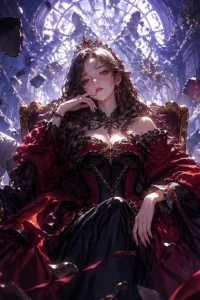
The gown inside was not white. Seraphina had expected white because men like Lucien enjoyed irony, and the city enjoyed spectacle, and there would be whispers tonight about purity bought with debt, about a bride transferred like property from one ledger to another. Instead, the dress was black—deep, light-devouring black—with a bodice of structured satin and sleeves of transparent gauze embroidered with tiny silver thorns. The skirt fell in layered waves, severe at first glance, then treacherous when she lifted it. The inner lining gleamed red.
A wound beneath mourning.
Atop the gown lay a necklace.
Seraphina went still.
It was a collar of diamonds and black pearls, old enough that the settings had the soft wear of generations. At its center hung a drop-shaped ruby so dark it looked almost clotted. A bride’s jewel. A chain disguised as inheritance.
The door opened behind her without a knock.
She did not turn.
“If I had known marriage included being dressed like a sacrifice,” she said, “I would have negotiated harder.”
Lucien’s reflection appeared in the vanity mirror, tall and dark in the threshold. He wore evening black already, though not completely. His shirt was unbuttoned at the throat, his cufflinks absent, his hair still damp as if he had just come in from the rain. He had the particular stillness of a knife laid beside a dinner plate: civil, polished, and present for one purpose.
His gaze moved from the open box to her wrist, where the linen had slipped, exposing a fresh scrape.
“You were in the east gallery,” he said.
“Was I?”
“The servants do not come back from there smelling of dust and defiance.”
“Your servants lack imagination.”
Lucien entered. The door clicked shut behind him. The sound was soft, but it sealed the room.
Seraphina picked up the necklace, weighing it in her palm. It was heavier than it looked. Cold, too, despite the fire in the grate. “Is this meant to charm them or warn them?”
“Both.”
“Efficient.”
He stopped close enough that the mirror held them in a single frame: her in dusty gray, him in black, the bed between them bearing silk and blood-colored satin. His face gave little away. It never did, not unless one knew where to look. The faint tightening at the corner of his mouth. The shadow under his eyes that sleep had not softened. The controlled breath when he noticed something he disliked.
His attention returned to her wrist.
“Who hurt you?”
There it was. Not concern, precisely. Something sharper. A claim unsheathed.
“A nail,” Seraphina said. “It leapt from the wall and attacked my virtue.”
“Which wall?”
“Are you going to have it shot?”
“If necessary.”
She laughed before she could stop herself. It came out too quiet, almost startled. Lucien heard it. Of course he did. His eyes flickered to her mouth, and for one charged second the room altered. The rain against the windows grew distant. The old house held its breath.
Seraphina placed the necklace back in the box.
“I won’t wear it.”
“You will.”
“Because you command it?”
“Because tonight every family that hates me will be looking at your throat.” His voice was low, almost indifferent, but the words landed with weight. “I would prefer they see diamonds instead of an opening.”
A chill moved across her skin that had nothing to do with the weather.
“You make parties sound so festive.”
“This is not a party.”
“No?”
“It is a census of enemies.”
Seraphina turned from the mirror to face him. “And what am I?”
Lucien studied her. Candlelight touched the hard line of his cheekbone and slid away. His eyes were the gray of storms seen over open water, the kind that swallowed ships without raising their voice.
“My wife.”
The answer should not have warmed anything in her. It was a legal word, a contract word, a word written by men in rooms where women’s lives were measured against debt. But from Lucien’s mouth it sounded less like ownership than warning. Less like tenderness than a blade placed between her and the dark.
Seraphina hated that her heart noticed the distinction.
“Your wife who does not know why the east gallery has a locked nursery,” she said softly. “Or why there are burn marks beneath three layers of paint. Or why a child’s ribbon was hidden behind the wainscoting.”
The change in him was minute.
A breath stopped.
A shadow crossed.
Then he was Lucien again, beautiful as a closed door.
“Get dressed.”
“That is not an answer.”
“It is the only one you’ll receive before we leave.”
He turned toward the door.
Seraphina’s temper caught. “Did you know my mother?”
Lucien paused.
Outside, thunder rolled over the sea.
“Your mother,” he said, “knew everyone worth fearing.”
Then he was gone.
Seraphina stared at the closed door until the candle beside the vanity guttered and bent toward the draft he had left behind.
Your mother knew everyone worth fearing.
The words followed her while two maids came to dress her, women with pale faces and careful hands who spoke only when necessary. They unlaced her, bathed her wrists with lavender water, brushed her hair until it shone like ink, and fastened the black gown around her body with the solemn precision of armor being buckled onto a soldier.
When the necklace clasped at her nape, Seraphina suppressed a shiver.
In the mirror, a stranger looked back.
The gown had transformed her angles into elegance, her leanness into severity. Silver thorns glittered down her arms. The ruby at her throat caught the firelight and burned. Her mouth, painted a deep wine by the older maid with hands that trembled only once, looked more dangerous than soft.
“There, madam,” the maid whispered.
Madam.
Not Miss Vale. Not daughter of a disgraced father. Not an art restorer with cracked nails and solvents in her blood.
Madam D’Aramitz.
Seraphina lifted her chin. The woman in the mirror did the same.
If the city wanted a spectacle, it would have one.
Lucien waited at the foot of the grand staircase beneath the chandelier of smoked crystal. He had finished dressing. Black tailcoat, white shirt, silk waistcoat so dark it nearly vanished against him. A raven-headed cane rested in one gloved hand, though Seraphina had never seen him need it. A silver signet ring gleamed on his right hand.
He looked up when she descended.
Only his eyes moved.
But that was enough.
Seraphina felt his gaze like a touch down the slope of her neck, over the jeweled collar, along the narrow waist of the gown and the red flash of lining with each step. His expression did not soften. Lucien D’Aramitz did not soften in view of servants, portraits, or God. Yet something in his stillness sharpened, focused, drew taut.
At the bottom stair, she offered him a smile sweet enough to poison wine.
“Will I do?”
He held out his hand. “You will ruin someone’s evening.”
“Only one?”
“We can hope for more.”
Against her better judgment, she placed her gloved hand in his.
His fingers closed around hers.
The heat of him came through the silk.
They stepped out beneath Ravenhall’s porte cochere into a night of slanting rain. The motorcar waiting below the stone steps was black, long, and polished to a predatory shine. Two guards stood beside it with hats low and coats buttoned over weapons that no one in polite society would admit to noticing. At the drive’s edge, the cliff dropped into roaring darkness, where the sea slammed white against black rock.
Lucien helped her into the car.
He did not release her hand until she was seated.
Inside, the leather smelled of smoke, cold air, and expensive restraint. The partition was raised. Rain streaked the windows, turning Ravenhall’s gaslights into blurred golden wounds.
As the car began its descent along the cliff road, Seraphina watched the mansion recede into the fog. It stood with its turrets and steep roofs hunched against the sky, too large for a home, too haunted for a fortress.
“Where are we going?” she asked.
“The Palazzo Argent.”
Her fingers tightened in her lap before she could stop them.
Lucien noticed. “You know it?”
“Everyone knows it.”
The Palazzo Argent sat in the old banking quarter, where canal water ran black beneath marble bridges and the city’s wealthiest families kept their palaces facing one another like beautiful enemies. Once a year, the Argent Foundation hosted a charity gala for the restoration of Saint Orison’s Cathedral. No one cared about the cathedral’s cracked frescoes except as an excuse to display jewels, make alliances, and ruin one another beneath string quartets.
Seraphina had attended once as a child, before her father’s name became a joke whispered behind fans. She remembered chandeliers like inverted gardens of light. Gold leaf ceilings. Her mother’s hand at the small of her back. A woman in emeralds bending down to say, What a pretty little ghost you are.
Then smoke.
Always, when memory turned, it found smoke.
“You’re pale,” Lucien said.
“How fortunate that I’m dressed for mourning.”
He watched her from the opposite seat. In the dimness, the passing city lights carved his face into brief fragments: mouth, cheek, eyes, darkness.
“Tonight you will be introduced as my wife,” he said. “There will be condolences disguised as compliments. Questions disguised as concern. Insults disguised as jokes. Do not drink from a glass you did not see poured. Do not allow anyone to separate you from me unless I permit it.”
“Permit?”
“Unless I am dead,” he amended.
“Very romantic.”
“Romance is what men offer when they have no soldiers.”
Seraphina turned to the window, hiding the reluctant curve of her mouth. The city rose around them in wet black stone and amber lamps. They passed shuttered shops, iron balconies slick with rain, shrines to saints whose painted faces peeled beneath candle soot. At an intersection, a cluster of boys in caps stopped beneath a streetlamp to stare at the car. One crossed himself when he saw the crest on the door.
“Do they fear you that much?” she asked.
“Not enough.”
“Is that why you married me? To improve your reputation?”
His laugh was soundless. “If I wanted a better reputation, I would have married a saint.”
“And instead you chose a woman whose father sold her to cover his debts.”
Lucien’s gaze sharpened. “Your father did not sell you.”
“No?”
“He offered. I accepted.”
“A distinction only a monster would find comforting.”
“I have never claimed to be comforting.”
The car turned onto the Avenue of Bells. Ahead, Saint Orison’s Cathedral rose from the rain, its twin spires vanishing into low cloud. Scaffolding climbed one side like a cage. Beyond it, connected by a bridge of glass and iron, the Palazzo Argent blazed with light.
Carriages and motorcars lined the wet street. Uniformed footmen held umbrellas over women in satin and men in severe evening clothes. Camera flashes popped near the entrance, briefly bleaching the night. Armed police stood under the cathedral colonnade, pretending their attention was casual.
The car slowed.
Seraphina felt it then—not fear, exactly. Fear was simpler. This was the sensation of stepping onto a stage where every face in the audience hoped the floorboards would give way beneath her.
Lucien leaned closer.
“Smile,” he murmured.
“I thought you preferred warnings.”
“A smile is one.”
The door opened.
Sound rushed in: rain, voices, music spilling from the palace, the crackle of flash powder, the restrained gasp of a crowd recognizing a man they had spent years discussing in rooms he did not enter.
Lucien stepped out first.
The effect was immediate.
Conversation thinned. Heads turned. A path opened where none had been offered. He did not look left or right. He simply stood in the rain as if weather, wealth, and human curiosity were all lesser forms of inconvenience.
Then he extended his hand into the car.
Seraphina took it.
For one suspended moment, as she emerged beneath the umbrellas and the light struck the ruby at her throat, the crowd forgot its manners.
Whispers rose like insects.
“That’s Vale’s daughter.”
“Impossible.”
“He married?”
“When?”
“Look at the necklace.”
“God help her.”
Seraphina smiled.
It was easier than she expected. Perhaps because anger had always suited her better than fear. She placed her hand on Lucien’s arm and felt the hard muscle beneath the fine wool. He guided her up the steps, past photographers who seemed eager and terrified in equal measure.
“Monsieur D’Aramitz!” one called. “Is it true the ceremony took place in Saint Merrow’s crypt?”
Lucien did not slow.
“Madame D’Aramitz, was the match arranged?”
Seraphina turned her head just enough for the nearest camera to catch the calm cruelty of her smile. “All marriages are arranged by someone. The fortunate ones get to know by whom.”
A ripple went through the gathered press.
Lucien’s hand covered hers briefly on his arm. Not restraint. Approval.
Inside, warmth struck her first. Then perfume. Hundreds of bodies, lilies, beeswax, champagne, wet wool, expensive powder, and beneath it all the mineral damp of old stone. The Palazzo Argent had been built to intimidate creditors and kings. Its entrance hall rose three stories beneath a painted ceiling where winged figures poured silver coins from bowls into a painted sea. Marble columns gleamed veined and cold. A broad staircase swept upward in two arms, both crowded with guests pretending not to stare.
At the landing, a string quartet played something bright enough to be obscene.
A receiving line had formed beneath an enormous tapestry depicting Saint Orison holding his severed tongue on a golden plate. Seraphina had always found that particular saint honest. Silence, after all, was usually purchased with blood.
The first to greet them was their hostess, Contessa Maribel Argent, a woman made entirely of ivory silk, sapphires, and social violence. Her hair was silver, not with age but intention, arranged in a sculptural crown. She kissed the air beside Lucien’s cheek without touching him.
“Lucien,” she said, and made his name sound like an old sin. “You have deprived us of your presence so long that some of us feared you had become a legend.”
“Legends are more useful when unseen.”
Her smile sharpened. “And yet here you are. With a bride.”
Her gaze settled on Seraphina. It flicked over the dress, the necklace, the face. Cataloguing, pricing, judging where to press.
“Madame D’Aramitz,” the contessa said. “How unexpectedly delightful.”
“Contessa.” Seraphina inclined her head. “Unexpected delights are the only kind worth attending these functions for, I’m told.”
Maribel’s eyes warmed by half a degree. “A tongue as polished as her jewels. How dangerous.”
Lucien’s voice cut in, mild as winter. “You invited danger when you sent the card.”
“I invited a donor.”
“Same thing.”
The contessa laughed, and the people nearest them laughed half a heartbeat later, relieved to be told the correct response.
As they moved on, Seraphina felt gazes catch at her like hooks. She recognized old banking names attached to powdered faces: Veyr, Chastain, Morel, Sancia. Families whose fortunes had been built on shipping, relics, loans to desperate kings, and the careful laundering of sins through cathedral restoration funds. They greeted Lucien with smiles that never reached their eyes. They greeted Seraphina with the delight of vultures discovering fresh silk tied around a corpse.
“My dear,” said Lady Ysabet Veyr, a narrow woman in green velvet whose fingers glittered with emeralds large enough to ransom a province, “what a marvelous surprise. We had all quite lost track of the Vale family.”
“How kind of you to look.”
Lady Veyr blinked.
Her husband, a soft man with a banker’s damp handshake, gave a wheezing chuckle. “Art restoration, wasn’t it? Your occupation before…this?”
His pause opened like a trapdoor.
Seraphina looked at his hand, still holding hers too long. “Yes. I specialize in removing grime from valuable old things.”
Lucien coughed once into his fist. It might have been amusement. It might have been a warning to the banker, whose grip loosened immediately.
They passed beneath an arch of white roses into the main ballroom.
Light burst over Seraphina in a thousand fragments.
Chandeliers blazed from a mirrored ceiling. The polished floor reflected gowns, jewels, black coats, and the pale flames of hundreds of candles set along the walls in niches carved with saints. At the far end of the ballroom, tall windows overlooked the cathedral square and the rain-silvered city beyond. Musicians played from a raised balcony. Champagne flowed. Laughter rose and fell in practiced waves.
And everywhere, beneath silk and perfume, Seraphina sensed knives.
Lucien moved through the crowd like a dark tide. Men stepped toward him to offer hands and then seemed to remember something urgent elsewhere. Women watched him over fans, some with fear, some with fascination, a few with old bitterness. Seraphina had thought his isolation at Ravenhall might be weakness. Here she saw it for what it was.
Power did not always enter rooms loudly.
Sometimes it merely arrived, and everyone adjusted their breathing.
A young man with auburn hair and laughing eyes intercepted them near a fountain overflowing with white orchids. He wore a burgundy waistcoat and an expression too charming to be trusted.
“Lucien,” he said, placing a hand dramatically over his heart. “You wound me. Married, and not a word? I had to hear it from my tailor, who heard it from a priest, who heard it from a dead man, apparently.”
Lucien’s mouth barely moved. “Rafael.”
“That frigid greeting confirms it. You are delighted to see me.” The young man turned to Seraphina and bowed deeply. “Madame D’Aramitz, Rafael Marchant. Cousin when he cannot avoid admitting it, friend when he is drunk, nuisance always.”
“Seraphina,” she said, offering her hand.
Rafael kissed the air above her knuckles with theatrical respect. “A restoration expert, I hear. How extraordinary. You must tell me if anything can be done for Lucien’s personality.”
“I would need stronger solvents.”
Rafael’s grin widened. “Oh, she’ll do.”
Lucien’s eyes cut to him. “Do for what?”
“Survival, naturally. No woman without wit should be forced to endure this family.” Rafael plucked a champagne flute from a passing tray, sniffed it, then handed it to a passing matron without drinking. “Do avoid the Veyr vintage. It tastes like regret and tax evasion.”
“You said you had information,” Lucien said.
Rafael’s levity thinned. Only for a moment, but Seraphina saw it. Beneath the charm, a wire pulled tight.
“Later.” His gaze flicked toward the balcony, where a cluster of men stood in conversation beneath a marble statue of Mercy blindfolded. “The Morels brought guests.”
Lucien did not look. “I know.”
“Do you also know one of them has been asking after your wife’s childhood?”
The floor seemed to tilt beneath Seraphina’s slippers.
Lucien’s hand settled at the small of her back.
To anyone watching, it was a husband’s possessive touch. To Seraphina, it was a command not to move.
“Who?” she asked.
Rafael’s eyes met hers, humor gone. “A man calling himself Bellamy. Gray beard, scar through the lip, too many rings. He asked whether the Vale girl still painted birds on the inside of wardrobes.”
Seraphina’s breath caught.



0 Comments