Chapter 5: Saints Do Not Survive Here
by inkadminThe Saint Orpheus Club had no sign.
It did not need one.
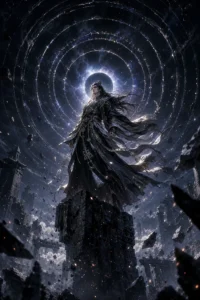
On Pall Mall, where rain glazed the black railings and turned the pavement into a mirror for passing headlights, the building sat between a shuttered embassy and a private bank with lion-headed knockers. Its façade was pale stone gone nicotine-yellow with age, its windows tall and blind behind velvet curtains the color of old wine. Above the door, carved into the arch, a marble saint leaned over a lyre with his throat slit from ear to ear.
Seraphina stared at him through the misted window of Cassian Blackthorne’s car and thought there was something indecently honest about that. Most holy places preferred to hide the blood.
“Lovely,” she murmured. “Nothing says refined society quite like a murdered musician.”
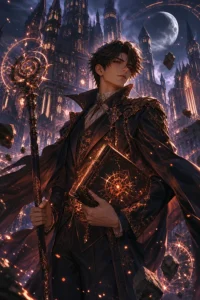
Cassian’s gaze did not leave the entrance. In the dim of the car, his profile looked cut from obsidian and candlelight—straight nose, hard mouth, the faint shadow of stubble along his jaw. Rain coursed down the window beside him, blurring the gold ring on his hand into a smear of fire.
“Orpheus went into hell for his wife,” he said.
Seraphina adjusted the pearl button at her wrist. Her gloves were ivory silk tonight, chosen by Cassian’s housekeeper and laid out on the bed like a surrender flag. “Didn’t work out terribly well for either of them, as I recall.”
At that, he looked at her.
It was an irritating talent of his, looking. Most men glanced and weighed and took. Cassian Blackthorne looked as though he meant to dismantle the thing before him and catalogue every secret screw.
“Then let’s hope you don’t look back,” he said.
The words settled between them with the cold intimacy of a hand at the nape.
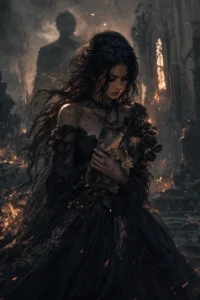
Seraphina smiled because it was either that or let him see the pulse hammering in her throat. The dress he had selected for her was black velvet, high at the neck, long at the wrist, severe enough for mourning and fitted enough to be an insult. A narrow line of pearls fastened the bodice from collarbone to sternum. Beneath them, her heart beat in frantic little treasons.
“Is that another rule?”
“A warning.”
“You give so many, I’ve begun to collect them.”
Cassian’s mouth tilted, not quite a smile. “Then tonight should be profitable.”
The driver opened the door, and wet London breathed in.
Cold rain, petrol, damp wool, cigar smoke drifting from some unseen doorway. Seraphina gathered her skirt and stepped out beneath the umbrella Cassian had taken from the driver. He held it over her without asking, close enough that his sleeve brushed her shoulder. The gesture could have been gallant from any other man. From him it felt like possession performed in public.
A pair of men stood beneath the awning of the club, both in black coats, both still as statues. Their eyes moved first to Cassian, then to her, then away. Recognition. Calculation. A silent accounting of the new wife.
Not wife, she corrected herself. Asset. Hostage. Keyhole.
Inside her left glove, hidden beneath silk and the fine tremor of her fingers, the scar across her palm tightened. Old pain had a way of waking near old danger.
Cassian placed his hand at the small of her back.
“Breathe,” he said softly.
She hated him for noticing.
“I am breathing.”
“You’re preparing to bite someone.”
“That’s also breathing.”
This time, the almost-smile became real enough to change his face for half a second, a flash of something young and ruinous. Then it was gone, and they were climbing the shallow stone steps to the saint with the cut throat.
The door opened before Cassian touched it.
Heat rolled out first, thick with beeswax, expensive liquor, burning cedar, perfume, and the metallic undertone of old money—polished silver, damp stone, secrets stored too long in locked rooms. The foyer was paneled in dark walnut, its ceiling painted with a fresco of angels falling into a river. A chandelier burned overhead with electric candles shaped like flames, each bulb trembling faintly in the draft.
A man in white gloves bowed to Cassian. He wore a tailcoat and an expression so polished it had no human fingerprints left on it.
“Mr. Blackthorne.”
“Hale.”
The man’s gaze slid to Seraphina. It did not linger, but it sharpened. “Mrs. Blackthorne.”
The name landed on her like a collar.
She inclined her head. “How unnerving. That sounded almost legal.”
Hale blinked once.
Cassian’s fingers pressed lightly at her back. Not warning. Not yet. Amusement, maybe, though with him the two often wore the same suit.
“My wife has a fondness for accuracy,” Cassian said.
“A rare quality here,” Seraphina added.
Hale bowed deeper, perhaps to hide whether he wanted to smile. “The club is honored.”
“The club survives,” Cassian said. “There’s a difference.”
Then they moved past him into the throat of Saint Orpheus.
The main hall unfurled like a fever dream of empire and sin. A sweeping staircase curved upward beneath portraits of men who had owned half of London and arranged the quiet deaths of the other half. Velvet banquettes crouched in shadowed alcoves. Card tables gleamed under green-shaded lamps. Along the far wall, a bar of black marble caught the amber light of a hundred bottles. Members stood in clusters beneath the smoke haze, women in satin and men in tailored darkness, diamonds at throats, knives in smiles.
No one stared.
That was the first cruelty.
They noticed her without giving her the dignity of being watched. Their conversations thinned as she entered, laughter dimming by a thread, eyes flicking toward her in mirrors, in polished silver trays, in the black windows reflecting the room. Seraphina felt each glance like a pin through silk.
Seven years.
Seven years she had avoided rooms like this. Seven years scraping varnish from saints’ faces in a cold studio under the name Sophie Lark, eating toast over catalogues, pretending the past was a painting she had successfully restored by painting over the blood. Seven years of keeping her head bowed just enough, her accent plain just enough, her papers convincing just enough.
And now she stood on Cassian Blackthorne’s arm while London’s gilded wolves scented the air.
“Your pulse is visible at your jaw,” Cassian murmured without moving his lips.
“How intimate of my circulatory system.”
“Control it.”
“Shall I ask it politely?”
“If politeness has ever worked for you, I’ll be astonished.”
She looked up at him. “You know very little about what works for me.”
His gaze dropped to her mouth for a single, dangerous beat.
The hall seemed to tilt closer.
Then a woman’s voice sliced through the moment, bright as a champagne flute cracking.
“Cassian, darling. You’ve brought the lamb.”
The speaker emerged from a knot of people near the fireplace. She was tall and copper-haired, draped in emerald silk that clung to her like envy. A diamond serpent coiled around her wrist. Her eyes were pale green, amused and appraising.
“Lenora,” Cassian said.
Not warmly. Not coldly. The way a man might acknowledge a blade he had once used and not yet thrown away.
Lenora kissed the air beside his cheek, then turned all her attention on Seraphina.
“Seraphina Vale.” She said the name slowly, tasting it. “Back from whatever convent your family hid you in.”
“No convent would have me.”
“Sensible women.” Lenora’s smile widened. “I’m Lenora Vane.”
“I know.”
A small pause.
Lenora’s eyes gleamed. “Do you?”
Seraphina allowed her gaze to drift to the serpent bracelet, then to the faint scar at the woman’s collarbone, half-hidden by powder. She had restored a portrait once from Lenora’s family collection—a seventeenth-century martyr with Lenora’s same cool eyes and the same talent for looking beautiful while someone else burned.
“Your family collects Flemish work and unfortunate husbands.”
Someone nearby choked on a laugh.
Cassian did not look at Seraphina, but his hand at her back stilled.
Lenora’s smile froze, then thawed into something far more dangerous. “How delightful. She has teeth.”
“I did warn you,” Cassian said.
“Did you?” Seraphina asked. “I must have been busy not obeying.”
Lenora laughed properly then, throwing her head back. It was too practiced to be real, but effective enough that the nearby men relaxed. “Oh, I like her. How unfortunate for you.”
“Most things are,” Cassian replied.
“Are we drinking to the marriage or mourning it?” Lenora lifted two glasses of champagne from a passing tray and offered one to Seraphina.
Seraphina looked at the glass, then at Cassian.
He gave the smallest shake of his head.
Poison, then. Or something meant to loosen the tongue. In this room, even hospitality came sharpened.
Seraphina took the glass anyway.
Cassian’s fingers flexed against her spine.
She smiled at Lenora, raised the champagne, and tipped it deliberately onto the roots of a potted fern beside the fireplace.
“To growth,” she said.
Lenora’s laughter went silver and sharp. “Careful, Cassian. This one may survive you.”
“No one survives anyone in here,” said a man from the shadows.
He stepped forward with the languid grace of someone who had never hurried because consequences hurried for him. He was perhaps fifty, with dark hair gone iron at the temples and a face that might once have been handsome before indulgence softened it and cruelty refined it again. A ruby pin gleamed at his cravat, red as an accusation.
Cassian’s posture changed.
The shift was nearly invisible: shoulders settling, jaw easing, eyes emptying. But Seraphina felt it through the hand on her back as one might feel the floor harden before an earthquake.
“Uncle,” he said.
Magnus Blackthorne smiled.
So this was the uncle. The one who had governed the Blackthorne interests while Cassian’s father drank himself into a ruin and Cassian became the family’s favorite threat. Magnus had been a name in whispers when Seraphina was a girl: patron of operas, breaker of unions, buyer of judges. A gentleman with manicured hands and cellars full of screaming.
His eyes moved over her, lingering not on the shape of her body but the places where secrets might be hidden—gloves, throat, hairline, the tiny pearl buttons at her cuffs.
“My dear niece.”
Seraphina’s stomach turned at the word. “We’ve only just met. Perhaps let us not become family too quickly.”
Magnus chuckled. “Cassian neglected to mention you were charming.”
“He neglects so much.”
“Does he?” Magnus looked at Cassian. “How unusual. I’ve always found my nephew obsessively thorough.”
Cassian’s expression did not alter. “When the subject merits it.”
“And does she?”
The question was soft. The room around them seemed to lean in.
Seraphina felt the trap beneath it. If Cassian said yes, she became valuable. If no, she became disposable. Men like Magnus did not waste curiosity. They invested it.
Cassian’s thumb moved once against the seam of her dress, a stroke so light it might have been accidental.
“She is my wife,” he said.
Magnus’s smile deepened. “That was not what I asked.”
“It was the answer you’re getting.”
For one exquisite second, nobody breathed.
Then Magnus laughed, and the room remembered itself. Glasses lifted. Conversations resumed. Somewhere, a piano began to play, the melody delicate and minor, notes falling like rain into a grave.
Magnus stepped closer to Seraphina and took her gloved hand before Cassian could prevent it. His lips hovered above her knuckles without touching.
“Welcome to Saint Orpheus, Mrs. Blackthorne.” His breath smelled faintly of cloves. “A word of advice: saints do not survive here.”
Seraphina withdrew her hand slowly. “How fortunate I’ve never been one.”
His eyes sharpened.
For a heartbeat, she saw something flicker there. Not anger. Recognition’s ugly cousin.
Then Cassian moved, placing himself half a step between them.
“We have people to greet.”
“Of course.” Magnus’s gaze stayed on Seraphina. “Everyone will be so eager.”
As they walked away, Seraphina kept her chin level, her pace measured. The urge to look back at Magnus’s stare crawling over her shoulders was nearly unbearable.
Cassian leaned down. “You enjoy inviting death to dinner?”
“Only when death is rude enough to introduce itself first.”
“Magnus does not forgive insults.”
“Then he must be very lonely.”
“Seraphina.”
Her name in his mouth cut cleaner than any threat. She glanced at him, expecting fury. Instead she found something worse: concern disguised so poorly as irritation that it made her chest ache.
“Do not spar with him unless you know where his knives are,” he said.
“And do you?”
“Some.”
“Not all?”
“No one knows all of Magnus’s knives.”
They reached the bar. Cassian ordered without asking what she wanted. “Water for my wife. Whisky for me.”
“How thoughtful. You’ve decided I’m incapable of selecting my own poison.”
“You selected Lenora’s.”
“And generously donated it to horticulture.”
The bartender placed their drinks down with the reverence of a priest presenting relics. Seraphina took the water. It tasted of ice, lemon, and suspicion.
Cassian drank whisky and watched the room over the rim of his glass. “Everyone here wants something from you.”
“How tedious. I brought so little.”
“You brought the Vale name.”
Her fingers tightened around the glass. “So did my father. It didn’t improve him.”
“You brought whatever he sold me.”
There it was—the reason beneath the vows, beneath the rules, beneath the velvet dress and the hand at her back.
The key.
Not brass or iron, though she sometimes wished it were so simple. A word. A cipher. A chain of debts hidden inside an old family lie. Cassian believed the Vales had stolen something from the Blackthornes, something valuable enough that he had married a woman he did not want to retrieve it.
Only he did want something.
Not her. Never that.
But when his eyes dropped to her mouth, when his hand found the exact place her breath faltered, when he watched the room as if daring anyone to decide she was prey before he did, Seraphina was no longer sure which possibility frightened her most.
“I told you,” she said. “I don’t know what you think I have.”
“And I told you no lies.”
“Yes, how could I forget? No lies, no locked doors, no leaving without you. You should have had them embroidered on a pillow.”
“I considered having them carved above your bed.”
“Romantic.”
“Practical.”
She looked at him over the rim of her water. “Do you ever tire of being monstrous?”
Cassian’s face went very still.
A lesser man would have flinched. A better man would have denied it.
He stepped closer instead, close enough that his coat brushed the velvet at her sleeve, close enough that the scent of him—smoke, cedar, winter air—cut through the room’s perfume and made a traitor of her lungs.
“No,” he said. “I tire of pretending it shocks anyone.”
Something in her softened before she could stop it.
He saw that too. Of course he did. His gaze narrowed as if tenderness were more suspicious than hatred.
A bell rang somewhere above them, low and resonant.
The conversations in the hall shifted. People began moving toward the far doors, where two footmen had pulled back heavy curtains to reveal an inner chamber washed in candlelight.
“What now?” Seraphina asked.
“The evening’s entertainment.”
“Please tell me it isn’t murder.”
“Not officially.”
“Your reassurance needs work.”
Cassian offered his arm.
She stared at it.
“Take it,” he said. “Unless you’d rather enter alone and let them decide who may approach you.”
The practical part of her understood at once. In this room, Cassian’s arm was not affection. It was a border.
Seraphina slid her hand into the crook of his elbow.
His muscles tensed beneath her touch.
Interesting.
They entered the inner chamber with the rest of the predators.
It had once been a chapel.
Seraphina knew it instantly by the bones of the room—the arched ceiling, the narrow stained-glass windows, the apse where an altar should have stood. But Saint Orpheus had remade worship in its own image. The pews had been removed and replaced by crescent rows of velvet chairs. The altar was now a raised platform draped in black silk. Above it hung a painting nearly twelve feet tall, veiled in gauze.
Her breath caught.
Cassian glanced down. “You know it?”
“No.” Too quick. She forced herself to soften the lie. “Not from here.”
But she did know the frame.
Gilt acanthus, late eighteenth century, damaged on the left corner and repaired poorly with composition paste. She had seen photographs of it years ago, tucked between documents in a locked drawer that had smelled of her mother’s violet soap and gun oil.
The painting had belonged to the Ashbourne collection.
To her.
No—not her. Never her.
To the dead girl.
Seraphina’s ears filled with the dull roar of her own blood.
Auction assistants moved through the chamber, distributing slim black catalogues embossed with the club’s crest: the throat-slit saint and his lyre. Cassian took one, flipped it open, and his expression changed.
Not much. A fraction of darkness gathering behind his eyes.
“What is it?” she asked.
He handed her the catalogue.
The page showed a blurred image of the veiled painting and a lot number.
LOT VII
Portrait of a Young Woman as Saint Cecilia, artist unknown, c. 1890.
Provenance disputed.
Offered from a private estate.
Bidding by invitation only.
Below the text, in small italic type, was a line that made her fingers go numb.
Recovered after the Ashbourne fire.
The chapel seemed to shrink around her.
Fire. Screaming. Rain at the windows. A girl in a white nightdress standing at the top of a staircase, hair unbound, face streaked with soot.
Run, Sera. Don’t let them see your face.
Seraphina closed the catalogue.
Cassian was watching her now, not the room. “You’ve gone pale.”
“The lighting is unkind.”
“Try again.”
“No lies, yes, I remember. Unfortunately, I have no honest answer that won’t bore you.”
His hand covered hers over the catalogue. Warm, firm, inescapable. “If you know something about that painting, tell me before someone else makes use of it.”
The cruelty was that he sounded almost like he meant to protect her.
“And if what I know is mine?”
“Nothing in this room is yours.”
She met his gaze. “Including me?”
For once, he did not answer quickly.
The auctioneer stepped onto the platform, saving them from whatever might have happened next. He was a narrow man with silver hair and a voice smooth enough to make extortion sound like etiquette.
“Ladies and gentlemen, honored members, cherished sinners.” A ripple of laughter. “Tonight’s private sale includes several pieces whose provenance is best discussed in whispers, if at all. As always, discretion is not requested. It is required.”
A servant locked the chapel doors.
Seraphina heard the bolt slide home.
Her skin prickled beneath the velvet dress.
The first lots passed in a blur. A Fabergé cigarette case that had belonged to a murdered duke. A reliquary containing, allegedly, the finger bone of a saint and, less allegedly, microfilm sealed beneath the gold. A Turner watercolor stolen in 1986 and sold tonight to a woman with widow’s eyes and a bodyguard who kept one hand inside his jacket.
Money moved with the softness of silk. Bids were indicated by a tilt of a catalogue, the touch of a ring, a murmured number to an assistant. Beneath the civility, Seraphina sensed currents of threat. A man in the second row stopped bidding after Magnus looked at him. Lenora purchased a set of antique dueling pistols and blew Cassian a kiss over the catalogue.
Cassian bought nothing.
He waited.
So did Magnus, seated three rows ahead, his ruby pin catching candlelight like a fresh wound.
At last, the auctioneer turned to the veiled painting.
“Lot Seven.” His smile became reverent. “A portrait long believed destroyed, recently returned to the dark from which beauty so often emerges.”
Two assistants grasped the gauze.
Seraphina stopped breathing.
The veil fell.

0 Comments