Chapter 2: Blackthorne House
by inkadminRain followed Seraphina Vale into Blackthorne House like a witness unwilling to be left outside.
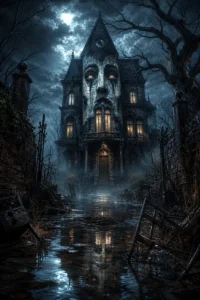
It came in sheets over the gravel drive, silvering the world beyond the iron gates and turning the mansion’s black stone façade into something wet and breathing. The house rose from the dark gardens with too many windows and not enough warmth, its gables clawing at the low-bellied clouds, its chimneys jagged as broken teeth. Gargoyles crouched along the roofline, their mossy jaws open in silent laughter. Ivy strangled the eastern wall. Somewhere in the distance, the Thames moved unseen beneath the city’s fog, carrying secrets through London’s underbelly like blood through a vein.
Seraphina stood at the threshold with her small suitcase in one gloved hand and the taste of cold metal on her tongue.
Behind her, the car that had brought her from the solicitor’s office idled for three seconds too long. Then its engine purred away, tires hissing over rain-slick stone, taking with it the last soft illusion that she could turn around.
The door before her was carved from ancient oak and banded in iron. No handle on the outside. Only a bronze knocker shaped like a raven’s skull, its beak polished by generations of desperate hands.
She did not touch it.
The door opened anyway.
A man in a black suit stood within, narrow as a blade, his silver hair combed perfectly back from a face so expressionless it might have been painted on porcelain. He looked at her suitcase first, then her gloves, then her face. The order told her more than a greeting would have.
“Miss Vale,” he said.
Not Mrs. Blackthorne. Not yet.
Seraphina lifted her chin. “That depends who’s asking.”
The man’s pale brows did not move. “Edwin Graves. House steward.”
“Graves,” she repeated. “How reassuring.”
His eyes flicked, briefly, to the rain dripping from the brim of her hat. “The house has been waiting.”
That was worse than if he’d said Cassian had.
Seraphina stepped inside.
Warmth closed around her, heavy and scented with beeswax, old smoke, rain-soaked wool, and lilies left too long in vases. The entrance hall soared three stories above her, ribbed in black oak and crowned by a stained-glass skylight where moonlight bled through panels of burgundy and blue. The floor beneath her boots was marble, black veined with white, polished enough to hold her reflection like a drowned woman beneath ice.
A grand staircase curled upward at the far end of the hall, twin flights meeting on a landing beneath a portrait large enough to dominate a chapel. A Blackthorne ancestor stared down from the canvas in a red hunting coat, one hand resting on the head of a wolfhound. Or he would have stared—if both his eyes had not been gouged from the paint in violent, deliberate scratches.
Seraphina’s fingers tightened on the suitcase handle.
Not time-wear. Not neglect. She knew the difference. She had spent years studying damage: the yellowing creep of varnish, the delicate web of craquelure, the bruising of damp, the savage honesty of a knife.
Someone had blinded that man.
Someone who had wanted it to hurt.
“Your coat,” Graves said.
Seraphina glanced away from the portrait and found his gloved hand extended.
“I’ll keep it.”
“The house is warm.”
“So are coffins, I imagine, if one spends enough time in them.”
A sound—small, quickly smothered—came from her left.
Seraphina turned.
Two maids stood near an arched passage, both in severe black dresses with white collars. One was older, brown-skinned, with glossy hair coiled at the nape of her neck and eyes that watched without seeming to. The other was barely twenty, freckled, red-haired, and pale with curiosity. The younger maid dropped her gaze the instant Seraphina saw her smile.
Graves’s attention sliced toward them.
The older maid curtsied. “Mrs. Vale’s rooms are prepared, Mr. Graves.”
“Miss Vale,” he corrected.
The maid did not blink. “Of course.”
Seraphina noted the correction. Not wife, not guest, not prisoner. A thing between states. A candle not yet lit, a body not yet buried.
Footsteps sounded from above.
Measured. Unhurried. Possessive.
The house changed before he appeared. That was the only way she could think of it. The servants straightened by a breath. The silence gathered itself. Even the rain seemed to lower its voice against the windows.
Cassian Blackthorne descended the staircase as though it had been built for the sole purpose of delivering him into rooms.
He wore black again, though this suit was less formal than the one from the solicitor’s office—no tie, the collar of his white shirt open at the throat, sleeves fastened with obsidian cufflinks. The looseness should have made him look less dangerous. It did not. It only suggested the knife had been removed from its sheath.
His dark hair was damp at the temples. He smelled faintly of rain and tobacco and something sharper, expensive leather warmed by skin. A bruise shadowed one knuckle. Seraphina noticed because noticing had kept her alive.
His eyes found hers.
Not blue. Not grey. Some color between storm cloud and gunmetal, cool enough to freeze the room and bright enough to cut through it.
“You’re late,” he said.
Seraphina let her gaze drift to the grandfather clock by the wall. Its brass pendulum swung with the slow indifference of an executioner’s axe. “Your driver took the scenic route.”
“My driver follows orders.”
“Then your orders lack imagination.”
The freckled maid inhaled too sharply.
Cassian reached the bottom stair. He did not look at the servants. He did not need to.
“Leave us,” he said.
The maids disappeared through the arch. Graves remained.
Cassian’s gaze shifted a fraction.
Graves bowed his head and withdrew, closing the inner door to the passage with a soft click that carried through the hall like the turning of a lock.
Seraphina and Cassian stood alone beneath the blinded portrait.
For one moment, the past pressed its cold mouth to the back of Seraphina’s neck.
Her father’s trembling hand signing paper. The wax seal pressed into red. The solicitor refusing to meet her eyes. Cassian’s voice, quiet and brutal: Your father sold what he still owned.
She drew in a breath through her nose. Lilies. Wax. Damp stone. Male cologne. Blood beneath expensive soap? Perhaps imagination. Perhaps not.
Cassian looked at her suitcase. “That’s all?”
“I travel light when abducted.”
“You weren’t abducted.”
“No? I must have mistaken the signed contract, the armed driver, and the house with no exterior door handle.”
A shadow of amusement touched his mouth. It vanished before it became human. “You came because refusing would have put your father in a grave before dawn.”
Seraphina smiled.
She had learned that a smile, properly used, could be armor, invitation, or blade. This one was all three.
“You speak as if I’m fond of him.”
“You came anyway.”
The words slipped beneath her ribs, seeking soft places. She refused to flinch.
“Curiosity is a terrible flaw.”
“In this house,” Cassian said, “it’s fatal.”
Thunder rolled beyond the windows. The skylight shivered with it. Above them, the scratched-out ancestor kept his ruined watch.
Seraphina removed one glove finger by finger, slowly, because his eyes had fixed on her hands from the moment she entered. Her left hand first. Slim fingers, neat nails, a faint crescent scar near the thumb from a scalpel slip six years ago. Then the right. The black silk gloves folded together in her palm like shed skin.
“I’ll try not to die before the wedding,” she said.
Cassian stepped closer.
It was not much. Half a pace. Enough to bring him into the edge of her space, close enough that the air shifted between them. Seraphina refused the instinct to retreat. Retreat taught predators the distance you were willing to give.
“There are rules,” he said.
“Of course there are.”
“You will not leave the grounds without my permission.”
“How medieval.”
“You will not contact anyone from your former life.”
Her pulse struck once, hard.
Former life. As if he knew. As if he had peeled back the name she wore and glimpsed the bones beneath.
“My former life consists largely of turpentine, cracked canvases, and men who think restoration means making a five-hundred-year-old saint look recently moisturized.”
“Then you won’t miss it.”
“I’ll miss the saints. They had better manners.”
His gaze dropped to her mouth. Not with softness. With calculation. As though he were assessing a lock.
“You will not enter the west wing.”
There it was.
Seraphina heard the hinge in his voice. The small concealed door opening.
She looked toward the corridor branching beyond the staircase, where two black double doors stood beneath a carved lintel of thorns. A velvet rope stretched across them. Not to keep anyone out, truly. To remind them someone could.
“What’s in the west wing?”
“Nothing that concerns you.”
“That phrase has never once concealed something dull.”
“You will not enter it.”
“And if I get lost?”
“Don’t.”
“London’s great crime heir, undone by inadequate signage.”
Something passed through his eyes then—not amusement. Not anger. Recognition, perhaps. He was beginning to understand that fear had not made her quiet. A mistake men often made. They thought a woman who smiled softly had already surrendered.
Cassian leaned in, and his voice lowered.
“Escape will cost you more than obedience, Seraphina.”
Her name in his mouth felt like a hand at her throat. Not squeezing. Measuring.
She held still. “Is that a threat?”
“It’s an accounting.”
“I’ve always hated numbers.”
“Then let me simplify it. The gates are guarded. The staff report to me. The city knows my name better than yours. If you run, every door that opens for you will open because I allow it. Every man who offers help will sell the offer before you finish thanking him. Every train station, every airport, every cheap hotel with stained carpets and romantic ideas about anonymity—I own someone there, or someone who owns someone there.”
His words should have frightened her.
They did frighten her.
Fear moved through Seraphina like cold water under ice. Invisible, contained, deadly if stepped on carelessly. But beneath it, something else stirred. Not defiance. Older than that. The quiet, precise fury of a girl who had once hidden under floorboards while men in velvet coats searched above her, laughing as they decided which of her family’s debts would be collected first.
“How exhausting,” she said. “Owning the world.”
“Only the useful parts.”
“And am I useful?”
Cassian’s eyes did not leave hers.
“That remains to be seen.”
There it was again. The transaction beneath the silk. He did not want a wife. He wanted something from her. The key, according to whispers her father thought she had never heard. The Blackthorne key. The debt marker. The thing her family had stolen and hidden so well it had ruined three bloodlines hunting for it.
Seraphina did not have it.
But she knew better than to say so.
Men like Cassian believed denial was flirtation with truth.
The inner door opened. Graves returned with the silent timing of a man who had been waiting with his ear to the wood.
“Dinner will be served at nine, Mr. Blackthorne.”
Cassian did not look away from Seraphina. “Have Mrs. Hawthorne send up tea.”
“To the east rooms?”
“To my mother’s suite.”
For the first time, Graves’s composure cracked. Not enough for most to notice. Seraphina noticed the tightening at his jaw, the small pause before his answer.
“Yes, sir.”
Cassian turned, and the spell broke like glass beneath a heel.
“Come,” he said.
Seraphina picked up her suitcase before Graves could. “How charming. My captor gives tours.”
“My captive asks too many questions.”
“Your captive hasn’t begun.”
Cassian glanced back at her over his shoulder.
His mouth curved, faint and dangerous.
“Then I look forward to disappointing you.”
He led her up the grand staircase.
Seraphina counted the steps.
Twenty-four to the first landing. Portrait above. Scratched eyes. Right wall: two sconces, gas-flame styled but electric, both functional. Left: a narrow servant’s door half-hidden behind a tapestry depicting ravens over a battlefield. Hinges new. Lock old. Possible passage.
They turned at the landing and ascended another flight.
Seventeen steps.
The second-floor gallery stretched long and dim in both directions, paneled in dark wood polished by centuries of hands. The carpet runner was deep red, patterned with black vines. The air grew cooler here, carrying a faint mineral dampness beneath the lilies.
More portraits lined the walls.
Men in formal coats. Women with pearls at their throats and knives in their eyes. Children holding silver toys, their small painted faces solemn with inherited cruelty. And everywhere, those same violent marks.
Not every portrait. That would have been madness made obvious. No, only certain ones. A woman in emerald silk whose face had been left intact but whose left hand had been scraped down to raw canvas. A boy of twelve with his mouth slashed open from cheek to cheek. An old man whose throat had been painted over in thick black strokes.
Not vandalism.
A language.
Seraphina slowed before the emerald woman.
The brushwork was exquisite. Late nineteenth century, perhaps. A society painter with a taste for luminous flesh and moral rot. The scratched hand had once held something. The outline remained, pale against the darker gown. A key? A letter? A flower?
“Do you admire the damage?” Cassian asked.
She looked at the painting, not him. “Damage is honest. It tells you what someone couldn’t bear to leave untouched.”
“And what does this tell you?”
Seraphina stepped closer. The varnish had darkened with age, but beneath the scratches she could see pressure marks where the blade had bitten too deep. Whoever had done it had been angry, but not careless. They had avoided the face. Preserved the expression. Wanted the woman to keep watching while her hand was erased.
“It tells me someone hated what she held more than they hated her.”
Silence.
When she turned, Cassian was looking at her with an expression she could not read. Not surprise. Not quite.
“You see a great deal,” he said.
“Occupational hazard.”
“And yet you missed the most important part.”
“Which is?”
He came to stand beside her, close enough that his sleeve nearly brushed hers.
“She did it to herself.”
The corridor seemed to lengthen around them.
Seraphina looked back at the woman in emerald. At the proud tilt of her chin, the dark hair coiled beneath diamonds, the hand flayed from history.
“Why?”
“Because Blackthorne women learn early what a hand can be forced to sign.”
He moved on before she could answer.
Seraphina followed, her suitcase wheels muffled by the carpet.
Second floor. Gallery east-west. Portrait language. Servant door near landing. West wing forbidden. Mother’s suite accessible from east corridor.
She wrote the map in her mind the way she used to reconstruct lost underdrawings beneath paint. Layer by layer. Shape by shape. What was visible mattered less than what had been hidden.
They passed three closed doors on the right, all black, all with brass nameplates turned inward so they could not be read from the corridor. On the left, a long window looked down over the rear gardens. Seraphina glimpsed clipped hedges, a dry fountain shaped like a weeping angel, and beyond it a glasshouse glowing faintly green in the storm.
There were two guards outside the glasshouse.
Not gardeners. Not in that weather. Not standing so still.
Cassian stopped at the end of the corridor before a set of double doors painted a faded shade of blue so dark it nearly passed for black. Unlike the other doors, these bore no lock she could see.
He opened them.
Seraphina stepped into a suite preserved like a memory too beloved to bury and too poisoned to touch.
The sitting room was all muted silver and old rose, its tall windows draped in velvet the color of dried blood. A fire burned low in the marble hearth, filling the room with a warmth that did not reach the corners. Bookshelves climbed one wall, their spines cracked and gilded. A pianoforte stood beneath a sheet near the window. On the mantel, a clock had stopped at 2:17.
Fresh lilies stood in a crystal vase.
The scent was strongest here. Sweet, funereal, almost suffocating.
Seraphina looked at Cassian.
“Your mother liked lilies?”
“No.”
A simple answer. A locked door.
She set her suitcase down. “Then someone has a cruel sense of housekeeping.”
Cassian crossed to the mantel and touched the stopped clock with one finger. Not sentimentally. As though confirming it had not betrayed him by moving.
“My mother hated lilies. Said they made any room feel like it was waiting for a corpse.”
“Was she wrong?”
He looked over his shoulder. The firelight found the hard line of his cheekbone, the shadow beneath his lower lip, the old exhaustion around his eyes that power had polished but not erased.
“Often.”
“You put them here anyway.”
“I don’t.”
The answer slid into the room and stayed there.
Seraphina glanced toward the vase. Fresh stems. Water clear. Pollen staining the tablecloth gold. Someone had arranged them that morning, perhaps while Cassian was away. Someone with access. Someone permitted, or someone no longer afraid of permission.
“Do all your ghosts have florists?” she asked.
“Only the persistent ones.”
He moved to another door and opened it. “Bedroom. Dressing room. Bath through there. You’ll remain in this suite until the wedding.”
“Your mother’s suite.”
“Yes.”
“Why?”
“Because it is secure.”
Seraphina walked past him into the bedroom.
It was beautiful in a way that made her throat tighten unwillingly. A canopied bed stood in the center, carved with blackthorn branches and hung with gauze curtains pale as mist. The rug underfoot was Persian, worn soft in pathways from bed to window, window to vanity, vanity to door. A silver-backed brush lay on the dressing table beside a perfume bottle gone cloudy with age.
The mirror above the vanity had been cracked from one corner to the center.
Not shattered. Not replaced.
A single fracture cut the reflection into two versions of Seraphina: one pale, composed, hat brim shadowing her eyes; the other warped, elongated, a stranger leaning out of glass.
She set her suitcase on the bed.
“Secure,” she said. “Such a romantic word.”
Cassian remained in the doorway. “Romance is inefficient.”
“Only when done poorly.”
His gaze moved over her, slow enough to be insulting, controlled enough to be intentional. Her damp coat, her dark dress, the slim line of her throat. He was trying to unsettle her.
The infuriating part was that he succeeded by inches.
Her skin became aware of itself beneath his attention. Not warm, exactly. Alert. A match held near paper.
She disliked him for that most of all.
“You’ll find clothes in the wardrobe,” he said. “A maid will attend you.”
“I dress myself.”
“Not for dinner.”
“I eat better when unobserved.”
“You’ll dine with me.”
“And if I decline?”
He pushed away from the doorframe and came into the room.
“Then I’ll have dinner brought here, and we’ll discuss obedience over soup.”
“You do keep returning to that word.”
“You keep resisting it.”
“Some habits are difficult to break.”
“I’m very good at breaking things.”


0 Comments