Chapter 4: Dinner with Wolves
by inkadminThe rain had not stopped by dusk.
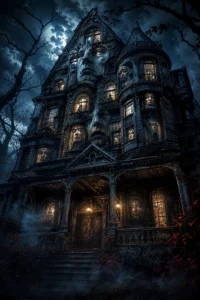
It pressed itself against Blackthorne Hall in long, silver scratches, dragged sideways by the wind coming off the sea. The glass walls of the west wing trembled faintly with each gust, and the whole mansion seemed to breathe around Mara as she stood in the dressing room with her hands clenched at her sides.
Three dresses had been laid out on the bed by a maid who did not meet her eyes.
One was pearl-white and soft enough to pretend at innocence. One was black, high-necked, with sleeves that ended in points over the knuckles like mourning made fashionable. The last was wine-red satin, cut to bare the shoulders and fasten around the throat with a narrow band that looked too much like a collar.
Mara chose the black.
Not because it was modest. Not because it would please them. Because when the girl in the mirror lifted her chin and stared back, she looked less like a bride and more like a widow deciding whom to bury next.
Her scalp still prickled where Silas’s voice had touched her in the forbidden corridor.
You are not the girl your father gave me.
He had said it with no triumph. No surprise. No anger sharp enough for her to catch and use. He had simply looked at her in that ruined nursery, surrounded by dustless toys and a cradle no child had slept in for decades, and spoken as though he had known before she ever stepped through his doors.
And then he had let her leave.
That was the worst part.
Silas Blackthorne did not drag her by the wrist. He did not threaten to expose her. He did not demand explanations in the cold, controlled voice she was beginning to hate because of how carefully she listened for it.
He had only said, “Dinner is at eight. Wear something you can bleed in.”
Now, as the maid tugged the final row of buttons closed at Mara’s spine, the words slid again beneath her skin.
“Will Mr. Blackthorne be dining with us?” Mara asked.
The maid’s fingers stilled for half a heartbeat. She was small and dark-haired, with a spray of freckles across her nose and the anxious precision of someone who had been trained not to be noticed. Her name was Elianor, or perhaps Eleanor; no one had introduced her properly, and servants in houses like this were often treated as furniture that breathed.
“Yes, madam.”
“How unfortunate for everyone.”
The maid’s mouth twitched before fear smothered it. “The family has arrived.”
“All of them?”
“Most.”
There was something in that word. A crack in the varnish. Mara watched the girl in the mirror.
“Which ones should I avoid?”
The maid went pale. “I wouldn’t presume—”
“Presume quietly. I won’t tell.”
Elianor lowered her gaze to the final button at Mara’s waist. “Lady Octavia likes weakness. Mr. Cassian likes secrets. Mrs. Halewick likes blood, though she pretends it’s wine. The twins like whatever hurts.”
Mara absorbed the list as if it were a menu. “And Silas?”
The maid’s hands fell away.
For the first time, she looked directly at Mara in the mirror. Her eyes were gray and young and far too tired.
“Mr. Blackthorne likes silence,” she whispered. “But it doesn’t like him back.”
Before Mara could ask what that meant, three sharp knocks struck the outer door.
Elianor flinched so hard the silver brush on the vanity toppled onto its side.
Mara turned.
“Come in.”
The door opened, and Silas Blackthorne filled the threshold as if the house had shaped itself around him and resented everyone else for existing. He wore black evening dress with an ivory shirt open at the throat, no tie, no ornament but the signet ring on his right hand. His dark hair was still damp, combed back from a face too beautiful for mercy. The faint scar near his jaw caught the firelight like a pale thread.
His gaze moved over Mara once.
Not slowly. Not greedily. Worse.
Precisely.
As though he were noting every weapon she had chosen to carry and every place she had left unarmored.
“Leave us,” he said.
Elianor was gone before the air finished holding his command.
The door shut behind her with a click that sounded very much like a lock, though Mara knew it wasn’t.
“If you’ve come to inspect the merchandise,” Mara said, turning back to the mirror to fasten her earrings, “you’ll have to make an appointment. I’m very busy being deceived.”
Silas stepped inside.
The room altered when he moved. Shadows sharpened. The rain seemed louder. He did not approach her at once, which was more unnerving than if he had.
“You went into the corridor after I told you not to.”
“I’ve always had difficulty obeying men who think warnings and threats are the same thing.”
“They are not.”
“No?” She pushed a black pearl through her earlobe and met his eyes in the mirror. “Then which was it when you told me to wear something I could bleed in?”
“Advice.”
A laugh escaped her, thin and bright. “How chivalrous.”
His eyes lowered to the hollow of her throat where the dress fastened. “You should have chosen the red.”
“You should have married someone docile.”
“I was not shopping for docile.”
The words landed too close.
Mara turned from the mirror. “What were you shopping for, Silas?”
His expression did not change, but the silence between them tightened until it had bones.
“Survival,” he said.
She hated the way her pulse answered him.
He crossed the room then. Slow. Unhurried. She held her ground because pride was cheaper than fear and she had spent enough of both in her life to know which one left prettier scars. He stopped an arm’s length away and lifted something from his pocket.
A narrow velvet box.
He opened it.
Inside lay a necklace of black diamonds set in silver, each stone cut like a shard of night. At its center hung a small pendant shaped like a thorn. Beautiful. Expensive. Pointed.
“A bridal gift?” she asked.
“Armor.”
“It looks like a leash.”
“Most armor does, to people who’ve never worn it.”
He removed the necklace and held it up.
Mara should have told him no. She should have stepped away. She should have remembered the nursery, his hand braced above her against the doorframe, his voice stripping the false skin from her life.
Instead, she turned.
The air changed again.
Silas came behind her, and though he did not touch her skin, she felt the heat of him like a threat. The necklace settled cold against her throat. His fingers brushed the nape of her neck as he fastened the clasp, a contact so brief she could have imagined it, except her body betrayed her with a shiver.
He saw. Of course he saw.
His reflection stood behind hers, a dark shape with pale, merciless eyes.
“At dinner,” he said, “you will not drink anything poured by my aunt.”
“Which aunt?”
“Any of them.”
“Large family problem?”
“Selective breeding produces interesting defects.”
“And what defect did it produce in you?”
His hands lowered. For one suspended second, his knuckles hovered near her bare shoulders. Then he stepped back.
“Restraint.”
The word should not have sounded like a sin.
Mara faced him. “You know who I am.”
“I know who you are not.”
“Then ask me.”
“No.”
That single syllable struck harder than curiosity would have.
“No?”
“If you tell me because I demand it, it becomes another thing taken from you.” His mouth held no softness. His eyes did. Barely. “I prefer debts freely offered.”
“How generous. My captor has manners.”
“Your husband has patience.”
“Those are not the same man.”
For a moment, something like amusement lived at the corner of his mouth and died there.
“No,” he said. “They are not.”
A gong sounded somewhere deep below, one solemn note that moved through the mansion like a warning.
Silas turned toward the door. “Stay near me.”
“For protection?”
He looked back at her.
“For appearance.”
“Liar.”
“Always.”
Then he offered his arm.
Mara stared at it.
There were choices in life that announced themselves with trumpets, and others that slipped a blade quietly between the ribs. Taking Silas Blackthorne’s arm felt like both.
She placed her hand on his sleeve.
The fabric was warm. Beneath it, his body was unyielding.
Together, they went down to dinner.
Blackthorne Hall revealed new teeth at night.
By day it was a fortress of stone, glass, and sea spray; at night it became something older, all bruised shadows and gold light pooled beneath chandeliers, with portraits watching from paneled walls. The faces in the frames were long-jawed and pale-eyed, men and women painted with hunting dogs, ships, knives, letters sealed in wax. Generations of predators preserved in oil.
Mara let her gaze skim them as she and Silas descended the grand staircase. Somewhere beyond the west windows, lightning unfurled over the sea, exposing the waves in a brutal white flash. The cliffs below appeared for an instant—black, sheer, wet as a freshly opened wound—then vanished again.
Voices drifted from the dining room.
Laughter. Crystal. The low purr of people who had learned to smile without showing blood on their teeth.
At the bottom of the stairs, a man waited.
He was older than Silas by perhaps fifteen years, though the resemblance lay only in the bone structure: the same aristocratic severity, the same winter-colored eyes. But where Silas was controlled force, this man was rot beneath velvet. His evening coat was immaculate, his blond hair swept back, his smile charming enough to have gotten many people killed.
“There they are,” he said. “The newlyweds. I was beginning to think Silas had misplaced you already.”
Silas did not slow. “Cassian.”
“Cousin.” Cassian Blackthorne’s gaze moved to Mara and warmed with calculated interest. “And cousin’s wife. Mara Vale. The city’s most discussed hostage.”
“How flattering,” Mara said. “I assumed I was only the second most discussed. Who died?”
Cassian’s smile widened. “Several people, depending on who you ask.”
“Then ask better people.”
He laughed, genuinely this time, and took her free hand before she could withdraw it. He bowed over her knuckles, but his lips did not touch. A gentleman’s courtesy performed by a snake.
“I see why he chose you.”
Silas’s hand covered Mara’s where it rested on his arm. Not possessive. Not gentle. A warning delivered through bone.
“Careful,” Silas said.
Cassian lifted both hands. “Always.”
“Never,” Silas replied, and walked past him.
Mara felt Cassian’s attention between her shoulder blades long after they left him behind.
The dining room doors stood open.
Inside, the Blackthornes had gathered around a table long enough to host a coronation or a massacre. Candles burned in silver branches down its center, flames wavering though no windows were open. Dark roses spilled from crystal vases, their petals so deep red they were nearly black. Plates gleamed like bone. Knives rested to the right of each setting, polished to a surgical shine.
There were twelve people seated, though only nine looked alive.
At the head of the table sat Lady Octavia Blackthorne.
She was not old in the gentle way of grandmothers. Age had refined her into something bladed. Her silver hair was coiled at the nape of her neck, her throat wrapped in emeralds, her mouth painted the color of dried blood. She wore black silk and no expression at all, as if emotion were an indulgence she had taxed and abolished.
To her right lounged a woman in her forties with copper hair and a laugh that arrived too loudly: Mrs. Genevieve Halewick, if Mara guessed correctly. On Octavia’s left sat a pair of young people so alike they had to be the twins—one male, one female, both golden-haired, both beautiful in the vacant way of porcelain dolls left too near a fire. Their eyes followed Mara in perfect synchronization.
Others filled the chairs: uncles, cousins, spouses, wolves in silk. A heavyset man with ink-stained fingers. A narrow woman wearing three strands of pearls and a smile of devotional cruelty. A youth with a bruised mouth and trembling hands. All turned to look as Silas and Mara entered.
The room cooled.
Not because they feared Mara.
Because Silas had arrived.
Mara felt it pass through them like a draft through reeds. Backs straightened. Glasses paused halfway to lips. The twins stopped smiling. Lady Octavia alone remained still, though one emerald at her throat shifted with the pulse in her neck.
So Elianor had been right.
They feared him.
And yet, beneath that fear, Mara sensed something stranger. Their gazes flickered past Silas occasionally, toward the ceiling, the walls, the closed servants’ door at the far end of the room. As if listening for footsteps that had not yet arrived.
As if the house itself had a seat at the table.
Silas drew out Mara’s chair at the opposite end from Octavia—placing himself at the other head. Not beside his bride, but across the length of polished mahogany from the matriarch.
A challenge disguised as seating.
Mara took the chair to his right. Cassian, arriving after them, claimed the chair to her other side before anyone could object.
“How festive,” he murmured. “A knife on each side of you.”
“I’ve dined with Vales,” Mara said. “I’m used to worse cutlery.”
Across the table, Genevieve Halewick clapped her hands. “Oh, she has teeth. Thank God. I was afraid Edric Vale would send us another wilted girl in diamonds.”
“Genevieve,” Octavia said.
The woman raised her wine. “What? It’s a compliment.”
“From you,” Mara said, “I’ll assume it needs disinfectant.”
A beat of silence.
Then Cassian laughed into his glass.
The twins smiled.
Silas did not react, but Mara saw his fingers relax by a fraction around the stem of his untouched water glass.
Lady Octavia turned her cold gaze on Mara.
“Welcome to Blackthorne Hall, Mrs. Blackthorne.”
There was the faintest emphasis on the name. A reminder. A chain laid delicately across the table.
Mara smiled. “Thank you. It has been unforgettable.”
“Has Silas shown you the grounds?”
“Only the rules.”
“He always did prefer boundaries to conversation.”
“Boundaries are useful when people have difficulty behaving.” Silas lifted his glass at last, but did not drink. “Some of us learned young.”
The temperature dropped again.
A servant appeared at Mara’s left to fill her wine. Before the bottle tilted, Silas spoke.
“Not that one.”
The servant froze.
Genevieve arched a copper brow. “Must you police the girl’s palate already? Let the poor thing get through one family dinner drunk.”
“I said not that one.”
No one moved.
The servant’s hand trembled so slightly that only the candlelight betrayed it in the quiver of glass.
Octavia looked down the table at Silas. “It is a Château Merlain seventy-two. Your father’s favorite.”
“My father had many unfortunate appetites.”
“And yet here you sit,” said the pearl-strung woman softly.
Mara felt the insult before she understood it.
Silas smiled.
It was the first true smile Mara had seen from him, and it did something terrible to the room. People did not become calmer beneath it. They became prey aware of a shadow passing overhead.
“Yes, Aunt Lisette,” he said. “Here I sit.”
Aunt Lisette lowered her eyes to her soup spoon.
The servant withdrew the bottle and returned with another. This time Silas allowed the pour, though he watched the stream of red enter Mara’s glass as if it were a snake being placed in her hand.
Mara did not drink.
The first course arrived: oysters on crushed ice, glistening like tongues; black bread warm from the ovens; butter whipped with salt and herbs. The scents mingled with beeswax, roses, storm-wet stone, and the faint metallic tang that old houses carried in their bones.
Conversation began again, but carefully, like animals returning to a watering hole after hearing a gunshot.
“How are you finding married life?” Cassian asked Mara, spearing an oyster with unnecessary elegance. “Has our dear Silas charmed you with his warmth?”
“He gave me jewelry and threatened my bloodshed within an hour. By family standards, I assume that counts as foreplay.”
The youth with the bruised mouth choked on his wine.
Genevieve howled. The twins blinked, delighted. Cassian leaned back, gaze gleaming.
Silas finally looked at Mara.
Not with anger.
With something far more dangerous.
Interest.
“Careful,” he said again, but this time the word was low enough that only she heard it.
She picked up her water glass. “You keep saying that as if I’ve ever found caution attractive.”
“You find danger attractive?”
“I find honesty attractive.”
“Then you are in the wrong house.”
Before she could answer, Lady Octavia tapped one lacquered nail against her glass. The sound cut through the room.
“A toast,” she said.
Every hand lifted except Silas’s.
Mara followed a breath later, her untouched wine catching candlelight like liquid ruby.
Octavia rose, elegant and grave. “To the joining of Blackthorne and Vale. May old debts be settled, old wounds be forgotten, and old blood learn to obey new vows.”
“How poetic,” Mara said. “And here I thought marriage was about tax advantages.”
Octavia’s eyes did not flicker. “In families such as ours, child, marriage is about survival.”
“So I keep hearing.”
“Then listen better.”
The admonition cracked like a whip.
Silas set down his untouched glass. “Sit down, Octavia.”
Someone sucked in a breath.
Lady Octavia remained standing. “I was not finished.”
“You are now.”
The emeralds at her throat shifted again. Fear, Mara realized, could look very much like rage when pride dressed it well.
Slowly, Octavia sat.
The toast dissolved. Glasses lowered. No one drank until Genevieve, with a wicked little shrug, emptied half her wine.
The second course came: consommé dark as amber, floating herbs like drowned weeds. Mara lifted her spoon, then paused.
Across from her, the twins were whispering to one another.
The girl twin—Vivienne, perhaps—had a pearl hairpin shaped like a beetle. The boy—Vaughn—wore a signet ring too large for his slender hand. Their mouths moved in matching rhythm, and though Mara could not hear them, she saw where their eyes kept straying.
Not to her.
Not to Silas.
To the wall behind Lady Octavia, where an enormous portrait hung between two sconces.
A woman in a white dress stood painted before the sea, one hand resting on the shoulder of a little boy with black hair and solemn eyes. The boy was unmistakably Silas, perhaps six years old. The woman’s face had been slashed.
Not by time. By a blade.
Three cuts raked through the painted features, gouging out eyes, mouth, identity. Yet the rest of the portrait had been meticulously preserved, dustless and restored, as if the vandalism had been framed as part of the composition.
Mara’s spoon dipped back into the bowl untouched.



0 Comments