Chapter 3: The Locked East Wing
by inkadminThe rain did not stop after midnight.
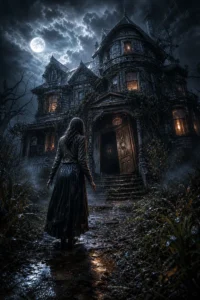
It dragged its nails down the tall windows of Mara’s bedroom, turning the black glass silver with veins of water. Beyond the panes, the sea threw itself at the cliffs again and again, a beast trying to break its own bones. Blackthorne Hall did not sleep so much as hold its breath, every corridor beyond her door sunk in a listening hush.
Mara lay on the enormous bed and stared at the canopy overhead.
The sheets were cold despite the fire someone had lit before leaving her alone. They smelled faintly of lavender and smoke, an expensive attempt to soften a room built for imprisonment. The walls were paneled in charcoal wood. The mirror above the vanity was old enough to have watched women lace themselves into corsets and men come home with blood on their cuffs. A silver tray sat untouched beside the fire: tea, sliced pears, a single square of dark chocolate, and a folded note from a housekeeper who had signed only Mrs. Bell.
If you require anything, ring.
Mara had laughed when she read it.
If she required anything.
She required a knife. A map. A locked safe left carelessly open. She required Silas Blackthorne’s throat under her heel until he told her why there had been blood on his cuff and why every servant in this house flinched from the east wing as if it breathed plague.
Instead, she had a bell pull made of braided silk and a husband who had stood in the doorway of this room three hours earlier, beautiful as a blade beneath the low chandelier, and told her the rules of their marriage with all the tenderness of a judge pronouncing sentence.
You will not enter the east wing.
You will not question my staff.
You will not leave the grounds without my permission.
And you will not mistake my refusal to touch you for weakness.
Mara turned onto her side and watched the fire gnaw at the logs. The flames painted her hands gold, made her wedding ring flash like a warning. Black diamond set in platinum. A Blackthorne stone for a Vale bride. A collar disguised as devotion.
Silas had not kissed her after the ceremony.
Not at the altar under the eyes of both families. Not in the car while rain stitched the city into gray ribbons outside the tinted windows. Not when he had led her into Blackthorne Hall with his hand hovering at the small of her back, close enough for heat, never close enough for contact.
That refusal should have relieved her.
It did not.
It irritated some reckless creature beneath her ribs that had survived too many men by learning exactly where their hunger began. Silas Blackthorne’s hunger was hidden better than most. But she had seen it once, for a heartbeat, when she had caught his sleeve and turned his cuff toward the light.
Blood, bright and wet, soaked into white linen.
His face had gone still. Not blank—never blank. Still, like a predator choosing whether to bite.
Then he had pulled away and said, “Go to bed, Mara.”
As if she were obedient.
As if she were harmless.
She smiled into the dark.
At two minutes past one, Mara slipped from bed.
The floorboards were cold beneath her bare feet. She had changed out of the silk nightdress the maid had laid out—black, thin, insulting—and into the least conspicuous clothes in the wardrobe: soft trousers, a charcoal sweater, her hair tied back with a ribbon she found in a drawer. She removed the wedding ring and placed it on the bedside table, then paused.
The fire snapped.
Slowly, she picked the ring back up and slid it onto her finger.
If she was caught, let Silas see his cage had teeth.
She crossed to the door and pressed her ear to the wood. Nothing. No footsteps. No murmur of guards. Blackthorne Hall was too old to be silent, though. Somewhere within its bones, pipes sighed. The wind prowled beneath eaves. Far away, a door clicked softly shut.
Mara waited.
When no alarm followed, she opened her door.
The corridor outside was washed in moonless dark, broken by wall sconces burning low and blue behind smoked glass. Portraits hung between them—dead Blackthornes in black coats and ivory gowns, their eyes glossed with varnished contempt. They watched Mara step out and close the door without a sound.
Her room sat in the west wing, appointed for honored guests or decorative prisoners. She had memorized the route from dinner: left past the tall windows, down the gallery of hunting dogs, across the landing with the cracked marble angel, then the long hallway where the carpet turned from wine-red to black.
Black carpet. Black doors. East wing.
Forbidden places always dressed too dramatically.
At the first corner, Mara stopped.
A guard stood at the end of the gallery.
He was broad in the shoulders, wearing a black suit too expensive for a simple hired gun and an earpiece that caught the light. His posture said military. His hands said murderer. He faced the windows, looking out at rain and sea, but his reflection in the glass stared directly down the corridor.
Mara retreated before his gaze could sharpen.
Her pulse ticked once, hard.
There would be guards on obvious routes. Silas Blackthorne had not built a family empire by leaving his secrets behind polite velvet ropes. But old houses had servants’ paths. Places designed for invisible people.
Mara looked down at the floor.
A brass vent sat low against the wall near a side table crowded with porcelain cranes. Too small. Beyond it, a narrow door half-hidden by a tapestry depicting some ancestral Blackthorne stabbing a stag through the heart.
Mara’s mouth curved.
“Subtle family,” she whispered.
The door opened into a passage no wider than her outstretched arms. The air changed at once. Less polish, more dust. Less lavender, more damp stone and old wax. Here the house showed its seams: bare floorboards, exposed pipes, stacked linens on shelves. Servants moved like ghosts in these veins while the family performed grandeur in the arteries.
Mara slipped inside and eased the door shut.
The passage ran parallel to the main corridor. A thin stripe of light glowed beneath a door ahead, and voices seeped through.
“…not my place to ask,” a woman murmured.
“Then don’t,” a man replied. “You saw Mr. Blackthorne’s face.”
Mrs. Bell, perhaps. And the man from the entry hall, the one with silver hair and a scar pulling down one eyelid.
Mara held still.
“She’ll go looking,” the woman said. “Girls like that always do.”
“She isn’t a girl.”
“No. She’s a Vale.”
Silence followed, heavy as a covered body.
Then the man said, lower, “That is what they’re calling her.”
Mara’s fingers tightened on the edge of a shelf.
The woman made a soft sound. “You think he knows?”
“Mr. Blackthorne knows everything eventually.”
A spoon clinked against porcelain. Someone sighed.
“God help her if he knows already,” Mrs. Bell whispered.
Mara waited until the voices drifted away, a door opened, then closed. Her heart had climbed into her throat and lodged there like a stone.
That is what they’re calling her.
Not she is. Not Lord Vale’s daughter.
Calling her.
Old terror stirred beneath her skin, ancient and familiar. It wore her father’s aftershave, heard the scrape of a chair across a marble floor, felt a hand closing around the back of a child’s neck as a voice said, Names are not gifts, Mara. They are weapons. Hold yours properly or someone else will put it in your mouth.
She forced herself onward.
The servants’ passage turned twice, sloped down, then rose again by three shallow steps. At a junction, she found a panel set with little brass labels: Gallery, Morning Room, East Service. She chose East.
The air grew colder.
Not draft-cold. Preserved-cold. The kind of chill that lived in rooms no one opened, where sheets covered furniture and time collected like ash.
The passage ended at another hidden door. Mara pressed her palm against it and felt faint vibration through the wood.
Not movement.
Rain. Wind. The sea’s rage traveling through stone.
She found the latch and pushed.
The east wing unfolded before her.
It was darker than the rest of the house, though several sconces burned along the walls. Their flames were electric but flickered like candles, engineered nostalgia for people rich enough to purchase atmosphere. The corridor stretched long and straight, paneled in black walnut, its runner rug worn down the center as if many feet had once traveled here and then abruptly stopped.
Every door was closed.
Unlike the west wing, there were no portraits. No flowers. No tables holding bowls of glass fruit or books arranged by spine color. The emptiness felt deliberate.
Mara stepped onto the black runner.
A camera watched from the corner near the ceiling.
She saw it too late.
Its small red light blinked once.
Mara froze, then tilted her head and gave it her sweetest smile.
“If you wanted me to behave,” she whispered, “you should have bored me less.”
She moved quickly then, trying doors. Locked. Locked. Locked. Each handle cold beneath her palm. One smelled faintly of tobacco. Another of bleach. A third door had scratches near the lock, thin white scars in dark varnish. She knelt, touched them, and felt unease prick along her spine.
Not the marks of a key missing its aim.
Fingernails.
A sound came from somewhere behind her.
Soft. Metallic.
Mara rose.
The corridor remained empty, but the house had changed. She felt it with the instinct of someone who had learned as a child to read rooms faster than faces. A current had entered the air. Somewhere, someone knew.
Good.
Let him come.
She reached the final door at the end of the hall.
It was different from the others. Narrower, painted not black but a faded cream that looked obscene in that dark corridor. A small brass plate had been removed from its center, leaving two holes like bitten eyes. Above the frame hung a carved wooden swallow, wings spread in permanent flight.
Mara touched the handle.
It turned.
For one strange second, she did not open it. The ease of it stopped her more effectively than any lock. Her breath fogged faintly in the cold. Behind her, the corridor waited. Ahead of her, something waited harder.
Then she pushed the door inward.
The smell hit first.
Dust. Old milk. Cedar. A sweetness gone sour beneath layers of time.
Moonlight leaked through tall windows veiled in white curtains, turning the room pale as a drowned face. Mara stepped inside and felt the carpet give softly beneath her feet. A nursery spread around her, preserved with such care it felt less abandoned than paused.
A white crib stood near the windows.
A rocking horse faced the door, one painted eye fixed on her in chipped black. Shelves lined the walls, crowded with cloth rabbits, wooden soldiers, porcelain dolls whose curls had yellowed. A mobile of silver stars hung above the crib and moved though there was no breeze, turning slowly, slowly, as if stirred by breath.
Mara’s skin tightened.
On one wall, children’s drawings had been pinned in neat rows: crooked houses, stick figures, a black dog with red eyes, a woman in a blue dress standing beneath a yellow sun. Some were signed in looping letters.
E.
Only that.
In the corner sat a small table laid for tea. Three cups. Three saucers. A tiny silver spoon resting beside each. In one chair slumped a bear with one ear missing. In another, a doll in a lace dress stared upward, mouth parted in a permanent gasp. The third chair was empty.
Mara moved toward the crib.
Her hand hovered above the rail but did not touch it. The bedding was immaculate: white blanket, embroidered edge, a pillow too small to be useful. A small indent remained at the center of the mattress.
Impossible.
She leaned closer.
Not an indent from age. A hollow, shaped like the memory of a body.
“What happened here?” she breathed.
The room answered with the faint creak of the rocking horse.
Mara turned sharply.
It had moved.
Only a little. Enough that its wooden runners whispered against the carpet.
Wind, she told herself, though the windows were shut. Old floor, old house, old tricks.
She crossed to the shelves. Most toys had been cleaned, arranged, loved into position by obsessive hands. But beneath the lower shelf, almost hidden in shadow, something glinted.
Mara crouched and reached under.
Her fingers closed around a picture frame.
The glass was cracked from corner to corner. Dust coated the silver, but when she wiped it with her sleeve, a photograph emerged.
Three children stood on a lawn beneath a bright summer sky.
The boy in the center was unmistakable even at perhaps eight years old. Silas Blackthorne had been beautiful before he became terrifying—dark hair falling into eyes too serious for a child, mouth set in a line that suggested he had already learned not to ask for comfort. Beside him stood a younger boy, blond and laughing, one arm thrown around Silas’s shoulders. On Silas’s other side was a little girl in a white dress, her hand clutched in his.
The girl’s face had been scratched out.
Not faded. Not damaged by accident.
Scratched, violently, until the paper had torn.
Mara stared at the ruined oval where a child’s features should have been.
On the back of the frame, someone had written in black ink:
S, C, and Elian. Summer before the drowning.
Elian.
The initial on the drawings.
Mara’s mouth went dry.
She looked back at the crib. Then at the tea table set for three. The three children in the photograph. The scratched-out face. The summer before the drowning.
A memory flashed, uninvited and sharp.
Her mother kneeling on a bathroom floor, hands red, whispering a name Mara was not supposed to remember. Not Mara. Not Vale. Another name, pressed against her ear like a blessing or a curse.
If they come, you answer to what I taught you.
A door slammed somewhere outside the nursery.
Mara rose too fast. The frame slipped from her hand and struck the carpet with a dull thud.
Footsteps entered the east corridor.
Not hurried.
Worse.
Measured.
Each step landed with the certainty of ownership.
Mara looked for another exit. There was a second door half-hidden behind the curtains, but when she reached it, the knob would not turn. Locked from the outside. Of course.
The footsteps stopped beyond the nursery door.
For one suspended moment, only the rain moved.
Then Silas Blackthorne said from the hall, “Come out.”
His voice did not rise. It did not need to. It slid under the door and wrapped around her throat.
Mara considered the window. Three stories, sheer cliff, violent sea. Dramatic but impractical.
“I’m admiring the décor,” she called. “It’s charming, if your taste runs toward haunted confession.”
The door opened.
Silas filled the threshold in black trousers and an open-collared white shirt, sleeves rolled to the forearms. No jacket. No tie. No shoes, she realized absurdly. He had come barefoot through his own forbidden wing, silent as sin until he wanted to be heard.
The cuff she had seen bloodied earlier was gone. Fresh shirt. Clean hands. But there was a cut across his knuckles, raw and recent.
His eyes found the frame on the floor.
Something moved across his face.
Not grief. Not anger.
A door locking.
“Put it down,” he said.
“It’s already down.”
“Step away from it.”
Mara lifted her chin. “Is this the part where you remind me I was forbidden to enter?”
“This is the part where you decide how much worse tonight becomes.”
His calm crawled beneath her skin. She preferred shouting. Shouting revealed cracks. Silas gave her polished stone and dared her to bloody her fists on it.
“Was she yours?” Mara asked.
His gaze cut back to her.
“The girl,” she said. “Elian. Sister? Cousin? Little ghost you keep in a nursery like a shrine?”
The air seemed to thin.
Silas crossed the room.
Mara should have stepped back. She did not. Pride pinned her feet to the carpet as he came close enough that she caught the scent of rain on him, cedar soap, and something metallic beneath. His shadow covered her.
“You don’t speak her name,” he said.
“Everyone in this house speaks in warnings instead of answers. I’m tired of translating.”
“You should have stayed in your room.”
“And you should have chosen a more obedient wife.”
His mouth curved, but it was not a smile. “I didn’t choose you for obedience.”
The words struck strangely. Too precise. Too intimate.
Mara’s pulse changed.
“No?” she asked. “Then what did you choose me for?”
Silas looked down at her, and for the first time since she had met him, something like fatigue touched him. It did not soften him. It made him look more dangerous, as if whatever beast lived behind his restraint had been starved too long.
“Do you know what happens to curious things in this house?”
“They get murdered in nurseries?”
His hand shot out.
Mara’s back met the wall before she registered movement. He had not hurt her. Not exactly. One palm hit the panel beside her head, the other gripped the shelf near her waist, caging her without touching skin. The dolls rattled in their places. A porcelain shepherdess toppled and shattered against the floor.
Silas’s face hovered inches from hers.
“You think sharp words make you safe,” he said softly. “They don’t.”
Fear flared, hot and bright.
So did anger.



0 Comments