Chapter 1: Ten Minutes of Mercy
by inkadminAt 3:17 a.m., every speaker in Philadelphia screamed, and the voice on the other end gave the city ten minutes to live.
The ambulance radio went first, exploding into a wall of static so loud Rowan Vale jerked hard enough to crack his knee on the bench seat. Then his phone lit up in his breast pocket. Then the tablet mounted by the cabinets. Then the portable heart monitor at Marisol Vega’s elbow, which had no business making any noise except the sleepy tick of her pulse and still somehow found a voice.
INTEGRATION BEGINS IN TEN MINUTES.
STAY INDOORS.
AVOID OPEN SKY.
PRAY IF YOU BELIEVE.
The message came in a flat, sexless tone without accent or urgency, which made it worse. No panic. No rise or fall. Just certainty.
Outside, Broad Street answered in kind. Car alarms joined the chorus. Store security speakers barked from darkened storefronts. Somewhere down the block a church bell started ringing, not in peals but in one ugly, continuous metallic shriek. Rowan could hear phones going off on the sidewalk, in pockets, in passing cabs, in apartments above the shuttered deli across the street.
Marisol clapped both hands over her ears. “What the hell is that?”
Officer Dani Shaw, SEPTA police, turned in the open rear doors with one hand already going for the radio on her shoulder. “Dispatch? Dispatch, come up.”
The radio answered with the same voice.
INTEGRATION BEGINS IN TEN MINUTES.
Rowan reached over Marisol’s lap and thumbed the monitor silent. It screamed again immediately. He ripped the battery loose, and the screen went black.
For one full second, the inside of the ambulance held its own stale little world: antiseptic, old vinyl, the sour edge of coffee gone cold in the cup holder by his knee. Marisol breathing fast on the stretcher. Shaw standing in the doorway in dark transit blues, broad-shouldered and sharp-jawed under the wash of streetlight. Rowan with his trauma shears clipped to his belt, one glove half on, halfway through the dead center of an overnight shift that had already included a fentanyl arrest, a psych hold, and a man who’d tried to bite him because Rowan wouldn’t let him smoke in the rig.
Then the city outside started to come apart.
Brakes shrieked. Glass shattered. Somebody screamed, and then ten more somebodies answered.
Rowan shoved himself to the doors and looked out.
The block had been damp and empty thirty seconds ago, all sodium-yellow reflections and trash skittering along the curb. Now people were pouring out of the station entrance and out of the all-night laundromat beside it, stumbling into the street with their phones up in front of their faces like prayer candles. Traffic had locked crooked in both directions. A delivery truck had jackknifed against a bus stop. The digital ad panel on the shelter had gone black except for one red number that ticked down in silence.
09:31
“This some kind of hack?” Marisol asked. Her voice shook, but there was anger in it too, the kind people used when fear was too expensive. “Tell me this is one of those stupid emergency tests.”
“Emergency tests don’t usually say pray if you believe,” Shaw muttered.
Rowan already had his phone in hand. No service bars. No LTE. No city alert banner, no department message, no explanation. Just a black screen that pulsed once and turned red.
09:26
He stared at it, pulse suddenly loud in his throat.
“Rowan?” Shaw said.
He looked up. “We don’t stay here.”
“Hospital’s eight minutes if traffic moves,” Shaw said automatically.
They both looked out at Broad Street, where traffic was no longer moving at all. A sedan had climbed the curb. Two people were pounding on the locked door of a pharmacy. Another had dropped to his knees in the middle of the crosswalk and was making the sign of the cross with frantic, jerking hands.
Marisol made a small sound and grabbed the rail on her stretcher. “My contractions are getting closer.”
That cut through the unreality like a blade. Rowan was a paramedic. Burnout, divorce papers in his backpack, twelve years of bad coffee and blood under fluorescent lights—none of that mattered next to a patient talking about contractions.
He switched tracks. “How close?”
“I don’t know. Six minutes? Maybe five? I wasn’t timing because I was busy falling down your stupid station stairs,” she snapped at Shaw.
“They are not my stairs.”
“You wear the badge.”
“Ladies,” Rowan said.
The world boomed.
It came from above them, from no direction he could name. Not thunder. Not an explosion. More like the sky itself had been struck like a gong. The air inside the ambulance flexed inward, and for a second Rowan’s ears popped so hard he tasted metal.
Every head on the street tilted up.
“Avoid open sky,” Shaw said softly.
Rowan followed their gaze.
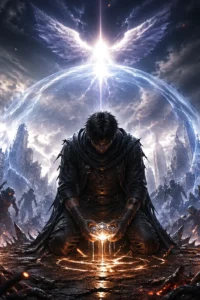
The clouds over Center City had split.
Not parted. Split. Black March clouds peeled back in long geometric seams, exposing bands of color behind them that didn’t belong over Philadelphia or over any place where human lungs had evolved to work. Deep bruised red. Luminous violet. A gold so bright it looked solid. The edges of the break in the sky did not feather like vapor. They were clean. Engineered. Too straight.
Someone in the street started screaming harder.
“Inside,” Rowan said. “Now.”
“The station?” Shaw asked.
He nodded once. “Underground beats here. You said there’s a first-aid room?”
“Lower mezzanine. Cinderblock closet with a cot and a rolling fire shutter. Mostly for overdoses and drunks.”
“Perfect.”
Marisol gave a breathless laugh that bordered on hysteria. “Did he just call a closet perfect?”
“You got a better bunker?” Rowan asked.
“Fair.”
He moved fast then, because moving was easier than looking up again. He yanked the jump bag from its bracket, slung the monitor strap over one shoulder out of habit before remembering the monitor was dead weight, cursed, dropped it, grabbed oxygen instead. Shaw climbed in and unlocked the stretcher.
“Can you walk?” Rowan asked Marisol.
She put both feet down, winced, then set her jaw. “I can cuss and walk at the same time.”
“That’s the spirit.”
He and Shaw got her down to the sidewalk between them. The city’s noise rolled around them in sick, overlapping waves: alarms, crying, engines revving nowhere, the ceaseless calm voice from every speaker in hearing distance.
08:41
A man barreled past and slammed into Rowan’s shoulder hard enough to spin him. Rowan caught himself against the ambulance door.
“Hey!” Shaw shouted.
The man didn’t even look back. His pupils were blown wide. Blood striped one side of his face where he’d run through broken glass.
That was when Rowan noticed the pigeons.
There were hundreds of them on the roofline of the laundromat and the bus shelter and the SEPTA sign. Not moving. Not cooing. Just sitting with their heads turned toward the split sky, every bird in impossible stillness.
Nope.
He hooked Marisol’s arm over his shoulders. “Move.”
They crossed toward the station entrance with Shaw taking point, hand on her sidearm, eyes flicking everywhere. Her composure looked real until you saw how white her knuckles were.
The first injured stranger found them before they’d gone twenty feet.
A bike messenger skidded out from between two stalled cars and hit the pavement on his knees. He was maybe twenty-two, skinny under a soaked windbreaker, one cheek flayed open from eyebrow to jaw where he’d kissed asphalt. His left hand was wrapped in the chain of his bike, fingers blood-slick and twisted in the links.
“Please,” he gasped. “Please, I can’t—”
“Rowan,” Shaw barked.
Because of course she knew that look on his face already. They’d spent twenty minutes together and she already knew.
“Two seconds.”
“We don’t have two seconds.”
“Then thirty.”
He dropped the jump bag, knelt in the grit, and snapped the bike chain away from the kid’s hand with gloved fingers. The metal had cut deep into the webbing between thumb and forefinger. Nothing arterial. Good. Rowan shoved gauze into the palm and wrapped it tight with a pressure bandage while the kid hissed through his teeth.
“Name,” Rowan said.
“Theo.”
“Theo what?”
“Why does that matter?”
“Because if I’m dragging you into hell, I’d rather not call you Bike Guy.” Rowan tightened the wrap. Theo yelped. “Name.”
“Theo Park.”
“Great. Theo, listen to me. Hold pressure. Don’t let go unless I tell you. If you puke, turn your head. If you faint, I’m charging you for the paperwork.”
Theo blinked blood out of his eyes, half-horrified, half-offended. “You people really joke at times like this?”
“Only if we’re worried.” Rowan hauled him upright by the good arm. “Come on.”
They stumbled on, now four people and a jump bag. Then five.
The second injured stranger was under the shattered bus shelter.
She was young, maybe nineteen, Black, in Temple sweats and a puffer coat with one sleeve torn open. Glass glittered through her hair, turning the blood on her scalp silver under the streetlight. One ankle bent under her at a bad angle. She was trying and failing to stand, hissing curses in a clipped whisper like she didn’t want to give the city the satisfaction of hearing her hurt.
Rowan swore. “You with us?”
Her eyes focused on him with effort. “That depends. Are you a hallucination?”
“Unfortunately not.” He crouched. “Can you move?”
“On one foot? Sure. To the Olympics.”
Marisol, breathing hard beside him, barked a laugh. “I like her.”
“Aisha,” the girl said. “My name’s Aisha.”
“Rowan. I’m going to help you up.”
“I was pre-med,” Aisha said through gritted teeth as he checked her pupils. “Before tonight I would have appreciated you buying me dinner first.”
“You flirting or concussed?”
“Both, maybe.”
Good. Sarcasm meant functioning brain.
He wrapped her ankle quickly with an elastic bandage, not enough to fix, just enough to hold. Shaw scanned the street and swore under her breath.
“Now, Rowan.”
Something had changed in the soundscape. The alarms were still going, the message was still repeating, but underneath it came a new noise—wet, skittering, as if a thousand bare hands were scrambling across brick.
Rowan looked up.
The pigeons launched all at once.
They did not fly away. They flew upward, straight into the split in the sky, and vanished as if swallowed by colored glass.
Then the first thing dropped out.
It hit the roof of the jackknifed delivery truck so hard the metal imploded around it. The truck flattened on its axles with a concussive bang. People screamed and scattered. Rowan saw only pieces at first: a mass of pale limbs unfolding too fast, a spine jointed in too many places, skin slick as if it had been skinned and lacquered. It was the size of a horse and moved like a spider trying to imitate one.
Its head lifted.
There was no face. Just a vertical mouth splitting open where the face should have been, lined with teeth that clicked like cutlery dumped in a sink.
The thing sprang.
It crossed half the street in a blur and landed on the praying man in the crosswalk. The scream cut off at once. Blood hit the side of a parked car in a fan.
For one frozen heartbeat nobody did anything.
Then the block broke.
People ran in every direction. Some darted for doorways, some for cars, some just away. The thing on the corpse tore once, fast and efficient, then raised its slick head and turned toward the nearest motion.
“Down!” Shaw shouted, drawing.
Her first shot cracked the night open. The bullet hit the thing in the shoulder. Flesh burst in a spray of black fluid—and sealed shut while Rowan was still processing what he’d seen.
“Nope,” Shaw said. “Nope. Move!”
They ran for the station.
Theo nearly went down on the first stair. Rowan caught him and shoved him forward. Marisol grunted, one hand under the curve of her belly, every breath now coming sharp and measured. Aisha hopped with Rowan under one arm and the rail under the other. Above them the street had become a slaughterhouse of echoes—gunshots, screaming, that knife-and-fork clatter of impossible teeth.
06:12
The station mezzanine smelled like old piss, wet concrete, and hot dust from the emergency lights that had kicked on when the power flickered. Half the turnstiles had frozen closed. The LED screens that normally crawled arrival times now showed only the countdown in blood-red digits.
A SEPTA kiosk worker was hammering both fists against her locked booth window from the inside. Shaw veered toward her.
“Open the gate!” the woman shrieked.
“Can’t,” Shaw shot back. “Get under the desk, lock down, and stay away from the glass!”
“You can’t leave me—”

0 Comments