Chapter 18: Hero, Demon General, and One Extremely Awkward Table
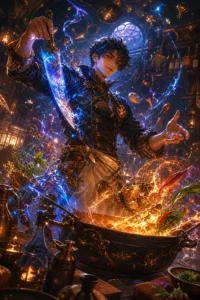
by inkadminThe first thing Kael noticed about the Demon Lord’s former fortress was that it smelled like garlic butter.
This was not, according to any heroic manual he had ever been forced to read, how bastions of ancient evil were supposed to smell. They were meant to reek of sulfur, rot, despair, and possibly the copper tang of fresh sacrifice. The training priests of Saint Armand had been very specific about this. Evil had an odor. Evil fouled the air. Evil announced itself through black smoke and chanting and the occasional screaming skull.
Nate Mercer’s dining hall smelled like warm bread, roasted root vegetables, seared river fish, and the sharp, mouthwatering bite of pickled peppers. Laughter bounced off the high stone arches. Candlelight poured honey-gold over long communal tables polished to a gleam by use rather than nobility. A goblin child in a flour-dusted apron darted between benches carrying a basket nearly as large as his torso. Two horned laborers argued cheerfully over whether mashed cloud-yams counted as a soup. Somewhere near the hearth, a dwarven mason sang with the sincere confidence of a man who had not been blessed with pitch.
Kael stood just inside the entrance with a hero’s sword at his hip, a saint-blessed cloak over his shoulders, and the quiet, horrifying sensation that the world had been replaced while he blinked.
At his left, Nate clapped his hands together with the weary optimism of a man about to defuse a bomb using etiquette.
“Okay,” Nate said. “Ground rules.”
Across the dining hall, Vexa turned from the sideboard.
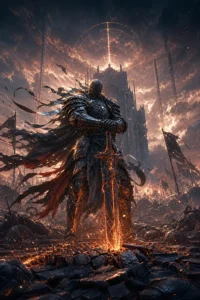
The former demon general wore no armor tonight, which somehow made her look more dangerous. Her obsidian horns swept back from silver-white hair tied in a severe braid. A dark coat, crisp at the shoulders and clasped with a black iron brooch, framed the effortless menace of someone who had once directed armies across burning plains. Her crimson eyes landed on Kael like a drawn blade.
Kael’s hand moved toward his sword.
Half the room tensed.
The goblin child with the bread basket froze mid-step. A spoon clattered somewhere. The dwarven song died on an entirely unrelated wrong note.
Nate stepped between them and raised both palms.
“Rule one,” he said, voice bright and too loud. “Nobody stabs anybody at dinner.”
Vexa’s gaze did not move from Kael. “An inefficient rule. Stabbing during dinner has ended many conflicts before dessert.”
“Not at my table.”
“Your table,” Kael said, before he could stop himself, “appears to seat three hundred monsters.”
The hall went so silent that Kael could hear fat sizzling on the hearth.
Nate slowly turned his head toward him.
“We’re going to put a pin in the word monsters,” Nate said, “because I’m trying very hard to keep this from turning into a workplace harassment seminar.”
Kael did not understand half the sentence. He understood enough from the faces around him. The horned laborers’ smiles had vanished. A lamia near the soup cauldron lowered her eyes. A shaggy, wolf-eared courier’s fingers curled around his cup until the wood creaked.
Heat crawled up Kael’s neck.
They are monsters, a dozen lessons whispered. The enemy. The blight-blooded remnants. The fang in mankind’s throat.
But an hour ago, one of those “monsters” had shown him how to knead dumpling dough because Kael had been elbow-deep in kitchen chaos and too proud to admit he did not know what he was doing. Another had laughed when flour exploded over them both. Another had pressed a cup of chilled berry tea into his hands when the lunch rush finally ended.
He had been undercover. He had been observing. He had absolutely not been enjoying himself.
Vexa’s mouth curled. “Do not soften on my account, little sword. Say what your handlers put in your mouth.”
Kael straightened. The old certainty rushed back like a shield raised just in time. “My handlers did not conjure your war crimes from thin air.”
A ripple went through the hall.
Nate’s expression became that of a man watching a priceless vase tip off a shelf in slow motion.
“And here we are,” he murmured. “Already in the deep end.”
Vexa took one unhurried step forward. Candlelight flashed along the points of her horns. “I have been called many things by men who hid behind banners. Be precise, Hero. Which crime shall we discuss first?”
Kael’s fingers tightened around his sword hilt. The saint-runes along the scabbard stirred, faint gold glimmering like fireflies under glass. “The Burning of Valebridge. The slaughter at White Orchard. The Night of Chains. The Ash March.”
Each name struck the room like a bell.
Vexa’s face did not change at first. Then something small and cold moved behind her eyes.
“Sit down,” Nate said.
Kael blinked. “What?”
“Both of you. Sit.” Nate pointed at a table set slightly apart from the others near the western windows, where purple evening pressed against panes of newly installed glass. “We’re doing this with food. If anyone starts glowing, summoning, drawing steel, invoking ancestral grudges, or monologuing in a way that scares the children, I will personally assign them to latrine logistics for a week.”
Vexa looked at him.
Nate met her stare with the exhausted bravery of a man who had survived performance reviews, jury duty, and a vending machine falling on him. “Dental coverage does not extend to teeth lost in voluntary duels.”
Several people in the hall inhaled sharply.
Vexa’s aura wavered.
It was the tiniest thing—less than a flinch, more than nothing. Kael would have missed it if his entire life had not been sharpened into the ability to notice enemy weakness.
“That,” Vexa said, “is administrative blackmail.”
“Correct.”
“Dishonorable.”
“Also correct.”
For one breath, the demon general looked as though she might decide honor was overrated and violence remained the superior option.
Then she clicked her tongue, seized a chair, and sat with military precision.
Kael hesitated.
Nate’s eyes slid to him. “Hero?”
“I will not be coerced.”
“Great. Then choose freely to sit down before you cause a diplomatic incident in my cafeteria.”
“This is a dining hall.”
“It becomes whatever my stress level says it is.”
Kael looked at Vexa. Vexa looked back with the patient malice of a guillotine.
He sat.
The hall exhaled. Conversation returned in fragments, brittle at first, then swelling as people pretended not to watch. Plates appeared almost immediately. Nate must have planned this ambush in advance, because Mira the tavern cook herself arrived with a tray broad enough to serve as a shield. She was a broad-shouldered woman with smoke-brown skin, iron-gray curls wrapped in a red scarf, and the authority of someone who ruled the kitchen more absolutely than Nate ruled the land.
She set down three bowls of stew, a platter of roasted mushrooms glazed dark with herb oil, sliced bread, salted butter, a crock of pepper relish, and three cups of something amber and steaming.
“No killing until after my honey cakes,” Mira said.
Vexa inclined her head. “Chef.”
Kael frowned at the respectful tone.
Mira noticed. “Boy, if you stare at my general like that, I’ll pour stew in your boots.”
“She is not your general.”
“She organized my pantry after the basil incident. That outranks you.” Mira leaned in, eyes narrowing. “And around here, you earn the right to be stupid after you’ve peeled three sacks of onions. You’ve peeled one and cried through half of it.”
A few nearby diners coughed into their cups.
Kael’s face burned hotter. “The onions were enchanted.”
“They were onions.”
“They were very aggressive onions,” Nate said, because apparently even mercy came in humiliating portions.
Mira sniffed, patted Nate’s shoulder, and left them to the table.
For a moment, no one spoke.
The stew smelled unfairly good. Kael stared into his bowl at tender chunks of meat, pearl onions, and orange tubers swimming in a glossy brown broth. Steam dampened his face. His stomach, traitorous instrument of the flesh, growled.
Vexa’s eyes flicked downward.
“Say a word,” Kael muttered, “and I will—”
“Be assigned to latrines,” Nate finished. “Both of you, eat.”
“I do not break bread with demons,” Kael said.
Vexa picked up a slice, spread butter with one smooth motion, and bit into it. The crust cracked softly between sharp teeth. “Then starve with theatrical dignity.”
Kael’s stomach growled again, louder.
Nate nudged the bread platter toward him. “Look, Kael. I know this is weird.”
“Weird,” Kael repeated. “I was summoned from another world, trained by priests who told me the fate of humanity rested on my shoulders, sent to investigate the rebirth of the Demon Lord, and discovered the dark citadel is operating a lunch service. Weird is insufficient.”
“As the guy who died under a vending machine and woke up legally responsible for a haunted fortress, I respect that.” Nate tore bread in half. “But here’s the thing. You two were about to duel in the market street. The market street currently has a glassblower stall, three vegetable carts, a daycare group touring the fountain, and one dragon pretending she doesn’t live here napping on the roof. So we are having dinner instead.”
Vexa sipped the amber drink. “The dragon lives here.”
“She has not filled out the residency form.”
“She burned her name into the western cliff.”
“Not notarized.”
Kael stared between them. “Do you hear yourselves?”
Nate sighed. “Constantly. It’s my burden.”
Vexa set her cup down. “Ask your questions, Hero. You are choking on them. I would prefer you choke on stew.”
Kael’s appetite vanished beneath the pressure in his chest. The names he had spoken still hung in his mind, each one illustrated by chapel murals, battlefield lectures, survivor accounts copied by trembling scribes. Charred bridges. Children in chains. Orchards watered with blood.
“Valebridge,” he said.
Vexa’s fingers stilled on the table.
“The histories say your vanguard crossed the Dawn River under a false truce banner,” Kael continued. “You ordered the bridge burned while refugees were still on it. Three thousand died.”
Nate stopped chewing.
Vexa looked at the candle between them. Its flame trembled, though there was no draft.
“That is what they say?” she asked.
Kael’s jaw tightened. “Do not pretend ignorance.”
“I do not pretend.” Her voice had gone flat. “The Valebridge crossing was my defeat.”
Kael blinked.
“We arrived two days after the fire,” Vexa said. “The bridge had been destroyed from the western bank. Human construction charges. Saltpeter, resin, sun-oil. Clumsy mixture. Effective.”
“Lies.”
“Likely.” She looked up at him. “But not mine.”
Kael’s chair scraped as he leaned forward. “The refugees—”
“Were gone when we arrived.”
“Because you killed them.”
“Because the Ninth Legion drove them across the bridge ahead of their retreat, then burned it to slow us.” Vexa’s eyes were red glass in candlelight. “My scouts found bodies in the shallows for three miles. Mostly old. Mostly children. They had arrows in their backs.”
The hall seemed to recede. Kael heard his heartbeat first in his ears, then in his teeth.
“No,” he said.
Vexa’s mouth curved without humor. “Compelling rebuttal.”
“The Ninth Legion were heroes of the western campaign.”
“They were efficient cowards with expensive banners.”
Gold light flickered along Kael’s scabbard. The soup in his bowl trembled.
Nate placed one hand gently but firmly on the table between them. “Breathe.”
Kael did not want to breathe. Breathing meant making space inside himself for the possibility that one of the first holy histories he had memorized was wrong. Not misinterpreted. Not incomplete. Wrong.
“You expect me to accept the word of a demon general over the testimony of Saint Roderick’s chroniclers?”
Vexa gave a low laugh. “Saint Roderick. Yes. I remember him. He wore white gloves so he would not have to touch wounded soldiers.”
“He founded three orphanages.”
“With funds seized from towns he ‘liberated.’”
“Enough,” Nate said.
Neither of them looked at him.
Kael’s hand tightened. “White Orchard.”
A shadow crossed Vexa’s face.
“Careful,” Nate said softly.
Kael barely heard him. “The histories say demon troops poisoned the wells and butchered the farmers during harvest. Every man, woman, and child. White petals turned red. They call it the proof that demons would never accept peace.”
Vexa did not answer immediately.
The candle burned lower. Wax slid down its side like a slow white tear.
“White Orchard was not a human village,” she said at last.
Kael stared. “What?”
“It was mixed.” Her voice remained controlled, but something rough scraped beneath it now. “Human farmers. Beastkin orchardists. Three goblin families who bred frost-resistant bees. Two demon veterans who had married local women after the First Armistice. A dryad grove at the northern boundary. Children with horns and round human ears and tails and no tails.”
Kael’s mouth had gone dry.
“There was no First Armistice,” he said.
Vexa’s eyes sharpened. “Of course there was.”
“The war lasted forty years without pause.”
“It lasted twenty-six, paused for seven, resumed for fourteen.”
“No.”
“Your priests cannot do arithmetic?”
“There was no peace with demons.”
Vexa leaned back as if she had taken a blow and refused to show the bruise. “We signed it at Greywillow Ford. Twelve human lords. Four beastkin clans. The court of the Demon Lord. I was there.”
Nate’s gaze moved between them. His face had lost its nervous humor. He looked, for once, exactly like a man sitting over a crack in the world and hearing something vast shifting beneath.
“What happened to White Orchard?” Nate asked.
Vexa’s jaw flexed.
She reached for her cup, then left it untouched.
“The village sent grain to both sides during the armistice,” she said. “After the war resumed, Lord Harren of Eastmere declared them collaborators. He gave them three days to surrender all nonhuman residents. They refused.”
Kael remembered a mural in the Hall of Instruction. White trees. Black-armored demons descending like crows. A human mother lifting a child toward the light of Saint Roderick’s blessing.
He remembered kneeling beneath it at seventeen while High Priest Alben told him, This is why mercy toward darkness is cruelty toward mankind.
“Lord Harren died defending the orchard,” Kael said. His voice sounded far away. “He was martyred.”
“Lord Harren died three villages south when his horse threw him into a ditch during a thunderstorm.” Vexa’s smile was thin as wire. “His men burned White Orchard before my detachment arrived. We executed three officers for the massacre.”
Kael pushed back from the table. Wood groaned beneath his grip. “Stop.”
“You asked.”
“Stop.”
“You wanted crimes. I remember crimes.” Vexa’s control cracked, and through it came heat, grief, and an old fury too large for the hall. “I remember the smell of frost-bee hives burned with the children hiding beneath them. I remember a human woman with a kitchen knife standing over a demon boy who was not hers, daring my soldiers to come closer because she thought we were Harren’s men returning. I remember burying two hundred and nineteen people under trees that bloomed out of season because the dryads died screaming.”
Kael could not breathe.
Nate said his name, but the sound blurred.
In his mind, the chapel mural peeled like wet paint. Beneath it was smoke. Beneath smoke were bodies. Beneath bodies, not demons laughing, but soldiers in human colors with torches.
No.
The word rose weakly. It had nowhere to stand.
A plate touched the table near his hand.
Kael flinched.
The goblin child from earlier stood beside him, eyes enormous, basket tucked under one skinny arm. He placed a honey cake on a small dish. The cake glistened with syrup and crushed nuts.
“Mira says sweet helps when grown-ups are being haunted,” the child whispered.
Kael stared at him.
The goblin swallowed. One of his ears twitched. “You don’t have to eat it.”
Then he fled.
Kael looked down at the honey cake. His vision had gone strangely sharp. He saw every golden drip, every crumb at the edge of the plate, the tiny chip in the ceramic rim.
“He is eight,” Vexa said quietly. “His grandmother survived White Orchard.”


0 Comments