Chapter 7: The Hero Kingdom Declares Mild Concern
by inkadminThe first rumor reached Valedorn under a film of dried swamp mud and panic-sweat.
The courier had changed horses three times between the border watch and the capital. By the time he thundered beneath the white gates of Auramere, his tabard had gone from royal blue to a respectable shade of misery, his left eye was swollen from a branch strike, and the tube slung over his shoulder had been tied shut with so much wax and string that the gate sergeant assumed it contained either a declaration of war or the crown prince’s gambling debts.
It turned out to be worse.
The report climbed the city faster than a fire would have. It passed from gauntleted hand to ink-stained hand, up from the barracks quarter where the smell of horse and steel lingered in the morning fog, through the ministries with their polished halls and muttering clerks, and at last into the upper keep where sunlight struck the palace windows so brightly they looked holy from below.
Auramere itself did not seem a city that could be troubled by anything as vulgar as a demonic resurgence. Its towers gleamed cream and gold. Its bells sang on the hour. Flower boxes spilled over balconies in scarlet and blue. The broad avenues were being swept even as merchants opened shutters and apprentices shouted at one another over fresh bread, lamp oil, and bolts of imported silk.
From the palace ridge, the whole city spread like a painted ideal of civilization: domes, courtyards, tiled roofs, banners bearing Valedorn’s sun-crowned lion. It was the kind of city that expected problems to arrive in an orderly queue with proper documentation.
The Blighted March had sent a problem in ink and terror instead.
By the time the royal council assembled, a second report had arrived, and a third was waiting outside with a junior clerk who looked as if he regretted every life choice that had led him into state service.
The council chamber was a long oval room paneled in dark cedar, cool even in the summer heat. A mosaic map of the continent spread across the floor beneath a polished table large enough to host a minor banquet and usually about as productive. High windows cast bars of white light over stacks of sealed correspondence. The scent of wax, parchment, and expensive tea hung in the air.
At one end of the table sat King Edrian IV of Valedorn, who was thirty-two years old, broad-shouldered, clean-shaven, and currently looked as if he had been awake for a month. A crown rested on his dark hair with the suspicious casualness of a man who had put it on because protocol insisted, not because he had fond feelings for it.
On his right sat Chancellor Meren Talveth, thin and smooth and folded into his robes like a blade hidden in silk. Beside him was Lord Marshal Garran Holt, square as a fortress gate and twice as charming, his silver hair tied at the nape and one hand drumming the pommel of the ceremonial sword he insisted on wearing indoors. Across from them sat Lady Vestra Corvin, Master of Whispers, in unadorned gray so fine it made the jeweled ministers beside her look vulgar. Her face was calm, dry, and impossible to read.
Further down, fidgeting with a ring and pretending not to fidget, was Minister of Trade Pell Arn, who smelled faintly of orange oil and fear. Next to him sat Archbishop Celianne, severe in white and gold, her silver rosary wound twice around one wrist. The final occupied chair belonged to Lord Cassian Veller, Minister of Foreign Correspondence, who had the expression of a man who had built his career on language so bland it could survive anything.
Near the wall stood a junior secretary with an armful of fresh paper and the haunted eyes of prey animal nobility. His name was Tomas. No one important knew that.
King Edrian broke the seal on the first report himself. His gaze moved down the page. Stopped. Moved back up. He read the same line twice, then lowered the parchment and stared at nothing for a moment.
“I see,” he said.
Everyone around the table watched him.
“Your Majesty,” said Chancellor Talveth softly, “is it war?”
Edrian held up the page between two fingers. “That depends on whether we classify road maintenance as an act of aggression.”
There was a pause.
Lord Marshal Holt frowned. “I beg your pardon?”
The king passed the report left. “Read.”
Holt snatched it, his heavy eyebrows drawing together. As he read, the lines in his face deepened in stages. Chancellor Talveth reached for the paper next, but Holt did not surrender it at once.
“This scout was drunk,” the marshal declared.
“Our border scouts are always drunk,” said Lady Vestra. “That is why we send three.”
“Then all three were drunk.”
“That is why we compare reports.”
Talveth finally extracted the page. His eyes flicked across it with bureaucratic efficiency. Unlike the marshal, he did not scoff. He merely set his fingertips together.
To His Majesty’s Command, from Watch-Captain Henred Vale, Southwatch Post:
At dawn on the 18th, black banners were observed flying over the old fortress in the Blighted March, formerly the seat of the Demon Lord. Fortification damage visible these past decades appears repaired in significant part. Western wall restored. Gatehouse active. Lanterns seen after sundown in inhabited pattern.
Road from the old causeway to lower marsh cut and resurfaced.
Repeat: resurfaced.
Traffic observed entering site under no visible duress, including goblins, beastfolk, two ogres hauling timber, one covered wagon marked with produce, and what may have been a tax cart.
Request confirmation whether demons are now collecting tolls.
Minister Pell made a choked sound. “A tax cart?”
“That is what troubles you?” asked Archbishop Celianne.
“Naturally that troubles me, Your Grace. If there is organized collection at the border—”
“If there is organized collection by demons,” Holt rumbled, “then that is called a military economy.”
“If there is organized collection by anyone,” Pell said weakly, “then that is called competition.”
King Edrian pinched the bridge of his nose.
Lady Vestra folded her hands. “The second report corroborates the first. The third elaborates.”
“On the tolls?” Pell asked.
“On the bathhouse.”
The room went still.
“The what?” said the king.
Vestra nodded toward the secretary. “Tomas.”
The young man jumped, shuffled forward, and presented the next report with both hands as if offering a sacrificial blade. Edrian opened it. This time his jaw tightened visibly.
“Read it aloud,” said Chancellor Talveth.
The king looked at him, then at the parchment, and perhaps decided that if he was being forced to suffer, the others could join him.
“Fine.” He cleared his throat. “From Sister Ameline of the Shrine of Saint Oris, outer frontier parish. ‘To those in authority and preferably armed, there is increased movement from the cursed lands, but the refugees or settlers or whatever they presently classify themselves as have not attacked our village. In fact, one goblin caravan sold us winter carrots of exceptional quality. Their leader claimed they were grown in “reclaimed blight-neutralized soil” under the protection of a new lord. They also distributed printed notices advertising safe lodging, medicinal herb markets, and a grand opening discount on mixed bathing for families.’”
Silence thickened in the chamber.
Then Lord Cassian Veller, who had faced three foreign congresses and once survived a six-hour trade dispute with dwarves, said very carefully, “Mixed bathing.”
“For families,” Minister Pell added faintly.
Archbishop Celianne shut her eyes for one dignified moment. “Blasphemy continues to innovate.”
Lord Marshal Holt slapped a broad hand on the table. “Enough nonsense. Black banners over the old fortress means a claimant. Repaired walls means labor. Traffic means supply lines. We mobilize now, before this farce hardens into a threat.”
“Mobilize what?” Talveth asked without looking at him.
“An army.”
“How many?”
“Enough.”
“A precise and useful figure.”
Holt’s jaw shifted. “Ten thousand, then, if that satisfies your love of columns.”
“And from which treasury entry shall I derive the silver for ten thousand men marching into cursed marshland in high summer?” Talveth asked. “Shall I take it from bridge repair? Grain subsidy? Veteran pensions? Temple restoration?”
“Take it from whatever line covers preventing a second Demon War.”
“That line,” Talveth said, “is titled emergency reserve, and I am saving it for emergencies.”
“What in all shining heavens would you call this?”
Talveth steepled his fingers. “At present? Mild concern.”
Holt stared at him as if considering whether murder in council could be justified as patriotic maintenance.
King Edrian exhaled slowly through his nose. “Chancellor.”
“Your Majesty,” Talveth said, inclining his head, “I am not dismissing the reports. I am placing them in useful proportion. We have rumors of a restored ruin, monster migration, and apparently competent hospitality. We do not yet have evidence of mobilized armies, raids on our territory, or direct hostile intent.”
“A demon fortress reviving in our backyard is direct hostile intent by architecture alone,” Holt snapped.
Lady Vestra spoke before the argument could widen. “There is more.”
Everyone looked at her.
She slid another folded sheet onto the table. The wax seal had been broken and resealed in her own office. “Intercepted from a merchant consortium in Bellcross. The report was circulating privately before my people acquired a copy.”
Profit advisory: avoid assuming standard risk rates in the former March. Roads between Blackstone Ford and the old fortress have improved measurably. Monster attacks on caravans decreased in districts nearest the central keep, though toll enforcement appears newly consistent. Demand rising for tools, seed stock, lumber, linen, and ceramic piping. Unexpected market in medicinal salves, alcohol, and decorative lanterns.
Unconfirmed but repeated: new ruler pays in full and does not haggle like a necromancer.
Minister Pell leaned over as if the parchment might begin spitting coins. “Decorative lanterns?”
“You are focused with almost supernatural determination,” murmured Veller.
“A functioning new market in the March would be economically disruptive,” Pell protested. “Do you know what border tariffs—”
“No,” said Holt, “because the demons will be collecting them.”
Archbishop Celianne’s rosary clicked against her ring. “The spiritual implication is not secondary. If cursed land is being made habitable under a demonic standard, pilgrims, peasants, and fools will begin speaking of miracles. The common people are disastrously egalitarian in what they are willing to worship if bread is involved.”
King Edrian looked tired enough to age ten years in a blink. “Do we know who is ruling it?”
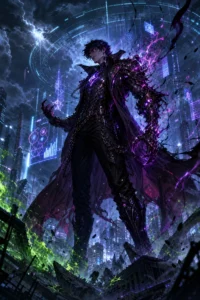
Lady Vestra’s expression altered by less than a breath. “No confirmation. Rumors conflict. Some claim the Demon Lord returned. Others say one of the old generals has raised a pretender. One witness described ‘a tall dark-haired man in a lord’s coat arguing with an elderly skeleton over roofing tiles.’ Another reported a dragon sleeping on a watchtower.”
“A dragon,” said Pell weakly.
“To be fair,” said Veller, “that part sounds more plausible than the roofing dispute.”
“What of the demon generals?” Edrian asked. “Any names?”
“One appears repeatedly,” Vestra said. “Gharrek the Ash-Maw. Former western campaign commander. Presumed dead after the Siege of Hollow Crest.”
Holt swore under his breath.
Even Talveth went still.
The old name moved through the chamber like cold water. Gharrek had been one of the great nightmares of the last war, a horned giant in black armor whose charge had broken cavalry lines and city gates alike. Songs still used him as shorthand for children who refused to sleep.
“Presumed dead,” Edrian said quietly.
“Presumed,” Vestra repeated. “As we are discovering, history contains an alarming amount of optimism.”
Holt planted both hands on the table and rose half from his chair. “There. Enough debate. We strike first. Before roads become armies and tolls become tribute.”
Talveth remained seated. “We send ten thousand men into a blighted wasteland, and if the reports are exaggeration, we look like aggressors attacking refugees and turnips.”
“Turnips do not raise demonic banners.”
“Neither do roads.”
“Roads lead to banners!”
Their voices crashed against the cedar walls. Tomas the secretary flinched every time one of them hit a consonant hard enough.
King Edrian let the noise run for three breaths, then struck the table once with the flat of his palm. It was not loud, but authority sharpened it. The chamber fell silent.
“No army,” he said.
Holt stared. “Your Majesty—”
“Not yet.” Edrian’s gaze was steady now, the exhaustion banked under iron. “We do not march on rumors. If I move ten thousand troops toward the March, every border lord from here to the western sea will panic, every grain speculator in the capital will double prices by sunset, and three neighboring kingdoms will begin asking if Valedorn intends annexation under cover of virtue.”
That, at least, made Veller wince. Diplomatic letters bred like rats in summer.
“Then a strike force,” Holt said. “Elite knights. Small, decisive, deniable if needed.”
“If needed?” Veller said. “You propose deniable knights?”
“Paint over the heraldry.”
“I am surrounded by strategists,” Veller murmured to no one.
Archbishop Celianne straightened. “The Church can send investigators.”
Lady Vestra glanced at her. “In white robes with holy emblems?”
“Yes.”
“Then they will be visible from the moon.”
“Visibility is useful in matters of righteousness.”
“Stealth is useful in matters of survival.”
“We are not discussing thieves, my lady.”
“No. We are discussing cursed ruins, demon veterans, and a possible dragon. I assure you, stealth remains applicable.”
King Edrian rubbed his temple. “Spies, then?”
“Already attempted,” Vestra said. “One did not return. One returned with a jar of pickled mushrooms, a brochure for a seasonal market, and no memory of the previous six days. The third insists the place is safer than our east road and requests reimbursement for a hot-stone massage.”
Pell’s head snapped up. “They have massage services?”
Talveth gave him a look of pure administrative contempt.
“The point,” Vestra said, “is that conventional infiltration is unreliable. Something about the central territory interferes with curse wards, tracking charms, and perhaps common sense.”
“That is called the Blighted March,” Holt muttered.
“The reports do contain one consistent pattern,” she said. “Whatever has awakened there is not presently behaving like a conquering regime. It is behaving like…”
“Go on,” Edrian said.
For the first time, Lady Vestra looked faintly offended by reality itself.
“Like a provincial landlord with expansionist accounting.”
Veller’s mouth twitched before he mastered it.


0 Comments