Chapter 20: A Princess in Commoner Boots
by inkadminThe boots pinched.
Princess Elara Valenholt had worn jeweled slippers through the Hall of Crowns, riding boots lined with winter fox fur across the royal hunting preserves, silk dancing shoes at twelve separate betrothal feasts, and once—during a particularly awful diplomatic visit to the Salt Dukes—sandals made entirely of polished shells that had left her bleeding between every toe.
None of them had betrayed her quite as thoroughly as the pair of scuffed brown commoner boots currently conspiring against her heels.
They looked convincing. That had been the point. No gilded buckles. No embroidered crest. No servant polishing them until she could see the curve of her own frown in the leather. Just rough stitching, mud-caked soles, and a faint smell of goat that no amount of lavender sachets had banished from the travel trunk.
“If Your—” Sir Garron caught himself as a horned woman hauling a basket of glowing turnips passed within earshot. The knight’s mustache twitched beneath his borrowed drover’s cap. “If Ella would permit, we should withdraw from this… gathering and observe from a safer distance.”
“If Ella had wanted a safer distance,” Elara murmured, shifting her weight so the left boot would stop gnawing at her ankle, “Ella would have remained in the royal capital listening to Lord Brevane explain why the peasants ought to be grateful for turnip tariffs.”
Garron looked pained, which was his natural state whenever Elara went unsupervised for more than three breaths. He was built like an old oak wardrobe, broad and square and scarred along one cheek from the Rivergate War. His disguise consisted of a patched wool coat, a wooden vendor’s badge, and a heroic inability to slouch.
Beside him, Mira—Elara’s youngest handmaid and the only member of the royal household capable of lying without blushing—had embraced her role as a traveling cloth merchant with unnerving enthusiasm. She wore a headscarf, carried a bolt of cheap blue linen, and had already haggled two demon children out of a sweet bun by accident.
“Your Grace,” Mira whispered, then winced. “I mean. Ella. If you limp any harder, people will assume we stole the boots off a corpse.”
“These boots were stolen from the palace costume stores,” Elara whispered back. “The corpse is implied.”
A shadow slid over them, vast and warm.
Elara’s hand went to the little dagger hidden beneath her sleeve before she could stop herself.
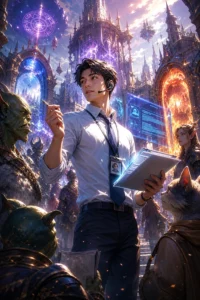
Above the festival grounds, a dragon drifted lazily through strings of enchanted lanterns. She was not the distant, myth-painted kind of dragon depicted on royal tapestries with knights stabbing politely at her knees. She was there, bronze scales burning red-gold in the afternoon sun, wings broad enough to roof a chapel, smoke curling from her nostrils as she banked around a floating banner that read WELCOME TO THE FIRST ANNUAL BLIGHTED HARVEST FAIR in letters made of fireflies.
Children cheered.
A goblin in a paper crown waved a stick of candied eel and shouted, “Do the loop again, Miss Veyra!”
The dragon, who according to every military briefing Elara had read should have been hoarding treasure, razing cities, or accepting sacrifices, snorted a perfect smoke ring around the boy’s paper crown and called down, “Absolutely not. I am a creature of ancient terror and dignity.”
Then she did the loop again.
Elara stared.
The Blighted March was supposed to be dead.
Every map in the royal archive shaded this region in sickly gray ink. Every border captain spoke of bone wind and cursed stones, of black fields where nothing grew but ashweed, of the old Demon Lord’s fortress crouched at the world’s edge like a skull with windows. Merchants avoided the roads. Priests turned their eyes away. Nobles invoked its name when they needed to frighten heirs into obedience.
And yet the road under Elara’s aching boots was smooth pale stone veined with silver light. Lanterns floated from curved iron poles shaped like flowering vines. Stalls lined both sides of the broad avenue beyond the fortress gate, each one bright with cloth awnings, hand-painted signs, and impossible produce.
Pumpkins glowed softly from within like captured sunset. Corn cobs chimed when the wind touched their silk. Mushrooms as wide as parasols were being sliced and seared on griddles by a minotaur wearing a kiss-the-cook apron. The air was thick with smoke, sugar, roasting meat, fresh bread, monster spices sharp enough to sting the eyes, and beneath it all the damp green scent of fields after rain.
People crowded everywhere.
Not just humans. That was the first astonishment. Beastkin with twitching ears argued cheerfully with dwarven masons over a produce contest. A family of kobolds shared fried dough with a pair of human pilgrims. Orcs in clean linen shirts compared livestock feed with farmers from the southern plains. A skeletal man in a straw hat examined a jar of pickled radishes with grave academic focus while a little girl—human, no older than six—tugged on his sleeve and asked if he could remove his thumb again.
“Only if your mother says yes,” the skeleton replied.
The girl’s mother, a woman with flour on her cheeks and an infant asleep against her chest, sighed. “Fine. But not near the jam table this time.”
The skeleton popped off his thumb. The girl shrieked with delight.
Sir Garron made a sound like armor bending.
Elara should have been horrified. She had been raised on courtroom sermons about the proper order of the world: humans within their walls, monsters beyond them, nobles above, commoners below, duty binding each life into place like stones in a tower. Yet here the stones had been poured into a sack and shaken until they clattered into some new, ridiculous shape.
No one bowed when she passed.
No one stared too long at her face, calculating resemblance to portraits hung in royal halls. No one measured her worth in alliances, dowries, or the probability that marrying her might grant influence over her father’s border policy.
They bumped shoulders with her. They called out prices. They laughed too loudly. A goblin tried to sell her a turnip shaped like a duke.
“Two copper,” the goblin said, holding it up. The vegetable’s lumpy nose did bear an unfortunate resemblance to Lord Brevane. “It screams if you boil it.”
Elara’s mouth twitched.
“We do not need screaming turnips,” Garron said.
“One copper because your large friend is rude,” said the goblin.
Mira leaned in. “Does it scream specific insults?”
The goblin’s grin widened, all tiny teeth. “Depends how guilty you are.”
Elara bought it.
Garron looked betrayed as she tucked the turnip into her basket beside a roll of honey bread. “This is not an investigative priority.”
“It may become one,” Elara said. “If Lord Brevane attends dinner.”
They moved deeper into the festival.
The fortress loomed ahead, transformed beyond recognition from the grim charcoal sketches in royal intelligence reports. Its blackened outer walls had been scrubbed, reinforced, and threaded with living ivy whose leaves shone faintly blue. Where siege scars had once cratered the stone, there were balconies with flower boxes. Watchtowers wore pennants. The massive gatehouse yawned open not like a monster’s mouth, but like a marketplace arch, busy with traffic and guarded by two armored figures chatting over skewers.
One was a human woman with a spear and spectacles. The other was a towering demon with crimson skin, swept-back horns, silver hair tied in a neat queue, and a smile so polished it could have passed for a duelist’s blade. His uniform was black and immaculate, his epaulettes gleaming. A paper festival badge on his chest read VOLUNTEER SAFETY MARSHAL.
Elara recognized him from a classified war folio locked in her father’s strategy room.
General Azrak the Red. Former commander of the Sixth Infernal Legion. Scourge of the Ashen Ford. Allegedly killed eleven years ago by the Knights of the Dawn.
He was currently bending down so a tiny slime with a ribbon tied around its middle could offer him a grilled mushroom.
“Why, thank you, Miss Puddles,” Azrak said in a deep, velvety voice. “How thoughtful. Do remind your guardian that the west drainage ditch is not a swimming lane, yes?”
The slime burbled.
“I understand it sparkles. The answer remains no.”
Mira’s hand tightened around her cloth bolt.
Garron shifted in front of Elara. “We should leave. Now.”
Elara watched Azrak accept the mushroom delicately between two clawed fingers. His teeth were indeed terrifying—ivory crescents, perfectly aligned, numerous enough to trouble theology. Then he chewed and made a pleased hum.
“That man burned three watchforts,” Garron whispered.
“I know.”
“He drank Captain Rovel’s blood from a—”
“According to the folio, that part was unverified.”
“Your High—Ella.” Garron’s whisper became desperate. “Please.”
Elara should have felt fear like ice water. She did feel it, but it was braided with something sharper: disbelief, curiosity, and the faint offense of someone discovering half the world might have been lying on official parchment.
Azrak noticed them staring.
The demon general smiled.
Garron’s hand twitched toward where his sword would have been if Elara had not forbidden him from bringing anything more conspicuous than a walking staff.
“Welcome to the Blighted Harvest Fair,” Azrak said, as warmly as a noble host greeting guests at a garden party. “If you are seeking the produce judging, continue past the fountain shaped like an alarming radish. If you are seeking barbecue, follow your nose and accept that your clothes are already doomed. If you are lost, emotionally or geographically, please inform a marshal.”
Elara dipped her head the way a merchant’s daughter might. “Thank you.”
Azrak’s golden eyes flicked over Garron, lingered on his stance, then slid away with polite disinterest. “Do enjoy yourselves. Oh, and avoid the leftmost pickle stall unless you have signed a liability waiver.”
They passed under the gate.
Inside, the fortress courtyard had become a riot of impossible civic planning. Elara had expected barracks, gallows, perhaps an altar of bones. Instead she found a cobblestone square centered around a fountain where clear water spilled from the jaws of three stone gargoyles into a basin full of copper coins and floating flower petals. Children chased enchanted soap bubbles between benches. A signboard listed events in cheerful chalk:
2:00 — Competitive Giant Marrow Weigh-In
3:00 — Introductory Curse Safety Workshop
4:00 — Barbecue Finals: No Sentient Ingredients Division
5:00 — Landlord Address / Cake Cutting
All Day — Free Dental Consultation, Ask General Azrak
Elara stopped so abruptly Garron nearly stepped on her heel.
“Dental consultation?” she said.
Mira peered at the sign. “The scourge of Ashen Ford has office hours.”
“I heard that,” Azrak called from the gate without turning around. “And dental neglect is the true scourge.”
Garron’s face entered a state beyond despair.
They wandered.
Elara had entered villages in disguise before, though always with guards hidden nearby and careful routes planned by people whose job was to ensure she encountered only the charming face of poverty. She had seen washed children, swept thresholds, elders instructed to praise the king. She had smiled at bakeries that received royal flour the day before her arrival. She had given coins to farmers who bowed so low they seemed afraid the earth might punish them for standing.
Here, no one performed gratitude.
A one-eyed orc argued with a dwarf over whether the new tax assessment on tavern profits was too low.
“Too low,” the orc insisted, slapping one huge palm on the stall counter. “Road got fixed in three days. My beer carts don’t lose wheels. You think roads grow from dirt wishes? Charge us proper.”
The dwarf snorted. “If we ask Lord Nate to charge proper, he’ll look guilty and build another public bath.”
“Then we ask Miss Liora.”
“You ask Miss Liora. I like having eyebrows.”
Nearby, two human women in patched dresses leaned over a table of spice jars.
“I told him straight,” one said, grinding pepper between her fingers. “If the new lord wanted my boy for militia, he could dig the grave himself first. Lord Nate says, ‘That seems fair,’ and gives the lad an apprenticeship with the lamplighters instead.”
“My cousin wrote from Eastmere,” the other replied. “Their baron takes one in five for road levy. No road yet. Just levy.”
“Should move here.”
“With my mother? She’d call the goblins short and get hexed by supper.”
“The goblins are short.”
“Aye, but they’re organized about it.”
Elara pretended to examine a jar of star-anise while every word landed in her like pebbles dropped down a well.
They told him no.
It was such a small thing. Absurdly small. Peasants said no all the time in stories, usually before villains burned their cottages and heroes avenged them. In life, people swallowed refusals before they reached the tongue. They lowered their eyes. They paid what they could not afford. They smiled because a lord’s displeasure could ruin a generation.
But here a farmer had told the so-called Demon Lord’s successor that he could dig a grave himself.
And the successor had apparently found the argument reasonable.
“Ella,” Mira murmured.
Elara followed her gaze.
A crowd had gathered near the largest field beyond the inner courtyard, where neat rows of transformed farmland rolled toward the repaired outer wall. At the center stood an elevated platform made of fresh planks and garlanded with luminous vines. Upon it, a woman with moon-pale hair and pointed ears held up a beet the size of a baby.
Dark elf.
Elara knew that before the whisper rippled through nearby visitors. Knew it from the woman’s charcoal skin, her silver eyes, her severe beauty sharpened by annoyance. Knew it from the way several disguised noblemen at the edge of the crowd stiffened as though someone had poured ice down their collars.
The dark elf wore a work apron stained green and purple. Her long hair had been braided back with bits of twine, and three knives hung at her belt—less weapons, Elara suspected, than gardening tools with grudges.
“This,” the woman announced, “is not a beet.”
The crowd leaned in.
“It was entered as a beet,” said a halfling judge with spectacles.
“It has beet-like aspirations,” the dark elf allowed. “But its mana root structure shows unauthorized rutabaga tendencies. Disqualified.”
A chorus of groans erupted from a knot of goblins.
“Bias!” shouted one.
“Science,” snapped the dark elf. “Which, unlike your entry form, is not fiction.”
The goblins booed. Someone threw a flower. The dark elf caught it without looking and stuck it behind one pointed ear.
Elara bit the inside of her cheek.
On the far side of the platform, a young woman in a plain hooded cloak was handing cups of water to overheated contestants. She moved with the quiet grace of someone trained never to spill wine on silk carpets. Her face was mostly hidden, but when she turned, sunlight caught the warm brown of her eyes and the little gold charm at her throat—a sunburst worn beneath the collar, quickly tucked away.
Elara’s breath caught.
Saint candidate.
Not officially. Officially, Lady Seraphina of House Orwen was in seclusion at the Temple of the Dawn preparing for her sacred engagement to Prince Cedric of Marithel, an alliance Elara’s father had called “useful, if the girl does not bolt.” Rumor said she had vanished three months ago, leaving behind a letter, a stunned archbishop, and one very embarrassed prince.
Here she was, giving water to a sweating ogre and scolding him for not wearing a hat.
The ogre ducked his head. “But hats fear me.”
“Then we will find you a brave one,” Seraphina said.
Mira made a faint squeak.
Elara stared at the saint candidate, then at the dragon circling overhead, then at the demon general marshaling traffic, then at the dark elf disqualifying fraudulent root vegetables with judicial brutality.
“This place,” she said softly, “is where missing scandals go.”
“It is where treason goes to open a bakery,” Garron muttered.
“There’s a bakery?” Mira asked.
Garron gave her a look.
“Investigatively,” Mira said.
A bell rang bright and clear from the platform. The crowd shifted, voices rising.
“Final category!” called the halfling judge. “Overall excellence in magically assisted agriculture. Sponsored by the Department of Public Works, the Department of Unclear Explosions, and Veyra, who denies responsibility.”
From somewhere above, the dragon shouted, “Because I am innocent.”
A small explosion puffed purple smoke near a melon table.
“Mostly!” the dragon amended.
Laughter rolled through the crowd like summer thunder.
Then a new voice cut in, close enough to startle Elara.
“If that melon grows legs again, nobody chase it toward the jam.”
It was not a commanding voice. Not polished, not booming, not trained to carry across battlefields or courtrooms. It was the tired, dry voice of a man who had spent too many meetings explaining simple concepts to people committed to misunderstanding them.
The crowd parted.
Nate Mercer walked through with a clipboard under one arm and a half-eaten skewer in the other hand.
Elara had seen the sketches. All the courts had. The alleged new Demon Lord had been described in frantic dispatches as a tall foreign sorcerer with unknown magic, bearer of a cursed title, master of fortress and field, commander of monsters, raiser of ancient defenses.
The man before her wore rolled-up sleeves, dusty trousers, and an expression of weary suspicion directed at a suspiciously vibrating melon. His dark hair had been flattened on one side as if he had run his hand through it too often. A smear of barbecue sauce marked his jaw. A little girl with wolf ears clung to his leg, and he continued walking with the practiced resignation of someone who had accepted this as a mode of transportation.
“Lord Nate!” someone shouted.
He flinched. “We talked about volume, Brukka.”
An orc woman waved from a grill. “We did not agree!”
“That is unfortunately accurate.” Nate looked down at the wolf-eared child attached to his shin. “Lena, are you my new ankle weight?”
“Mama says you gotta judge the spicy sauce fair,” the girl said.
“Your mother’s spicy sauce made Azrak see his ancestors.”
“He said they had nice teeth.”
“Of course he did.”
The crowd laughed again, not the brittle laughter of courtiers rewarding a prince’s joke, but the uncontrolled kind that made shoulders shake and faces crease. Nate shook his head, set the clipboard on a barrel, and crouched until he was eye-level with the girl.
“I promise to judge the sauce fairly. I also promise not to die, because there is paperwork due tomorrow and apparently I’m the only person here who understands the horror of quarterly projections.”
“What’s quarter lee?” Lena asked.
“A monster worse than anything in the old dungeon.”
She gasped. “Can I stab it?”
“Emotionally, yes.”
Elara realized she was smiling.
It felt rusty. Dangerous.
Nate straightened and his gaze swept the crowd. For one brief heartbeat, his eyes met hers.
They were brown. Ordinary. Alert in a way that did not match his rumpled appearance. His gaze flicked over her boots, her basket, Garron’s shoulders, Mira’s too-careful posture. Something like recognition did not appear—but something like calculation did.
Then he smiled, small and crooked, and moved on.
“Tourists?” Mira whispered.
“He noticed,” Garron said.
Elara’s heel throbbed inside the cursed boot. “Good.”
Garron looked at her as if she had announced plans to juggle vipers.
Elara stepped toward the sauce judging table.
She did not know precisely what she intended. Interrogate him? Test him? Ask whether he planned to invade the human kingdoms between dental consultations and melon containment? There were a hundred questions approved by ministers and spymasters, each sharpened for political use.
None made it past the smell of barbecue.
The table was chaos. Bowls of sauce in every shade from innocent honey-gold to apocalyptic black were arranged before five judges: Nate, the dark elf botanist, a dwarf with a braided beard, Seraphina in her hood, and—improbably—a translucent ghost wearing a napkin as a bib.
“Entry twelve,” said the dwarf, sweating. “Smoky plum with mild ember pepper.”
Nate dipped a bit of bread, tasted, and blinked rapidly. “Mild?”
The dark elf sampled hers without expression. “Acceptable. Notes of soil terror.”
“That is not a flavor category, Liora.”
“Cowardice is why human cuisine lacks rigor.”
Seraphina coughed delicately into her sleeve. “It is very… awakening.”
The ghost’s transparent head turned bright red. “I have remembered my death.”
“Was it the sauce?” Nate asked.



0 Comments