Chapter 11: The Price of Water
by inkadminBy sunrise the tower smelled like blood, bleach, and wet concrete baked hot under ash. The third floor lobby had become a triage ward, a pantry, a tribunal, and a graveyard in the span of six hours. Someone had dragged office chairs into a ring around the broken reception desk. Someone else had hung sheets over shattered windows to keep the light from catching on the dead in the hallway.
Mara stood near the stairwell with her arms folded tight across her chest, watching people line up for water as if a plastic jug could become a sacrament.
It was never enough. That was the first rule the city taught now.
The second was that hunger made neighbors into accountants.
A woman in a puffer coat—one of the residents from the twenty-second floor, Mara thought, though the woman’s face had gone slack with the first long night—lifted her cup with both hands and stared at the half-inch of cloudy water at the bottom as if it had betrayed her personally.
“That’s it?” she snapped.
Rita, the woman assigned to the potable bins because she had once worked in hotel management and knew how to smile while turning people away, didn’t look up from her clipboard. “That’s your allotment for the cycle.”
“Cycle?” the woman barked. “It’s morning.”
“Cycle,” Rita repeated, with the brittle patience of someone already exhausted by the math of survival. “Twenty ounces per adult, twelve per child, six per injured. If you’re assigned to labor, you can earn supplemental allotments.”
“Labor?” A man near the back laughed once, a short ugly sound. “What is this, a fucking plantation?”
That got a ripple of murmurs. Not agreement. Not exactly. Mostly fear dressed up as outrage.
Mara watched the line shift, shoulders tightening, hands clenching around containers that used to hold protein powder, motor oil, coffee. Now every vessel in the building had been conscripted into the new religion of scarcity.
Rita pushed her glasses up her nose. “You can call it whatever you want. The water still comes from the tanks on the seventh floor, and the seventh floor still needs to be cleaned out before anyone can get more of it.”
“So go clean it out,” someone said.
“With what?” Rita shot back. “The dead bolted the stairwell door from the inside.”
That shut people up for half a breath.
Half a breath was all the world was giving lately.
At the edge of the room, Father Thomas sat slumped in a rolling chair with a blanket over his shoulders. He looked like a man trying to hold together a body that had become mostly pain. His hands were wrapped in gauze from the cuts he’d taken the night before. His eyes were open, but the rest of him seemed to have turned inward, listening to something no one else could hear.
Mara crossed to him. “You eating?”
“I had the host’s body for breakfast,” he muttered.
She almost smiled and didn’t. “Funny.”
His mouth twitched. “Not on purpose.”
He tipped his head toward the line. “They’re making contracts.”
“I see that.”
“No,” he said softly. “Not just rationing. Binding.”
Mara looked again.
At the front of the line, a boy no older than nineteen was being handed a strip of laminated paper and a pen made of someone’s precious last ink cartridge. He signed while a man in a ski jacket watched with the solemnity of a banker. Another resident received a bottle of water only after agreeing to “daily contribution to infrastructure recovery,” which apparently meant hauling bodies and debris, patching windows, and guarding the stairwells with whatever weapons could be scraped together.
Water for labor. Water for compliance. Water for obedience.
“Who came up with this?” Mara asked.
“You know who,” Father Thomas said.
Of course she did.
The council had formed in the ugly pause after the attack: the building manager, an ex-cop from the penthouse, the retired engineer from nineteen, the school counselor from six, Rita because she had a clipboard and the nerve to use it, and two men who’d survived by being loud enough to sound useful. They met in the old community room with the smashed vending machine and called it governance.
Mara called it the first shape power took when no one had the courage to wear a crown.
“They’re going to break the place this way,” she said.
Father Thomas looked up. “Maybe that’s the point.”
Before Mara could answer, a shout went up from the line.
One of the men at the back had tried to shove forward, demanding to know why he was lower priority than a woman with a sprained ankle. The ex-cop stepped between them, palms open, voice low and dangerous.
“No one is getting special treatment.”
“Then why does she get more?”
“Because she’s assigned to medical support.”
“Assigned by who?”
The cop’s jaw flexed. “By the council.”
“The council,” the man repeated, and spat the word like a seed. “You mean the people deciding who drinks and who works?”
“I mean the people keeping you alive.”
The laugh that followed was thin and full of panic. “Alive? You call this alive?”
Someone else said, too loudly, “Shut up before they cut your water.”
That was the real fear in the room. Not the dead outside the tower, not the thing with too many teeth that had come through the lobby glass before dawn, not even the ash storm darkening the Rockies like a bruise. It was the sudden, brutal arithmetic of a society where the first currency had become a sip, and all currency eventually became a chain.
Mara turned away before her hands turned into fists.
She found Juniper in the old fitness room, which had been converted into a grim little clinic. The stationary bikes had been shoved aside to make room for cots. Bandage rolls, antibiotic ointment, and half a bottle of whiskey sat under a handwritten sign that read CLEAN HANDS BEFORE ENTRY.
Juniper looked as if she’d slept in intervals measured in heartbeats. Her dark hair was tied back with surgical tape. Her scrubs were stained at the knee. She was forcing herself through a stack of triage notes with the expression of a woman trying not to tell the universe to go to hell in front of witnesses.
“Tell me,” Mara said, “that I’m wrong and they’re not turning water into leverage.”
Juniper didn’t look up. “You’re wrong and they’re not turning water into leverage.”
Mara snorted once. “That was fast.”
Juniper finally met her eyes. “It’s a joke. A very bleak joke.”
“I needed one.”
Juniper set the notes aside. “They’re scared. They’re making bad choices because they think structure will keep the floor from collapsing under them.”
“And labor contracts?”
“Especially labor contracts.” Juniper’s mouth tightened. “Every promise written down is a way to make people easier to punish.”
Mara leaned on the frame of a treadmill. “Can we stop them?”
“You?”
“Me.”
Juniper studied her for a beat, then glanced toward the hallway as if checking whether the walls had ears. “Not from the inside. Not yet. You need something they can’t ignore.”
“Like food.”
“Like water.”
“Then I need a source.”
Juniper gave a humorless smile. “I thought you might say that.”
She reached under the cot and pulled out a folded floor plan of the building. Someone had marked the main lines in red marker; old maintenance routes, rain catch cisterns, fire suppression tanks, and the obsolete utility tunnel leading to the street-level supermarket across the plaza.
“The south block flooded when the side street buckled,” Juniper said. “The market below it’s half-submerged. The basement got tagged by the System overnight.”
Mara took the map. Across the paper, one corner had been circled three times in sharp black.
Dungeon instance detected: Meridian Foods / Hydrology Variant
She looked up. “You’ve already been?”
Juniper shook her head. “No one’s been willing to lead a run. Too many unknowns.”
“Unknowns are all we’ve got.”
“There’s more.” Juniper lowered her voice. “The council knows the tanks won’t last. They’re talking about allocating access by workshare. If you’re on the team that secures water, you get priority. If you aren’t…”
She didn’t finish.
Mara did the math for her. “Then people sign up for labor because they’re thirsty enough to do it.”
Juniper nodded once.
The anger arrived cold, precise, and familiar. It was the same thing she used to feel on wildfire lines when command would sit too long debating and the mountain would keep burning anyway. Someone always got to call panic “planning” when they had enough chairs.
“Who’s going?” Mara asked.
“If you say yes? You pick the team.”
“Then yes.”
Juniper exhaled like she’d been holding her breath since sunrise. “I’ll send the others.”
“The others” turned out to be Eli, who showed up with a cracked camera, a backpack full of batteries he swore were “for documentation,” and the face of a man who hadn’t decided whether journalism had become cowardice or luxury. Nia came next, all scowls and raw energy, a stolen kitchen knife strapped against her thigh with duct tape because she refused to carry anything that looked like a gun. Father Thomas insisted on coming too, because apparently dying in pursuit of holy inconvenience was still on his schedule.
“You’re wounded,” Mara told him.
“So are all of us,” he said, and then, with a small lift of his chin, “You don’t get to tell me no because I’m old.”
“I get to tell you no because you’re one bad stair from face-planting.”
“Then make sure I don’t meet the stair.”
He smiled faintly. It looked expensive.
Nia rolled her eyes. “This is the team? Great. We’re the sad parade.”
Eli adjusted the strap on his pack. “For the record, I requested a more glamorous assignment.”
“And yet here you are,” Nia said.
“Braving the post-collapse grocery underworld.” He held up a hand as if narrating a documentary. “The city’s first dungeon economy. Historic.”
Mara looked at him. “If you narrate while we’re inside, I’ll leave you there.”
“Noted.”
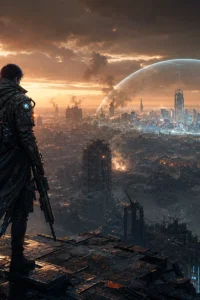
They moved out through the service corridor at 09:14, with the ash light slanting between broken high-rises and the sound of distant sirens dwindling into something almost like static. The air outside had a metallic taste, like rainwater drawn through old pipes. Denver had become a city of wet ash, cracked glass, and the occasional shape moving too quickly between storefronts to be safely named.
The supermarket sat across a collapsed plaza, the front half drowned in runoff from a ruptured municipal line. Its sign still blinked in sections: MERIDIAN FOODS, then only MER—IAN, then a stuttering absence. Floodwater lapped the loading dock, greasy and gray. The automatic doors were gone, replaced by a jagged hole rimmed with bent metal and something dark smeared high on the frame.
Mara paused at the threshold.
Her Ashbinder sense prickled like heat under skin. The place wasn’t merely damaged. It was claimed. The air inside carried the sour, mineral odor of a system bent around death and water both, and the faint whisper of glass cracking somewhere deep in the dark.
Dungeon Instance: Meridian Foods — Hydrology Variant
Condition: Flooded
Hostile Entities: Present
Environmental Hazard: Drowning, contagion, structural failure
Reward Classification: Unbound
Eli let out a low whistle. “Unbound sounds bad.”
“Everything sounds bad now,” Nia muttered.
Mara tightened her grip on the pry bar she’d taken from a maintenance closet. “Stay close. Don’t drink anything unless I say so. If it moves wrong, hit it until it doesn’t.”
“That’s your whole strategy?” Eli asked.
“It’s gotten me this far.”
Inside, the supermarket had become a wet cathedral of wreckage. Fluorescent lights hung in stuttering strips from the ceiling. Aisles had buckled, their shelves collapsed into the black water below. Canned goods drifted like drowned relics. Detergent foam floated along the corners in pale skin-like clumps. The cold cases had burst open, and a smell of rot and ammonia hung over everything.
Water covered the floor from ankle to knee in places, and the current moved with a patient, creeping force as if the whole building were breathing under the flood.
Father Thomas murmured something under his breath. Mara looked at him and saw his lips shaping an old prayer with the familiarity of habit, not comfort.
“You seeing something?” she asked quietly.
“Not yet.”
“That’s reassuring.”
They moved along the left wall where the shelving was highest, using the aisle markers like landmarks in a submerged maze. Nia climbed onto a fallen shelf to keep her shoes dry until the metal groaned under her weight and Mara snapped, “Off that. Now.”
“I was fine.”
“You were one bad step from becoming a headline.”
Nia dropped down, muttering, “Bossy as hell.”
“Alive as hell,” Mara said.
Near the deli counter, they found the first body.
It had been a stock clerk once, maybe. The blue apron still hung around its waist, swollen and plastered to the skin. Its face had gone pale and pruny, lips drawn back from the teeth. Something had torn open the throat. Something else had fed. Mara knelt, scanning the area, and saw the track marks in the water leading toward the back room.
She crouched beside the corpse and touched two fingers to the soaked apron.
Heat answered her touch—not from the body, but from the strange power under her skin, the awful new talent the System had given her when it should have given her mercy. Dead things still carried echoes. Burn them fresh enough, and the ash remembered.
She had not told the others what she’d done in the alley last night. Not all of it. The vision had shown a hand opening a gate sigil painted in blood and something that shimmered blue beneath the surface, not unlike the System’s own light. A shape in a hood. A voice. Someone inside the safe zone.
She wasn’t ready to say how that made her feel.
Eli hovered a few feet away, taking pictures he promised no one would believe later. “Do you need me to, uh—”
“No.”
She sliced a strip from the clerk’s apron with the knife Juniper had given her, then wrapped it around her hand to lift the body just enough to search the pockets. A keycard. Three stale mints. A name tag bent in half. Nothing useful.
“Anything?” Father Thomas asked.
“Not yet.”
Then the water rippled.
Mara froze.
Something pale moved under the surface between the aisles. Long, low, and too smooth. It slid through the floodwater with the glide of a fish and the mass of a dog. Then another shape passed behind it, and another.
Nia’s breath hitched. “Tell me those are eels.”
“No,” Mara said.
The thing surfaced in the endcap reflection first—an imitation of a human face, stretched thin and white, mouth split wider than any mouth should split. Skin hung in wet sheets along a ribbed frame of bone and tendon. Its eyes were blue only because they reflected the overhead emergency lights.
It smiled with too many teeth.
Mara moved before anyone else could. She waded in hard, driving the pry bar down as the creature lunged. Metal struck skull with a sound like hitting a sodden log. The thing folded sideways into the water, and the current burst with dark threads.
Something else hit her knee from the left. She staggered, caught herself on a shelf, and kicked back hard, feeling cartilage give under her boot. Eli made a strangled noise somewhere behind her. Father Thomas shouted a prayer that turned into a curse.
Two more shapes broke the surface, all wet limbs and jaws. One scraped claws across the tile with a sound like knives dragged over glass. Mara slashed, blood blooming black and thin in the water.
ASHBINDER triggered.
Heat Request: 1%
She felt the ember inside her answer.



0 Comments