Chapter 24: Firebreak
by inkadminThe first thing Mara noticed was the wind.
Not the screaming. Not the horns blaring from the barricade towers or the panicked surge of bodies in the streets behind her. Not the wet, hungry thunder rolling down Colfax as the monster wave poured through three broken intersections at once.
The wind.
It came low and dirty from the west, shouldering between collapsed storefronts and overturned buses, dragging ash in gray ribbons across the pavement. It smelled of burned cedar, hot asphalt, coppery blood, and the sharp chemical stink of ruptured gas lines. It combed through Mara’s cropped hair and pushed at the hem of her scorched jacket like an impatient hand.
Fifteen miles per hour, gusting higher through the street canyon. Variable around the high-rises. Eddying hard at the hospital’s south face. If fire took there, it would ladder up the hanging banners and into the triage balconies before anyone could blink.
Her eyes tracked the invisible shape of it while the city tore itself apart.
“Mara!” Isaac shouted from somewhere behind her. “They’re breaching York!”
She didn’t answer.
She was standing on top of a municipal bus that had been folded almost in half by a thing with antlers made of human femurs. Its dead bulk still steamed against the curb, each breathless rib cage glowing faintly with System rot. Below her, the defenders of the Civic Center Safe Zone were arranged in a crooked half-mile line made of buses, concrete dividers, cargo containers, burned-out cars, and desperation. Thousands of civilians packed the blocks beyond: families under tarps, wounded on doors used as stretchers, children with soot masks tied around their faces. The safe zone’s blue barrier shimmered fitfully behind them, a dome no longer whole, its surface spiderwebbed with black cracks where the first wave had gnawed at its rules.
In front of them came the second wave.
It was not a charge. It was weather.
Skinless hounds flowed over one another in red ropes of muscle and yellow teeth. Bone-limbed scavengers loped on knuckles too long for their bodies, their skull-faces clicking in anticipation. Taller things moved among them—mantis-backed crawlers with lamprey mouths, bloated carrion priests dragging chains of intestine, glassy-eyed walkers that had once been people from the fallen districts, their bodies sprouted over with black fungal plates and System sigils.
Above the horde, the sky over Denver pulsed open like a wound.
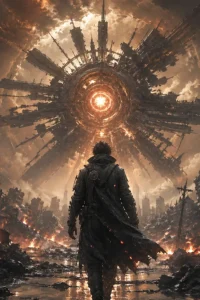
The rift over the Rockies had widened since dawn. It hung above the mountains in a vertical tear of ember-orange and impossible blue, spilling ash upward into the clouds and down again over the city. Every pulse of it pushed fresh pressure behind Mara’s eyes. Every pulse made the brand beneath her collarbone burn.
Ashbinder.
Not gift. Not miracle. A leash with teeth.
“We can’t hold that many!” shouted Rafi from the street. The conspiracy podcaster had lost his ridiculous mirrored sunglasses yesterday and somehow looked smaller without them, his face gray with ash, his beard singed on one side. He clutched a rifle like it might turn into a microphone if he believed hard enough. “Mara, the east crews are folding. Halpern’s militia is pulling back!”
Of course they were.
Mara looked past the main crush and saw it happen: men and women in scavenged body armor abandoning the York barricade, dragging ammunition crates with them, their black-and-yellow armbands bright against the smoke. They had hunted her through the Denver Public Library two nights ago. They had strung up three unawakened looters from lampposts and called it order. Their leader, Captain Halpern, had tried to trade children for access to the safe zone core.
Now his line bent, and behind it waited six thousand civilians who had no idea their lives had become a math problem.
“If York breaks, they roll us from the flank,” Isaac said. He climbed onto the bus beside her, one hand pressed to the bloody bandage at his ribs. The combat nurse had scavenged a firefighter’s helmet from somewhere, and the visor was cracked across one eye. “We have maybe four minutes.”
“Less,” Mara said.
Her voice came out calm. That frightened her more than panic would have.
She crouched and pressed her palm to the bus roof. Ash clung to her skin. There was so much of it now—fine gray powder in drifts along the gutters, piled on windshields, caught in hair and eyelashes and open wounds. It fell from the rift. It fell from burning buildings. It fell from bodies when the System took what it wanted and left the rest.
Fuel.
She hated that the thought came so easily.
Old training rose in her like an unwelcome ghost. Not the System’s cold blue language, but the world before: smokejumping out of Missoula, long hikes under hundred-pound packs, instructors with sun-cracked faces drilling the same words until they lived in muscle and bone.
Fire needs heat, fuel, oxygen. Change one side of the triangle, you change the fire.
Use terrain. Use wind. Anchor your line. Never light what you can’t hold.
A burn doesn’t stop a fire. It teaches the fire where to go.
Mara stared at the map burned into her mind. Broadway choked with wreckage. Colfax a funnel. York failing. Civic Center behind. The museum block to the south, its stone walls intact. The collapsed parking garage north of the Capitol, already burning in three places. If she tried to make a wall, the wave would pile against it, climb it, spill around it, and the civilians would die in the backwash.
But a corridor…
A corridor could make the horde narrow itself.
A corridor could turn weather into a river.
A river could be dammed, trapped, cut, burned.
She rose so fast Isaac grabbed her elbow.
“Tell me you’ve got a plan,” he said.
“I’ve got a bad idea.”
“At this point, I’ll take one with a pulse.”
Mara pointed down Colfax, then south across the ruined avenues. “We don’t stop them at the line. We open the middle.”
Rafi, who had climbed onto the hood of an ambulance below, stared up at her. “That sounds exactly like letting them in.”
“It is.”
“Fantastic. Love that. Very Denver. Let the murder dogs browse the farmers market.”
Isaac’s eyes narrowed. He followed her gaze, lips moving silently as he counted streets, angles, bodies. He understood triage. He understood choosing who bled so others could breathe.
“You want to channel them.”
“Ashfire on both sides,” Mara said. “From the parking garage to the museum steps, then dogleg west along the courthouse. We give them one open lane. Everything else burns too hot to cross.”
Rafi made a strangled sound. “Ashfire? As in the blue-white stuff that ate a troll and half a bank vault? That ashfire?”
“Yes.”
“Can we maybe put a pin in how your plan involves setting downtown on magical fire?”
“No.”
Isaac looked toward the failing barricade. Another section of concrete dividers lurched inward as something enormous struck it from the far side. The impact rattled teeth. A gout of black blood sprayed over the top, followed by a defender’s severed arm still gripping a spear.
“Kill zones?” Isaac asked.
“Here.” Mara pointed to the intersection below them where three bus carcasses formed a U-shaped choke. “And at the courthouse plaza. Crossfire from the rooftops. Spears at the mouth. Grenades if we have any left. Anyone with area Skills waits until the bulk is in the lane. No hero charges.”
“We don’t have enough disciplined fighters for that.”
“Then find me frightened ones and tell them the truth.”
Isaac gave a humorless laugh. “Which truth?”
“That if they run, their kids get eaten.”
For a heartbeat, only the wave answered them.
Then a new sound split the air—a high keening from the east. Mara turned and saw one of the carrion priests climbing the side of an apartment building like a spider, its swollen belly scraping brick, its long arms placing human fingerbones into mortar cracks. Its throat pouch inflated. The defenders below staggered as the sound hit them. Men dropped weapons. A woman clawed at her ears until blood ran between her fingers.
The skinless hounds surged toward the weakness.
“Go,” Mara said.
Isaac didn’t argue. He slid down the bus ladder and landed hard, already shouting orders. “Med crews back two blocks! Shield teams to the blue markers! Anyone with a slow, root, trip, glue, net, or weird-ass floor spell, you are now my favorite person—move!”
Rafi hesitated. Beneath the ash and fear, his eyes were bright with the terrible hunger that had kept him alive: the need to understand the monster eating the world.
“Mara,” he said, quieter, “what does this cost you?”
The brand under her collarbone throbbed.
Everything, probably.
“Time,” she said.
He held her gaze long enough to let her know he knew she was lying. Then he raised his rifle, turned to the crowd, and became a voice again.
“Listen up!” Rafi bellowed, somehow projecting over gunfire and screams with the same manic authority he had once used to sell emergency water filters to paranoid retirees. “You see the woman on the bus? That’s Mara Vance. She jumped into forest fires for a living before the sky became a subscription service from hell. She says we move, we move. She says stand, you glue your feet to the asphalt and ask questions when you still have a mouth!”
Some people laughed. A few sobbed. Most moved.
Mara jumped from the bus.
She hit the pavement in a crouch and felt the city through the ash.
That was new. Or maybe not new—maybe she had been refusing to name it. The ash was everywhere now, and wherever it lay, a part of her listened. Footsteps trembled through it. Blood warmed it. The dead cooled beneath it. Each corpse was a coal wrapped in memory.
She could feel the bodies left from the first wave in alleys and storefronts. The defenders who had fallen before their names reached anyone’s lips. The monsters burning out in twitching heaps. The people who had been people until teeth and hunger made them something else.
The System had called them resources once.
Mara had vomited then.
Now she reached.
ASHBINDER ACTIVE SKILL: Cinderwake
Available ash mass: Severe saturation.
Available death residue: Severe saturation.
Warning: Extended ignition may induce class instability.
“Yeah,” Mara muttered. “Get in line.”
She thrust both hands toward the broken parking garage.
The ash answered.
It did not rise like smoke. It unstitched itself from the world. Gray drifts lifted from windshields, gutters, hair, wounds, and open mouths. It streamed across the street in twisting cords, each thread catching fire from within. Not red. Not orange. Ashfire burned the color of lightning seen through bone—white at the heart, blue at the edges, flecked with tiny black sparks that fell upward.
Heat slammed into her face. Her eyelashes crisped. The air lost moisture in an instant, sucking at her tongue and lungs.
A line of ashfire tore along the pavement from the parking garage’s burning maw to the first row of overturned cars. It crawled over metal without consuming it, draped across concrete without smoke, then rose waist-high, shoulder-high, taller. The flames made no natural sound. No crackle. No roar. Just a low hungry whisper, like thousands of pages turning in an empty room.
The nearest hounds hit it at full sprint.
They did not stop. They became silhouettes.
For half a second, Mara saw every tendon and bone lit inside them. Then they collapsed into falling ash, their momentum carrying gray smears across the pavement. The monsters behind them veered away with shrieks that sounded almost human.
A cheer burst from the defenders.
“Don’t cheer!” Mara shouted. “Move!”
The first line was only an anchor. A burn without an anchor was just arson with delusions. She dragged her hands south, and the ashfire followed, laying itself across the street in a molten ribbon. Her boots skidded as something pulled back through the connection, a weight vast and cold behind the heat.
Not the monsters.
The rift.
It noticed every time she burned.
Above the mountains, orange-blue light pulsed.
Mara’s vision doubled. For an instant, Denver was gone. She saw a black forest under a red sun, trunks like charred ribs, things hanging from branches in cocooned rows. She smelled smoke older than language. She heard an auctioneer’s bell ring once, deep enough to shake stars.
Then Isaac’s voice snapped her back.
“Mara! Left side!”
A mantis-backed crawler had launched from a second-story balcony, sailing over the new fireline with its hooked limbs spread wide. Mara twisted, but too slow.
A red blur hit it midair.
Tessa slammed into the crawler with a length of rebar in both hands, her stolen motorcycle jacket flapping open over a blood-stiff hoodie. The runaway teen weighed maybe one hundred pounds with boots, fury, and System spite included. Her new Skill turned the air around her into a flickering afterimage, a half-step out of sync with the world. She drove the rebar through the crawler’s lamprey mouth and rode it down into the side of a police cruiser.
The impact shattered glass.
“You said no hero charges!” Rafi yelled.
Tessa wrenched the rebar free in a spray of black fluid. “I’m a minor! Rules are fake!”
“Get to the kill zone!” Mara barked.
Tessa flipped her off, which Mara accepted as acknowledgment, and sprinted west.
Mara kept moving.
She lit the second line from the museum steps, using the stone facade as an anchor. Heat peeled old posters from walls. Flags on lampposts curled into black fists. A sedan’s tires burst one after another, shotgun-loud. Civilians screamed as the ashfire rose, but Isaac’s crews forced them back with shields and shoulders and raw profanity.
“Back! Back, damn you!” Isaac roared at a man trying to drag a cart of canned goods through the forming lane. “Leave it!”
“That’s all we have!” the man cried.
Isaac grabbed him by the collar and shoved him toward a waiting teenager. “No, your lungs are all you have! Move!”
On the east flank, Halpern’s militia saw the corridor forming and misunderstood it.
Or maybe they understood perfectly and were cowards.
They began falling back toward the open lane, dragging their ammo, trying to use Mara’s firebreak as cover while the wave pressed at their heels. Captain Halpern himself rode atop an armored pickup, his shaved head streaked with soot, one arm in a sling, the other waving a pistol as if bullets could command physics.
“Vance!” he shouted when he saw her. “Open your line! My people are cut off!”
“Your people abandoned the barricade,” Mara called back.
His face twisted. “We’re redeploying!”
Behind him, bone scavengers poured through the gap his retreat had made. They came low and fast, hands slapping pavement, skull jaws chattering. Civilians on a rooftop screamed and opened fire too early. Bullets sparked off asphalt, punched through monsters, hit nothing important.
Halpern’s truck swerved toward the narrowing mouth of the corridor.
If he jammed it there, everything behind him would pile up. The horde would spill around. The firebreak would fail before it finished.
Mara pointed at the truck.
“Stop him.”
Rafi stared. “With what, my sparkling personality?”
Then Father Paul stepped into the road.
The old priest looked like death had misplaced its receipt. His skin had gone waxy, the veins at his temples dark with the System infection he insisted was not a curse, not exactly. His black shirt was torn, collar gone, rosary wrapped around one fist and a rusted fire axe in the other. Since the first night, he had claimed the System whispered back when he prayed.
Sometimes Mara believed him.
He raised the rosary toward Halpern’s truck.
“Captain,” Father Paul said, and his voice carried like a church bell through smoke. “Do not make your fear into another man’s coffin.”
Halpern aimed the pistol at him. “Move, priest!”
Father Paul closed his eyes.
The air folded.
Not visibly. Mara felt it in her teeth, a pressure change like thunder without sound. Halpern’s truck hit an invisible slope and slewed sideways. Tires screamed. The armored vehicle smashed into a concrete planter, flipped half onto its side, and blocked the militia’s retreat without blocking the corridor.
Men spilled from the back, cursing and bleeding.
The scavengers hit them seconds later.
Mara looked away only long enough to keep the line straight.
That was the first cut the day took from her.
Not the deaths. Death had become too common, a currency shoveled into the System’s furnace. The cut was the decision. The moment her mind measured Halpern’s people against thousands behind her and found them light.
Ashfire surged higher.
CLASS FEATURE: Funerary Combustion
Death residue converted.
Efficiency increased by 3.1%.
Emotional resistance detected.
Resistance reduces output.
“Shut up,” Mara hissed.
The System did not.
Accept optimization?
She slammed the prompt away so hard sparks bled from her fingertips.
The corridor took shape.
Two walls of ashfire ran through downtown like the borders of a new hell. Between them lay a strip of open pavement three lanes wide, curving west into the prepared kill zones. At its mouth, the horde hesitated. Monsters crowded against one another, instincts warring with System compulsion. The fire hurt them. The open lane promised prey.
Then the carrion priest on the apartment building screamed again.
The wave obeyed.
They poured into the corridor.
“Now!” Isaac shouted.
The first kill zone erupted.
Gunfire stitched the lane from both sides. Not random panic now, but angled fire from rooftops and windows where Isaac had placed shooters with ruthless care. Spears jabbed through gaps in bus frames. A woman in a blood-soaked business suit slammed both palms to the pavement, and a sheet of ice spread beneath the leading hounds; they skidded, tangled, and vanished under the crush behind them. Someone dropped a homemade bomb from a balcony. The blast lifted bodies in a red-black fountain.
Still they came.
Mara walked backward along the corridor’s edge, arms out, holding the walls. Every monster that brushed the ashfire fed it. Every dead defender behind the line tempted it. The flames wanted to widen. They wanted the alleys, the buildings, the people packed behind sandbags with eyes too wide for their faces.
She held them narrow by memory.
Dig line. Scrape to mineral soil. Watch for rollouts. Watch for spot fires. Watch the wind.
The wind shifted.
Just five degrees north, but enough.
Ashfire on the museum side leaned toward a row of medical tents.
“Isaac!” Mara shouted.
He saw it at the same time. “Water! Blankets! Foam if you’ve got it!”
“Water won’t stop it!”
“Then lie to it convincingly!”
Medics dragged patients from the tents as the blue-white flames strained toward them like dogs on leashes. Mara clenched both fists, pulling the fire back. Pain lanced up her arms. Blisters rose across her palms and burst. The ash did not burn her skin from outside; it burned through the pathways the System had carved inside her.
The rift pulsed again.
This time she saw more.
A hall of basalt under a skyless void. Tiered seats filled with shapes that hurt to look at—glass-winged silhouettes, thorn-crowned giants, pale masks floating in jars of black fluid. Earth hung above them in miniature, blue and white and fragile. Lines of gold light marked continents. Red flares bloomed where cities fell.
A voice like a million insects clicked:
Lot 7-113: Native adaptive species demonstrates accelerated violence economy. Fire-aspect candidate emerging. Bidding interest rising.
Mara stumbled.
A hound burst through a low point in the fireline and landed on a medic.


0 Comments