Chapter 21: Ash on the Altar
by inkadminThe cathedral had grown teeth.
Mara remembered Saint Brigid’s from before the sky tore open—red sandstone walls, green copper spires, a soup line in the side alley, stained-glass saints staring down with jewel-colored pity while downtown Denver pretended not to see the people sleeping beneath them. It had been old, beautiful in a tired way, the kind of building that held weddings and funerals and winter coats donated in black trash bags.
Now it crouched at the end of Colfax like a wounded animal protecting a kill.
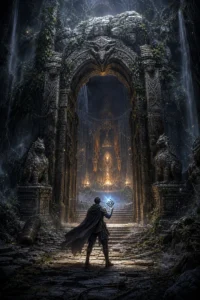
The sandstone had stretched upward in impossible angles, ribs of black basalt punching through mortar and brick. Flying buttresses hooked into the neighboring office towers like talons, dragging glass and steel into the cathedral’s warped anatomy. Spires split into antlered crowns, their bells replaced by pulsing sacs of translucent membrane that throbbed with gold-white light. Every toll came without sound at first—just pressure, a hand closing around Mara’s skull—then the delayed boom rolled through her chest and made ash lift from the street in trembling sheets.
Hymns burned in the air above the doors.
Not written. Not carved. Burned.
Lines of luminous script spiraled around the archway, each symbol shaped from flame the color of old bone. They crawled over one another like living things. Where the code touched stone, the rock wept black sap.
Jax crouched beside the husk of a city bus, one hand pressed to the cracked pavement. His other hand held a pistol so tightly his knuckles had gone gray. The podcaster had painted System sigils onto his jacket in reflective tape, half warding theory and half madness, and the tape flickered whenever the cathedral bells pulsed.
“Tell me somebody else sees the Latin doing yoga,” he whispered.
“Not Latin,” said Sister Mercy.
The combat nurse stood on Mara’s other side, shotgun braced low, white coat traded for scavenged riot armor and a red scarf tied around her mouth. Blood had dried in a fan across one cheek. None of it was hers. The compact medkit strapped to her thigh clicked softly as she shifted her weight.
“It’s not any church language,” Mercy said. “It’s made to look like one.”
“Great. Corporate branding for demons.”
“Quiet,” Mara said.
Their column froze behind her.
Twenty-three fighters remained from the mess of factions she had bullied, bribed, and terrified into marching with her. Rook’s barricade crews in patched body armor. Three riflemen from the Civic Center militia. Two teenagers from the Speer drainage camp with machetes and shaking hands. An old man named Calder who had awakened as a Stonewright and could make concrete remember it had once been mountain. Even Kellan from the Auraria enclave had come, though he’d made sure everyone saw him come with two armed escorts and a silver-threaded cloak that caught the ash like moonlight.
None of them wanted to be here.
Mara didn’t blame them.
Across the wide avenue, the cathedral doors stood open. They were not doors anymore, not truly. They had unfolded into four vertical jaws lined with knuckles of ivory. Between them yawned a nave lit by furnace glow and filled with drifting ash.
Ezra was in there.
The thought tightened around her lungs. The boy’s face kept flashing behind her eyes: narrow chin, too-large hoodie, the stubborn tilt of his head when he pretended not to be afraid. He had stolen food from her the first night and then saved her life with a flare gun and a lie shouted at exactly the right time. He was seventeen and had learned too quickly how to step over bodies without looking down.
The Hollow Choir had taken him because he had begun to hear what Father Callahan heard before he died.
Because the System whispered back.
Ash shifted under Mara’s boots. She flexed her fingers, feeling the blackened heat beneath her skin answer. Her class sat in her bones like a second pulse, hungry and patient.
Ashbinder Lv. 19
Current Cinder Reserve: 83%
Bound Remnants: 47
Warning: Consecrated hostile architecture detected.
Warning: Territorial claim contested.
“Hostile architecture,” Jax muttered, glancing at the blue pane reflected in Mara’s eyes. “System really looked at murder church and went, ah yes, zoning issue.”
“Can you disrupt the hymn code?” Mara asked.
Jax swallowed. Humor drained out of him, leaving the exhausted man underneath. “Maybe. I can jam pieces if I get close to a node. Bells, altar, choir loft—something will be acting as a repeater.”
“And if you’re wrong?” Kellan asked.
Jax looked back at the cathedral. “Then I die doing important audio work.”
Kellan’s mouth curled. “Comforting.”
Mara turned on him. “You can still leave.”
For an instant the militia prince of Auraria showed his age. He was barely thirty, soft-handed before the Fall, dressed now like he’d been born to command walls and ration lines. Fear tightened his eyes. Pride shoved it down.
“And let you claim the relics inside alone?” he said. “No.”
Mercy gave a low laugh without warmth. “At least he’s honest when being disgusting.”
The cathedral bell sacs pulsed again. This time sound came with light. The hymn code flared, and down the avenue the empty storefront windows bowed inward as if listening.
Then people began to sing.
It rose from inside the cathedral—hundreds of voices braided together, thin and sweet and wrong. Children, old women, men with broken throats. Some sobbed through the notes. Some laughed. The melody crawled into the cracks of Mara’s teeth.
Behind her, one of the Speer kids dropped his machete.
“No,” Mercy snapped, catching his shoulder before he took a step forward. “Eyes on me. Breathe.”
The boy stared past her, pupils huge. “My mom—”
“Not her,” Mercy said. “It’s wearing her voice.”
But there were others shifting now, heads tilting, mouths parting. The song knew grief. It reached into each listener and pulled out a voice they had buried.
Mara heard her brother.
Mae.
Not the way he sounded in memory, laughing over cheap beer after a fire season, but the way he had sounded over the radio in the last minutes, static cutting his breathing into pieces while the crown fire jumped the ridge.
Mae, I can’t see the line. Tell me where to go.
For one heartbeat she was not on Colfax. She was in Idaho smoke, heat smashing the world flat, orange sky turning black at noon. She tasted grit and melted plastic. She smelled hair burning.
Then her dead answered from inside her.
The remnants bound to her class stirred—shades of scavengers, hounds, neighbors, things she had killed and things she had failed to save. They rustled like dry leaves in a furnace. The false voice snagged on them and tore.
Mara exhaled smoke.
“Move,” she said.
Calder raised both hands. The street in front of them buckled. Concrete slabs wrenched upward, forming a jagged shield wall as the first defenders came pouring from the cathedral mouth.
They had been people once.
The Hollow Choir wore white robes stitched from bedsheets, curtains, altar cloths, skin. Their faces were hidden behind smooth masks of wax, each mask molded into an expression of rapture. Gold thread sutured the masks to their flesh. Their throats had been opened vertically from chin to sternum, not bleeding but glowing, strings of hymn code stretched across the wounds like vocal cords.
They sang as they ran.
The front rank hit Calder’s wall and climbed it like insects. Rifles cracked. Shotguns boomed. A Choir acolyte leapt over the barrier with both arms outstretched, fingers grown into hooked tuning forks. Mara met it midair with a blade of compacted ash.
Her weapon formed from the dead dust around her, black and ember-veined, curving like a wildfire’s edge. She cut through robe, ribs, glowing throat. The acolyte split open without blood. Music spilled out in a shrieking chord.
Hollow Acolyte slain.
Cinder gained.
Remnant unsuitable: soul collateral claimed by external lienholder.
Mara’s stomach turned.
External lienholder.
The words flashed and vanished as another acolyte came at her. She ducked under tuning-fork claws, slammed her palm against its mask, and let Ashbind ignite. Heat roared from her hand. The mask cracked, wax running over her fingers. Beneath it was a woman’s face stretched around a smile too wide to fit a human skull.
“He paid for us,” the woman sang. “He paid in advance.”
Mara crushed her skull against the concrete wall.
The assault became a knife fight at the gates of hell.
Mercy moved with brutal economy, shotgun emptying, then reversing into a club. She took a claw across the shoulder, grunted, hooked the acolyte’s leg, and drove a medical spike into the glowing slit of its throat. Blue-white sparks snapped over her fingers as her healing class inverted itself into harm.
“Triage that,” she hissed.
Jax sprinted for the side steps under cover of rifle fire, a backpack of salvaged transmitters bouncing against his spine. Mara saw two acolytes angle toward him and flung a chain of ash. It wrapped one around the waist, burned through robe and flesh, and yanked it backward into the path of Kellan’s escort.
Kellan lifted his hand. Silver light unfolded in geometric panes before him. The second acolyte struck the barrier and shattered its own arms. Kellan smiled despite himself.
Then the cathedral sang a lower note.
The silver barrier rippled, inverted, and slammed back into Kellan’s chest. He flew ten feet and hit the side of the bus hard enough to dent metal. His escorts broke formation to drag him up.
“Adapt faster,” Mara shouted.
“I hate you,” Kellan wheezed.
“Stand in line.”
They drove forward by inches. The street became a churn of ash, shell casings, broken masks, and burning script. Every slain Choir member left no remnant for Mara to bind. Each kill fed her cinder reserve but left a cold absence where a soul should have been, like reaching for a hand and finding a receipt nailed to empty air.
At the threshold, the cathedral tried to stop her.
The hymn code above the doors uncoiled. Flaming symbols dropped like brands, striking fighters across shoulders and brows. One of Rook’s barricaders screamed as a sigil burned through his helmet and into his scalp. His eyes went gold. He turned his rifle on Mercy.
Mara moved before thought.
Ash surged beneath her boots, launching her sideways. She caught the barrel as it fired. Pain exploded through her left hand. The bullet tore across her palm, hot and ugly, but she twisted the weapon up and drove her ash blade through the man’s thigh, pinning him to the pavement.
“Mercy!”
The nurse was already there. She slammed two fingers against the burning sigil on the man’s forehead. Her mouth tightened. “It’s writing over him.”
“Can you stop it?”
“If I don’t care what I cut out.”
The man sobbed, gold eyes rolling. “Please—”
Mercy’s jaw flexed. “Hold him.”
Mara gripped his shoulders. Mercy drew a scalpel that glowed dull red and carved the sigil off his skin in three quick strokes. The smell hit like pork fat in a pan. The man screamed until his voice snapped. The gold drained from his eyes.
“He lives,” Mercy said.
“He fights?”
Mercy glanced at the way his hands trembled. “Not today.”
Mara nodded to two militia fighters. “Get him behind the bus. Anyone marked gets cut or carried. No hesitation.”
Then she stepped through the jaws of the cathedral.
The inside was bigger than the outside.
That was the first wrongness. The nave stretched into a cavernous length no Denver block could contain, its ceiling lost in smoke and constellations of burning hymn code. Pillars rose like fused vertebrae, each one wrapped in gold wire and human hair. Pews had been stacked into barricades and confessionals grafted into watchtowers. Stained-glass windows floated free from the walls, rotating slowly in midair, each saint’s face replaced by a blank oval of light.
Along both sides of the nave hung cages.
Hundreds of them.
People were crammed inside—families, militia fighters, vagrants, office workers still wearing ID badges from a world that no longer existed. Some clutched the bars. Some hung limp. Some had golden script crawling under their skin in delicate branching lines. The song came from them, dragged out of their throats by the wires looped around their necks and vanishing into the ceiling.
Mercy stopped dead beside Mara.
For the first time since Mara had met her, the nurse looked unsure where to put her hands.
“Jesus,” Jax whispered from somewhere behind them, then flinched as if afraid the word might answer.
“He’s not receiving calls here,” said a voice from the pulpit.
The Hollow Choir’s cantor stood above the ruined nave in robes of layered white and gold. His mask was different—porcelain instead of wax, painted with blue tears beneath the eyes. A halo of burning code turned slowly behind his head, casting his shadow in six directions.
Mara recognized the posture before the voice. Mayor Sloane’s chief negotiator. The man who had smiled over ration tables at Civic Center three days after the Fall and promised cooperation while measuring everyone’s weakness.
“Daniel Hart,” she said.
The porcelain mask inclined. “Names are such small rooms. I have been given a larger house.”
Jax raised his pistol. “I liked you better when you were a bureaucratic parasite.”
Hart spread his hands. “And I liked you better when your audience numbered in the hundreds and your paranoia had no footnotes.”
“My paranoia has aged incredibly well.”
Mara lifted her ash blade. “Where is Ezra?”
At the boy’s name, the cages nearest the altar trembled. A ripple passed through the hymn. Hart’s head tilted with exquisite interest.
“The little receiver,” he said. “A raw thing. Untaught. He hears frequencies meant for saints and sovereigns. We are helping him become useful.”
“You’re going to give him back.”
“No.” Hart’s answer was gentle. “But you may attend his ascension.”
The nave floor split.
Pews toppled as stone unfolded into steps descending beneath the altar. Heat breathed up from below, thick with frankincense, blood, and hot copper. The hymn deepened. The prisoners in the cages arched as one, mouths open, voices pouring out in cords of light that fed into the widening stair.
“Trap,” Kellan rasped behind her, one hand pressed to his ribs.
“Yes,” Mara said.
Mercy stared at the cages. “We can’t leave them.”
Mara counted defenders, distances, exits. Hart watched her through porcelain. He wanted her split. Wanted her trying to save everyone and losing the one person she had come for.
Leadership had always been triage with more screaming.
“Calder,” Mara said. “Break the cages on this side. Mercy, coordinate evac. Jax, find that repeater and make the song choke. Kellan—”
“If you say hold the nave, I will be extremely offended by how predictable you think I am.”
“Hold the nave.”
Kellan coughed a laugh, then winced. “I was right to be offended.”
Mara stepped toward the descending stair.
Mercy grabbed her arm. “Alone?”
“Not alone.” Mara opened her burned hand. Ash gathered, coiling through her fingers. The bound dead stirred, silhouettes forming in the smoke at her back—hounds with ember eyes, bone-limbed scavengers, the faint outlines of people who had chosen to fight beside her after death because the alternative was silence.
Mercy’s grip tightened. “Those things cost you.”
“Everything does.”
The nurse’s eyes searched her face, seeing too much. “Bring him out.”
Mara looked down the stair where the heat pulsed like a giant heart. “That’s the plan.”
“Plans change.”
“Then I’ll improvise violently.”
Mercy let go.
Mara descended beneath the altar.
The stairs went farther than they should have. With every step, the cathedral above faded and something older pressed close. The walls changed from stone to a glossy black substance threaded with gold veins. Not obsidian. Not bone. It flexed when her shoulder brushed it, warm as skin.
System messages flickered and died at the edge of her vision, interrupted by lines of symbols she couldn’t read. The architecture was chewing on the interface.


0 Comments