Chapter 7: The Child in the Stairwell
by inkadminThe house was quiet in the way a grave was quiet: not empty, not peaceful, only waiting for the next sound to decide what it meant.
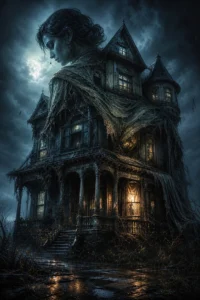
Mara stood in the front hall with Elias Vale’s ring of keys lying heavy in her palm, every one of them dark with age, their teeth cut into strange old patterns that looked less forged than grown. The brass smell had stayed on her skin after he’d pressed them into her hand, and beneath it lingered the house’s own odor—wet plaster, old wood, the mineral cold of places that had spent too long underwater and somehow had not drowned.
Behind her, the front door hung open to the drained lakebed. Evening had lowered over Stillwater in bands of iron and violet. Far off, work lights from the salvage camp burned like ship lanterns in a dead sea. The exposed streets of the town lay under slick sheets of mud, foundations crouched where homes had been, church steps rising to nowhere. Beyond all of it, the black bowl of the reservoir climbed toward the tree line.
Inside the house, the gas sconces along the walls glimmered with their small impossible flames.
“You don’t have to keep acting like it’ll bite if you set them down,” said Jessa from the dining room doorway.
Mara looked up. Jessa had her clipboard tucked under one arm and a flashlight in the other, though the beam was off. Her red braid had come mostly undone, copper strands stuck to her cheeks with sweat. Mud darkened the knees of her coveralls. She tried for dry humor the way some people used cigarettes—constantly, and mostly to hide a tremor.
“I’m deciding whether I hate him for waiting forty years to mention the dream keys,” Mara said.
Jessa snorted. “Only forty? That’s practically prompt communication for an old mountain man.” Her gaze shifted toward the parlor where Elias sat in a spindle-back chair near the cold fireplace, hands folded over his cane. “He all right?”
Mara looked too. Elias had not moved much since they’d come in. The old diver’s face was a map of river-cut lines and healed weather, but tonight it seemed carved from a paler thing. When he had given her the keys, his hand had been steady. His eyes had not.
“He says he’s fine,” Mara said.
“That usually means someone’s about to see God or an IRS auditor.”
Elias turned his head without lifting it. “Girl,” he said, “if the Lord wanted me, He’s had ample opportunity.”
“See?” Jessa muttered. “Not dead yet.”
A floorboard cracked overhead.
All three of them went still.
The sound came from the second floor, faint but distinct. Not the long settling groan the house often made, nor the soft wet tick that sometimes moved inside the walls. This was a single sharp complaint of wood beneath weight.
Mara’s fingers closed around the keys.
“Ronan?” Jessa called upward, voice already too thin.
No answer came. Ronan had gone back to camp an hour ago with the generator inventory and a face gone grey after opening a linen closet that had contained, for one impossible second, his dead brother’s school jacket hanging among moth-eaten sheets. He was not in the house. Mara was sure of that. She had watched him cross the mud flats toward the lights, shoulders hunched, one hand over his mouth like he was trying to keep something in.
The board cracked again.
Then came the laugh.
It was high and brief and bright as glass beads scattered across a floor.
Mara did not realize she had stopped breathing until her chest hurt.
Jessa whispered, “No.”
The laugh came again, farther down the upstairs hall. A child’s laugh. Not monstrous. Not warped. Almost ordinary, which made it worse. There was delight in it, and the kind of secrecy children used when they wanted to be found and not found at once.
Elias made a sound low in his throat. “Don’t answer it.”
“I wasn’t planning to,” Jessa snapped, too quick.
Mara was already moving. She did not decide to. Her body recognized the sound before her mind could refuse it. The old instinct hit her in the spine, a pull so fierce it erased the room around her.
Not memory exactly. Something before memory. A blur of white bannister spindles. A ribbon on a small braid. Her mother’s hand leaving hers for just one second while sunlight turned dust gold in a stairwell somewhere she had not been able to find again.
“Mara,” Elias said sharply.
She had crossed half the hall before she turned. “If there’s someone up there—”
“There isn’t.” He gripped the head of his cane. “It learns your wanting. It puts a face on it.”
“Good,” Mara said, and heard how cold she sounded. “Then maybe it’ll finally show me one clearly.”
Jessa swore under her breath and pushed off the doorway. “I’m not letting you go alone.”
“Stay with Elias.”
“Absolutely not.”
Another laugh rippled from above, ending in the soft patter of feet running over carpet.
Mara was at the stairs before either of them could stop her. The runner there was once-red, now faded toward the color of old liver, but it looked dry despite the dampness that lived in the rest of the house. Her boots sank into it with a muffled hush. The carved banister was smooth beneath her free hand, polished by generations of hands that should never have existed.
The gaslight dimmed as she climbed.
On the landing above, the darkness gathered in corners with a kind of intent. She could feel Jessa behind her for the first few steps, breathing hard through her nose, flashlight clicking on at last. The beam lanced past Mara’s shoulder and made the wallpaper bloom in sickly color—green vines, pale flowers, tiny birds with black bead eyes.
“I hate this house,” Jessa whispered.
“Take a number.”
Elias did not follow. Mara could hear him below, not moving, as if he had gone rigid in his chair. For a strange second that frightened her more than the laughter.
At the top of the first flight, the landing split in two directions. The upstairs corridor stretched left toward the rooms they had already cataloged—the nursery that smelled faintly of pond water, the blue bedroom whose mirror reflected one extra window after dusk, the washroom where dry taps sometimes ran whispering black. To the right, the hall bent toward a wing they had not fully explored, because every time they tried, the distance changed. Six doors became eight. A closed end became a staircase. Once, a narrow hall had opened on a view of the drowned town outside, though it should have faced the center of the house.
The laugh came from the right.
Closer now.
Mara lifted a hand for silence, though neither of them was speaking. Then she heard it: the tiny slap of bare wet feet on wood.
Not running anymore. Walking.
Slowly.
Deliberately drawing them on.
Jessa’s flashlight trembled. “That’s not funny.”
“Who said it was?” Mara stepped onto the landing.
The air changed at once. It thickened, cooling against her face with the slick chill of cave air. A smell rose that had not been there below—the sweet, rotten perfume of lilies left too long in a vase, overlaid with lake water and something rusty, almost meaty.
Her light was in her coat pocket. She realized she had come up without taking it out, without thinking. Stupid. Her hand moved automatically, fingers brushing past the keys before finding the flashlight’s metal cylinder. When she clicked it on, the beam joined Jessa’s in crossing the hall.
The footprints shone instantly.
They began three feet ahead of them on the faded runner, small and perfectly formed. A child’s footprints. Narrow heel, little spread toes, each print edged in dark wetness. They walked in a crooked line along the hallboards, glimmering black-blue under the flashlights like fresh water. One print overlapped another where the child had pivoted as if glancing back.
Jessa made a choking sound. “Oh hell no.”
Mara crouched. The nearest print reflected the beam in a thin skin. It was not mud. It was not the ooze that coated the lakebed outside. It looked clean. Cold. Reservoir water carried in from nowhere. She reached toward it, stopped an inch above, and felt the temperature drop again.
“Don’t touch it,” Jessa said.
Mara almost laughed. That ship has sailed, hit an iceberg, and sunk in this damn lake.
She straightened. The trail continued down the hall. Floorboards dipped under old floral paper stained in places where damp had climbed and dried and climbed again. Small gilt frames hung crooked on the walls, each containing sepia photographs whose faces had blurred into fog. As the two women followed the prints, the hall seemed to inhale around them. The house’s quiet deepened until the only sounds were the scuff of their boots, the little tremor in Jessa’s flashlight, and every few seconds, one bright peal of laughter farther ahead.
Mara knew that laugh.
Not truly. Not with reason. But recognition pressed at her from somewhere under her ribs, painful as a bruise. She saw, in scraps: a little girl in a yellow dress, hem dark with water. Crouched by a stair rail, looking up through hanging hair. Mouth open in delight. Eyes hidden by the angle of her head.
You are six years old and there is someone else in the house. Your mother says don’t go upstairs. Something laughs anyway.
Mara stumbled.
Jessa caught her elbow. “Hey. Hey, stay with me.”
“I’m fine.”
“You’re white as a sheet.”
“Then stop shining the light at me.”
Jessa’s grip tightened before she let go. “You always do this.”
Mara glanced at her. “Do what?”
“Get that look.” Jessa swallowed. “Like you’d rather walk into a furnace than admit you’re scared.”
Mara turned away. Ahead, the footprints reached the end of the corridor—or what should have been the end. There was no door there. Only a section of wall papered in the same green vine pattern, with a narrow table set against it and an oval mirror hanging above. On the table sat a porcelain bowl full of cloudy marbles.
The prints went right to the wall.
And stopped.
Jessa’s light climbed the wallpaper, then jerked sideways, searching for a hidden seam. “Nope,” she said. “No. Absolutely not.”
Mara approached slowly.
The last footprint was turned sideways, toes inward, as if the child had paused there with one hand on the wall. Water still beaded in the grain of the floorboards. The wallpaper above it looked undisturbed at first glance—flowers, vines, a repeating spray of white blossoms with gold centers. Then Mara noticed one petal had been rubbed dark, as though a damp palm had pressed there again and again.
She looked in the oval mirror.
The reflection showed the hall behind them exactly as it should have been, except for one thing: a small shape stood at the bend near the landing, just at the edge of the flashlight beams. Bare legs. A dress hanging straight with water. Head tilted.
Mara spun around.
The hall was empty.
Jessa saw her reaction and pivoted too fast, beam slicing wildly across the walls. “What? What was there?”
“Nothing.” The word came out rough.
“Mara.”
“In the mirror.”
Jessa slowly turned the flashlight back to the oval glass. They stood shoulder to shoulder now. In the reflection, the corridor behind them was empty.
Jessa whispered, “You sure?”
“Yes.”
“Great. Excellent. Love that.”
The laugh sounded again.
Not behind them this time. Not ahead.
Inside the wall.
It rippled through the plaster with a muffled intimacy, as if a child had covered her mouth with both hands and giggled inches from Mara’s face. Jessa yelped and staggered back hard enough to strike the opposite wall. The marbles in the bowl clicked softly together.
Mara stared at the wallpaper.
Every instinct she owned told her to run. Her body answered with the opposite. She set Elias’s keys on the narrow table so they would stop rattling in her hand, and raised her fingers toward the place where the damp handprint had darkened the flowers.
“Don’t,” Jessa said.
Mara touched the wall.
The wallpaper was warm.
Not room temperature. Warm like skin warmed from within. Beneath the thin paper and the plaster under it, something thudded once against her fingertips.
A pulse.
She jerked back with a curse.



0 Comments