Chapter 16: Stillwater Gospel
by inkadminThe voice beneath the floorboards knew how to wait.
Mara lay belly-down in the dark with her cheek pressed to old pine, one arm hooked around a joist, her camera strap cutting a hot line into the side of her neck. The space under the lifted floor was not large enough for breath. It tasted of mouse nests, coal dust, and the sour mineral stink of water that had slept too long. Beneath her, beyond the black ribwork of beams and pipe shadows, something had shifted with patient weight.
Have you finally brought the key?
It had not been her mother’s voice. That was the mercy.
It had been close enough to bruise.
Mara did not answer. The house seemed to bend itself around her silence. Boards ticked softly above her back. Somewhere in a wall, water ran where no water should have run, a thin arterial trickle. Her own breath sawed in and out through her teeth, loud enough that she hated herself for it.
Then the thing below moved again.
Not a scuttle. Not a rat, not settling stone. A slow drag, as though a wet hand the size of a door had been pulled across the underside of the world.
Mara shoved backward so fast a splinter tore through the heel of her hand. She bit down on the sound that tried to leave her, kicked once, found purchase, and wriggled out from under the buckled flooring into the hallway. Her shoulder slammed the wall. Plaster flaked around her in soft gray petals.
For one disorienting second she saw the hall as it must have been before water: framed photographs level on flowered wallpaper, a runner rug flattened by Sunday shoes, brass sconces polished bright. Then the vision blinked away, leaving sagging paper, black mold blooms, and the crooked line of her flashlight trembling over a closed door that had not been closed before.
She scrambled to her feet.
The door at the end of the hall was white. All the others were raw, warped wood, swollen dark with decades of submersion. This one gleamed with fresh paint. A porcelain knob sat at its center, round and milk-pale, and from behind it came the soft, domestic sound of pages turning.
“No,” Mara whispered.
The knob rotated halfway.
Mara ran.
The house did what it always did when frightened prey gave it motion: it rearranged itself just enough to make running uncertain. The hall stretched by inches and then yards. The floor dipped where it had been straight. Her flashlight beam stuttered over door after door, each showing her some impossible slice when she passed: a kitchen with a birthday cake sagging under black lakewater; a child’s bedroom where paper stars dripped from the ceiling; an empty parlor filled with people standing shoulder to shoulder, all facing the corner.
She kept one palm on the wall. That was what Jonas had told them to do after Abe disappeared for six hours and returned from the upstairs linen closet with someone else’s wedding ring on his tongue. Keep contact with the wall. Houses lie less when they can feel you watching.
Jonas had said it with the weary confidence of a man who had spent too many decades pulling bodies from unsafe places, but even he had not believed it enough to laugh.
Mara reached the stairs. The banister was slick and warm.
She took the steps two at a time, boots sliding on damp grit. Behind her, the white door opened with a sigh.
The house exhaled.
Warmth followed her down, smelling of candle wax and old hymnals and her mother’s shampoo.
At the bottom of the stairs, the front room had become the church vestibule.
Mara stopped so abruptly her knees struck a pew.
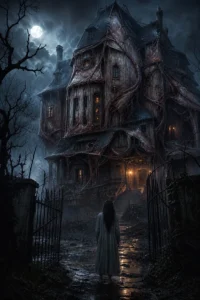
There should have been no pews in the impossible house. There should have been the parlor with its shrouded sofa, the upright piano with all the keys swollen shut, the mantel where the same four photographs kept changing faces. Instead, rows of pews marched into darkness beneath a ceiling that arched higher than the house’s roof allowed. Stained-glass windows glowed faintly though the night outside was moonless and buried under a drained lakebed’s wall of black mud.
At the far end, a pulpit leaned like a broken tooth.
The air was colder here. Wet cold. Church-basement cold. Cold from stone that remembered being underground before men named it holy.
Mara turned, searching for the front door, but where it had been was a corkboard layered with yellowed announcements. Baptism luncheon. Ladies’ Aid. Miner’s Relief Fund. Missing Dog. Revival Week. A child’s crayon drawing of a red house under a black sun was pinned crookedly in the center.
On the nearest pew, a hymnal lay open.
Its pages fluttered though the air was still.
Mara lifted the flashlight. The hymn title, printed in severe black letters, read:
BRING THE KEY HOME
Her stomach folded inward.
A scrape came from beyond the pulpit.
Mara moved before thought could net her. She slipped sideways between pews, keeping low. The church interior seemed assembled from memory and ruin. Mud filmed the aisle. The pew backs were scarred with initials and waterline stains. Dead leaves lay underfoot though no tree grew within miles. Every few steps, her boot found a soft place that gave like lung.
Behind the pulpit was a narrow door with a tarnished brass plate.
ARCHIVES.
Of course.
The town had had a church. Stillwater Baptist, clapboard-white and steepled, its bell salvaged before the flooding and displayed for years outside the county courthouse until someone stole it for scrap. Mara had photographed the church foundation three days earlier on the lakebed, a rectangle of stones half-drowned in weeds and silt. No walls. No roof. Certainly no archives.
But the house liked to offer rooms it should not have.
Rooms baited with need.
Her splintered hand throbbed. Blood slicked her palm, black in the flashlight’s glow. She could turn back. She could shout for Daniel, for Jonas, for anyone in camp who might still be awake and sane enough to come running. She could refuse this room the way she had refused the basement door, the one below the house, the one the house had been coaxing her toward since she arrived.
Instead she thought of the voice under the floor.
Have you finally brought the key?
She thought of her mother vanishing when Mara was six, of Julia Voss’s wet hair in the last photograph taken before the flood, of the way every adult had spoken afterward as if disappearance were a kind of weather. She thought of the county archive boxes full of redacted reports and moldy maps, all saying nothing in the official language of men who were paid not to see.
Mara opened the archive door.
The smell hit first: paper rot, mildew, leather, mouse droppings, and underneath it the metallic tang of deep mine water.
Her flashlight beam discovered a room much longer than the church behind her. Shelves climbed the walls to a ceiling lost in gloom. Filing cabinets stood shoulder to shoulder like mausoleums. Cardboard boxes had collapsed into themselves. Ledgers lay stacked on a central table, their covers furred with mold. A stained-glass fragment hung from a nail, casting a faint blue wound across the floor.
And there, seated at the far end of the table, was Eli Garner.
For one mad instant Mara saw not the man she knew but a drowned clerk arranged for viewing. Then he coughed wetly into his sleeve and lifted his head.
“Took you long enough,” he said.
Mara nearly dropped the flashlight. “Jesus—Eli?”
“Not in here, probably.” His voice had gone hoarse, the edges frayed. “I’ve been waiting twenty minutes or two years. Hard to tell.”
He looked terrible. His sandy hair clung to his forehead in strings. Mud smeared the side of his face, and one lens of his glasses was cracked. His left hand pressed a rag to his ribs. His right rested on a ledger as if guarding it.
Mara hurried to him, every shelf seeming to lean inward as she passed. “What happened? Where’s Jonas?”
“Back at camp when I left. Or when I thought I left.” Eli gave a laugh that collapsed before it became sound. “He was cussing at the generator. Daniel was trying to get a signal. I saw a light in the church foundation. Thought I’d be helpful.”
“You came alone?”
“That’s why I said helpful, not smart.”
She crouched beside him. The rag at his side was soaked dark. “Let me see.”
He caught her wrist with surprising strength. His fingers were cold. “No. Read first.”
“Eli, you’re bleeding.”
“Mara.” He looked up through the cracked glasses, and something in his eyes stopped her. Eli had been the crew’s academic stray, a grad student in Appalachian material culture who had arrived with too many notebooks, too little field sense, and a reverence for every rusted nail. He had cataloged buttons like relics and blushed when confronted. Now his face had sharpened around fear. “If you patch me up and we leave, this room won’t be here again. Or it’ll be here wearing another name. Read first.”
Mara’s gaze slid to the ledger beneath his hand.
It was not a ledger. It was a journal, the kind sold blank a century ago, brown leather swollen at the corners, clasp rusted open. The cover bore three initials pressed into the leather.
H. W. C.
“Pastor Caleb,” Eli said. “Henry Whitcomb Caleb. Last pastor of Stillwater Baptist. County records say he drowned during evacuation. Church records say nothing because, well.” He gestured weakly around them. “Here we are.”
Mara pulled out the chair across from him. It groaned beneath her weight like an animal troubled in sleep.
“How do you know it’s his?”
“Because he keeps signing his own damn confessions.” Eli pushed the journal toward her. “And because your mother’s in it.”
The room tightened.
Mara did not touch the book.
For a moment the archive shelves were no longer shelves but mine ribs, black and damp, pressing around a seam of coal. Her mother’s name had become a blade the house knew how to slide between her ribs. It had used Julia’s humming in the walls. Julia’s handprint on fogged glass. Julia’s voice pouring from dry taps with silt and minnows.
“That’s not funny,” Mara said.
“I’m scared past funny.” Eli’s hand trembled on the table. “Read the marked pages. Please.”
A ribbon of black cloth protruded halfway through the journal. Mara opened to it.
The handwriting inside was cramped, ink browned to the color of dried blood. Some entries were orderly, each letter upright and disciplined. Others sloped downward as if written aboard a sinking ship. Damp had blurred the edges of several pages, but the words remained stubbornly legible.
March 3, 1968
Three men dead in East No. 4, though the company says two. It has become the custom in Stillwater that the earth may swallow a man whole and the ledger may spit him back out as absent, transferred, or never employed. I prayed with Mrs. Tiller until my knees ached. She asked whether Martin had suffered. I lied in the name of mercy and felt no mercy in the lie.
There are sounds beneath the mine now that the men will not describe when sober. At supper after the funerals, Elias Rusk told me the lower shaft has begun to answer when spoken to. Not echo. Answer.
Mara’s fingertips went numb.
Eli watched her across the table, face gray and shining. “Keep going.”
She turned the page.
March 17, 1968
I went down today at Mr. Bellweather’s insistence, to bless the East No. 4 seam and calm the men. I have never liked the mine. A man of God should not fear the dark, but there is dark made by absence of light and there is dark that has body and appetite. In the third drift the lamps guttered blue. Rusk showed me a wall of coal that had split open in the shape of a door.
Beyond it was no tunnel cut by pick or machine. The stone curved smooth as an organ pipe. Warm air came from within. It smelled of Sunday dinner, pipe tobacco, rain on laundry, a child’s scalp. It smelled like every threshold I have ever crossed and been welcome.
Rusk wept. He said he heard his mother calling from inside, though she has been dead twenty years.
I heard my own house. The scrape of Anna’s chair. The kettle. Our Samuel coughing in the nursery before the fever took him.
The archive’s cold deepened around Mara’s ankles. She imagined miners black-faced and exhausted, standing before a seam in the earth that breathed out home. Men whose houses sagged above them on company land, whose children coughed coal dust into handkerchiefs, whose wives stretched beans and grief across paydays. What would they do if the mountain opened its mouth and spoke in beloved voices?
What had her mother done?
“This is impossible,” Mara said, but the words had no spine.
“That word’s been useless since Tuesday,” Eli muttered. “Page after next.”
Mara turned, the paper rasping under her fingers.
April 2, 1968
I write this so that I may see the shape of my sin.
We returned to the door in the coal. Bellweather ordered it sealed after the first incident, but the men broke the boards by lantern-light. They have begun leaving things there. A baby tooth. A lock of hair. Wedding bread. A brass button from a dead son’s coat. They say the mine gives comfort when fed memory.
I stood before the opening and heard Anna singing to Samuel.
I knew it for a temptation. I knew the dead do not sing from stone. Yet I stepped inside.
The passage was not long, though it should have run beneath the ridge for miles. At the end stood my childhood porch in summer rain. Every board was true. The swing creaked. My mother’s blue pitcher sat by the door, cracked where I broke it at nine years old. Inside, the table was set for four though we were six in life. The house knew which absences I could bear and which I could not.
My mother came from the kitchen.
God forgive me, I embraced her.
Mara did not realize she had stopped breathing until her lungs cramped.
The house knew which absences she could bear.
Across the table, Eli whispered, “It builds from grief.”
Mara’s injured palm had begun to bleed again, a slow pulse brightening between her fingers. A drop fell onto the table. The wood drank it instantly.
“Don’t,” Eli said sharply.
Too late.
Something knocked once inside the wall.
Both of them froze.
The archive settled into listening silence. Far away—or perhaps just underfoot—came the sound of a door closing gently.
Eli’s mouth tightened. “It likes blood. Caleb says that later.”
Mara wrapped her hand in the hem of her shirt. “Why didn’t you start with that?”
“I was busy bleeding dramatically.”
The thin edge of humor nearly broke her. She pressed the cloth harder to her palm and looked back to the journal.
The next marked section was months later. The handwriting had changed. The orderly pastor’s hand had become crowded, urgent, sentences running into margins as though chased.
September 11, 1969
Sixteen have gone into the lower dark and returned wrong.
I do not mean mad, though some call them so. They remember rooms never built. They speak of siblings their mothers never bore. Mrs. Pruitt’s boy came home knowing the taste of seawater though he has never left these mountains. Old Deacon Mays prayed yesterday in a language not heard in this church, nor any church I know, and when I asked him its meaning he said, “It is how the house prays when it is hungry.”
There is talk now among the women that the shape in the mine is not a place but a mouth imitating shelter. The men mock them until darkness falls, then sleep with lamps burning.
Bellweather has ordered the lower shafts closed. He has also sent for surveyors from Charleston and paid them cash not to record what they find.
“Bellweather,” Mara said. “The mining company owner.”
“And reservoir board member later.” Eli shifted and hissed through his teeth. “His name’s on every condemnation order for the flood.”
Mara remembered Bellweather from county records: fat signature, thin excuses. The dam had been sold as progress, power, flood control, a future bought with one town’s drowning. The official files praised sacrifice and engineering. None mentioned a mine-mouth that prayed.
She turned more pages. There were descriptions of missing children found asleep in cupboards that did not exist, of women dreaming the same red room beneath the church, of miners refusing wages unless paid in family photographs. Caleb wrote of his own addiction to the place, though never in that word. He returned again and again to the false childhood house, to the mother who held him too long and smelled faintly of coal oil beneath her lavender soap.
Then the entries jumped to 1971.
January 5, 1971
We have begun to understand the terms.
It cannot climb where it is not invited. It cannot hold a shape unless memory fastens it. It cannot speak in a voice no living heart longs to hear.
Yet these are small comforts. Stillwater is a town of longing. Every house here is built on a grave or beside one. The company took fathers, sons, lungs, wages, sleep. The war took others. Fever took babes. The mountain took the rest.
We have made of ourselves a table laid for hunger.
Mara felt the sentence sink its teeth into her.
Stillwater had been poor, cornered, and grieving. A town full of people trained to endure loss by making it sacred. They had not fed the thing beneath the mine out of foolishness. They had fed it because it had offered what life had stolen and called the offering love.
A cold scrape of understanding moved through her.
The house on the lakebed had not appeared because the reservoir drained.
It had survived because the reservoir had been its lid.
“Mara,” Eli said.
She looked up.
He was staring past her.
At the shelves behind her, something pale withdrew between two rows of hymnals.
Mara spun, flashlight raised. The beam caught only dust, cracked bindings, and a wet handprint sliding slowly down the end of a cabinet. The print had six fingers.
Eli swallowed. “It keeps doing that.”
“How long has that been there?”
“Which answer gets us out alive?”
“None.”
“Then fifteen minutes.”
A soft rustle traveled along the high shelves. Paper shivered. Somewhere above them, unseen books began to open.
Mara turned another marked page because terror had momentum now and stopping felt more dangerous than moving.
May 22, 1972
The first house appeared last night.
Not in the mine. On Orchard Street, between the Kline place and the old wash house, where there has only ever been a vacant lot. It stood two stories tall with yellow windows and smoke in the chimney though June heat lay heavy as sin. Every person who looked upon it claimed to know it.
Mrs. Tiller said it was her grandmother’s home in Pennsylvania. Deacon Mays said it was the mission school where he first met God. Rusk fell to his knees and called it by his dead wife’s name.
At dawn it was gone.
So were the Rusk twins.
Mara’s mouth had gone dry.
“A house,” she said.
“First one,” Eli said. “Not the last.”
The journal thickened under her left hand, pages swelling with damp. She flipped through entries: sightings of impossible houses along roads, behind the church, halfway up mine slopes where no foundation could hold. Houses that looked different depending on who saw them. Doors opening into parlors, nurseries, kitchens, bedrooms where the dead waited and the living stepped inside.
Some returned.
Some did not.
Those who returned carried memories like infections.
June 9, 1972
Little Ruth Pruitt was found beneath the pews after three days missing. She cried when her mother touched her and said, “You are not the one who tucked me in.” She asks now for a brother named Daniel, though no such child lives or has lived in that family.
Mrs. Pruitt struck me when I suggested prayer. I do not fault her.
Daniel.
Mara’s skin prickled. Daniel Hart was out at camp with his radio and his cigarettes and the scar on his jaw he never explained. Coincidence, she told herself. There had been a thousand Daniels. Yet the house had a talent for taking ordinary things and arranging them into teeth.
“There’s more about names,” Eli said, following her stare. “It repeats them. Reuses them. Like it learns what hurts in one generation and saves it for the next.”
The rustling above grew louder. The shelves seemed to be breathing now, each exhale shedding dust.
“We need to photograph this,” Mara said.
Eli gave her a look. “Of course that’s your first instinct.”
“Documentation is how evidence survives.” She lifted the camera with hands that shook less now because purpose had gripped them. “And because nobody will believe us without it.”
“Mara, nobody will believe us with it. They’ll say mold exposure, mass hysteria, carbon monoxide, grief, take your pick.”
“Then let them choke on the negatives.”
She began shooting. The shutter cracked through the archive like a small bone breaking. Journal page. Initialed cover. Caleb’s handwriting. Eli pale across the table. The wet six-fingered handprint on the cabinet. Each flash bleached the room white for a fraction of a second.
On the third flash, Mara saw people standing between the shelves.
The darkness returned before she could count them.
Her breath hitched.
“What?” Eli whispered.
“Don’t move.”
She raised the camera again, not the flashlight. Pressed the shutter.
Flash.
Seven figures stood in the aisle behind Eli. Miners in old coveralls. A woman in a housedress. Two children holding hands. Their faces were blurred, not by motion but by absence, features rubbed thin as old photographs carried in wallets too long. Mud dripped from their hems. Their heads were turned toward the journal.
Dark.
Eli’s breathing became audible.



0 Comments