Chapter 2: Low Tide Road
by inkadminThe road to Halewick did not exist until the sea decided to lend it.
Mara Voss sat in her idling car at the edge of the mainland and watched the Atlantic draw back from the causeway stone by stone, as if a vast black hand were peeling wet cloth from a corpse. The tide retreated reluctantly. It left behind glistening ribs of rock, long bands of kelp, shallow pools trembling under the wind, and the narrow road that connected the world she knew to the place she had spent twenty years pretending was not real.
A rust-bitten sign leaned at the entrance, its warning letters half-scalped by salt.
LOW TIDE ROAD
UNSAFE IN RISING WATER
NO CROSSING AFTER SIREN
Beneath it, someone had added in black paint:
IF IT CALLS YOUR NAME, KEEP DRIVING
Mara stared at that for longer than she meant to.
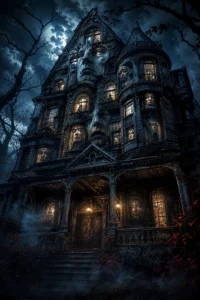
The heater coughed lukewarm air against the inside of the windshield. Rain freckled the glass, scattered by gusts that came hard off the water and rocked the car on its suspension. Beyond the causeway, Halewick Island rose out of the dull silver sea like the back of a drowned animal. Low houses huddled along its eastern shore, their slate roofs dark with wet. A church spire jabbed up from the village, crooked as a broken finger. Above all of it, on the island’s western cliff, Blackcap House crouched under the storm clouds.
Even at this distance, Mara knew it.
She had no memory of the journey away from that house as a child. No clear final image of the front door closing, no hand gripping hers, no ferry horn, no suitcase, no tears. Her childhood on Halewick ended in fragments: a room with yellow wallpaper breathing inward and outward; her mother’s voice from inside a wall; a stair carpet soaked through with seawater though the windows were shut; a nursery rhyme sung by someone under the floor.
Then the mainland. Foster records. New schools. New surname spoken sharply by women paid to care. A funeral when she was eight, attended in a stiff black dress and shoes that pinched her toes. A coffin too small in her memory and too large in the photograph the social worker had shown her. Her mother dead. Her mother buried. Her mother gone.
Except two days ago, a solicitor’s letter had arrived on cream paper, informing Mara Voss that her mother, Elian Voss, had recently passed away and left her sole possession of Blackcap House.
Recently.
Mara’s gloved fingers tightened around the steering wheel.
The envelope still lay on the passenger seat, along with the photograph that had kept her awake the previous night. Mara as a child, five or six perhaps, standing in the long grass before Blackcap House. A woman beside her, one hand resting on Mara’s shoulder. The woman’s face scratched away so violently the paper had furred white.
Mara had looked at that faceless shape until dawn and told herself a hundred reasonable things. Clerical error. Fraud. A distant relative with the same name. A cruel joke from someone who had read about the inquiry into St. Bartholomew’s and thought a disgraced hospice nurse would make an easy target.
Reasonable things had always been her strongest sedatives. She had offered them to the dying in quiet rooms where machines counted down the breaths. Pain will ease soon. Your daughter is on her way. The doctor knows. You are not alone.
Not lies, exactly. Soft structures built over terror.
The sea hissed over the rocks as it drew farther back. Ahead, the causeway emerged fully, a single lane of concrete patched with older stones, its edges broken where winter storms had taken bites. White posts marked the sides, though some leaned inward like drunk mourners and others were missing altogether. In shallow channels on either side, water continued to run, eager to reclaim what had been exposed.
Her phone chimed from the cup holder.
No signal.
She picked it up anyway. A weather alert filled the screen, delayed from some tower behind her.
SEVERE ATLANTIC STORM WARNING IN EFFECT. COASTAL FLOOD RISK. AVOID TIDAL ROADS.
“Useful timing,” Mara muttered.
Her own voice startled her. It sounded thin in the car, stripped of the competence she used with doctors, police, grieving families. She had learned to speak calmly while blood filled a man’s lungs, while a woman forgot how to swallow, while a son screamed that she had murdered his father because she had pushed morphine through a line with steady fingers.
That steadiness had failed her exactly once.
She saw again the pale oval of Mr. Bell’s face on the pillow, his mouth opening around words no one else could hear. Don’t let her in. She has your eyes. Then his monitor shrilling. Then the missing dose. Then the inquiry panel, their lowered voices, the word negligence polished clean of all its blood.
Mara shoved the phone into her coat pocket and put the car in gear.
The tyres dipped off the mainland ramp and onto the wet causeway with a splash that slapped the undercarriage. Immediately the world changed. The mainland behind her shrank in the mirror, its road and petrol station and last sensible hedgerow becoming a smear of grey. Wind struck from both sides. The smell of salt forced its way through the vents: brine, rotting weed, mud unsealed after long pressure. The sea lay low and restless to either side, not gone but waiting.
She kept both hands on the wheel.
The causeway surface was slick with algae. Water streamed across it in shining threads. Every pothole held a piece of the sky. The car’s headlights swept over mussel shells crushed into the concrete, a dead gull flattened wing-wide, a tangle of orange rope snagged on one of the posts.
Halfway across, the first siren sounded.
It came from the island: a long, low mechanical moan that rolled over the exposed seabed and vibrated in Mara’s teeth.
She stamped the brake without meaning to.
The car slid a foot, then caught.
Her breath fogged the windshield. She stared ahead, heart knocking hard enough to hurt. The sign had said no crossing after siren. But she was already crossing. Behind her, the mainland seemed farther than the island. The road narrowed through a shallow depression where black water licked close to both edges.
The siren wailed again.
“Low tide,” she said aloud. “Still low tide.”
The tide tables had been clear. She had checked them three times before leaving the hotel in Brackenport. There should be forty minutes before the water turned dangerous. More than enough.
Unless storms changed the rule.
Something knocked beneath the car.
Mara flinched and looked down, absurdly, as if she might see through the floor mats. Another knock. Not mechanical. Hollow. A sound like knuckles rapping from below.
She pressed the accelerator.
The engine growled. The car crept forward. Water flicked up from the tyres and struck the sides in sharp handfuls. To her left, a channel of seawater moved against the general flow of the retreating tide, curling back toward the road. Foam gathered in patches. For an instant, the foam arranged itself into pale shapes that looked like faces turned upward.
Mara looked away so quickly her neck hurt.
“No,” she whispered. “We are not doing that.”
The car’s radio crackled.
She had not turned it on.
Static filled the cabin, rising and falling with the wind. Mara reached for the dial, but before her fingers touched it, a woman’s voice slipped through the hiss.
“—Mara?”
The car swerved.
She caught the wheel, breath trapped in her chest. The voice had been faint, warped by interference, but intimate. Close enough to feel on the ear.
Static snapped.
“Mara, darling, don’t—”
She struck the power button. The radio display went black.
Silence flooded in, louder than the voice.
Her palms were slick inside her gloves. The island end of the causeway rose ahead now, a ramp of stained concrete climbing toward a gatehouse no larger than a shed. Beyond it stood a row of wind-bent cottages and a boarded kiosk with a sign advertising crab rolls in flaking blue letters.
Someone waited at the top of the ramp.
A man in a yellow oilskin stood beside a red barrier arm, hood pulled tight around his face. He held one hand up, palm out.
Mara slowed. The tyres bumped off the causeway and onto island ground. She had expected relief when land rose beneath her again. Instead, an odd pressure settled over the car, as if something had placed its palm on the roof.
The man lowered his hand and leaned toward her window.
Mara pressed the button. The glass slid down with a reluctant squeal, and cold rain blew in, needling her cheek.
The man bent close. He smelled of tobacco, wet wool, and fish scales.
“Cut that fine, didn’t you?” he said.
His accent was thick with the island, vowels drawn long and low. He was somewhere past sixty, his face furrowed brown-red by wind, one eye clouded pale as sea glass. The good eye studied her through the rain.
“The tide table said I had time,” Mara replied.
He barked a laugh without humor. “Tide table. Hear that, then? She’s got a paper says the sea should behave.”
There was no one else with him.
Mara glanced past him toward the village. “I’m looking for the solicitor’s office. Calder and Pike.”
The man’s laugh died. His good eye narrowed. The rain ticked off his hood.
“Aye,” he said slowly. “I reckoned you would be.”
“Can you point me in the right direction?”
He did not answer. His gaze moved over her face with uncomfortable care, pausing at her eyes, her mouth, the scar under her chin from a childhood fall she could not remember. Recognition changed him in small increments. The tightening jaw. The shoulders drawing back. A flicker of something almost like fear.
“You’re early,” he said.
Mara swallowed. “For what?”
“For coming back.”
Rain spattered the inside of the door. Mara tasted salt on her lips. “I’ve never met you.”
“No.” He lifted his chin slightly. “You wouldn’t remember meeting me, I expect.”
There it was again, that islander’s assumption that memory was a cupboard others might inventory better than she could.
“My name is Mara Voss,” she said, more sharply than she intended.
The man’s expression did not settle. If anything, it grew worse.
“Today it is,” he said.
For a moment the only sound was the rain and the far seething draw of water across stones.
Mara stared at him. “Excuse me?”
He stepped back from the window. “Calder’s office is on Gull Street, just past the church, black door with brass plate. Don’t park under the wall. Stones come loose in weather.”
“What did you mean, today it is?”
The man gripped the barrier arm and hauled it up. “Go on, Elian’s girl.”
“What did you call me?”
But he had already turned his back, yellow oilskin shining in the rain. The barrier creaked overhead. Mara kept looking at him for another second, willing him to turn around. He did not.
Behind her, the causeway siren groaned a third time.
The old man flinched at the sound and made a sign with two fingers against his chest. Not a cross. Something older, or simply stranger.
Mara closed the window and drove into Halewick.
The village appeared not as a place entered but as a thing that had gathered around her while she blinked. Narrow lanes twisted between cottages built of dark stone, their mortar veined white with salt. Rainwater ran along gutters clogged with seaweed though the ocean lay below. Nets hung from hooks beside front doors. Glass floats in faded green and blue gleamed in windows like trapped eyes. Every roof seemed to sag toward its neighbor, the houses leaning close over the lane as if exchanging gossip about the stranger passing beneath.
Except she was not a stranger.
Faces appeared at windows. Curtains shifted. A woman carrying a basket of laundry stopped in the shelter of a doorway and went still. Two boys in school jumpers under raincoats stared openly until an unseen hand yanked them inside by their collars. An old woman standing outside the butcher’s pressed her knuckles to her mouth.
Mara kept her speed low. The streets were barely wide enough for the car. Her headlights shone on wet cobbles, crab claws crushed near drains, a stray cat with one ear that darted beneath a parked van. Somewhere close, a bell rang once, not the church bell but a smaller brass note, cut short.
Her stomach turned with the same slow nausea she had felt as a child when adults stopped talking upon her entrance.
At the end of the first lane, she passed a shop with peeling gold letters:
BELLWETHER GENERAL
POST — PAPERS — PROVISIONS
A woman stood under the awning smoking a cigarette, her hair pinned up in silver coils. She had a broad, handsome face and the ruin of red lipstick at one corner of her mouth. As Mara drove by, the woman’s cigarette slipped from her fingers and hissed out on the wet pavement.
“Nora?” the woman said.
Mara heard it through the closed window. Not loud. Not a shout.
Nora.
She looked in the rearview mirror. The woman had stepped off the curb into the rain, staring after the car. Her lips moved again.
Mara drove on.
Her left hand had begun to ache from gripping the wheel. Nora. She searched for it among the loose pages of her childhood. Foster placement forms. School registers. Doctor’s notes. Mara Voss, date of birth uncertain until amended. No Nora. Never Nora.
The lane curved, and the church came into view.
St. Dymphna’s stood at the center of a small square paved with uneven stones. Its graveyard surrounded it on three sides, enclosed by a low wall black with lichen. The church itself had been built from the same dark rock as the cottages, but it seemed wetter, as though the rain did not fall on it but seeped from within. The spire leaned slightly toward the sea. Its weather vane had broken so that the iron rooster pointed downward, beak to grave.
A priest stood at the lychgate.
He was bareheaded in the rain, a black cassock plastered to his thin frame. His hair, what remained of it, clung white to his skull. He watched Mara’s car approach with an expression of such strained expectancy that she eased off the accelerator.
The priest stepped into the road.
“Jesus,” Mara breathed, and braked.
The car stopped a few feet from him. He came to the driver’s side before she could decide whether to lock the doors.
For one irrational second she thought he would put his hand on the glass and leave a print that smoked.
Instead, he bent at the waist, bringing his face level with hers. His eyes were pale blue, inflamed around the rims. There were tremors in the muscles beside his mouth.
Mara lowered the window halfway.
“Can I help you, Father?”
The priest gave a small, broken laugh. “That was always your question, wasn’t it?”
Rain ran down his nose. He did not blink it away.
“I’m sorry?”
“Can I help you. Can I sit with you. Shall I fetch the basin. Shall I open the window.” His gaze sharpened on her. “You made kindness sound like a knife being wrapped.”
Mara’s throat tightened. Hospice rooms rose around her in memory: dim lamps, antiseptic, lavender lotion, the papery warmth of hands near death. “Do I know you?”
His lips parted. For a moment he looked younger, and utterly devastated.
“No,” he whispered. “No, Ruth. You never knew me at all.”
Ruth.
Anger came as relief, hot and clean. “My name is Mara.”
The priest closed his eyes.
“Of course,” he said. “Of course it is. Forgive me.”
“I’m trying to find Calder and Pike.”
“Mr. Calder died seven years ago. Mr. Pike never existed, except on the letterhead. It is just Ambrose now.”
Mara let that settle with all the other wrongness. “Ambrose who?”
“Ambrose Calder. The son.” The priest opened his eyes again. “He should have come to the mainland himself. I told him as much.”
“You know why I’m here?”
His face crumpled in a way that made her wish she had not asked.
“Everyone knows when Blackcap sends for someone.”
A gull cried overhead, harsh as tearing cloth. Mara glanced toward the graveyard. Some of the stones leaned at impossible angles. One near the wall had split down the middle, its halves separated just enough that something pale had grown between them—fungus, perhaps, in a shape too much like fingers.
“Blackcap didn’t send for me,” she said. “A solicitor did.”
Father whoever-he-was smiled without showing teeth. “Yes.”
Mara felt the weather inside the car change. “Could you move, please?”
The priest placed a hand on the window frame. His fingers were long and bloodless, nails bitten to the quick.
“Do not sleep in the west rooms,” he said. “If Ambrose offers, refuse. If you hear your mother crying behind a door, do not open it.”
“Move.”
“And if you see a portrait covered in blue cloth—”
“Father.” Mara’s voice came out low, the tone she had used with agitated relatives and men twice her size. “Take your hand off my car.”
He obeyed at once, stepping back into the rain. Shame crossed his face like a shadow.
“I’m sorry,” he said again. “I thought I would be ready.”
“For me?”
He shook his head slowly.
“For whichever one of you came back.”
Mara raised the window. His last words blurred behind the glass, but she saw him say something else as she drove past, lips shaping the syllables with terrible care.
Mary. Mara. Moira. Mine.
Or perhaps she imagined it.
Gull Street sloped down from the church square toward the harbor, a cramped row of shops with painted signs swinging violently in the wind. The solicitor’s office sat between a closed tea room and a chandlery whose window display featured coils of rope, brass hooks, and a child-sized mannequin in a fisherman’s jumper. The black door was exactly where the old causeway keeper had said it would be. Its brass plate read:
CALDER & PIKE
SOLICITORS
EST. 1841
The plate had been polished recently. The windows had not. Rain filmed the glass, distorting the dim interior. Mara parked opposite beside a stone wall that looked ready to shed its upper layer onto her roof. Then, remembering the old man’s warning, she muttered a curse, restarted the car, and moved it ten yards farther down in front of the chandlery.
As she cut the engine, the island pressed close.
No heater hum. No road noise. Just rain, gulls, distant surf, and underneath it all a deep periodic boom from the western cliffs, as if some giant door were being struck again and again by the sea.
Her phone still had no signal.
“Fine,” she said to it. “Be useless.”
She gathered the letter, the photograph, and her bag. Before stepping out, she looked up the hill beyond the village, past chimney smoke flattened by wind, toward the high black shape of the house.
Blackcap House seemed nearer now.
That was impossible. It stood on the far cliff, at least a mile above the village, half-hidden by rain and thorn trees. Yet its windows were visible with unsettling clarity. Rows of them. Tall, narrow, blind with reflected stormlight. One of the upper windows glowed faintly yellow.
Mara leaned toward the windshield.
The light went out.
She shoved open the car door and stepped into the rain.
Halewick’s cold had teeth. It bit through her coat cuffs, found the back of her neck, worked immediately into her bones. The harbor smell was stronger here: diesel, fish guts, wet rope, tar, and the mineral sourness of old stone. Her boots splashed through a gutter stream carrying cigarette ends and a single white feather.
The solicitor’s door opened before she touched the handle.
A man stood on the threshold, filling it with tall angles and expensive restraint. He looked to be in his late thirties, perhaps early forties. His dark hair was neatly parted, his suit charcoal and far too fine for an island being chewed by weather, though the cuffs showed damp where the rain had reached him. He wore no overcoat. His face was long, watchful, and composed in a way that suggested composition had become his religion.
“Miss Voss,” he said.
Mara stopped with one foot on the step. “Mr. Calder?”
“Ambrose Calder.” He offered his hand. His grip was cool, dry, and brief. “You made the crossing.”
“Clearly.”
His eyes flicked past her, toward the causeway, though it could not be seen from the lane. “The weather has worsened faster than predicted.”
“Everyone keeps telling me that after I’ve already arrived.”
“Halewick prefers its warnings to be retrospective.”
It was almost a joke. His mouth did not quite permit it.
He stepped aside. “Come in before you drown on my doorstep.”
The office smelled of paper, damp wool, coal ash, and furniture polish attempting to defeat mildew. Shelves lined the walls from floor to ceiling, bowed under ledgers tied with red tape. A coal fire sulked in a narrow grate, giving more smoke than heat. On one wall hung an old map of Halewick, ink faded to the color of bruises. Blackcap House was drawn in miniature atop the cliff, with exaggerated chimneys and tiny black birds circling its roof.
Mara removed her gloves slowly, taking in the room. There were two desks but only one looked used. The other held stacks of files and a framed photograph turned face down.
Ambrose saw her notice it.
“My father’s,” he said.
“Mr. Calder.”
“The original Calder, yes. Pike remained theoretical.”
“The priest mentioned that.”
“Father Sennett intercepts arrivals when he is in one of his moods.” Ambrose closed the door against the rain. “I apologize if he distressed you.”
“He called me Ruth.”
Ambrose stilled for just a fraction too long.
Mara watched him. “Is that one of his moods?”
“Father Sennett has suffered losses.”
“Most people have. They don’t usually stand in traffic and rename strangers.”
“No,” Ambrose said. “Most people don’t.”
He moved behind his desk and gestured to the chair opposite. Mara sat without relaxing. The chair’s leather was cracked and cold beneath her. Ambrose opened a file already waiting at the center of the blotter. Her name was typed on the tab.
VOSS, MARA.
Seeing it there gave her a small, fierce comfort.
Ambrose folded his hands. “Tea?”
“No.”
“Coffee?”
“Answers.”



0 Comments