Chapter 4: The Nursery That Burned
by inkadminThe last of the daylight went out of Blackcap House as if someone had pinched a wick.
Mara stood in the long gallery with one hand braced against the wall, her fingers sunk into velvet paper gone soft with damp. The windows on her left had gone black, every pane reflecting her in fragments: a child with blunt-cut hair and a split lip; a woman older than she was, gray at the temples, her eyes milked over; a version of herself without a mouth, skin smooth from nose to chin like wax poured over a doll.
She did not move until the mouthless one lifted a hand.
Mara snatched her own hand from the wall. Her palm came away wet. Not with water.
A thin gray smear marked her skin, gritty and cold. Ash.
Behind her, Elias Crowe made a sound that might have been a curse or a prayer. The solicitor stood halfway down the corridor, his black coat gleaming with rain, his narrow face cut into angles by the failing light. He had a lantern in one hand, though he had not lit it. Perhaps he feared what a flame might wake.
“I warned you,” he said.
Mara rubbed the ash between her fingers. It clung to the whorls of her prints and turned them dark. “About the windows?”
“About staying.”
“Very helpful warning. Next time lead with ‘the house keeps spare faces in the glass.’”
Elias’s mouth tightened. He looked not at her, but at the windows, as if etiquette forbade meeting the eyes of whatever stood inside them. “Mock if it steadies you.”
“It does, a little.” Her voice sounded too loud in the gallery. Sound carried strangely here; each word seemed to travel ahead and return altered, as though the house repeated her in another room. It does, a little. It does, a little. Little. Little.
From somewhere above them came the faintest thread of music.
Three notes, bright and delicate. A childish tune picked out in metal teeth.
Elias went still.
Mara watched the movement run through him: the hardening of his jaw, the quick drop of his eyes toward the floorboards, the way his fingers cinched around the unlit lantern until the knuckles whitened. It was not surprise. It was recognition.
“What is that?” she asked.
“Nothing you need concern yourself with tonight.”
The music came again, clearer now, drifting down through the bones of the house. It slipped through cracks in plaster and stairwell shadows, a tune made to lull infants, but every note carried a brittle edge, as if the mechanism wound inside it had teeth.
Mara knew the melody.
Her throat closed before memory could name it. Her body remembered first: the sour taste of smoke, a blanket dragged over her head, heat licking the backs of her hands. Her seven-year-old lungs burning as she screamed for a woman whose face she could never hold in her mind.
“The nursery,” she said.
Elias’s head snapped toward her. “You don’t remember that.”
Not You shouldn’t. Not How could you?
You don’t.
Mara took one step toward him. “Don’t tell me what’s in my own head.”
“Your head is not trustworthy in this house.”
“And yours is?”
His expression flickered. For an instant he looked less like a solicitor and more like a man who had once been young enough to be frightened in hallways. Then the shutters came down again. “There is no nursery at Blackcap House.”
The music tinkled overhead, amused.
Mara lifted her ash-stained hand. “Then something upstairs has poor taste in lullabies.”
“Miss Voss.” Elias took a step after her as she turned toward the grand staircase. “Mara. Listen to me.”
It was the first time he had used her given name. It struck oddly in the dim, too intimate, like a hand placed on the back of her neck.
She paused with one foot on the stair.
“There are rooms in this house that are not rooms,” he said quietly. “There are doors that open only because something on the other side wants you to enter. You have been gone a long time. That has not made you safer. It has only made you… interesting.”
The tune faltered above them, winding down into a slow metallic stutter. Mara looked up the staircase. Its banister curled into darkness, polished mahogany slick as wet bone.
“My mother died twenty years ago,” she said. “Then I inherited her house. My windows are auditioning replacements for my face. And now there’s a nursery playing a song I heard the night it burned to the ground.”
She looked back at him.
“Interesting is better than ignorant.”
“Ignorance survives longer on Halewick.”
“That explains the locals.”
His mouth twitched, involuntary and grim, before fear swallowed it. “If you go up there, do not touch anything.”
“You’re coming with me?”
“No.”
The answer came too quickly.
Mara studied him. Rain ticked against the windows like thrown gravel. In the glass, the mouthless Mara had lowered her hand. A new reflection stood behind Elias now—a child in a smoke-black nightdress, face turned away.
“Of course not,” Mara said. “You’re just going to stand here in the dark and bill the estate for cowardice.”
Elias’s eyes flashed. “I will stand here because if you don’t come back, someone must know which door took you.”
For a moment, neither of them spoke.
The music began again.
This time, the tune seemed to come from directly above Mara’s head.
She climbed.
The staircase groaned under her weight, each step issuing a complaint from deep in the wood. The air grew colder as she ascended, but not the clean cold of drafts. This was cellar-cold. Grave-cold. It carried the mineral damp of buried stone and, beneath it, a smell that made her chest seize.
Smoke.
Not the fresh, sharp smoke of a hearth or storm-blown chimney. Old smoke. Wet ash. Charred cloth. The smell that never truly left a burn ward no matter how often the floors were mopped, that clung to hair and skin and the backs of the teeth.
Mara put a hand over her nose and kept climbing.
At the landing, the corridor bent left into a wing she had not seen during Elias’s brittle tour. The wallpaper changed here. Downstairs had been all mildew roses and peeling gilt. Here, small blue birds flew over a cream background, their painted wings spread in endless escape. Many of them had been scratched out. Tiny gouges cut through their bodies, as if a child with a pin had tried to free them from the paper and failed.
The music box played from beyond the third door.
Mara counted as she walked, though she did not know why. First door: shut, paint blistered. Second: no knob, only a round black hole where the brass should have been. Third: half open, breathing a thin line of gray light into the hall.
She stopped before it.
The door was painted white. Not aged ivory, not the yellowed shade of old enamel, but a clean nursery white that looked obscene in that rotting corridor. At the height where a child might reach, tiny handprints darkened the paint. Some were too small to be hers. Some were much too large.
A brass plaque hung crooked beneath the latch.
It read: MARA.
Her name had been engraved with careful curls, each letter filled with soot.
Behind her, from far down the stairs, Elias called, “Miss Voss?”
His voice arrived thin and warped.
Mara did not answer. Her attention had snagged on the plaque, on the way the final A had been cut deeper than the rest, the groove packed black. She lifted her hand before she could stop herself.
Do not touch anything.
Her fingertips hovered a breath from the metal.
The door sighed inward.
Warm air breathed over her face.
Mara smelled lavender water, dust, milk gone sour in a bottle, and beneath all of it the ash. Always the ash. She pushed the door wider with her boot.
The nursery waited, whole and impossible.
Moonlight lay across the floorboards in pale bars, though no moon should have pierced the storm. The room was large, tucked beneath the eaves, its sloped ceiling painted with fading clouds. A cradle stood near the far window, draped in gauze. Shelves bowed under toy animals with glass bead eyes. A rocking horse faced the corner, its mane real hair gone tangled and gray. Alphabet blocks sat stacked on a rug patterned with rabbits and foxgloves.
Nothing was burned.
Mara could not breathe.
She had watched this room burn.
Not in a dream. Not in the soft, unreliable way of stories told too often by adults who wanted a child to remember incorrectly. She had stood in the rain below with her foster father’s coat around her shoulders and watched flames chew through the nursery windows. Orange light had pulsed behind the glass. Something inside had screamed with the voice of splitting beams. A woman had been on the lawn on her knees, arms held by two men, her face lost in smoke and hair and rain.
My mother.
The thought rose like a bubble from black water.
Then burst.
No face came with it. Never a face. Only the sense of one: warmth bending over her, hands smelling of cloves, a voice that could quiet any room by lowering itself.
The music box sat on a small round table near the cradle.
It was larger than she expected, carved from dark wood and polished to a dull sheen. A little stage rose from the top, and on that stage turned three figures: a woman, a child, and a house. They circled one another as the melody played, the woman’s hand extended toward the child, the child’s face lifted toward the woman, the house leaning over them both with windows like hungry eyes.
Mara stepped into the room.
The floorboards were smooth beneath her shoes. No crunch of charcoal. No give of damaged timber. A draft moved through the gauze around the cradle, setting it to sway though the air elsewhere stood still.
She forced herself toward the music box.
With each step, the nursery changed in tiny ways, as if adjusting itself while she wasn’t looking directly. A stuffed rabbit slumped from sitting to lying down. A porcelain doll’s head turned on its lace pillow. The blocks on the rug shifted letters.
M A R A
Then:
M A M A
Then:
A M A R
She stopped.
The music box slowed, then caught again, struggling through the lullaby. The carved woman turned. Her dress had been painted blue once, but age had darkened it almost black. Her hair fell to her waist in fine incised waves. Where her face should have been, there was only a smooth oval of pale wood.
Mara leaned closer.
No. Not smooth.
The face had been cut away.
Someone had gouged it out with a tiny blade, removing the features but leaving the outline of cheekbones, brow, chin. The empty surface bore faint scratches, delicate as wrinkles. The child figure had Mara’s own face at seven: small chin, solemn eyes, a nick in one eyebrow from falling against the quay steps.
The house figure had dozens of faces carved into its walls.
Some slept. Some wept. Some pressed wooden mouths open in silent song.
Mara reached for the music box key.
“I said don’t touch anything.”
She whirled.
Elias stood in the doorway, lantern now lit. Its flame bent away from the room, shrinking inside the glass chimney. His face looked bloodless in the glow.
“You said you weren’t coming.”
“I reconsidered my cowardice.” His eyes moved over the nursery and refused to settle. “Step away from it.”
“You see it.”
“Unfortunately.”
“Then stop pretending there’s no nursery.”
“There isn’t,” he said. “There was. It burned in 2004. The roof collapsed. I saw the ruins myself.”
The date struck her like cold water. “I was seven.”
“Yes.”
“Were you here?”
His jaw flexed.
“Elias.”
“No.”
The lie was so cleanly spoken it might have passed if he had not looked toward the cradle as he said it.
Mara followed his gaze.
The gauze canopy stirred.
For a moment she saw nothing beneath it but a folded blanket. Then the blanket rose and fell.
Once.
Twice.
Like breath.
Mara’s nurse training moved before her terror did. She crossed the room in three strides and snatched aside the gauze.
The cradle was empty.
Inside lay a pillow, yellowed with age, and on that pillow a ring of black hair.
Not strands shed from a comb. A ring, carefully arranged. Infant-fine in places, adult-thick in others. It formed a dark halo around an impression in the pillow the size of a baby’s head.
The blanket rose again.
From beneath it came a soft, congested sigh.
Mara froze, one hand gripping the cradle rail. Her pulse slammed hard enough to blur her vision.
Elias whispered from the door, “Don’t.”
The sound came again.
A newborn’s mewl, weak and wet.
She had heard that sound in hospital corridors, in television dramas, in the mouths of babies placed against mothers’ chests. But here it unstitched her. The cry slid under her ribs and tugged at something old, something that had never healed because she had never known it was torn.
“There’s something—”
“There is nothing in that cradle that needs your help.”
“You don’t know that.”
“I know this house.”
“Then you know less than you think.”
Mara reached for the blanket.
Elias moved fast. He crossed the nursery and seized her wrist before her fingers touched the cloth. His grip was hard enough to hurt.
“Let go,” she said.
“You open that, and it will show you what it thinks you want.”
“I want the truth.”
“No one wants the truth. They want a version that lets them sleep.”
She looked at his hand on her wrist, then at his face. Up close she saw the fine tremor at the corner of his mouth, the old scar under his left eye, the rain caught in his lashes. He smelled of wet wool, salt, and the faint medicinal bite of cloves.
Cloves.
Mara’s stomach turned.
“Why do you smell like her?”
Elias released her as if burned. “Like whom?”
The music box wound lower. The carved figures slowed, the faceless woman circling toward them one last time.
“My mother,” Mara said.
Something rapped inside the wall.
One knock.
Then three.
Then a dragging sound, as if furniture were being moved in the next room. But there was no next room. The nursery occupied the end of the wing. Beyond the wall lay empty air and the cliff.
Elias backed toward the door. “We’re leaving.”
Mara did not move. The smell of cloves had opened a seam in her memory, and through it came a flash: a blue dress brushing the floorboards; hands fastening buttons at the back of Mara’s nightgown; a woman humming the music box tune, then stopping suddenly because someone had knocked at the nursery door.
Not tonight, Mara.
The voice in memory was low, urgent.
Whatever it says, do not answer in your own voice.
Mara swallowed. Her tongue felt too large for her mouth.
“My mother told me not to answer something,” she said. “In this room.”
Elias went utterly still.
“What was it?” she asked.
The rapping came again, closer now. Not from the wall. From under the floor.
The cradle rocked once.
“Elias.”
He stared at the rug between them, at the alphabet blocks scattered there. His face had gone slack, emptied by a memory he had spent years keeping behind locked doors.
“It mimics,” he said.
“The house?”
“The thing beneath it.”
The words seemed to darken the room. The painted clouds overhead gathered shadow at their edges. The toy animals on the shelves watched with bright black eyes.
“It takes what is given,” Elias continued, each word forced. “Voices. Names. Habits. Faces, eventually. The islanders used to bring it secrets. Harmless ones at first. Petty sins. Hidden births. Affairs. Then the sea stayed calm and the boats came home, so they brought more.”
“What did they bring from my family?”
His silence answered too much.
Mara stepped toward him. “What did they bring?”
The music box stopped.
In the sudden quiet, a child laughed from inside the chimney.
Both of them looked toward the small fireplace set into the wall. Its grate was clean. No soot, no logs. Above it hung a narrow mirror framed in tarnished silver. The glass reflected the nursery behind them, but not Elias. Not Mara.
It reflected a woman.
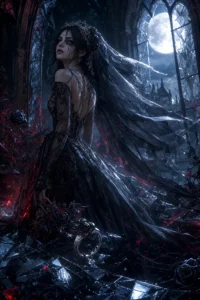
She stood near the cradle in a blue dress, her long dark hair unbound. Her body was slender, familiar in a way that made Mara’s bones ache. Smoke curled around her skirts. Flames flickered low along the hem without consuming it.
Where her face should have been, there was a blur.
Not blankness. Movement. Features trying to assemble and failing, as if a hundred faces had been laid atop one another while wet.
Mara’s breath caught. “Mother?”
Elias said, sharply, “Don’t call to it.”
The woman in the mirror lifted her head.
The blur shivered. For half a heartbeat, Mara saw a mouth. Then only a cheek. Then an eye, dark and enormous, fixed on her.
“Mara,” the woman said.
The voice came not from the mirror, but from the music box.
It was small, metallic, and broken into notes.
“Mara, my darling girl.”
Mara had comforted the dying through fevers, morphine dreams, and the raw panic of last breaths. She had held hands that clawed at invisible sheets. She knew the cruel ventriloquism of memory, the way grief could put a beloved voice in the hiss of radiators or the sigh of a kettle.
This was not that.


0 Comments