Chapter 3: Blackcap House Opens Its Eyes
by inkadminThe road to Blackcap House forgot it was a road halfway up the hill.
It began as cracked tarmac slick with rain, shouldered by hedges bent permanently inland from years of Atlantic punishment. Then the hedges thinned into blackthorn and gorse, their yellow flowers bruised brown by salt wind, and the tarmac surrendered to gravel, then mud, then a pale rib of stone that climbed between fields gone to rushes. Mara drove slowly, both hands tight on the wheel, while the hired car juddered over ruts deep enough to remember wagon wheels.
Below her, Halewick hunched around its harbor in a scatter of slate roofs and chimney smoke, every house turned away from the sea as if ashamed of it. The causeway she had crossed less than an hour earlier had already vanished beneath the tide. Where the road had been there was only churning gray water, shouldering itself against the rocks with a sound like heavy furniture being dragged across an upstairs floor.
She had thought she would feel relief once the island was behind her, once the causeway lay drowned and temporary. Instead, the sight tightened something under her ribs.
No leaving until morning.
The locals had known that before she had.
At the harbor shop, the woman with the raw red hands had stared at Mara’s face too long and said, “You’ll be wanting matches, then, Ruth.”
At the petrol pump, a boy of perhaps seventeen had dropped the nozzle when she stepped from the car. “Sorry,” he had said, paling beneath his acne. “Thought you were Elsie.”
And outside the churchyard, where the rain ran over leaning stones and pooled in the names, an old man had lifted one finger to his cap and murmured, “Back again, are you, Miss Voss?”
That one had known the right name. Somehow that had been worse.
The car lurched hard. Mara cursed and braked before the left tire sank deeper into a rut. The wipers fought at the windshield, smearing water and grime into translucent bands. Beyond the glass, the hill steepened. At its crest, Blackcap House waited.
She had no memory of seeing it from this angle.
That was not the same as never having seen it.
The distinction had mattered since childhood, since the blank spaces began. Doctors had called it trauma. Foster parents had called it lying. Later, professors and supervisors had called it compartmentalization, resilience, pathology, depending on whether she was passing their exams or standing before a disciplinary board with dried blood under one thumbnail and no explanation she could give that didn’t sound like madness.
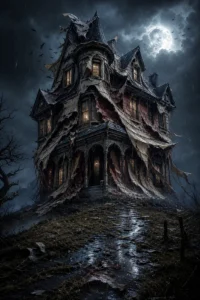
Blackcap House emerged from the rain in pieces: first a chimney stack angled like a broken finger, then a steep slate roof furred with lichen, then the upper row of windows, blind and black beneath their brows of stone. The house squatted on the cliff’s crown, too large for the island and too heavy for the hill, a Victorian manor built with the grim confidence of people who believed money could bully weather. The sea struck the cliffs behind it in great hidden blows. With every impact, the car’s windows trembled.
Mara stopped before a pair of rusted iron gates.
Blackcaps perched along the bars.
Dozens of them.
Small dark birds with charcoal heads and brown-gray bodies, round as fistfuls of soot. They faced her in silence, rain beading on their feathers. None flew off when the engine coughed and idled. One cocked its head. Another blinked. Their little throats pulsed, but they made no sound.
“Of course,” Mara whispered.
Her voice fogged the inside of the windshield. She killed the engine, and the sudden absence of it let the house announce itself.
Not with a creak. Not with some cinematic groan.
With breathing.
A low, patient draw and release moved through the air beyond the gates. Wind, Mara told herself. Wind in chimneys, wind under eaves, wind worrying at gaps in old stone. She had sat with enough dying lungs to know breath where she heard it, but knowing had never protected anyone from denial. Denial was a kind of splint. Sometimes it held long enough to walk.
She took her phone from the passenger seat. No signal. The little icon displayed nothing but a hollow triangle, as if the device had become a warning sign. She tapped it anyway, tried to load a message, watched the spinning wheel fail with quiet contempt.
On the seat beside the phone lay the solicitor’s letter, folded and refolded until the creases had gone soft.
Dear Ms. Voss,
We write to inform you that, pursuant to the last will and testament of one Helena Voss, deceased, you have been named sole beneficiary of the property known as Blackcap House, Halewick Island…
Helena Voss.
Her mother had drowned twenty years ago.
Her mother had been identified by a shoe, a coat, and the testimony of people who now looked through Mara as though reading old handwriting. Her mother had left no body. No estate. No explanation.
And yet here was a house.
Here was a will.
Here was a hill full of blackbirds that were not blackbirds, watching Mara as though they had expected her to arrive in another car, in another year, with another face.
She stepped out into rain that needled sideways.
The island wind took immediate liberties, dragging hair from her collar and snapping it across her mouth. Salt coated her lips. The air smelled of wet iron, crushed weeds, and something sweeter beneath, a closed-room smell, like lilies left too long beside a bed.
“Move,” she told the birds.
They did not.
Mara shoved the gate.
For a moment it resisted with theatrical stubbornness, iron fused by rust and neglect. Then something inside the latch clicked though her hand was nowhere near it. The gate opened inward with a scream that sent the birds up all at once.
Wings erupted around her, soft bodies and frantic air. Mara ducked despite herself. The flock rose above the drive in a wheeling black cap, silent even in flight, and scattered toward the eaves of the house.
“Welcome home,” someone said.
Mara spun.
A man stood just inside the gatepost, where he had not been a breath earlier.
He was tall and narrow in a dark wool coat that must have been expensive once and was now merely stubborn. Rain shone on the shoulders but never seemed to soak in. His face had the handsome severity of old portraits: high cheekbones, deep-set eyes, a mouth made for refusing requests. Silver threaded the black hair at his temples. He held a leather document case in one gloved hand and a long black umbrella in the other, though the umbrella remained closed.
“Ms. Voss,” he said.
His voice was smooth, dry, and without warmth. Not hostile exactly. Hostility required heat. This was something refrigerated.
“You must be Crowe.”
One eyebrow moved a fraction. “Elias Crowe. Solicitor to the estate.”
“You could’ve mentioned the road was a landslide with aspirations.”
“I assumed you would notice.”
Mara stared at him through the rain. “That’s your first impression? Condescension?”
“No,” he said. “That was my second. My first was that you were late.”
She might have laughed if the house had not exhaled behind him.
Elias Crowe’s gaze flicked to her face, quick as a match strike. He had heard it too. Or he had heard her hear it.
“The tide delayed me,” Mara said.
“The tide does not delay. It obeys its table. People delay.”
“Wonderful. You and the sea can exchange Christmas cards.” She reached back into the car and grabbed her bag. “I’m here. I’ll sign whatever needs signing, take a look around, and be gone at first light.”
“That would be best.”
The speed of his answer made her pause.
“You agree?”
“Enthusiastically.”
He turned toward the house, expecting her to follow. Mara looked once more at the drowned causeway below. The tide had risen higher, swallowing rocks she had used as markers on the drive in. The mainland was a darker bruise beneath the storm cloud, impossibly far.
When she faced forward, Elias Crowe was watching her.
“You warned me in your letter not to arrive after sunset,” she said.
“Yes.”
“You didn’t say why.”
“No.”
“Are all solicitors on Halewick trained to answer like malfunctioning clocks, or is that a personal gift?”
His mouth almost changed shape. “It is generally unwise to give a client information they are determined not to believe.”
“Try me.”
Elias looked past her, down the hill to the village. Smoke lifted from chimneys and was shredded by wind before it rose a dozen feet. “The island observes certain habits. They are older than law and less forgiving.”
“I didn’t come for folklore.”
“No one ever thinks they have.”
He began walking up the drive.
Mara stood where she was for one deliberate second, because following him immediately felt too much like obedience. Then rain slid cold beneath her collar, and pride lost its charm.
The drive curved through a garden that had gone feral with enthusiasm. Rhododendrons pressed close in glossy, poisonous masses. Nettles grew waist-high beneath the dripping skeletons of rose arches. Stone urns lay toppled in the grass, spilling black soil and pale roots like entrails. Here and there, she glimpsed statues between the foliage: a cherub without a face, a woman with both hands over her ears, a hound whose carved muzzle had been deliberately broken off.
“Has anyone maintained this place?” Mara asked.
“The house discourages staff.”
“By not paying them?”
“Among other methods.”
She caught up to him near a fountain clogged with leaves. At its center stood a black stone bird with its beak open. Rain filled the basin, trembling in rings with each gust.
“You know how insane you sound,” Mara said.
“I find sanity overrated in matters of property inheritance.”
“That must look good on your business cards.”
“My clients are generally dead.”
He said it with such composure that Mara glanced at him despite herself. “You’re enjoying this.”
“No, Ms. Voss. I am attempting to get you inside, explain your position, obtain the necessary signatures, and remove myself before dark. Enjoyment would require a far less predictable outcome.”
They reached the front steps.
Up close, Blackcap House was worse.
Distance had granted it the dignity of silhouette. Nearness revealed the disease. The stone façade was mottled with lichen and salt scars. Ivy strangled one wing and had forced hairline cracks between blocks. The windows were tall and narrow, each divided into old glass panes that warped the rainy sky into bruised fragments. Above the entrance, a carved crest had eroded to near shapelessness, though Mara could still make out a bird, a cup, and something like an eye.
The front door was oak, blackened by age, studded with iron. A brass knocker in the shape of a woman’s hand hung at its center. The fingers were long and thin. Too thin.
Mara stared at it.
A memory moved behind her eyes.
Small fingers, sticky with jam, reaching up. A woman’s laugh from somewhere above. Not that door, Mara. That one only opens when it wants to.
Then the memory folded shut.
She touched the side of her head before she could stop herself.
“Are you unwell?” Elias asked.
“No.”
His gaze lingered. “The house may produce certain recollections.”
“Houses don’t produce anything but damp and bills.”
“This one produces heirs.”
Before she could ask what he meant, he took a key from his coat. It was long and iron, its bow worked into the shape of a blackcap’s skull. He slid it into the lock.
The door opened before he turned it.
Not much. Only an inch.
Enough for darkness to show its teeth.
Elias did not move.
Mara felt the rain on her scalp, the wind pushing at her back. From within came the smell she had caught at the gate: lilies, dust, extinguished candles, and under that, the unmistakable mineral stink of a sea cave at low tide.
“You saw that,” she said.
“Yes.”
“Old hinges?”
“If you like.”
“I don’t.”
“Then don’t.”
He pushed the door open wider and stepped across the threshold. After a moment that lasted too long, Mara followed.
The entrance hall swallowed sound.
Rain, wind, sea—all of it dimmed the instant she stepped inside, as though the walls had closed soft palms over her ears. The hall rose two stories to a shadowed landing, its ceiling lost in gloom. A grand staircase climbed ahead and split in two, the banisters carved into twisting vines and birds with human eyes. The floor was black-and-white marble, cracked in places, its checker pattern warped where the house had settled. Dust lay thick over everything except a narrow path from the door to a table beneath the stairs.
On that table stood a vase of fresh lilies.
White petals. Wet stems. Water clear as glass.
Mara stopped.
“Who put those there?”
Elias set his document case on the table without looking at the flowers. “I did not.”
“Is someone living here?”
“No one who pays rent.”
“Enough.” Her voice came sharper than she intended. The hall returned it to her, thinned and delayed. Enough… enough… “If this is some island prank, I’m not in the mood.”
“Halewick does not prank Blackcap House.”
“Why?”
Elias removed his gloves finger by finger. “Because pranks require the belief that one will leave laughing.”
The door behind Mara swung shut.
Not slammed. That would have been honest. It closed with care, the latch settling softly into place.
Mara turned, jaw tight. “Did you—”
“No.”
The simple answer sat between them.
Somewhere deep in the house, a pipe knocked once.
Then again.
No rhythm. No plumbing complaint. A sound like someone testing wood from the other side.
Elias opened his case and withdrew a sheaf of papers bound with a black ribbon. “We should proceed.”
“You’re joking.”
“I very rarely joke.”
“There are fresh flowers in an abandoned house, the door just closed by itself, and you want to discuss paperwork?”
“Paperwork is mankind’s most effective defense against chaos.”
“I worked hospice for twelve years. Trust me, it isn’t.”
His hands stilled on the ribbon.
The look he gave her then was different. Not pity. Recognition, perhaps. He had known her profession from the scandal. Everyone with internet access and an appetite for ruin had known by the end. Mara Voss, the nurse who had stayed after shift with a dying patient whose family had begged for comfort. Mara Voss, found unconscious on the floor beside the bed while Mrs. Ilyana Peake lay dead with a smile on her face and a syringe uncapped nearby. Mara Voss, who could not remember preparing the injection. Mara Voss, who swore the old woman had spoken in a child’s voice and called her little blackcap before she died.
No charges had stuck. Her license had not survived the stain.
Elias looked down first.
“Then you understand the value of timely arrangements,” he said.
Mara let out a breath through her nose. “Fine. Where?”
He gestured to a room on the left of the hall. “The morning room.”
“It’s nearly evening.”
“The name has proved aspirational for some time.”
He led the way.
The morning room had once been yellow. Mara could tell from the scraps of wallpaper not yet surrendered to damp, faded sprigs of painted flowers climbing behind mildew blooms. Tall windows faced the sea, though rain blurred the view into a gray moving wall. A marble fireplace crouched beneath a mantel crowded with framed photographs turned face-down. Two armchairs sat angled toward each other before the cold hearth, their upholstery split, horsehair bulging like old stuffing from wounds.
Elias did not sit. He spread papers across a writing desk near the window. The desk had been polished recently; its surface shone in the dimness, reflecting his hands, Mara’s coat, the pale oval of her face.
Too pale.
She looked away.
“The essential facts,” Elias said, slipping into professional cadence. “Helena Voss acquired Blackcap House by inheritance from Agnes Voss, her mother, who acquired it from Thomasin Voss, and so on through a maternal line that predates reliable parish records. The property includes the manor, outbuildings, gardens, cliff rights, and certain obligations attaching to the original land grant.”
“Obligations?” Mara said.
“Nominal.”
“If they were nominal, you’d tell me.”
Another almost-smile. “You have an adversarial nature.”
“I developed it around men with folders.”
“Sensible.” He tapped a page. “Blackcap House cannot be sold until the heir has formally taken possession.”
“Then I’ll take possession.”
“You must remain in the property for one night.”
The room seemed to draw a breath.
Mara heard it. Elias heard it. His eyes did not leave the paper.
“No,” she said.
“It is stipulated in the will.”
“Dead women don’t get to decide where I sleep.”
“In matters of inheritance, they very often do.”
“I’ll challenge it.”
“You may. The estate will remain unsettled until litigation concludes. Given the property’s condition and standing restrictions, you will accrue maintenance liabilities, council assessments, and legal costs. Conservatively, several years. Expensively, more.”
“You rehearsed that.”
“I anticipated reluctance.”
Mara leaned over the desk. “You warned me not to stay after dark.”
“I warned you not to arrive after sunset. That was all.”
“A distinction only a solicitor could love.”
“Ms. Voss.” His voice lost its polish. Beneath it was something older and more tired. “Sign the papers. Remain until dawn. Do not explore the east wing. Do not open any locked interior door, no matter what you hear behind it. Keep to rooms with fireplaces, even if unlit. If you see anyone you recognize, do not speak first. If you hear your mother, do not answer at all.”
Rain scratched at the glass.
Mara stared at him.
“You’re serious.”
“Very.”
“You expect me to spend the night in a house where you have rules for maternal hallucinations.”
“Expectation is not the word I’d choose.”
“What word would you choose?”
He looked toward the window.
The sea heaved beyond the glass. The room had darkened while they spoke, dusk pooling in corners, thickening beneath furniture. In the reflection, Elias Crowe appeared older than the man beside her. His reflected hair was entirely white. His reflected mouth moved a half second late when he answered.
“Necessity.”
Mara stepped away from the desk.
The reflected Elias smiled.
The real one did not.
Her pulse struck hard in her throat. She turned sharply toward him, then back to the window. The reflection had corrected itself. Now there were only rain-streaks, gray water, and her own face hovering over the glass like something drowned and returned.
“Did you see that?” she asked.
“I try not to look at windows near evening.”
“That isn’t an answer.”
“It is the only useful one.”
Anger rose, hot and welcome. Fear could hollow a person; anger gave her edges again. She snatched the top page from the desk and scanned it. Legal language crawled before her eyes. Names. Dates. A description of property boundaries. Helena Voss, deceased. Mara Voss, lawful heir.
“Where was she?” Mara asked.
Elias watched her over the papers. “Who?”
“Don’t.”
He folded his hands. “Your mother died at sea.”
“My mother was declared dead at sea twenty years ago. This will was signed eight months ago.” Mara slapped the page down. “Where was she?”
The house settled around them. Not with age. With attention.
Elias’s expression closed. “I do not know.”
“You expect me to believe she walked into your office after twenty years and you didn’t ask?”
“She did not come to my office.”
“Then where?”
He was silent long enough for the room to grow colder.
“Here,” he said.
The word slipped under Mara’s skin.
“You met her here?”
“No.”
“You just said—”
“The will appeared here. On this desk. Witnessed. Sealed. Filed in accordance with instruction.”
“Appeared.”
“Yes.”
“Paperwork against chaos,” Mara said. “But only if the ghost fills it out properly.”
“Mockery will not alter your circumstances.”
“No, but it’s keeping me from screaming, so let’s not undervalue it.”
A sound came from upstairs.
Both of them went still.
It was small. A footstep, perhaps. A shift of weight on old boards.
Then another.
Directly above the morning room.
Mara thought of the hotel bag still in her car, of the tide over the road, of the village below with its shuttered windows and people who called her by dead women’s names.
“No one lives here,” she said.
“Correct.”
“Is there a caretaker?”
“No.”
The footsteps crossed the ceiling slowly. Measured. Bare feet, Mara thought absurdly. Not shoes. A soft pad and flex, like someone wandering in the dark.
Then came a child’s laugh.
Not loud. Not gleeful.
A private little laugh from above them, as if someone had just remembered a secret.
Mara’s hands curled at her sides.
Elias reached for the ribbon around the remaining documents. His fingers were steady, but the skin over his knuckles had gone bloodless.
“Sign,” he said.
“There’s a child upstairs.”



0 Comments