Chapter 6: The Blue Wall
by inkadminThe stadium rose out of the burning city like a broken crown.
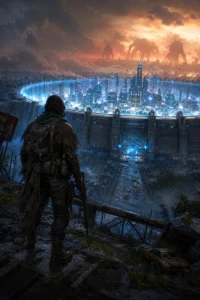
For most of Elias’s life, it had been a landmark of noise and beer and winter Sundays, a bowl of steel and concrete squatting beside the interstate while traffic crawled around it in red and white streams. Tonight it was a silhouette against a fractured sky, half its upper ring split open by whatever had punched through Denver when the System arrived. Floodlights still burned in patches, their beams cutting across smoke like prison searchlights, illuminating ragged banners, hanging cables, and the endless churn of bodies at the gates.
Thousands of people were trying to get in.
They moved in waves through the streets surrounding the stadium, spilling over medians, climbing dead cars, dragging children, wheelchairs, shopping carts, makeshift stretchers, dogs on leashes, propane tanks, suitcases, rifles. Panic had turned the avenues into rivers. The closer the current came to the stadium, the more it foamed. People shoved. People screamed. People prayed in voices hoarse enough to sound like curses. Somewhere a baby wailed with mechanical persistence, swallowed again and again by the roar of the crowd.
Above all of it, fixed in Elias’s vision no matter where he looked, the black interface counted down.
SAFE ZONE ACTIVATION: 00:17:42
Designated Shelter: Mile High Stadium Ruins
Entry permitted until activation threshold.
Warning: Entities outside boundary at activation will be classified as Exposed.
Exposed.
The word tasted clean and clinical, and that made it worse.
Elias leaned heavily on the length of rebar he had wrapped in surgical tape and torn bedsheet. His ruined leg had gone from hot to numb somewhere around Federal Boulevard. Numb was bad. Numb meant the pain had run out of useful things to say and started chewing through the walls. Every step sent a cold spark up his hip. Blood from the cut beneath his ribs had dried, cracked, and started bleeding again under his jacket. He could smell himself beneath the smoke and sewage and winter air: sweat, old hospital disinfectant, metal.
He glanced back.
They were still with him. Somehow.
Mara Keene limped six paces behind, one arm hooked under Mr. Alvarez’s armpit, half carrying the old man despite looking like she might fall apart if the wind changed direction. Her paramedic jacket was black with dust and brown at the cuffs. The System had given her something after the garage fight—a class, or a skill, or a curse—but she hadn’t had time to explain. All Elias knew was that twice on the road she had pressed her hands to wounds that should have killed, whispered through gritted teeth, and watched torn flesh close as if stitched by invisible fingers. Each time, afterward, her nose had bled.
Now it was bleeding again.
“Mara,” Elias called.
She looked up with eyes too bright in a face gone gray. “If you tell me to rest, I’m going to use my last miracle to fuse your mouth shut.”
“Was going to tell you your nose is bleeding.”
“Then stop making me use my face as a triage center.”
Mr. Alvarez gave a thin laugh that turned into coughing. The retired mechanic had a strip of hospital curtain tied around his chest and his left arm bound against him. He had stopped complaining an hour ago, which Elias liked less than the complaints.
Behind them came Jenna Park with her teenage brother Tommy. Jenna had found a kitchen knife somewhere and held it point down in a white-knuckled grip like she was afraid the weapon might escape. Tommy carried the oxygen tank they had stolen from the hospital, both hands wrapped around its handle. He was fourteen, maybe fifteen, all elbows and terror, and kept glancing at the stadium as if it might decide to walk away.
Mrs. Nasser shuffled behind them with her grandson asleep against her shoulder. The child’s hair was full of ash. He had not woken when the thing with too many elbows had dropped from the overpass and taken the man in the Broncos hoodie. He had not woken when Elias had driven the rebar into its eye socket while three strangers died keeping its claws off the children. He slept now with the terrible trust of the very young.
Sixteen had left the hospital basement.
Nine reached the stadium.
Elias did not let himself count the ghosts walking in the spaces between them. That way lay hesitation. That way lay names spoken in the dark and men bleeding out in dust while his radio spat static.
Later, he told the dead, as he always had. If there’s a later, I’ll pay attention.
A crack of gunfire snapped from somewhere near Gate B. The crowd compressed as if struck by an invisible fist. Screams spiked. Elias turned, rebar coming up on instinct, and saw two men on the roof of a city bus firing into the air. One wore a police vest over a flannel shirt. The other had a hunting rifle and the wild, red-eyed focus of someone who had discovered authority was an outfit you could steal.
“Single file!” the man in the vest bellowed through a traffic cone held to his mouth. “Single file, goddamn it! Women and children to the left! Injured to the—”
The crowd surged. Someone fell. Several someones. The bellowing turned to screaming.
“There’s no left,” Jenna said. Her voice cracked. “There’s no lanes. What are they doing?”
“Panicking with props,” Elias said.
Mara swallowed hard, eyes scanning the mass ahead. “We won’t make it through that with Alvarez and Nasser. They’ll get trampled.”
Elias knew. The crowd at the main gates was not a crowd anymore. It was terrain. It had currents, pressure points, killing pockets. The weak would go under. The injured would slow, stumble, vanish beneath boots. The stadium entrances had been built for crowds that wanted nachos and seats, not for the end of the world with a timer hanging over every skull.
He looked for angles.
North side: clogged. East ramp: clogged worse, a clot of people fighting around a jackknifed semi. South parking lots: fires, moving shapes in the smoke, too many. West service access: fenced, partly collapsed, fewer people—because a line of National Guard Humvees blocked the approach and men with rifles were waving civilians away.
Elias’s eyes narrowed.
“We’re going west.”
Jenna stared at him. “The soldiers?”
“They have a gate.”
“They’re not letting people in.”
“Then we’ll ask politely.”
Mara gave him a look. “Your version of politely once involved breaking a vending machine with a fire extinguisher because it ate your dollar.”
“It was a matter of principle.”
“It was a Snickers.”
“Morale is principle.”
The exchange bought them three seconds of something that almost resembled breathing. Then a deep, ululating howl rolled across the city from behind them, bouncing between office towers and gutted apartment blocks. The crowd answered with its own animal sound.
Tommy whispered, “They’re coming.”
Elias turned.
Beyond the last ranks of refugees, past the overturned cars and frost-slick asphalt, darkness moved in the streets. Not all at once. Not as an army. Worse than that. It flowed in fragments: long limbs over roofs, pale bodies slipping between vehicles, insectile silhouettes clinging to the sides of buildings. Red eyes opened in smoke. A streetlamp swayed, then toppled, dragged down by something large enough to make the pavement tremble.
The first wave had followed them.
Or maybe it had been herding them all along.
WAVE ONE: CULLING HOSTS DETECTED
Proximity: Critical
Survive.
“Move,” Elias said.
They moved.
He cut left across the edge of the crowd, using his shoulder and rebar to carve space where he could. He did not shove children. He did shove adults who tried to shove children. A man grabbed at Mara’s sleeve and shouted something about his wife. Elias knocked his hand away hard enough to make him yelp.
“Stay together!” Elias barked. “Hands on coats! If you lose grip, you shout!”
“What if we can’t hear?” Mrs. Nasser asked, clutching the sleeping boy.
“Then shout louder.”
The west side of the stadium was a maze of service roads, concrete barriers, dumpsters, and loading docks. In another life, trucks had come through here with beer kegs and nacho cheese and pallets of cheap merchandise. Now the road was choked with abandoned emergency vehicles. An ambulance sat nose-first against a concrete divider, its rear doors hanging open, bloody footprints leading away from it and then stopping. A police cruiser burned blue at the edges, paint blistering, lightbar still spinning silently.
At the service entrance, a chain-link fence had been dragged half across the road. Two Humvees blocked the gap beyond it, their mounted guns pointed at the street. Maybe a dozen uniformed soldiers and cops stood behind the barricade. Their faces were mud-gray with exhaustion. Some had bandages. One had a bite taken out of his cheek and kept touching it as if surprised the hole was still there.
Beyond them, through the loading tunnel, Elias saw open space.
A way in.
He also saw the bodies piled against the fence.
Not monsters. People. Dozens of them, pressed where they had tried to force through earlier. Some were moving. Some were not. A woman with a broken ankle dragged herself by her elbows, leaving streaks behind her, while a soldier shouted at her to stay back with tears on his face.
“No entry!” yelled the man nearest the Humvee. He had captain’s bars on his torn uniform and a blood-soaked scarf tied around one thigh. His rifle shook, but not enough to miss. “Back to the main gates!”
Elias kept walking.
“Elias,” Mara said quietly.
“I see him.”
The captain raised his rifle. “I said back!”
Elias stopped ten feet from the fence and planted the rebar like a cane. “Sergeant Elias Voss, formerly Second Battalion, 12th Infantry. I’ve got wounded civilians and children. We need through that tunnel.”
The captain’s jaw clenched. “Everyone needs through.”
“These people can’t survive the crush at the gates.”
“Neither can half the city.”
“Then open a lane.”
A laugh broke from one of the cops. It sounded hysterical. “Open a lane, he says. Why didn’t we think of that?”
The captain did not laugh. His eyes flicked over Elias—the taped rebar, the limp, the dried blood, the group behind him—and recognition passed there. Not of the man. Of the shape. One soldier measuring another and finding too much damage to dismiss.
“Orders are to hold this access for medical transport and command personnel,” the captain said.
Mara gave a raw little sound. “Medical transport? There aren’t any ambulances running.”
“Ma’am—”
She stepped forward, and only Mr. Alvarez’s weight kept her from getting too close to the rifles. “I’m a paramedic. I have two elderly civilians, a child, and a man with internal bleeding who keeps pretending he doesn’t. If your orders have a box for medical, check the damn box.”
The captain’s eyes moved to her jacket. “You have ID?”
Mara laughed, and this one had teeth in it. “I had an ID. Then the sky broke, the hospital collapsed, and a monster with a rib cage for a mouth ate the locker room. Would you like me to go back and look?”
The countdown ticked.
SAFE ZONE ACTIVATION: 00:12:09
Behind them, the crowd’s roar changed pitch. It lifted, thinned, sharpened. Elias had heard that sound once outside Kandahar when the market realized the second bomb was not a rumor.
The monsters had reached the rear edge.
The first screams were distant but distinct. Not panic screams. Contact screams. Meat being introduced to teeth.
Every soldier at the barricade flinched except the captain.
Elias leaned closer to the fence. “Captain. In twelve minutes, whatever magic bullshit built this zone turns on. Maybe it saves everyone inside. Maybe it doesn’t. But if you keep this tunnel empty for command personnel who aren’t coming, you’ll listen to people die against your fence until the last second. Then you’ll live with it, if you’re lucky.”
The captain’s eyes hardened. “Don’t you put that on me.”
“I’m not. It’s already there.”
For a moment the world narrowed to chain-link diamonds and the barrel of a rifle. Elias could smell hot oil from the Humvee, cordite, blood, the sharp ammonia stink of terror. The captain’s finger rested alongside the trigger guard. Proper discipline. That mattered.
Then a crash erupted to their right.
A delivery truck parked against the curb rocked on its suspension. Something hit it from the far side hard enough to buckle the panel inward. People screamed and scattered. The soldiers swung their rifles. A second impact flipped the truck’s rear wheels off the ground.
“Contact!” someone shouted.
The thing came over the truck like a spider made from skinned horses.
It had too many legs and none of them bent the right way. Its torso was a pale knot of muscle plated with shards of black chitin, and from the front of it hung a cluster of human hands, each finger ending in a needle claw. A head unfolded from between its shoulders, eyeless and wet, jaws opening vertically around a tongue lined with hooks.
The System labeled it as it landed on the hood of the burning police cruiser.
CULLING HOST – SKITTERBROOD REAPER
Level 7
Someone fired. Then everyone fired.
The barrage hammered the creature’s chest, punching black fluid from its plates. It shrieked and launched itself sideways, fast enough to blur. A soldier disappeared beneath it. His scream cut off as those human hands plunged into him and pulled in different directions.
The barricade dissolved.
The captain yelled for formation. No one heard. Refugees surged toward the fence. Soldiers backed away from the reaper. The mounted gun on the Humvee swung, but the gunner was too slow; the monster sprang onto the vehicle and drove a leg through his chest, pinning him to the turret like an insect in a display case.
Elias was already moving.
Not toward the monster. Toward the gap.
“Now!” he roared. “Through the fence!”
He hooked the rebar through the sagging chain-link and pulled. Pain detonated in his hip. He bared his teeth and kept pulling. Tommy dropped the oxygen tank, grabbed the fence with both hands, and added his skinny weight. Jenna joined. Mara dragged Alvarez closer while Mrs. Nasser shielded the boy’s head.
The fence shrieked, twisted, gave six inches.
Not enough.
A body slammed into Elias from behind. A man in a business suit, face slick with blood, tried to claw past him through the narrow gap. “Move! Move!”
Elias drove an elbow into his sternum. The man stumbled back gasping.
“Children and wounded first!” Elias shouted.
“Fuck your wounded!” the man screamed.
Jenna turned and slashed with the kitchen knife. Not deep. Enough. The man yelped, clutching his forearm, shock cutting through his frenzy.
Jenna stared at the red line she had made, horrified.
“Good,” Elias said. “Do it again if you have to.”
The reaper shrieked from atop the Humvee. Its legs scythed. A cop fired until his pistol clicked empty, then stared at it in disbelief before the monster’s hooked tongue wrapped around his head and tore him over the barricade.
The captain appeared on the other side of the fence, face splattered black, and grabbed the chain-link. For half a second Elias thought he meant to hold it shut.
Instead, he pulled.
“Private Bell!” the captain screamed. “Cutters!”
A young soldier with a shaved head sprinted from the tunnel carrying bolt cutters in shaking hands. She bit into the fence once, twice, three times. Metal snapped. Elias pulled again, and the gap opened wide enough for a body.
“Go!” he barked.
Tommy squeezed through first with the oxygen tank. Jenna followed. Mrs. Nasser thrust the sleeping boy ahead, sobbing apologies to him under her breath as his small body folded through the torn mesh. Mara shoved Alvarez toward the opening.
The old man balked. “You first.”
“Don’t be noble,” Mara snapped. “You’re terrible at it.”
“I’m old. It’s all I have left.”
Elias grabbed Alvarez by the back of his coat and shoved him through. “You have listening left.”
The reaper landed twenty feet away.
It hit the pavement between them and the main flow of refugees, scattering sparks from the cruiser’s burning wreck. Up close, it smelled like rotten fruit and opened graves. Its eyeless head tilted. The cluster of hands flexed, fingers clicking together like rain on glass.
People froze.
Elias did not.
“Mara, through.”
She stared at the creature. Her hands glowed faintly gold, a trembling light beneath the skin. “If it jumps—”
“Then I’ll be loud.”
“That’s not a plan.”
“It’s a personality flaw with benefits. Go.”
She went, slipping through the gap and nearly falling on the other side. The captain caught her by the elbow.
The reaper crouched.
Elias knew the math in the way the body knows cliffs. Distance. Speed. His leg. The gap. The crowd behind him pressing forward. If he tried to crawl through now, it would hit them in the bottleneck and tear half the group apart.
So he stepped away from the fence.
“Elias!” Mara screamed.
He lifted the rebar with both hands.
The ghosts came close then. He felt them not as voices but as pressure, a cold ring around his shoulders, the memory of men standing at his flanks in alleys full of dust. Ortiz laughing with blood in his teeth. Chen whispering about his daughter. Miller asking if anyone else heard the drones.
Not yet, Elias thought.
The reaper launched.
Elias dropped to his bad knee before his body could object. The creature sailed over where his chest had been, claws raking sparks off the rebar as he thrust upward. The bar punched into the soft underside between its plates. Not deep enough to kill. Deep enough to change its landing.
It crashed into the fence instead of the gap, tearing chain-link from posts. Elias rolled, or tried to. His bad leg caught. A claw hooked his jacket and opened his shoulder in a line of fire. He slammed the rebar down on the limb. Bone or chitin cracked.
The reaper screamed into his face.
Its mouth opened vertically, hot carrion breath washing over him. The hooked tongue shot out.
A rifle cracked.
The tongue snapped sideways, severed near the base in a spray of black fluid. The captain stood three yards away, rifle to shoulder, eyes wide and furious.
“Get up!” he shouted.
Elias laughed once because there was nothing funny anywhere. “Working on it.”
Private Bell and another soldier grabbed him under the arms and hauled him backward. His leg dragged uselessly. The reaper thrashed against the torn fence, one limb pinned in twisted metal, but it was freeing itself by inches.
The captain fired again. “Fall back! Tunnel! Everyone move!”
This time the order had somewhere to go.
Civilians poured through the widened breach. Not orderly. Not clean. But movement replaced the deadly crush, and for a few precious seconds the soldiers became a hinge rather than a wall. Elias was dragged through the gap, boots scraping pavement, his vision pulsing white at the edges.
Mara met him inside the service road with both hands already reaching. “You absolute suicidal bastard.”
“Compliments later.”
“That wasn’t—hold still.”
Her palms pressed to his shoulder. Heat lanced through him. The wound crawled, itching savagely as flesh pulled together beneath torn fabric. Mara swayed. Blood ran over her upper lip.
Elias caught her wrist before she could pour more of herself into him. “Enough.”
“It’s not closed.”
“Enough.”
She glared, but her knees buckled. Jenna caught her from behind.
“I’ve got you,” Jenna said, sounding surprised to find she meant it.
The tunnel swallowed them.
Inside, the noise changed. The open-air roar of the crowd became a trapped thunder that shook dust from the concrete ceiling. Emergency lights flickered red along the walls. The floor was slick with spilled soda syrup, blood, and fire-suppression foam. People stumbled through the dimness toward the field entrance ahead, where blue-white light pulsed like lightning behind a curtain.
Graffiti on the wall read WE BELIEVE in flaking orange paint. Someone had smeared a bloody handprint over the word believe.
Elias forced himself upright before the soldiers could carry him. “I can walk.”
Private Bell stared at his leg, then his face. “Sir, no you can’t.”
“Watch me disappoint you.”
The captain fell in beside him, still walking backward, rifle aimed at the tunnel mouth. “Voss, you said?”
“Yeah.”
“Captain Daniel Rowe.”
“Your gate policy needs work.”

0 Comments