Chapter 5: The First Riot Under Twin Suns
by inkadminThe first stone struck the western lens at 09:13 colony time, under the pale white gaze of Kepler-186 and the blood-dim ember of its companion sun.
Mara heard the impact through three floors of reinforced observatory glass.
It was not loud, not at first. A sharp crystalline tick, like a fingernail against a wineglass. She looked up from the console, her eyes gritty from eighteen sleepless hours spent inside the transmission’s impossible architecture, and saw a hairline fracture appear across the sky.
For one suspended second, the observatory remained silent.
Then the alarm woke.
PERIMETER BREACH. WESTERN APPROACH. PERIMETER BREACH. ALL SCIENTIFIC STAFF REMAIN IN SECURE ZONES.
Red light washed over the data pit, turning faces into masks. Half a dozen analysts jerked away from their terminals. Someone swore. Someone else began whispering a prayer Mara did not recognize, three syllables repeated with increasing speed as though language itself could become a locked door.
Beyond the lens, Lumen had gathered.
At first glance, the crowd looked almost beautiful. Thousands of colonists stood on the basalt terraces below the observatory, their thermal cloaks rippling in the morning wind, reflecting the twin suns in sheets of blue, silver, and rust. From above, they resembled a sea under alien light, each upturned face a brief bright coin.
Then Mara saw the signs.
THE SIGNAL IS A WOUND.
LET THE FUTURE SPEAK.
BURN THE MEMORY BEFORE IT BURNS US.
THE CHOIR HAS CALLED US BY NAME.
That name should not have been known.
Mara’s hand tightened on the edge of the console until the ridged polymer bit into her palm. The last time she had seen the word Choir, it had been buried inside a restricted transcript of Ilya’s neural episode, sealed behind Directorate locks and black-ice authentication. The child had spoken it while unconscious, in a voice that was not entirely his own, his small body strapped to a med-couch as the sensors recorded language braided with brain states that had no origin in his life.
Now it had been painted across a bedsheet and held aloft by a woman in a nursery-worker’s green jacket, tears freezing in silver beads along her jaw.
“How?” Mara said.
No one answered.
Director Saye stood at the central platform, rigid in her ash-gray administrative coat, one palm pressed against her ear implant. The display above her flickered between security feeds: the south access road choked with bodies, the cargo lift barricaded by rover parts, the aerial view of the observatory’s mirror fields where colonists had spilled between the solar towers like ants inside a machine.
Saye’s face did not change, but the muscles at the base of her throat fluttered with every swallowed word.
“No,” she said into the implant. “No kinetic deterrents. I don’t care what Protocol says. Those are colonists, not invaders. Hold the line.”
Another stone hit.
This one cracked louder.
Across the data pit, a junior systems engineer named Pell flinched so hard his chair rolled backward into a server column. “They’re going to break the lens.”
“They can’t,” said Dr. Han, the signal mathematician, though his voice had gone dry and papery. “It’s rated for micrometeorites.”
“Micrometeorites don’t carry bolt-cutters.”
Mara moved toward the window. The western lens was not a single pane but a layered array of smart glass and adaptive shielding, designed to withstand Lumen’s ash storms and the periodic ice-shrapnel fall from the upper atmosphere. Through it, the crowd’s chanting came muted and distorted, words dissolved by thickness and distance.
Still, she could feel the rhythm in her teeth.
“What are they saying?” asked Pell.
Mara listened.
At first, she caught only noise. Then the chant found shape.
“Open the sky,” the crowd roared. “Open the sky. Open the sky.”
A second chant rose against it from the east terrace, lower, harsher.
“Seal the wound. Seal the wound. Seal the wound.”
Two tides colliding beneath the twin suns.
Lumen had always pretended it was too practical for hysteria.
It was a colony of engineers, agronomists, miners, medics, teachers, children born beneath a sky their grandparents had only imagined. Its first cathedral was a water reclamation plant. Its holidays commemorated oxygen yield thresholds and fungus-resistant grain harvests. Even grief, on Lumen, had procedures. Airlock malfunctions were memorialized with plaques and revised training manuals. Crop failures became white papers. Births were logged alongside ration projections.
But no civilization was built only from systems. Beneath every pipe and law and habitat dome lay the old animal hunger: to know why the dark had called.
And three nights ago, the dark had answered.
The leak had happened at dawn.
By midmorning, every screen in Lumen carried pieces of the transmission.
Not the real thing. Not the raw memory. Saye had kept that locked behind an air-gapped quarantine in the observatory’s deep vault, or believed she had. What spread through the colony was worse in some ways—fragments, summaries, corrupted frames rendered into rumor. A future firestorm over the hydroponic towers. Earth gone silent. A word repeated by a sleeping child. Mara Venn’s name attached to theories that had once made her a professional pariah and now made her look like either prophet or saboteur.
The first feeds called it the Message. Within an hour, believers renamed it the Memory. By breakfast, the survival forums called it the Contamination.
By 09:13, someone threw a stone.
“Dr. Venn.”
Mara turned.
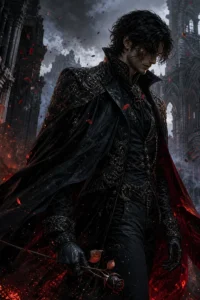
Jonas Vale stood at the entrance to the data pit, security armor half-fastened over his civilian undersuit, one gauntlet missing, dark hair damp with sweat. He looked like he had dressed while running. The scar along his left cheek—old plasma burn, badly regenerated—stood out pale beneath the alarm light.
“You’re supposed to be in the vault,” he said.
“I’m supposed to be doing many things,” Mara replied. “Most of them impossible before lunch.”
His mouth twitched, but only for a heartbeat. His gaze moved past her to the crowd beyond the lens. He saw the signs. He saw the fractures.
His expression closed.
“We have a problem.”
“Just one?”
“Ilya’s gone.”
The data pit seemed to tilt.
Mara heard Saye’s voice still issuing crisp orders, heard the alarms, the crowd, the hum of servers, but all of it receded behind the sudden cold opening inside her ribs.
“Gone from where?” she asked.
“Med-secure suite.”
“That suite has two armed guards and a biometric lock.”
“Had,” Vale said.
Mara was already moving.
She crossed the pit at a run, ignoring Pell’s startled call and Saye’s sharp, “Dr. Venn!” The corridor beyond the data level pulsed red-white-red, emergency strips guiding personnel toward inner shelters. Mara went the opposite way.
Vale fell into step beside her, his boots striking the resin floor with a soldier’s economy. He handed her a wrist tab. Security footage streamed across it in jittering fragments: the med-secure corridor empty except for two guards outside Ilya’s door. A burst of static. A woman in a maintenance hood pushing a sterilizer cart. One guard leaning to check her credentials. The other turning as if he had heard something behind him.
The feed flared white.
When the image returned, both guards lay on the floor. The door stood open. The bed inside was empty.
On the wall, written in black marker, were four words.
NO CHILDREN FOR THE CHOIR
Mara’s steps faltered.
“Are they dead?”
“Stunned. Neuroshock. Clean work.”
“Faction?”
“Survivalist cell, maybe. They call themselves the Ashen Line on the forums. If the leak gave them Ilya’s file—” Vale cut himself off, jaw tightening. “They think he’s a vector.”
“He’s eleven.”
“Fear doesn’t count birthdays.”
They reached the main lift. Its doors hung open, lights dark.
LIFT SYSTEM OFFLINE. PLEASE PROCEED TO DESIGNATED SHELTER AREAS.
“Of course,” Mara muttered.
Vale punched the manual panel. Nothing happened. He swore in a language Mara did not know and grabbed the emergency stairwell latch.
“Where would they take him?” Mara asked.
“If they want him dead? Anywhere.”
“Vale.”
He stopped with one hand on the latch. The red alarm strobed across his face, making his scar appear and vanish.
“If they’re smart,” he said, “they’ll use the riot as cover and get him out through service infrastructure. West side is chaos. East side is survivalists. But north maintenance tunnels connect to the old survey bore. From there, outside perimeter in six minutes.”
“And if they’re not smart?”
A third impact rang through the observatory, louder than the first two. This time, the floor trembled.
Vale looked toward the sound. “Then they’re already inside.”
They descended through the emergency stairwell as the observatory shook around them.
Mara had always loved the building for its audacity. Humanity’s first extrasolar observatory, raised on a ridge of black volcanic glass at the edge of Lumen’s settled basin, its lenses angled toward a sky no human eye had evolved to read. It was part temple, part machine—sixteen levels of laboratories and signal arrays wrapped around a central shaft that descended into cold rock. Beneath it, protected by stone and secrecy, the deep vault housed data so dangerous that even the air inside was monitored for unauthorized vibration.
Now the temple had become a bunker.
On level twelve, they passed researchers huddled behind a fire door, clutching tablets and emergency masks. One of them reached for Mara as she ran by.
“Is it true?” the woman asked.
Mara stopped despite herself. “Is what true?”
The woman’s eyes were wide, fever-bright. She was young, perhaps twenty-five, with a bioluminescent tattoo of Lumen’s twin suns pulsing at her temple. “That the signal knew your name before you were born.”
Vale seized Mara’s elbow. “Keep moving.”
But the woman leaned forward, desperate. “Dr. Venn, please. My brother was on relay duty when it came through. He said he saw his own death. He said it was peaceful. He said the Choir was merciful.”
“Your brother saw a neurological contamination event,” Vale snapped. “Not heaven.”
Her face hardened. “You don’t know that.”
“I know people who promise mercy from the sky usually bring knives.”
Mara pulled free of Vale’s grip. She looked at the woman, really looked at her—the trembling hands, the hope stretched so thin it had become terror wearing a holy mask.
“I don’t know what the signal is,” Mara said. “Not yet. Anyone who tells you they do is selling you certainty because fear is hungry and certainty tastes like food.”
The woman flinched.
Mara softened her voice. “Find a secure room. Stay away from the feeds. Don’t listen alone.”
“Why?”
Because memories could infect. Because the future might have teeth. Because Mara had woken with ash in her mouth after hearing a transmission from a star that did not exist, remembering a version of herself screaming beneath a burning sky.
Instead she said, “Because whatever this is, it knows how to make us divide ourselves.”
Then Vale dragged her onward.
At level eight, the stairwell door had been forced open.
Smoke drifted in the corridor beyond, thin and chemical. The emergency lights flickered. Somewhere nearby, people shouted.
Vale raised his shock pistol.
“Stay behind me.”
“I have never found that instruction useful.”
“Try novelty.”
They slipped into the corridor.
This level housed public outreach: the lecture amphitheater, visitor galleries, education labs where schoolchildren came to watch delayed stellar imagery bloom across domed ceilings. Mara remembered giving a guest lecture here seven years ago, before exile, before ridicule hardened into silence. A little girl in the front row had asked whether aliens would dream in colors humanity had no names for. Mara had answered yes, almost certainly, and the room had laughed with delight.
Now the amphitheater doors were barricaded from the inside, and someone had spray-painted over the educational mural of Kepler’s orbital family.
MEMORY IS INVASION
A crash sounded ahead.
Vale signaled for silence. Mara obeyed this time.
Voices echoed from the visitor gallery.

0 Comments