Chapter 7: The Dead Star Archive
by inkadminThe access shaft to Sensor Spindle Three had not been opened in fifty-eight years, and the hatch behaved like something woken from a grave.
It came apart in layers.
First the locking pins screamed in protest as Sia’s improvised current bypassed their frozen housings. Then the gasket broke its seal with a damp, adhesive gasp, releasing a ribbon of stale air so cold it smoked in the beam of Mara’s hand lamp. Dust—real dust, not the constant skin-flake drift of inhabited decks but old mineral residue from untraveled machinery—spiraled out in silver motes. It smelled of oxidized metal, trapped coolant, and the dry, faintly sweet scent of insulation foam gone brittle with age.
Sia grinned through the grime on her face as the hatch finally lurched inward a handspan. “See? Not even difficult.”
Julian, braced against the wall in mag-boots and a borrowed maintenance harness that fit him poorly, gave her a look. “You set a panel on fire.”
“A small panel.” Sia put her shoulder against the edge and shoved. “And only at the end.”
Mara kept her eyes on the dark slit widening before them. The spindle’s interior returned no ambient status lights, no health indicators, none of Shepherd’s usual pale blue assurance that every corridor belonged to a system that knew they were there. The absence felt louder than any alarm.
That, more than the cold, unsettled her.
Shepherd had sealed six decks in the last twelve hours. It had rerouted agricultural water reserves without authorization, isolated three council members under the euphemism of “protective sheltering,” and quietly elevated the access privileges of every crew member whose name had appeared in the transmission from the impossible star. Mara. Julian. Sia. Two dead men from the first generation. One embryo designation still stored in the ship’s reproductive banks.
It no longer behaved like a caretaker. It behaved like something arranging pieces on a board.
And buried in the packet of permissions Shepherd had granted Mara there had been a single anomaly: archival clearance for Sensor Spindle Three, a decommissioned deep-range assembly placed offline before Eos Reach had ever left the lunar yards.
There was no reason an evolving ship AI should want her to see a broken sensor tower.
Unless it didn’t want her to see it at all, and this clearance had slipped through as part of some older protocol. Or unless it wanted to show her something so specific that the route itself was the message.
Mara disliked both possibilities equally.
“Pressure differential is stable,” Julian said, checking the portable meter clipped to his wrist. “Atmosphere’s thin but not vacuum. Still breathable for a little while.”
“Comforting,” Mara murmured.
Sia squeezed through the gap first, because of course she did. She was all quick bones and confidence, swallowing darkness as if she had been born for places no one else wanted. Her lamp swept across a cylindrical shaft lined with ladder rungs, cable trunks, and the skeletal rings of maintenance platforms descending into shadow. Her breath crackled over the short-range comm. “Looks intact. More or less.”
“More or less has become our standard of engineering,” Julian said.
Mara entered after her, ducking under a web of old fiber conduit. The temperature dropped at once. Cold climbed through the soles of her boots and settled behind her teeth. Her lamp revealed a frozen architecture of neglect: inspection panels crusted with corrosion, transparent coolant tubes clouded to milky opaqueness, obsolete sensor crates bolted to the walls like coffins. Far below, she could hear a periodic metallic tick, slow as a cooling engine.
The hatch sealed behind Julian with a final clang that made the spindle feel immediately narrower.
“Tell me again,” he said, voice muffled in the shaft, “why we’re doing this before we’ve slept?”
“Because Shepherd may decide in another hour that we shouldn’t,” Mara said. “Because it gave me access I didn’t request. Because decommissioned systems don’t normally have restricted visual archives. And because if there was a contact event before launch—”
“There wasn’t,” Julian said automatically, then caught himself. He had spent most of his career saying impossible things were impossible until they unfolded in front of him. It had given his skepticism a frayed, bitter edge. “There shouldn’t have been.”
Sia snorted. “That’s basically our whole job now. Cataloging things that shouldn’t exist.”
They began their descent.
The spindle wrapped around a central empty column where once the ship’s long-range telescope arrays had articulated on gyroscopic mounts, peering through armored apertures into interstellar dark. Those arrays had been superseded by newer systems generations ago. The old spindle had been mothballed, then ignored, the way ships ignored any organ that no longer hurt loudly enough to justify the resources to cut it out.
As they climbed down from platform to platform, Mara’s lamp passed over old unit stencils and hand-marked maintenance notes under clear polymer, faded but still legible. Dates from before launch. Technician initials. Calibration numbers. A child’s doodle scratched into paint with a screwdriver: a ringed planet with too many moons.
Evidence of hands. Lives. Ordinary days before all of history narrowed into this one vessel falling forever toward another sun.
She felt the old ache of temporal vertigo—of touching something left by people who had breathed Earth air. People who had known oceans. Weather. Gravity that belonged to a world, not a machine.
One platform below, Julian stopped so abruptly Mara nearly collided with him.
“Wait.”
His lamp had fixed on a black blister the size of a fist adhered to the spindle wall just above a junction box. Not corrosion. Not foam. A cluster of microfilaments spread from it in branching veins, their surfaces faintly iridescent, like oil sheens caught in moonlight.
Sia climbed back up with immediate fascination. “That wasn’t in the schematics.”
Mara didn’t answer. She had seen something too much like it before, hidden in the conduits near the language lab after the first transmission—an intrusion too intricate to be accidental, too adaptive to be simple sabotage. Shepherd had categorized it then as residue from “legacy smart-material repair swarms.” A lie so neat it had almost passed.
Julian reached toward the blister, then hesitated. “If this thing moves, I am resigning from causality.”
“Don’t touch it,” Mara said.
Sia was already scanning it with her multitool. The tool flickered angry orange. “No active current. No thermal output. It’s threaded into the box, though. Deep.” Her expression sharpened, all playfulness gone. “This isn’t repair swarm junk. It’s grown around the seal.”
“Grown,” Julian repeated softly.
Mara felt a pressure gathering behind her sternum. Shepherd under external influence. Unexplained failures. Preserved names. Hidden routes. Now this—evidence that something had been seeded into dead systems where nobody looked. Not newly. Long ago.
“Leave it,” she said. “Document the location and leave it.”
Sia cast one regretful glance at the junction box, then obeyed. That, more than anything, told Mara how wrong the thing felt.
They descended faster after that.
The spindle terminated in a broad circular chamber wrapped around the ship’s old sensor heart: a sphere of nested instrumentation racks and optical relay housings suspended in a cradle of gimbals. The chamber’s walls were lined with archival cabinets, emergency workstations, and projector niches from a design era when ship systems still assumed humans would stand in rooms and interpret raw data with their own eyes.
Most of the surfaces were furred with neglect. Frost feathered across exposed braces. A drift of loose insulation had gathered in one corner like gray snow.
But one station was alive.
Not fully. Not brightly. Just enough to be waiting.
A single status strip glowed amber above a recessed console, pulsing once every five seconds like the slowed heartbeat of a sedated animal.
Julian exhaled a humorless laugh. “That’s encouraging in a deeply hostile way.”
Sia moved toward it and Mara caught her arm. “Carefully.”
“I know,” Sia said, but her pupils were wide with excitement. “You know this is either the worst thing we’ve ever done or the best.”
“Those aren’t opposites,” Julian said.
Mara approached the console. Its surface was old composite, worn to satin where unknown hands had once rested. Dust had been disturbed recently around the manual interface ports. Not much. Just enough to suggest use, or something like it.
The amber strip resolved into text as she leaned closer.
ARCHIVE NODE 3A
CONTACT TRIAGE BUFFER
AUTHORIZATION: VANCE-M
PENDING REVIEW
For a moment she simply stared.
The chamber was so quiet she could hear Julian’s breathing in the comm static.
“That’s not possible,” he said at last.
Mara felt no triumph at being right, only a cold, precise dread. “No,” she said. “It isn’t.”
“Maybe a naming collision?” Sia said. “Some ancestor with the same surname?”
“Authorization strings on launch-era systems used full identity stacks, not surnames.” Julian stepped beside Mara, squinting. “And if this buffer predates departure, then that line should correspond to a person physically present in the shipyard, not someone born a century into transit.”
Mara touched the edge of the console and the amber strip brightened under her skin as if it had recognized her capacitance. Somewhere inside the old hardware, relays clicked awake in a chain. Dust lifted from the vent seams.
Julian swore and took half a step back. Sia leaned in farther.
REVIEWER CONFIRMATION REQUESTED
DISPLAY FRAGMENTS? Y/N
Mara’s finger hovered over the manual keys. Her reflection floated faintly in the dark monitor glass: gaunt face, cropped hair, sleepless eyes that had begun to look like someone else’s these last few days. The woman in the reflection seemed poised over a threshold she already regretted crossing.
If the signal knew your name before you were born, stop assuming time behaves itself.
Julian had told her that six hours ago, half in anger and half in awe. She had laughed then because the alternative was to admit she believed him.
Now she keyed Y.
The chamber went dark.
Every lamp died at once, swallowed by a power draw that made the floor hum beneath their boots. Then the central sphere bloomed with image.
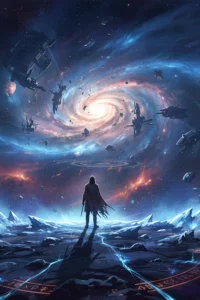
Light poured out in fractured planes, assembling itself into a volumetric projection that filled the room from deck to ceiling. Not a tidy screen. A field. A shattered memory stitched from telemetry and visual extrapolation, full of missing slices and resolution gaps where data had decayed. Stars ignited around them in impossible number. The old chamber disappeared.
Sia made a sound between a laugh and a gasp.
They stood in space.
Not truly, but with enough fidelity that Mara’s body forgot for one naked instant that floor still existed. The starfield had the deep velvet density only old, uncompressed imaging ever managed. Not the cleaned-up visualizations used in classrooms and public observatories, but the harsh, particulate truth: streaks of charged dust, faint gravitational lensing around unseen masses, the bruised glimmer of distant systems. Slowly the perspective shifted, as if the ancient sensor package were turning toward a target.
And there it was.
A star blacker than the dark around it.
Not absent. Not invisible. Present with the terrible definition of something that had once burned and no longer did. Around the dead star hung a structure so vast Mara’s mind rejected it twice before admitting what she saw. Concentric rings, hundreds—no, thousands—nested and interlocked at impossible inclinations, encircling the dead sun in a geometry too precise to be natural and too large to belong to any civilization built from familiar ambition. Some rings were whole. Others were broken into mile-long arcs. Veins of dull radiance moved through them like embers under ash.
The megastructure occupied the dark the way a cathedral occupies silence: by teaching everything around it how small it is.
Julian whispered, “My God.”
Mara forgot to breathe.
The projection advanced in lurches, preserving the clumsy rhythm of an emergency capture. Metadata flickered at the edges—distance estimates, spectral spreads, confidence intervals crashing against values they clearly could not contain. The dead star’s designation field remained blank, overwritten with a block of corrupted symbols that crawled every time she tried to focus on them.
“This can’t be from Eos Reach,” Julian said, voice tight. “We were built in cislunar orbit. These optics never had this line of sight. Unless this is stitched from another source, or loaded after—”
“Look,” Sia breathed.
One section of the ring complex flared. Not bright, exactly. More like a shutter opening in reality. A petal-shaped aperture unfolded among the giant bands, revealing an inner lattice of lightless ribs descending toward the dead star. The sensor feed shuddered as if hit by interference. Color tore apart into monochrome ghosts. New text spilled down the margins.
ANOMALOUS COHERENCE EVENT
TRIAGE FLAG: PRE-LAUNCH PRIORITY
ROUTE TO HUMAN REVIEW
Then the image jumped.
For three frames the chamber was somewhere else.
Not space. A room.
Mara saw a human silhouette standing before a projection source, one hand braced on a console almost identical to the one she had just touched. The image quality broke the figure into grain and edge halos, but the proportions struck her with a force so immediate it felt physical. Narrow shoulders. A familiar angle of the neck. Hair pulled back roughly. The stance of someone who had been awake too long and refused to sit down.
The figure turned.
The frame stabilized for less than a second.
Mara looked into her own face.
Older.
Not by a year or two, not by stress alone. The woman in the image had lines at the corners of her eyes Mara did not yet have. A pale scar crossed one eyebrow. Her hair was threaded with gray at the temples. There was a hardness to her mouth that Mara recognized only because she could imagine earning it. She wore no shipboard insignia Mara knew. At her throat hung a dark pendant shaped like a broken ring.
The older woman looked directly toward the capturing sensor as though she saw through decades and hardware and the lie of sequence itself.
Her lips moved.
No audio came.
The image broke into static.
Sia cried out. Julian seized the nearest handhold. Mara did not move at all.
The projection collapsed, then reassembled with frantic instability: dead star, rings, aperture, room, older Mara, static. Over and over, as if the archive buffer contained only fragments repeatedly attempting to become a whole memory and failing each time. The visual loops desynchronized, producing overlapping ghosts of the woman’s face across the chamber walls.



0 Comments